
Homework Answers
The Electric field intensity can be found by using Gauss's Law(Maxwell's First equation) which is given as follows:
∯D.dS = ∫∫∫ρvdV
D= Electric Flux density
ρv=Volume charge density
Here surface S is the suitable Gaussian surface and in case of spherical coordinates most suitable Gaussian surface is a sphere.
Solution is given in the image attached.
Note: E= Electric field intensity
ε∘= Permittivity of free space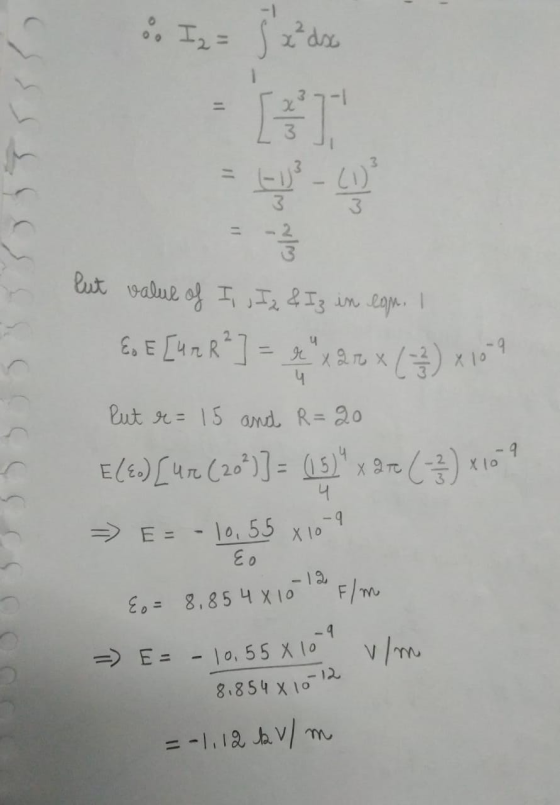
Add Answer to:
Q7. A charge distribution in free space has volume charge density r(4 cos’e) nC/mº for Osrs...
An infinite sheet with a uniform charge density, Ps = 5 nC/rn2, is in free space...
An infinite sheet with a uniform charge density, Ps = 5 nC/rn2, is in free space and located at 3x - + 6z = 5. Calculate the electric field intensity, E, at the origin (0,0,0).
An infinite sheet with a uniform charge density, Ps = 5 nC/rn2, is in free space...
An infinite sheet with a uniform charge density, Ps = 5 nC/rn2, is in free space and located at 3x -2y + 6z = 5. Calculate the electric field intensity, E, at the origin (0,0,0).
nc = 13 1. Find the charge in the volume defined by 1<r<2m, in the spherical...
 nc = 13
1. Find the charge in the volume defined by 1<r<2m, in the spherical coordinates if pv = (No cos?0)/r* (uC/mº). 2. Given that D = 7r2 a, + Nc sin 0 ag in spherical coordinates, find the charge density. 3. Find the work done in moving a point charge Q = - 20 uC from (4,2,0)m to the origin in the field E = (x/2 + 2y) ax + Nc xay (V/m). 1
nc = 13
1. Find the charge in the volume defined by 1<r<2m, in the spherical coordinates if pv = (No cos?0)/r* (uC/mº). 2. Given that D = 7r2 a, + Nc sin 0 ag in spherical coordinates, find the charge density. 3. Find the work done in moving a point charge Q = - 20 uC from (4,2,0)m to the origin in the field E = (x/2 + 2y) ax + Nc xay (V/m). 1
Q1.(25pts) A nonuniform volume charge distribution with density p,= 100 C/m3 , lies within the spherical region of...
 Q1.(25pts) A nonuniform volume charge distribution with density p,= 100 C/m3 , lies within the spherical region of radius a 0.2m in free space. a) Find the electric field intensity at a point outside the charge region. (9pts) b) Find the potential at the surface of the spherical charge region. (9pts) c) Determine the force acting on a charge of 10 Coulombs located at Px(5m, 90°, 90°), Indicate the position and orientation of the force vector on the sketch below....
1. In Free space, the planex 10 [m) carries a surface charge with the density p,...
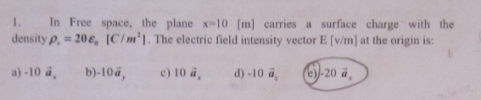 1. In Free space, the planex 10 [m) carries a surface charge with the density p, - 20, ICIm']. The electric field intensity vector E [v/m] at the origin is: b). 10a, @n e) 10 ai d)-10 a.
An infinitely long uniform line charge of 20 nC/m lie along the z axis in free...
 An
infinitely long uniform line charge of 20 nC/m lie along the z axis
in free space, determine the electric flux density (in Cartesian
coordinate system) at observation point P(1, 1, -1). No need to
derive any expressions! Show main steps with proper units.
An infinitely long uniform line charge of 20 nC/m lie along the z axis in free space, determine the electric flux density (in Cartesian coordinate system) at observation point P(1, 1,-1). No need to derive any...
An
infinitely long uniform line charge of 20 nC/m lie along the z axis
in free space, determine the electric flux density (in Cartesian
coordinate system) at observation point P(1, 1, -1). No need to
derive any expressions! Show main steps with proper units.
An infinitely long uniform line charge of 20 nC/m lie along the z axis in free space, determine the electric flux density (in Cartesian coordinate system) at observation point P(1, 1,-1). No need to derive any...
There is a region of space that has a very long cylindrical charge distribution. The charge...
There is a region of space that has a very long cylindrical charge distribution. The charge is distributed uniformly through a cylindrical region with a 4.0 cm radius. The charge density is 5 nC/m3. What is the electric field 2.0 cm from the axis of the cylinder. Use Gauss’ Law to determine this. You will need to express the charge in terms of the charge density.
A hollow sphere has a uniform volume charge density of 1.78 nC/m3. The inner radius is...
 A hollow sphere has a uniform volume charge density of 1.78
nC/m3. The inner radius is a = 10.3 cm and the outer radius is b =
41.2 cm.
+4 +t1 +b+t A hollow sphere has a uniform volume charge density of 1.78 nC/m. The inner radius is a= 10.3 cm and the outer radius is b= 41.2 cm What is the magnitude of the electric field at 16.5 cm from the center of the sphere? What is the magnitude...
A hollow sphere has a uniform volume charge density of 1.78
nC/m3. The inner radius is a = 10.3 cm and the outer radius is b =
41.2 cm.
+4 +t1 +b+t A hollow sphere has a uniform volume charge density of 1.78 nC/m. The inner radius is a= 10.3 cm and the outer radius is b= 41.2 cm What is the magnitude of the electric field at 16.5 cm from the center of the sphere? What is the magnitude...
4 A spherically symmetric charge distribution has the following radial dependence for the volume charge density...
 4 A spherically symmetric charge distribution has the following radial dependence for the volume charge density ρ: 0 if r R where γ is a constant a) What units must the constant γ have? b) Find the total charge contained in the sphere of radius R centered at the origin c) Use the integral form of Gauss's law to determine the electric field in the region r R. (Hint: if the charge distribution is spherically symmetric, what can you say...
31. In free space, infinite planes y-4 m and y -8m carry charges of 20 nC/m2...
 31. In free space, infinite planes y-4 m and y -8m carry charges of 20 nC/m2 and 30 nC/m2, respectively. If plane y-2 m is grounded, calculate the electric field intensity at (-4 m, 6 m, 2 m).
 nc = 13
1. Find the charge in the volume defined by 1<r<2m, in the spherical coordinates if pv = (No cos?0)/r* (uC/mº). 2. Given that D = 7r2 a, + Nc sin 0 ag in spherical coordinates, find the charge density. 3. Find the work done in moving a point charge Q = - 20 uC from (4,2,0)m to the origin in the field E = (x/2 + 2y) ax + Nc xay (V/m). 1
nc = 13
1. Find the charge in the volume defined by 1<r<2m, in the spherical coordinates if pv = (No cos?0)/r* (uC/mº). 2. Given that D = 7r2 a, + Nc sin 0 ag in spherical coordinates, find the charge density. 3. Find the work done in moving a point charge Q = - 20 uC from (4,2,0)m to the origin in the field E = (x/2 + 2y) ax + Nc xay (V/m). 1
 Q1.(25pts) A nonuniform volume charge distribution with density p,= 100 C/m3 , lies within the spherical region of radius a 0.2m in free space. a) Find the electric field intensity at a point outside the charge region. (9pts) b) Find the potential at the surface of the spherical charge region. (9pts) c) Determine the force acting on a charge of 10 Coulombs located at Px(5m, 90°, 90°), Indicate the position and orientation of the force vector on the sketch below....
 1. In Free space, the planex 10 [m) carries a surface charge with the density p, - 20, ICIm']. The electric field intensity vector E [v/m] at the origin is: b). 10a, @n e) 10 ai d)-10 a.
 An
infinitely long uniform line charge of 20 nC/m lie along the z axis
in free space, determine the electric flux density (in Cartesian
coordinate system) at observation point P(1, 1, -1). No need to
derive any expressions! Show main steps with proper units.
An infinitely long uniform line charge of 20 nC/m lie along the z axis in free space, determine the electric flux density (in Cartesian coordinate system) at observation point P(1, 1,-1). No need to derive any...
An
infinitely long uniform line charge of 20 nC/m lie along the z axis
in free space, determine the electric flux density (in Cartesian
coordinate system) at observation point P(1, 1, -1). No need to
derive any expressions! Show main steps with proper units.
An infinitely long uniform line charge of 20 nC/m lie along the z axis in free space, determine the electric flux density (in Cartesian coordinate system) at observation point P(1, 1,-1). No need to derive any...
 A hollow sphere has a uniform volume charge density of 1.78
nC/m3. The inner radius is a = 10.3 cm and the outer radius is b =
41.2 cm.
+4 +t1 +b+t A hollow sphere has a uniform volume charge density of 1.78 nC/m. The inner radius is a= 10.3 cm and the outer radius is b= 41.2 cm What is the magnitude of the electric field at 16.5 cm from the center of the sphere? What is the magnitude...
A hollow sphere has a uniform volume charge density of 1.78
nC/m3. The inner radius is a = 10.3 cm and the outer radius is b =
41.2 cm.
+4 +t1 +b+t A hollow sphere has a uniform volume charge density of 1.78 nC/m. The inner radius is a= 10.3 cm and the outer radius is b= 41.2 cm What is the magnitude of the electric field at 16.5 cm from the center of the sphere? What is the magnitude...
 4 A spherically symmetric charge distribution has the following radial dependence for the volume charge density ρ: 0 if r R where γ is a constant a) What units must the constant γ have? b) Find the total charge contained in the sphere of radius R centered at the origin c) Use the integral form of Gauss's law to determine the electric field in the region r R. (Hint: if the charge distribution is spherically symmetric, what can you say...
 31. In free space, infinite planes y-4 m and y -8m carry charges of 20 nC/m2 and 30 nC/m2, respectively. If plane y-2 m is grounded, calculate the electric field intensity at (-4 m, 6 m, 2 m).
Most questions answered within 3 hours.
-
Where is the error in this code sequence?
String s1 = "Hello";
String s2 = "ello";...
asked 10 months ago -
Financial data for Joel de Paris, Inc., for last year
follow:
Joel de Paris, Inc.
Balance...
asked 10 months ago -
Consider this reaction:
Al2(SO4)3 (aq)+ BaCl3
(aq) Al2Cl6 (aq)- +
3BaSO4(s) . What is the...
asked 10 months ago -
Suppose that Savneet is considering increasing her
recent random sample from 20 car rentals to 40...
asked 10 months ago -
Trucks arrive at an unloading terminal at an average rate of 120
per hour.
Trucks arrive...
asked 10 months ago -
Why are methanol and ethanol completely soluble in water while
octanol is not very little soluble....
asked 10 months ago -
A facilities manager at a university reads in a research report
that the mean amount of...
asked 10 months ago -
When the CuSO4 is rehydrated by adding water to the anhydrous
compound, is this an endothermic...
asked 10 months ago -
A ray of sunlight is passing from diamond into crown glass; the
angle of incidence is...
asked 10 months ago -
A block of mass 0.249 kg is placed on top of a light, vertical
spring of...
asked 10 months ago -
how do the kidneys compensate in the presences of acidosis
a) trigger hyperventilate
b) reserve acid...
asked 10 months ago -
Question 501 pts
The rental rate of capital to the firm increases. Which of the
following...
asked 10 months ago