
Homework Answers
Using conservation of energy as the bullet moves toward the mass wooden block it has only kinetic energy . When it is embedded into wooden block and compresses it ,it will have potential energy so these two energies must be conserve .

So

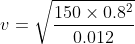
So we get
v=89.442719099991 m/s
Add Answer to:
1. A 0.012 kg bullet is fired horizontally into a 0.1 kg wooden block that is...
A 12.0-g bullet is fired horizontally into a 115-g wooden block that is initially at rest...
A 12.0-g bullet is fired horizontally into a 115-g wooden block that is initially at rest on a frictionless horizontal surface and connected to a spring having spring constant 146 N/m. The bullet becomes embedded in the block. If the bullet-block system compresses the spring by a maximum of 88.5 cm, what was the speed of the bullet at impact with the block?
A 12.0-q bullet is fired horizontally into a 103-q wooden block that is initially at rest...
 A 12.0-q bullet is fired horizontally into a 103-q wooden block that is initially at rest on a frictionless horizontal surface and connected to a spring having spring constant 158 N/m. The bullet becomes the bullet-block system compresses the spring by a maximum of 81.5 cm, what was the speed of the bullet at impact with the block? embedded in the block. m/s
A 12.0-g bullet is fired horizontally into a 113-g wooden block that is initially at rest...
A 12.0-g bullet is fired horizontally into a 113-g wooden block that is initially at rest on a frictionless horizontal surface and connected to a spring having spring constant 159 N/m. The bullet becomes embedded in the block. If the bullet-block system compresses the spring by a maximum of 89.0 cm, what was the speed of the bullet at impact with the block? m/s
A bullet of mass 4.3 g is fired horizontally into a 7.4 kg wooden block at...
A bullet of mass 4.3 g is fired horizontally into a 7.4 kg wooden block at rest on a horizontal surface. The coefficient of kinetic friction between block and surface is 0.53. The bullet stops in the block, which slides straight ahead for 1.7 m (without rotation). (a) What is the speed of the block immediately after the bullet stops relative to it? (b) At what speed is the bullet fired?
A 0.01kg bullet is fired horizontally into a 1 kg block of wood, initially at rest...
A 0.01kg bullet is fired horizontally into a 1 kg block of wood, initially at rest on a frictionless surface. After the impact, the block of wood with the bullet inside recoils with a velocity of 2m/s. 1. Is momentum conserved in this process?? 2.Is energy conserved in this process? 3. What was the velocity of the bullet before impact with the block of wood?
A bullet of mass Mb is fired horizontally with speed Vi at a wooden block of...
A bullet of mass Mb is fired horizontally with speed Vi at a wooden block of mass Mw resting on a frictionless table. The bullet hits the block and becomes completely embedded within it. After the bullet has come to rest within the block, the block, with the bullet in it, is traveling at speed Vf . 1)Which of the following best describes this collision? a)perfectly elastic b)partially inelastic c)perfectly inelastic 2) Which of the following quantities, if any, are...
A bullet of mass 7.00 g is fired horizontally into a wooden block of mass 1.20...
A bullet of mass 7.00 g is fired horizontally into a wooden block of mass 1.20 kg resting on a horizontal surface. The coefficient of kinetic friction between block and surface is 0.250. The bullet remains embedded in the block, which is observed to slide a distance 0.300 m along the surface before stopping. a) What was the initial speed of the bullet?
A wooden block of mass 7.50 kg rests on a horizontal frictionless surface. A 3.00 g...
A wooden block of mass 7.50 kg rests on a horizontal frictionless surface. A 3.00 g bullet traveling horizontally at 700 m/s suddenly hits and becomes embedded in the wooden block. Find the speed of the block after the impact.?
A3 g bullet is fired horizontally into the 0.5 kg block which rests on the rough...
 A3 g bullet is fired horizontally into the 0.5 kg block which rests on the rough surface coefficient of friction 01. Alter the bullet becomes embedded into the book, the block moves to the night 03 m before momentarily coming to rest Determine the speed (b) of the bullet. The spring has a stress 200-Num and is ongly un stretched [m/s] k = 200 N/m WWWWW
A 35 g bullet is fired horizontally into a hanging wooden block (mass 1.7kg) as shown...
A 35 g bullet is fired horizontally into a hanging wooden block (mass 1.7kg) as shown in (Figure 1). The bullet's initial speed is 300 m/s . The bullet becomes embedded in the block, which then swings upward some height. What is the maximum height to which the block rises? Instead of getting embedded in the block, the bullet passes completely through it, emerging on the other side with a speed of 100 m/s . How high does the block...
 A 12.0-q bullet is fired horizontally into a 103-q wooden block that is initially at rest on a frictionless horizontal surface and connected to a spring having spring constant 158 N/m. The bullet becomes the bullet-block system compresses the spring by a maximum of 81.5 cm, what was the speed of the bullet at impact with the block? embedded in the block. m/s
 A3 g bullet is fired horizontally into the 0.5 kg block which rests on the rough surface coefficient of friction 01. Alter the bullet becomes embedded into the book, the block moves to the night 03 m before momentarily coming to rest Determine the speed (b) of the bullet. The spring has a stress 200-Num and is ongly un stretched [m/s] k = 200 N/m WWWWW
Most questions answered within 3 hours.
-
Where is the error in this code sequence?
String s1 = "Hello";
String s2 = "ello";...
asked 11 months ago -
Financial data for Joel de Paris, Inc., for last year
follow:
Joel de Paris, Inc.
Balance...
asked 11 months ago -
Consider this reaction:
Al2(SO4)3 (aq)+ BaCl3
(aq) Al2Cl6 (aq)- +
3BaSO4(s) . What is the...
asked 11 months ago -
Suppose that Savneet is considering increasing her
recent random sample from 20 car rentals to 40...
asked 11 months ago -
Trucks arrive at an unloading terminal at an average rate of 120
per hour.
Trucks arrive...
asked 11 months ago -
Why are methanol and ethanol completely soluble in water while
octanol is not very little soluble....
asked 11 months ago -
A facilities manager at a university reads in a research report
that the mean amount of...
asked 11 months ago -
When the CuSO4 is rehydrated by adding water to the anhydrous
compound, is this an endothermic...
asked 11 months ago -
A ray of sunlight is passing from diamond into crown glass; the
angle of incidence is...
asked 11 months ago -
A block of mass 0.249 kg is placed on top of a light, vertical
spring of...
asked 11 months ago -
how do the kidneys compensate in the presences of acidosis
a) trigger hyperventilate
b) reserve acid...
asked 11 months ago -
Question 501 pts
The rental rate of capital to the firm increases. Which of the
following...
asked 11 months ago