
Homework Answers
 as
the N of aniline has an electron pair, it will attract the
anhydride which will break into CH3CO+ +
CH3COO-. The CH3CO+
will be attracted by the electron pair of aniline.
as
the N of aniline has an electron pair, it will attract the
anhydride which will break into CH3CO+ +
CH3COO-. The CH3CO+
will be attracted by the electron pair of aniline.
Add Answer to:
A. crude product which will be purified. B. starting material electrophile. C. starting material nucleophile. D.side...
please dont answer aniline? you differentiate based on IR spectrum, that your compound is acetanilide and not und...
 please dont answer
aniline? you differentiate based on IR spectrum, that your compound is acetanilide and not undicate which key absorptions lead you to your conclusions) (Relevant IR spectral frequency chart is provided to you at the back) (b) The starting material dissolves in dilute HCI, but the product acetanilide does not. Why? (c) Explain why the acetylation requires one mole of acetic anhydride per mole of aniline, though acetic anhydride contains two acetyl groups. How is the by-product containing...
please dont answer
aniline? you differentiate based on IR spectrum, that your compound is acetanilide and not undicate which key absorptions lead you to your conclusions) (Relevant IR spectral frequency chart is provided to you at the back) (b) The starting material dissolves in dilute HCI, but the product acetanilide does not. Why? (c) Explain why the acetylation requires one mole of acetic anhydride per mole of aniline, though acetic anhydride contains two acetyl groups. How is the by-product containing...
1. Which of the following statement is consistent with the mechanism between the starting material, 4-aminophenol...
1. Which of the following statement is consistent with the mechanism between the starting material, 4-aminophenol and acetic anhydride, used to synthesized 4-acetamidophenol. A) Acetic anhydride acts as a nucleophile attacking the alcohol group in 4-aminophenol. B) The alcohol group of 4-aminophenol acts as a nucleophile attacking the carbonyl carbon of acetic anhydride. C) The amine group of 4-aminophenol acts as a nucleophile attacking the carbonyl carbon of acetic anhydride. D) Acetic anhydride acts as a nucleophile attacking the amine...
3) For each reaction below, indicate which starting material is the Nucleophile and which is the...
 3) For each reaction below, indicate which starting material is the Nucleophile and which is the Electrophile. Show arrows to demonstrate how the transformation occurs. A) Putty » NH2 © NH2
Can someone tell me if a theoretical yield needs to be calculated for this experiment? And...
 Can someone tell me if a theoretical yield needs to be
calculated for this experiment? And if so, how do you calculate it?
please show all work. thank you. btw the aniline weighs
6.69g.
Synthesis of Acetanilide Acetanilide is synthesized from aniline by a reaction known as acylation. Acylation is the addition of an acyl group to a compound. In this experiment, aniline (1 amine) is reacted with acetic anhydride (acylating agent) to form acetanilide (an amide). H-C-CH3 + CH...
Can someone tell me if a theoretical yield needs to be
calculated for this experiment? And if so, how do you calculate it?
please show all work. thank you. btw the aniline weighs
6.69g.
Synthesis of Acetanilide Acetanilide is synthesized from aniline by a reaction known as acylation. Acylation is the addition of an acyl group to a compound. In this experiment, aniline (1 amine) is reacted with acetic anhydride (acylating agent) to form acetanilide (an amide). H-C-CH3 + CH...
3 Draw eAer reaction were complete. Indicate the nucleophile and electrophile in the first step. Hint-there...
 3 Draw eAer reaction were complete. Indicate the nucleophile and electrophile in the first step. Hint-there should be three steps, with two arrows in each step the mechanism for the reaction of the alcohol and the anhydride, assuming it occurred after the 6 pts) if 4) Draw the most favorable conformation of the diene starting material. What implication does this have for the energy of the reaction? (2 pts) 5) Cyclopentene could be used in this reaction in place of...
Answer ALL parts a)-e). You are given an experimental procedure in which aniline reacts with acetic...
 Answer ALL parts a)-e). You are given an experimental procedure in which aniline reacts with acetic anhydride to give acetanilide as shown below. The procedure uses 5.9 g of aniline and 6.3 g of acetic anhydride. aniline, M, 93 acetic anhydride, M, 102 acetanilide, M, 135 Calculate which of the reagents is limiting, and hence determine the maximum possible yield of acetanilide in grams. Show your working a) Based on your answer to part a), describe how you would remove...
12. Which is the major product of the reaction shown? (a) (b) (c) (d) 13. What...
 12. Which is the major product of the reaction shown? (a) (b)
(c) (d) 13. What are all of the possible products formed in the
following reaction? (choose all correct answers) (a) (b) (c) (d)
(e) (f) 14. The three compounds below can form a carbocation in the
presence of H2O and H2SO4. Which ones will form the same
carbocation? (a) I and II (b) I and III (c) II and III (d) all
three will form the same carbocation...
12. Which is the major product of the reaction shown? (a) (b)
(c) (d) 13. What are all of the possible products formed in the
following reaction? (choose all correct answers) (a) (b) (c) (d)
(e) (f) 14. The three compounds below can form a carbocation in the
presence of H2O and H2SO4. Which ones will form the same
carbocation? (a) I and II (b) I and III (c) II and III (d) all
three will form the same carbocation...
please show all steps with necessary mechanism arrows 1. Provide the starting specific nucleophile and electrophile...
 please show all steps with necessary mechanism arrows
1. Provide the starting specific nucleophile and electrophile that would result in each of the following molecules using an SN2 reaction. Do consider the ABC and provide the specific reagent necessary. (2 points) Me HH MeMe Me I wyn Me Me 2. Provide a detailed retrosynthesis and synthesis of the following compound from the indicated starting material. All atoms of the target must come from the indicated starting materials. You may use...
please show all steps with necessary mechanism arrows
1. Provide the starting specific nucleophile and electrophile that would result in each of the following molecules using an SN2 reaction. Do consider the ABC and provide the specific reagent necessary. (2 points) Me HH MeMe Me I wyn Me Me 2. Provide a detailed retrosynthesis and synthesis of the following compound from the indicated starting material. All atoms of the target must come from the indicated starting materials. You may use...
A.) Functioning as nucleophile, which attacks the electrophilic carbonyl center of substrate B.) Functioning as electrophile,...
 A.) Functioning as nucleophile, which
attacks the electrophilic carbonyl center of substrate
B.) Functioning as electrophile, which attacks the nucleophilic
carbonyl center of substrate
C.) Functioning as an acid
D.) Functioning as a base
The image is an example of:
A.) covalent catalysis
B.) acid-base catalysis
C.) metal-ion catalysis
D.) hydration catalysis
What is the function of cysteine residue in the active site of the following enzyme catalyzed reaction? CHZOPO NAD+ HCOH NADH CH OPC НСОН Ho Cys
A.) Functioning as nucleophile, which
attacks the electrophilic carbonyl center of substrate
B.) Functioning as electrophile, which attacks the nucleophilic
carbonyl center of substrate
C.) Functioning as an acid
D.) Functioning as a base
The image is an example of:
A.) covalent catalysis
B.) acid-base catalysis
C.) metal-ion catalysis
D.) hydration catalysis
What is the function of cysteine residue in the active site of the following enzyme catalyzed reaction? CHZOPO NAD+ HCOH NADH CH OPC НСОН Ho Cys
What are the starting materials for the experiment? a- Salicylic acid b-Acetic anhydride C-Acetic acid d-Aspirin...
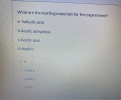 What are the starting materials for the experiment? a- Salicylic acid b-Acetic anhydride C-Acetic acid d-Aspirin o cand d a and b band
 please dont answer
aniline? you differentiate based on IR spectrum, that your compound is acetanilide and not undicate which key absorptions lead you to your conclusions) (Relevant IR spectral frequency chart is provided to you at the back) (b) The starting material dissolves in dilute HCI, but the product acetanilide does not. Why? (c) Explain why the acetylation requires one mole of acetic anhydride per mole of aniline, though acetic anhydride contains two acetyl groups. How is the by-product containing...
please dont answer
aniline? you differentiate based on IR spectrum, that your compound is acetanilide and not undicate which key absorptions lead you to your conclusions) (Relevant IR spectral frequency chart is provided to you at the back) (b) The starting material dissolves in dilute HCI, but the product acetanilide does not. Why? (c) Explain why the acetylation requires one mole of acetic anhydride per mole of aniline, though acetic anhydride contains two acetyl groups. How is the by-product containing...
 3) For each reaction below, indicate which starting material is the Nucleophile and which is the Electrophile. Show arrows to demonstrate how the transformation occurs. A) Putty » NH2 © NH2
 Can someone tell me if a theoretical yield needs to be
calculated for this experiment? And if so, how do you calculate it?
please show all work. thank you. btw the aniline weighs
6.69g.
Synthesis of Acetanilide Acetanilide is synthesized from aniline by a reaction known as acylation. Acylation is the addition of an acyl group to a compound. In this experiment, aniline (1 amine) is reacted with acetic anhydride (acylating agent) to form acetanilide (an amide). H-C-CH3 + CH...
Can someone tell me if a theoretical yield needs to be
calculated for this experiment? And if so, how do you calculate it?
please show all work. thank you. btw the aniline weighs
6.69g.
Synthesis of Acetanilide Acetanilide is synthesized from aniline by a reaction known as acylation. Acylation is the addition of an acyl group to a compound. In this experiment, aniline (1 amine) is reacted with acetic anhydride (acylating agent) to form acetanilide (an amide). H-C-CH3 + CH...
 3 Draw eAer reaction were complete. Indicate the nucleophile and electrophile in the first step. Hint-there should be three steps, with two arrows in each step the mechanism for the reaction of the alcohol and the anhydride, assuming it occurred after the 6 pts) if 4) Draw the most favorable conformation of the diene starting material. What implication does this have for the energy of the reaction? (2 pts) 5) Cyclopentene could be used in this reaction in place of...
 Answer ALL parts a)-e). You are given an experimental procedure in which aniline reacts with acetic anhydride to give acetanilide as shown below. The procedure uses 5.9 g of aniline and 6.3 g of acetic anhydride. aniline, M, 93 acetic anhydride, M, 102 acetanilide, M, 135 Calculate which of the reagents is limiting, and hence determine the maximum possible yield of acetanilide in grams. Show your working a) Based on your answer to part a), describe how you would remove...
 12. Which is the major product of the reaction shown? (a) (b)
(c) (d) 13. What are all of the possible products formed in the
following reaction? (choose all correct answers) (a) (b) (c) (d)
(e) (f) 14. The three compounds below can form a carbocation in the
presence of H2O and H2SO4. Which ones will form the same
carbocation? (a) I and II (b) I and III (c) II and III (d) all
three will form the same carbocation...
12. Which is the major product of the reaction shown? (a) (b)
(c) (d) 13. What are all of the possible products formed in the
following reaction? (choose all correct answers) (a) (b) (c) (d)
(e) (f) 14. The three compounds below can form a carbocation in the
presence of H2O and H2SO4. Which ones will form the same
carbocation? (a) I and II (b) I and III (c) II and III (d) all
three will form the same carbocation...
 please show all steps with necessary mechanism arrows
1. Provide the starting specific nucleophile and electrophile that would result in each of the following molecules using an SN2 reaction. Do consider the ABC and provide the specific reagent necessary. (2 points) Me HH MeMe Me I wyn Me Me 2. Provide a detailed retrosynthesis and synthesis of the following compound from the indicated starting material. All atoms of the target must come from the indicated starting materials. You may use...
please show all steps with necessary mechanism arrows
1. Provide the starting specific nucleophile and electrophile that would result in each of the following molecules using an SN2 reaction. Do consider the ABC and provide the specific reagent necessary. (2 points) Me HH MeMe Me I wyn Me Me 2. Provide a detailed retrosynthesis and synthesis of the following compound from the indicated starting material. All atoms of the target must come from the indicated starting materials. You may use...
 A.) Functioning as nucleophile, which
attacks the electrophilic carbonyl center of substrate
B.) Functioning as electrophile, which attacks the nucleophilic
carbonyl center of substrate
C.) Functioning as an acid
D.) Functioning as a base
The image is an example of:
A.) covalent catalysis
B.) acid-base catalysis
C.) metal-ion catalysis
D.) hydration catalysis
What is the function of cysteine residue in the active site of the following enzyme catalyzed reaction? CHZOPO NAD+ HCOH NADH CH OPC НСОН Ho Cys
A.) Functioning as nucleophile, which
attacks the electrophilic carbonyl center of substrate
B.) Functioning as electrophile, which attacks the nucleophilic
carbonyl center of substrate
C.) Functioning as an acid
D.) Functioning as a base
The image is an example of:
A.) covalent catalysis
B.) acid-base catalysis
C.) metal-ion catalysis
D.) hydration catalysis
What is the function of cysteine residue in the active site of the following enzyme catalyzed reaction? CHZOPO NAD+ HCOH NADH CH OPC НСОН Ho Cys
 What are the starting materials for the experiment? a- Salicylic acid b-Acetic anhydride C-Acetic acid d-Aspirin o cand d a and b band
Most questions answered within 3 hours.
-
Where is the error in this code sequence?
String s1 = "Hello";
String s2 = "ello";...
asked 10 months ago -
Financial data for Joel de Paris, Inc., for last year
follow:
Joel de Paris, Inc.
Balance...
asked 10 months ago -
Consider this reaction:
Al2(SO4)3 (aq)+ BaCl3
(aq) Al2Cl6 (aq)- +
3BaSO4(s) . What is the...
asked 10 months ago -
Suppose that Savneet is considering increasing her
recent random sample from 20 car rentals to 40...
asked 10 months ago -
Trucks arrive at an unloading terminal at an average rate of 120
per hour.
Trucks arrive...
asked 10 months ago -
Why are methanol and ethanol completely soluble in water while
octanol is not very little soluble....
asked 10 months ago -
A facilities manager at a university reads in a research report
that the mean amount of...
asked 10 months ago -
When the CuSO4 is rehydrated by adding water to the anhydrous
compound, is this an endothermic...
asked 10 months ago -
A ray of sunlight is passing from diamond into crown glass; the
angle of incidence is...
asked 10 months ago -
A block of mass 0.249 kg is placed on top of a light, vertical
spring of...
asked 10 months ago -
how do the kidneys compensate in the presences of acidosis
a) trigger hyperventilate
b) reserve acid...
asked 10 months ago -
Question 501 pts
The rental rate of capital to the firm increases. Which of the
following...
asked 10 months ago