
Homework Answers
a. The APT required (i.e. equilibrium) rate of return is given
by:
E(r) = 0 + (1 x 6) + (0.5 x 2) + (0.75 x 4) =
10%
a. From the equation given in the question, the expected return on the stock is 6%( (expected surprises on all factors are zero by definition). Because the actually expected return based on risk is less than the equilibrium return, we conclude that the share is overpriced.
Consider the following information: Beta Portfolio Risk- free Market Expected Return 6 % 11.4 9.4 20...
 Consider the following information: Beta Portfolio Risk- free Market Expected Return 6 % 11.4 9.4 20 a. Calculate the expected return of portfolio A with a beta of 20. (Round your answer to 2 decimal places.) Expected return b. What is the alpha of portfolio A (Negative value should be indicated by a minus sign. Round your answer to 2 decimal places.) Alpha c. If the simple CAPM is valid state whether the above situation is possible? Yes No 5....
6. You consider purchasing a share of stock at Po = $40. The asset is expected...
 6. You consider purchasing a share of stock at Po = $40. The asset is expected to pay a dividend of $3 and to sell for $41 in a year. If its B = -.5 find out if the asset is underpriced or overpriced. Assume that r;= .05 and E(TM) = .12.
With explanation please! 8. (6 pts) Provide polymer structures and monomers R-O-O-R 21 R-0-0- R EFF...
 With explanation please!
8. (6 pts) Provide polymer structures and monomers R-O-O-R 21 R-0-0- R EFF FF FF F I V V V PX X X F FF FF F
With explanation please!
8. (6 pts) Provide polymer structures and monomers R-O-O-R 21 R-0-0- R EFF FF FF F I V V V PX X X F FF FF F
What will be the O/P of these codes: int a 15 int b- 4: ntcO,d-0,c-0 c-a%b;...
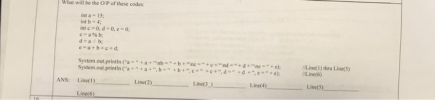 What will be the O/P of these codes: int a 15 int b- 4: ntcO,d-0,c-0 c-a%b; e a+b+c+d: System.out.printin "a+a "nbbnd-d"e System.out printin Ca _ " + a +".b-.. +b+",c--+e+", d-“ +d +",e-"+ek /Line(1) thru Line(5) /Line(6) ANS: Line I) Line(2) Line(3) Line(4) Line(5),
1. What is the output of the following code segment? int array[] = { 8, 6,...
1. What is the output of the following code segment? int array[] = { 8, 6, 9, 7, 6, 4, 4, 5, 8, 10 }; System.out.println( "Index Value" ); for ( int i = 0; i < array.length; i++ ) System.out.printf( "%d %d\n", i, array[ i ] ); 2. What is the output of the following code segment? char sentence[] = {'H', 'o', 'w', ' ', 'a', 'r', 'e', ' ', 'y', 'o', 'u' }; String output = "The sentence...
#include <stdio.h> int main ( ) { int k; int sum=0; for (k=0; k<6; k++) {...
#include <stdio.h> int main ( ) { int k; int sum=0; for (k=0; k<6; k++) { sum += k; } printf("%d\n", sum); return 0; } (a) [10 pts] Convert the C program to be an assembly code named as lab3_ex7_assembly.s. Please notice that your code must be executable in the Venus simulator. In the assembly code you write, you need to answer the following questions as well: (b) [5 pts] What are the registers in your code to represent the...
Find Big-O notation for the following algorithm: int function9(int n) { int ij for (i-0; in;...
 Find Big-O notation for the following algorithm:
int function9(int n) { int ij for (i-0; in; i++) for (0; j<n; j++ if (j1) break return j; }
int function9(int n) { int ij for (i-0; in; i++) for (0; j
Find Big-O notation for the following algorithm:
int function9(int n) { int ij for (i-0; in; i++) for (0; j<n; j++ if (j1) break return j; }
int function9(int n) { int ij for (i-0; in; i++) for (0; j
1 #include<stdio.h> 53 int findMax (int, SA 5 int main() 6 { int n; int max;...
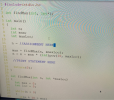 1 #include<stdio.h> 53 int findMax (int, SA 5 int main() 6 { int n; int max; int maxLoc; co n = //ASSIGNMENT HERE 12 13 14 15 16 max = findMax (n, &maxLoc); n = n - max* (int) pow (10, maxLoc); //PRINT STATEMENT HERE 17 18 return(0); 19 ) 20 21 int findMax (int n, int *maxLoc) 22 { 23 int max = 0; int loc = 0; 24 25 26 while(n > 0) 27 28 if(n% 10 >...
Big-O notation. Consider the following function. int func1(int n) { int sum = 0, i; for(i...
Big-O notation. Consider the following function. int func1(int n) { int sum = 0, i; for(i = 0; i<n; i++;) { sum += i; return sum; } Express the running time of func1 as a function of n using big-O notation. Write a function that has the same functionality as func1, but runs in O(1) time.
Question 5 (6 points) Let o: R+S be a ring homomorphism. Suppose that o(R) and ker...
 Question 5 (6 points) Let o: R+S be a ring homomorphism. Suppose that o(R) and ker o contain no nonzero nilpotent elements. Prove that contains no nonzero nilpotent elements.
 Consider the following information: Beta Portfolio Risk- free Market Expected Return 6 % 11.4 9.4 20 a. Calculate the expected return of portfolio A with a beta of 20. (Round your answer to 2 decimal places.) Expected return b. What is the alpha of portfolio A (Negative value should be indicated by a minus sign. Round your answer to 2 decimal places.) Alpha c. If the simple CAPM is valid state whether the above situation is possible? Yes No 5....
 6. You consider purchasing a share of stock at Po = $40. The asset is expected to pay a dividend of $3 and to sell for $41 in a year. If its B = -.5 find out if the asset is underpriced or overpriced. Assume that r;= .05 and E(TM) = .12.
 With explanation please!
8. (6 pts) Provide polymer structures and monomers R-O-O-R 21 R-0-0- R EFF FF FF F I V V V PX X X F FF FF F
With explanation please!
8. (6 pts) Provide polymer structures and monomers R-O-O-R 21 R-0-0- R EFF FF FF F I V V V PX X X F FF FF F
 What will be the O/P of these codes: int a 15 int b- 4: ntcO,d-0,c-0 c-a%b; e a+b+c+d: System.out.printin "a+a "nbbnd-d"e System.out printin Ca _ " + a +".b-.. +b+",c--+e+", d-“ +d +",e-"+ek /Line(1) thru Line(5) /Line(6) ANS: Line I) Line(2) Line(3) Line(4) Line(5),
 Find Big-O notation for the following algorithm:
int function9(int n) { int ij for (i-0; in; i++) for (0; j<n; j++ if (j1) break return j; }
int function9(int n) { int ij for (i-0; in; i++) for (0; j
Find Big-O notation for the following algorithm:
int function9(int n) { int ij for (i-0; in; i++) for (0; j<n; j++ if (j1) break return j; }
int function9(int n) { int ij for (i-0; in; i++) for (0; j
 1 #include<stdio.h> 53 int findMax (int, SA 5 int main() 6 { int n; int max; int maxLoc; co n = //ASSIGNMENT HERE 12 13 14 15 16 max = findMax (n, &maxLoc); n = n - max* (int) pow (10, maxLoc); //PRINT STATEMENT HERE 17 18 return(0); 19 ) 20 21 int findMax (int n, int *maxLoc) 22 { 23 int max = 0; int loc = 0; 24 25 26 while(n > 0) 27 28 if(n% 10 >...
 Question 5 (6 points) Let o: R+S be a ring homomorphism. Suppose that o(R) and ker o contain no nonzero nilpotent elements. Prove that contains no nonzero nilpotent elements.
Most questions answered within 3 hours.
-
Where is the error in this code sequence?
String s1 = "Hello";
String s2 = "ello";...
asked 11 months ago -
Financial data for Joel de Paris, Inc., for last year
follow:
Joel de Paris, Inc.
Balance...
asked 11 months ago -
Consider this reaction:
Al2(SO4)3 (aq)+ BaCl3
(aq) Al2Cl6 (aq)- +
3BaSO4(s) . What is the...
asked 11 months ago -
Suppose that Savneet is considering increasing her
recent random sample from 20 car rentals to 40...
asked 11 months ago -
Trucks arrive at an unloading terminal at an average rate of 120
per hour.
Trucks arrive...
asked 11 months ago -
Why are methanol and ethanol completely soluble in water while
octanol is not very little soluble....
asked 11 months ago -
A facilities manager at a university reads in a research report
that the mean amount of...
asked 11 months ago -
When the CuSO4 is rehydrated by adding water to the anhydrous
compound, is this an endothermic...
asked 11 months ago -
A ray of sunlight is passing from diamond into crown glass; the
angle of incidence is...
asked 11 months ago -
A block of mass 0.249 kg is placed on top of a light, vertical
spring of...
asked 11 months ago -
how do the kidneys compensate in the presences of acidosis
a) trigger hyperventilate
b) reserve acid...
asked 11 months ago -
Question 501 pts
The rental rate of capital to the firm increases. Which of the
following...
asked 11 months ago