
Homework Answers

Add Answer to:
Course Home C14.3 Rato Law and Reaction Order Exercise 14.42-Enhanced-with Feedback Consider the following data showing...
Consider the following data showing the initial rate of a reaction (A→products) at several different concentrations...
Consider the following data showing the initial rate of a reaction (A→products) at several different concentrations of [A](M) Initial rate (M/s) 0.15 0.024 0.30 0.191 0.60 1.525 Estimate the value of the rate constant, k.
Part A From the data, determine the rate law for the reaction. You may want to...
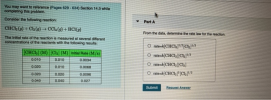 Part A From the data, determine the rate law for the reaction. You may want to reference (Pages 629 - 634) Section 14.3 while completing this problem. Consider the following reaction: CHCl(9) + Cl2(g) → CCL (9) + HC1() The Initial rate of the reaction is measured at several different concentrations of the reactants with the following results: [CHCI](M) [CI] (M) initial Rate (M/s) 0.010 0.010 0.0034 0.020 0.010 0.0068 rate=K[CHC13]/2Cl2}\/2 O rate-k[CHCI)(CI)" Oratenk(CHCI)(C1) O rate=k[CHC13) C1,]1/2 0.020 0.040 0.020...
Course Home <Homework 11 Exercise 7.42 - Enhanced - with Feedback You may want to reference...
 Course Home <Homework 11 Exercise 7.42 - Enhanced - with Feedback You may want to reference (Pages 295 - 299) Section 7.4 while completing this problem. Sulfuric acid dissolves aluminum metal according to the following reaction: 2 Al(s) + 3H2SO4 (aq) + Al(SO4)2 (aq) + 3H2(g) Suppose you wanted to dissolve an aluminum block with a mass of 15.9 g Review Part A What minimum mass of H2SO, would you need? Express your answer in grams. HVO AED O ?...
Consider the following data showing the initial rate of a reaction (A -products at several different...
 Consider the following data showing the initial rate of a reaction (A -products at several different concentrations of A. Part B Write a rate law for the reaction. [A](M) Initial Rate (M/s) 0.15 0.012 0.30 0.048 0.60 0.190 O Rate = k [A] O Rate = k[A] O Rate = k O Rate = k[A13 Submit Request Answer
Exercise 7.50 - Enhanced - with Feedback For the reaction Part A Mn(s) + O2(g) →MnO2...
 Exercise 7.50 - Enhanced - with Feedback For the reaction Part A Mn(s) + O2(g) →MnO2 (s) compute the theoretical yield of product in moles) for each of the following initial amounts of reactants 5 mol Mn and 5 mol O2 Express your answer using one significant figure. You may want to reference (Pages 299 306) Section 7 5 while completing this problem 10 AXO ? mol Submit Request Answer Part B 3 mol Mn and 9 mol Oy Express...
Consider the following data showing the initial rate of a reaction (A→products) at several different concentrations...
Consider the following data showing the initial rate of a reaction (A→products) at several different concentrations of A. [A](M) Initial rate (M/s) 0.15 0.017 0.30 0.069 0.60 0.278 What is the order of the reaction?
Consider the following data showing the initial rate of a reaction (A→products) at several different concentrations...
Consider the following data showing the initial rate of a reaction (A→products) at several different concentrations of A. [A] (M) | initial rate (M/s) 0.15 0.022 0.30 0.178 0.60 1.421 Estimate the value of the rate constant, k. in M^−2*s^−1
Exercise 15.54-Enhanced -with Feedback 32 of 56 Part A For the following reaction, K 255 at...
 Exercise 15.54-Enhanced -with Feedback 32 of 56 Part A For the following reaction, K 255 at 1000 K CO (g) +Cl2 (g)COCl2 (g) If a reaction mixture initially contains a CO concentration of 0.1510 and a Cl2 concentration of 0.175 at 100oK. What is the equilibriun concentration of CO at 1000 K? You may want to reference (Pages 693-702) Section 5.8 while completing this problem. Express your answer in molarity to three significant figures. [CO] = Submit Request Answer ▼...
You may want to reference (Pages 629 - 634) Section 14.3 while completing this problem Consider...
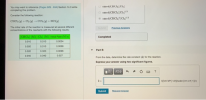 You may want to reference (Pages 629 - 634) Section 14.3 while completing this problem Consider the following reaction: CHC1, (g) + Cl2 (9) + CC14(9) + HC1(9) The initial rate of the reaction is measured at several different concentrations of the reactants with the following results: rate CHCICH ratek(CHCI||C1,112 ratok (CHCI,)*(Cl)/2 Subm Previous Answers Completed (CHC) (M) (C) (M) Initial Rate (M/s) 0.010 0.010 0.0034 0.020 0.010 0.0060 0.020 0.020 0.0096 0.040 0.040 0.027 Part From the data, determine...
Consider the following data showing the initial rate of a reaction (A→products) at several different concentrations...
Consider the following data showing the initial rate of a reaction (A→products) at several different concentrations of A. [A](M) Initial rate (M/s) 0.15 0.018 0.30 0.073 0.60 0.293 Estimate the value of the rate constant, k. Express your answer using two significant figures.
 Part A From the data, determine the rate law for the reaction. You may want to reference (Pages 629 - 634) Section 14.3 while completing this problem. Consider the following reaction: CHCl(9) + Cl2(g) → CCL (9) + HC1() The Initial rate of the reaction is measured at several different concentrations of the reactants with the following results: [CHCI](M) [CI] (M) initial Rate (M/s) 0.010 0.010 0.0034 0.020 0.010 0.0068 rate=K[CHC13]/2Cl2}\/2 O rate-k[CHCI)(CI)" Oratenk(CHCI)(C1) O rate=k[CHC13) C1,]1/2 0.020 0.040 0.020...
 Course Home <Homework 11 Exercise 7.42 - Enhanced - with Feedback You may want to reference (Pages 295 - 299) Section 7.4 while completing this problem. Sulfuric acid dissolves aluminum metal according to the following reaction: 2 Al(s) + 3H2SO4 (aq) + Al(SO4)2 (aq) + 3H2(g) Suppose you wanted to dissolve an aluminum block with a mass of 15.9 g Review Part A What minimum mass of H2SO, would you need? Express your answer in grams. HVO AED O ?...
 Consider the following data showing the initial rate of a reaction (A -products at several different concentrations of A. Part B Write a rate law for the reaction. [A](M) Initial Rate (M/s) 0.15 0.012 0.30 0.048 0.60 0.190 O Rate = k [A] O Rate = k[A] O Rate = k O Rate = k[A13 Submit Request Answer
 Exercise 7.50 - Enhanced - with Feedback For the reaction Part A Mn(s) + O2(g) →MnO2 (s) compute the theoretical yield of product in moles) for each of the following initial amounts of reactants 5 mol Mn and 5 mol O2 Express your answer using one significant figure. You may want to reference (Pages 299 306) Section 7 5 while completing this problem 10 AXO ? mol Submit Request Answer Part B 3 mol Mn and 9 mol Oy Express...
 Exercise 15.54-Enhanced -with Feedback 32 of 56 Part A For the following reaction, K 255 at 1000 K CO (g) +Cl2 (g)COCl2 (g) If a reaction mixture initially contains a CO concentration of 0.1510 and a Cl2 concentration of 0.175 at 100oK. What is the equilibriun concentration of CO at 1000 K? You may want to reference (Pages 693-702) Section 5.8 while completing this problem. Express your answer in molarity to three significant figures. [CO] = Submit Request Answer ▼...
 You may want to reference (Pages 629 - 634) Section 14.3 while completing this problem Consider the following reaction: CHC1, (g) + Cl2 (9) + CC14(9) + HC1(9) The initial rate of the reaction is measured at several different concentrations of the reactants with the following results: rate CHCICH ratek(CHCI||C1,112 ratok (CHCI,)*(Cl)/2 Subm Previous Answers Completed (CHC) (M) (C) (M) Initial Rate (M/s) 0.010 0.010 0.0034 0.020 0.010 0.0060 0.020 0.020 0.0096 0.040 0.040 0.027 Part From the data, determine...
Most questions answered within 3 hours.
-
Where is the error in this code sequence?
String s1 = "Hello";
String s2 = "ello";...
asked 11 months ago -
Financial data for Joel de Paris, Inc., for last year
follow:
Joel de Paris, Inc.
Balance...
asked 11 months ago -
Consider this reaction:
Al2(SO4)3 (aq)+ BaCl3
(aq) Al2Cl6 (aq)- +
3BaSO4(s) . What is the...
asked 11 months ago -
Suppose that Savneet is considering increasing her
recent random sample from 20 car rentals to 40...
asked 11 months ago -
Trucks arrive at an unloading terminal at an average rate of 120
per hour.
Trucks arrive...
asked 11 months ago -
Why are methanol and ethanol completely soluble in water while
octanol is not very little soluble....
asked 11 months ago -
A facilities manager at a university reads in a research report
that the mean amount of...
asked 11 months ago -
When the CuSO4 is rehydrated by adding water to the anhydrous
compound, is this an endothermic...
asked 11 months ago -
A ray of sunlight is passing from diamond into crown glass; the
angle of incidence is...
asked 11 months ago -
A block of mass 0.249 kg is placed on top of a light, vertical
spring of...
asked 11 months ago -
how do the kidneys compensate in the presences of acidosis
a) trigger hyperventilate
b) reserve acid...
asked 11 months ago -
Question 501 pts
The rental rate of capital to the firm increases. Which of the
following...
asked 11 months ago