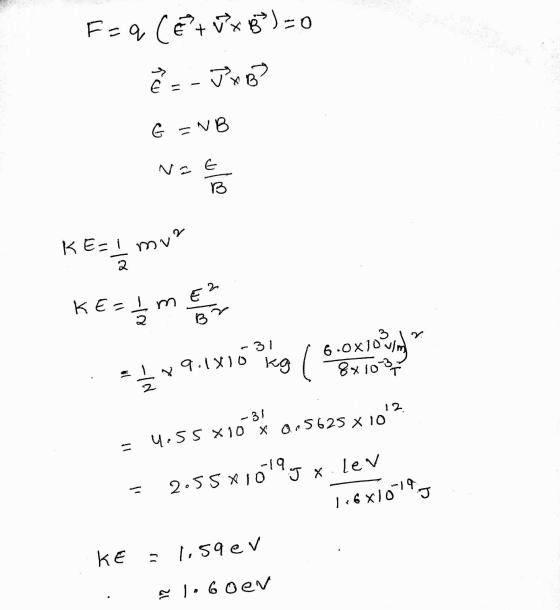
What is the kinetic energy of an electron that passes undeviated through perpendicular electric and...
Homework Answers
Add Answer to:
What is the kinetic energy of an electron that passes undeviated through perpendicular electric and...
1. A stream of electrons passes through a velocity filter where the crossed magnetic and electric...
 1. A stream of electrons passes through a velocity filter where the crossed magnetic and electric fields are O.02 T and 5.0 x10 V/m respectively. Find the kinetic energy (in electron volts ) of the electrons passing through the filter. ( 1 eV 1.60 X 10⁻¹⁹ J).
A velocity selector consists of electric and magnetic fields described by the expressions E = E...
A velocity selector consists of electric and magnetic fields described by the expressions E = E and B = B ĵ, with B = 24.0 mT. Find the value of E (in kV/m) such that a 800 eV electron moving in the negative x-direction is undeflected. How do you determine the speed of the electron if you know its kinetic energy? kV/m (b) What If? For the value of E found in part (a), what would the kinetic energy of...
(a) A velocity selector consists of electric and magnetic fields described by the expressions E =...
 (a) A velocity selector consists of electric and magnetic fields described by the expressions E = Ek and B-BJ, with B = 16.0 mT. Find the value of E (in kV/m) such that a 830 ev electron moving in the negative x-direction is undeflected kV/m (b) What If? For the value of E found in part (a), what would the kinetic energy of a proton have to be (in MeV) for it to move undeflected in the negative x-direction? Mev
magnetic fields of magnitude 1.53×10⁴V/m and 2.75×10⁻³T, respectively? me=9.11×10⁻³¹kg, e=1.60×10⁻¹⁹C. v = 5.56×10⁶ ms 1-What is...
magnetic fields of magnitude 1.53×10⁴V/m and 2.75×10⁻³T, respectively? me=9.11×10⁻³¹kg, e=1.60×10⁻¹⁹C. v = 5.56×10⁶ ms 1-What is the radius of the electron orbit if the electric field is turned off? Express your answer to three significant figures and include the appropriate units. 2- Δv = 4300 ms Assuming the minimum speed must be at least equal to its uncertainty, what is the electron's minimum kinetic energy? Express your answer using two significant figures.
A velocity selector consists of electric and magnetic fields described by the expressions = E and...
A velocity selector consists of electric and magnetic fields described by the expressions = E and = B ĵ, with B = 14.0 mT. Find the value of E such that a 810-eV electron moving in the negative x direction is undeflected. Answer must be in Kv/m
5. An electron with kinetic energy 1.20 keV moves in a circle in a plane perpendicular...
5. An electron with kinetic energy 1.20 keV moves in a circle in a plane perpendicular to a uniform magnetic field. The radius of the circular orbit is 25.0 cm. (a) Determine the speed, v, of the electron, and the period, T, of its motion. (b) Determine the magnitude of the magnetic field. (c) The figure illustrates a possible electron orbit. What magnetic field direction would give this orbit? (d) If the electron’s kinetic energy were increased by a factor...
Which field can change the kinetic energy of an electron? a. an electric field. b. a...
Which field can change the kinetic energy of an electron? a. an electric field. b. a magnetic field c. both of them. d. neither. Which field can accelerate an electron, but not change its kinetic energy? a. an electric field. b. a magnetic field c. both of them. d. neither.
An electron of kinetic energy 1.77 keV circles in a plane perpendicular to a uniform magnetic...
An electron of kinetic energy 1.77 keV circles in a plane perpendicular to a uniform magnetic field. The orbit radius is 28.2 cm. Find (a) the electron's speed, (b) the magnetic field magnitude, (c) the circling frequency, and (d) the period of the motion.
What is the velocity of a beam of electrons that goes undeflected when moving perpendicular to...
What is the velocity of a beam of electrons that goes undeflected when moving perpendicular to an electric and magnetic fields. E--> and B--> are also perpendicular to each other and have magnitudes 7900V/m and 9.1*10^-3T , respectively. What is the radius of the electron orbit if the electric field is turned off?
An electron of kinetic energy 4.5 keV moves in a circular orbit perpendicular to a magnetic...
An electron of kinetic energy 4.5 keV moves in a circular orbit perpendicular to a magnetic field of 0.315 T. (a) Find the radius of the orbit. ___mm (b) Find the frequency of the motion. ___GHz (c) Find the period. ___ns
 1. A stream of electrons passes through a velocity filter where the crossed magnetic and electric fields are O.02 T and 5.0 x10 V/m respectively. Find the kinetic energy (in electron volts ) of the electrons passing through the filter. ( 1 eV 1.60 X 10⁻¹⁹ J).
 (a) A velocity selector consists of electric and magnetic fields described by the expressions E = Ek and B-BJ, with B = 16.0 mT. Find the value of E (in kV/m) such that a 830 ev electron moving in the negative x-direction is undeflected kV/m (b) What If? For the value of E found in part (a), what would the kinetic energy of a proton have to be (in MeV) for it to move undeflected in the negative x-direction? Mev
Most questions answered within 3 hours.
-
Where is the error in this code sequence?
String s1 = "Hello";
String s2 = "ello";...
asked 11 months ago -
Financial data for Joel de Paris, Inc., for last year
follow:
Joel de Paris, Inc.
Balance...
asked 11 months ago -
Consider this reaction:
Al2(SO4)3 (aq)+ BaCl3
(aq) Al2Cl6 (aq)- +
3BaSO4(s) . What is the...
asked 11 months ago -
Suppose that Savneet is considering increasing her
recent random sample from 20 car rentals to 40...
asked 11 months ago -
Trucks arrive at an unloading terminal at an average rate of 120
per hour.
Trucks arrive...
asked 11 months ago -
Why are methanol and ethanol completely soluble in water while
octanol is not very little soluble....
asked 11 months ago -
A facilities manager at a university reads in a research report
that the mean amount of...
asked 11 months ago -
When the CuSO4 is rehydrated by adding water to the anhydrous
compound, is this an endothermic...
asked 11 months ago -
A ray of sunlight is passing from diamond into crown glass; the
angle of incidence is...
asked 11 months ago -
A block of mass 0.249 kg is placed on top of a light, vertical
spring of...
asked 11 months ago -
how do the kidneys compensate in the presences of acidosis
a) trigger hyperventilate
b) reserve acid...
asked 11 months ago -
Question 501 pts
The rental rate of capital to the firm increases. Which of the
following...
asked 11 months ago