
Homework Answers
a) We solve the equation  for variable
  (via quadratic formula), to get

Let  and
and  ; since
  , we have
  , so that
  are complex (and not real). Because
  , we find
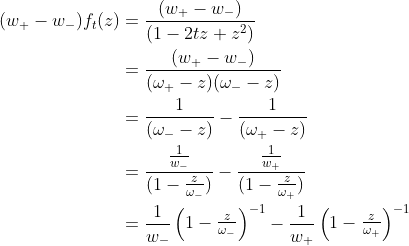
Recall that  has
a power series representation:
has
a power series representation:

Therefore, the above shows
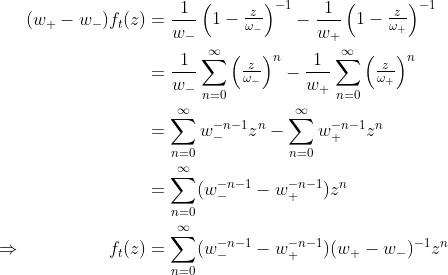
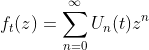
Thus, letting

we obtain the power series representation
b) Since

we get

c) In part a) above we have found the power series by looking at power series of

These power series converge if and only if  , respectively,
  . Therefore, the power series for
  converges if
and only if
converges if
and only if  . Thus, the radius of convergence is

Add Answer to:
c. Evaluate ,f(z) dz with า the circle of radius 1 centered at the origin and...
25. Show that cos eº? dz = 2ni.sin 1. 2 Z the circle of radius 8...
 25. Show that cos eº? dz = 2ni.sin 1. 2 Z the circle of radius 8 centered a
Q5) Evaluate $c f(z) dz where C is the unit circle Iz| = 1 and f(2)...
 Q5) Evaluate $c f(z) dz where C is the unit circle Iz| = 1 and f(2) is defined as follows a) f(z) = z2+z2+z_ b) f(x) = tan z c) f() = cosha
1 3. Let f(x) = 22(2-2)(2 - 4) and C a circle of radius 2k -...
 1 3. Let f(x) = 22(2-2)(2 - 4) and C a circle of radius 2k - 1 about the origin with counterclockwise orientation. (1) Find (2) Find 50, 5(=dz. Je_1(a) dz. 5. 1(a) dz. (3) Find
Expand the function f(z) = (z−1)/(3−z) in a Taylor series centered at the point z_0 =...
Expand the function f(z) = (z−1)/(3−z) in a Taylor series centered at the point z_0 = 1. Give the radius of convergence r of the series.
44. The vector field F has F 7 everywhere and C is the circle of radius 1 centered at the origin....
 44. The vector field F has F 7 everywhere and C is the circle of radius 1 centered at the origin. What is the largest possible value of F dr? The smallest possible value? What conditions lead to these values?
44. The vector field F has F 7 everywhere and C is the circle of radius 1 centered at the origin. What is the largest possible value of F dr? The smallest possible value? What conditions lead to these values?
44. The vector field F has F 7 everywhere and C is the circle of radius 1 centered at the origin. What is the largest possible value of F dr? The smallest possible value? What conditions lead to these values?
7. Let D = {z C z 1) denote the closed unit disc centered at the origin. Let f : D → C be a conti...
 7. Let D = {z C z 1) denote the closed unit disc centered at the origin. Let f : D → C be a continuous function which is holomorphic on the interior of D. Suppose If(:) 2/(2- 2) and that If (z)1-2 for all z such that 1. Show that f(z is constant.
7. Let D = {z C z 1) denote the closed unit disc centered at the origin. Let f : D → C be a continuous...
7. Let D = {z C z 1) denote the closed unit disc centered at the origin. Let f : D → C be a continuous function which is holomorphic on the interior of D. Suppose If(:) 2/(2- 2) and that If (z)1-2 for all z such that 1. Show that f(z is constant.
7. Let D = {z C z 1) denote the closed unit disc centered at the origin. Let f : D → C be a continuous...
1+ z Expand the function f(z) = in a Taylor Series Centered at Zo=i. Write the...
 1+ z Expand the function f(z) = in a Taylor Series Centered at Zo=i. Write the full series i.e., all the terms. Use The Sigma Notation. Find the radius R of the Disk of Convergence centered at zo.
Evaluate the integral $ 3z + 4)cos z dz, C:12+2i = 1 counterclockwise. z² +4 Integrate...
 Evaluate the integral $ 3z + 4)cos z dz, C:12+2i = 1 counterclockwise. z² +4 Integrate $c +436 yosz dz, C:/z+3–2i = 3 counterclockwise. (z +4)
4. Evaluate the following integrals: f, where contour γ is a circle of radius 2 centered at the origin. z.İ f, -1-i,1-i,1+i,and-1+i. (z-0.1-1); where contour γ is the square with the four vertice...
 4. Evaluate the following integrals: f, where contour γ is a circle of radius 2 centered at the origin. z.İ f, -1-i,1-i,1+i,and-1+i. (z-0.1-1); where contour γ is the square with the four vertices ill) Jo (2+7 cos(e))
4. Evaluate the following integrals: f, where contour γ is a circle of radius 2 centered at the origin. z.İ f, -1-i,1-i,1+i,and-1+i. (z-0.1-1); where contour γ is the square with the four vertices ill) Jo (2+7 cos(e))
4. Evaluate the following integrals: f, where contour γ is a circle of radius 2 centered at the origin. z.İ f, -1-i,1-i,1+i,and-1+i. (z-0.1-1); where contour γ is the square with the four vertices ill) Jo (2+7 cos(e))
4. Evaluate the following integrals: f, where contour γ is a circle of radius 2 centered at the origin. z.İ f, -1-i,1-i,1+i,and-1+i. (z-0.1-1); where contour γ is the square with the four vertice...
 4. Evaluate the following integrals: f, where contour γ is a circle of radius 2 centered at the origin. z.İ f, -1-i,1-i,1+i,and-1+i. (z-0.1-1); where contour γ is the square with the four vertices ill) Jo (2+7 cos(e))
4. Evaluate the following integrals: f, where contour γ is a circle of radius 2 centered at the origin. z.İ f, -1-i,1-i,1+i,and-1+i. (z-0.1-1); where contour γ is the square with the four vertices ill) Jo (2+7 cos(e))
4. Evaluate the following integrals: f, where contour γ is a circle of radius 2 centered at the origin. z.İ f, -1-i,1-i,1+i,and-1+i. (z-0.1-1); where contour γ is the square with the four vertices ill) Jo (2+7 cos(e))
 25. Show that cos eº? dz = 2ni.sin 1. 2 Z the circle of radius 8 centered a
 Q5) Evaluate $c f(z) dz where C is the unit circle Iz| = 1 and f(2) is defined as follows a) f(z) = z2+z2+z_ b) f(x) = tan z c) f() = cosha
 1 3. Let f(x) = 22(2-2)(2 - 4) and C a circle of radius 2k - 1 about the origin with counterclockwise orientation. (1) Find (2) Find 50, 5(=dz. Je_1(a) dz. 5. 1(a) dz. (3) Find
 44. The vector field F has F 7 everywhere and C is the circle of radius 1 centered at the origin. What is the largest possible value of F dr? The smallest possible value? What conditions lead to these values?
44. The vector field F has F 7 everywhere and C is the circle of radius 1 centered at the origin. What is the largest possible value of F dr? The smallest possible value? What conditions lead to these values?
44. The vector field F has F 7 everywhere and C is the circle of radius 1 centered at the origin. What is the largest possible value of F dr? The smallest possible value? What conditions lead to these values?
 7. Let D = {z C z 1) denote the closed unit disc centered at the origin. Let f : D → C be a continuous function which is holomorphic on the interior of D. Suppose If(:) 2/(2- 2) and that If (z)1-2 for all z such that 1. Show that f(z is constant.
7. Let D = {z C z 1) denote the closed unit disc centered at the origin. Let f : D → C be a continuous...
7. Let D = {z C z 1) denote the closed unit disc centered at the origin. Let f : D → C be a continuous function which is holomorphic on the interior of D. Suppose If(:) 2/(2- 2) and that If (z)1-2 for all z such that 1. Show that f(z is constant.
7. Let D = {z C z 1) denote the closed unit disc centered at the origin. Let f : D → C be a continuous...
 1+ z Expand the function f(z) = in a Taylor Series Centered at Zo=i. Write the full series i.e., all the terms. Use The Sigma Notation. Find the radius R of the Disk of Convergence centered at zo.
 Evaluate the integral $ 3z + 4)cos z dz, C:12+2i = 1 counterclockwise. z² +4 Integrate $c +436 yosz dz, C:/z+3–2i = 3 counterclockwise. (z +4)
 4. Evaluate the following integrals: f, where contour γ is a circle of radius 2 centered at the origin. z.İ f, -1-i,1-i,1+i,and-1+i. (z-0.1-1); where contour γ is the square with the four vertices ill) Jo (2+7 cos(e))
4. Evaluate the following integrals: f, where contour γ is a circle of radius 2 centered at the origin. z.İ f, -1-i,1-i,1+i,and-1+i. (z-0.1-1); where contour γ is the square with the four vertices ill) Jo (2+7 cos(e))
4. Evaluate the following integrals: f, where contour γ is a circle of radius 2 centered at the origin. z.İ f, -1-i,1-i,1+i,and-1+i. (z-0.1-1); where contour γ is the square with the four vertices ill) Jo (2+7 cos(e))
 4. Evaluate the following integrals: f, where contour γ is a circle of radius 2 centered at the origin. z.İ f, -1-i,1-i,1+i,and-1+i. (z-0.1-1); where contour γ is the square with the four vertices ill) Jo (2+7 cos(e))
4. Evaluate the following integrals: f, where contour γ is a circle of radius 2 centered at the origin. z.İ f, -1-i,1-i,1+i,and-1+i. (z-0.1-1); where contour γ is the square with the four vertices ill) Jo (2+7 cos(e))
4. Evaluate the following integrals: f, where contour γ is a circle of radius 2 centered at the origin. z.İ f, -1-i,1-i,1+i,and-1+i. (z-0.1-1); where contour γ is the square with the four vertices ill) Jo (2+7 cos(e))
Most questions answered within 3 hours.
-
Where is the error in this code sequence?
String s1 = "Hello";
String s2 = "ello";...
asked 11 months ago -
Financial data for Joel de Paris, Inc., for last year
follow:
Joel de Paris, Inc.
Balance...
asked 11 months ago -
Consider this reaction:
Al2(SO4)3 (aq)+ BaCl3
(aq) Al2Cl6 (aq)- +
3BaSO4(s) . What is the...
asked 11 months ago -
Suppose that Savneet is considering increasing her
recent random sample from 20 car rentals to 40...
asked 11 months ago -
Trucks arrive at an unloading terminal at an average rate of 120
per hour.
Trucks arrive...
asked 11 months ago -
Why are methanol and ethanol completely soluble in water while
octanol is not very little soluble....
asked 11 months ago -
A facilities manager at a university reads in a research report
that the mean amount of...
asked 11 months ago -
When the CuSO4 is rehydrated by adding water to the anhydrous
compound, is this an endothermic...
asked 11 months ago -
A ray of sunlight is passing from diamond into crown glass; the
angle of incidence is...
asked 11 months ago -
A block of mass 0.249 kg is placed on top of a light, vertical
spring of...
asked 11 months ago -
how do the kidneys compensate in the presences of acidosis
a) trigger hyperventilate
b) reserve acid...
asked 11 months ago -
Question 501 pts
The rental rate of capital to the firm increases. Which of the
following...
asked 11 months ago