
Homework Answers


Add Answer to:
Problem #1 (3 pts) Assuming that all transistors are saturated and operating in subthreshold. Assume identical...
PROBLEM 4 (20 pts) IMPORTANT: Assume all transistors are in saturation. a) Find the small-signal DC...
 PROBLEM 4 (20 pts) IMPORTANT: Assume all transistors are in saturation. a) Find the small-signal DC gain of the amplifier circuit when the small-signal voltage ViN is applied to the gate of M1. Ignore the body effect for M1 and M2. b) Find the small-signal DC gain of the amplifier circuit when the small-signal voltage Vin is applied to the body of M1. In this case, a DC bias voltage (VB) is applied to the gate of M1. Ignore the...
For the MOSFET circuit, . Given for M1 and M2, and for M3. (A/V2) for all transistors. a) Find the transconductanc...
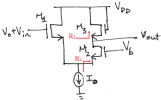 For the MOSFET circuit,
.
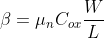
Given
for M1 and M2, and
for M3.
(A/V2) for all transistors.
a) Find the transconductance of all 3 transistors (in terms of
Io) and the small-signal voltage gain of the circuit.
Assume all transistors are in saturation.
b) Find R1 (looking into the source of M1)
and R2 (looking into the source of M2).
8nCor 166 L 1 L 4n Cor = 1 Vpp R1 R2
8nCor
166 L
1 L
4n Cor =...
For the MOSFET circuit,
.
Given
for M1 and M2, and
for M3.
(A/V2) for all transistors.
a) Find the transconductance of all 3 transistors (in terms of
Io) and the small-signal voltage gain of the circuit.
Assume all transistors are in saturation.
b) Find R1 (looking into the source of M1)
and R2 (looking into the source of M2).
8nCor 166 L 1 L 4n Cor = 1 Vpp R1 R2
8nCor
166 L
1 L
4n Cor =...
3. In the circuit shown below, the differential pair (Mand M2) is biased with a current miror that consists of M3, M and Rref. The circuit parameters are: VDD-3 V, Rre/-15 ka, RD = 20 ka, and RL-40 k...
 3. In the circuit shown below, the differential pair (Mand M2) is biased with a current miror that consists of M3, M and Rref. The circuit parameters are: VDD-3 V, Rre/-15 ka, RD = 20 ka, and RL-40 kn. The transistors 25 M, and M, are identicalwith()M and M, are identical with (The oh M and M4 are identical with = ·The other transistor parameters are: indox-: 0.1 m1A/V2,VTN-0.5 V, γ-0 (body effect coefficient) and λ 0 (channel length modulation...
For the MOSFET circuit, . Given for M1 and M2, and for M3. (A/V2) for all...
 For the MOSFET circuit,
.
Given
for M1 and M2, and
for M3.
(A/V2) for all transistors.
a) Find the transconductance of all 3 transistors (in terms of
Io) and the small-signal voltage gain of the circuit.
Assume all transistors are in saturation.
b) Find R1 (looking into the source of M1)
and R2 (looking into the source of M2).
8nCor 166 L 1 L 4n Cor = 1 Vpp R1 R2
For the MOSFET circuit,
.
Given
for M1 and M2, and
for M3.
(A/V2) for all transistors.
a) Find the transconductance of all 3 transistors (in terms of
Io) and the small-signal voltage gain of the circuit.
Assume all transistors are in saturation.
b) Find R1 (looking into the source of M1)
and R2 (looking into the source of M2).
8nCor 166 L 1 L 4n Cor = 1 Vpp R1 R2
3. Consider the circuit in the Problem #2 again. Assume all transistors are in saturation and...
 3. Consider the circuit in the Problem #2 again. Assume all transistors are in saturation and Vdd is sufficiently high to keep all transistors in saturation. Assume k, '=100 JAV, k,'= 50 A/V", Vsar = 300mV, n = 0.04, and the DC bias current I1 = 50uA. Also assume all the transistors have the same W/L = 10) except for M3, M6, M7, and M16. M3 is twice as wide, whereas M16 is a quarter (0.25) as wide as the...
4) Consider the MOSFET differential amplifier shown below, with Io-2 mA, and RL- 10 kS2, Rss-100 ...
 4) Consider the MOSFET differential amplifier shown below, with Io-2 mA, and RL- 10 kS2, Rss-100 k2, VDD- +8V and Vss--8V. The NMOS transistors in the circuit are nominally identical, with kn 2 mA/V2, VTn 1.0 V and ro 100 k2. The PMoS transistors in the circuit are nominally identical, with kp 2 mA/V2, [VTpl 1.0 V and ro 100 kΩ M3 M4 0 M1 M2 a) First consider the DC bias point. Assuming that the current mirror requires at...
Problem 1 -Integrated Common Source Amplifier: For the circuit in Fig.1, draw the small signal equivalent...
 Problem 1 -Integrated Common Source Amplifier: For the circuit in Fig.1, draw the small signal equivalent circuit and find the following small signal values: gm1 go1 go2 Vout/Vin Rout You can assume that the overdrive voltage for all transistors is 0.2V and A for the NMOS and PMOS are 0.1V1 and 0.05V1 respectively. The drain source current of the transistors M1 and M2 is 20HA. All gate lengths of homework 3.) 0.5um. (The DC analysis for this circuit was done...
Look at the circuit below and try not to freak out!). Assume all transistors are in...
 Look at the circuit below and try not to freak out!). Assume all transistors are in the active mode. You must now decide whether to include or neglect the Early effect (r.) in your model for each transistor - use the rules we established in class (don't just neglect it every time!). & Voc ¢ Voc a VoR Toetan SRE Rino R Fig 2 a) [3 points] Draw a small-signal model for this circuit (this may take a full page...
For the circuit in Figure 3, determine: a) I0 (in resistance) and b) Vo. (Assume that...
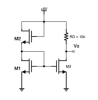 For the circuit in Figure 3, determine: a) I0 (in resistance)
and b) Vo. (Assume that all three transistors are identical with Kn
= 20mA / V2 and VTN = 2V).
+6V ş M2 RD = 10K Vo M1 M3
For the circuit in Figure 3, determine: a) I0 (in resistance)
and b) Vo. (Assume that all three transistors are identical with Kn
= 20mA / V2 and VTN = 2V).
+6V ş M2 RD = 10K Vo M1 M3
Problem 6: For the circuit below, assume V+=10V, V-=0V, IF9mA, all transistors have Kn=Kp = 0.5...
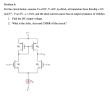 Problem 6: For the circuit below, assume V+=10V, V-=0V, IF9mA, all transistors have Kn=Kp = 0.5 mAv2,VTHV.,1 0.01, and the ideal current source has an output resistance of 1Mohm. 1. Find the DC output voltage. 2. What is the Adm, Acm and CMRR of the circuit? M3 M2 2
 PROBLEM 4 (20 pts) IMPORTANT: Assume all transistors are in saturation. a) Find the small-signal DC gain of the amplifier circuit when the small-signal voltage ViN is applied to the gate of M1. Ignore the body effect for M1 and M2. b) Find the small-signal DC gain of the amplifier circuit when the small-signal voltage Vin is applied to the body of M1. In this case, a DC bias voltage (VB) is applied to the gate of M1. Ignore the...
 For the MOSFET circuit,
.
Given
for M1 and M2, and
for M3.
(A/V2) for all transistors.
a) Find the transconductance of all 3 transistors (in terms of
Io) and the small-signal voltage gain of the circuit.
Assume all transistors are in saturation.
b) Find R1 (looking into the source of M1)
and R2 (looking into the source of M2).
8nCor 166 L 1 L 4n Cor = 1 Vpp R1 R2
8nCor
166 L
1 L
4n Cor =...
For the MOSFET circuit,
.
Given
for M1 and M2, and
for M3.
(A/V2) for all transistors.
a) Find the transconductance of all 3 transistors (in terms of
Io) and the small-signal voltage gain of the circuit.
Assume all transistors are in saturation.
b) Find R1 (looking into the source of M1)
and R2 (looking into the source of M2).
8nCor 166 L 1 L 4n Cor = 1 Vpp R1 R2
8nCor
166 L
1 L
4n Cor =...
 3. In the circuit shown below, the differential pair (Mand M2) is biased with a current miror that consists of M3, M and Rref. The circuit parameters are: VDD-3 V, Rre/-15 ka, RD = 20 ka, and RL-40 kn. The transistors 25 M, and M, are identicalwith()M and M, are identical with (The oh M and M4 are identical with = ·The other transistor parameters are: indox-: 0.1 m1A/V2,VTN-0.5 V, γ-0 (body effect coefficient) and λ 0 (channel length modulation...
 For the MOSFET circuit,
.
Given
for M1 and M2, and
for M3.
(A/V2) for all transistors.
a) Find the transconductance of all 3 transistors (in terms of
Io) and the small-signal voltage gain of the circuit.
Assume all transistors are in saturation.
b) Find R1 (looking into the source of M1)
and R2 (looking into the source of M2).
8nCor 166 L 1 L 4n Cor = 1 Vpp R1 R2
For the MOSFET circuit,
.
Given
for M1 and M2, and
for M3.
(A/V2) for all transistors.
a) Find the transconductance of all 3 transistors (in terms of
Io) and the small-signal voltage gain of the circuit.
Assume all transistors are in saturation.
b) Find R1 (looking into the source of M1)
and R2 (looking into the source of M2).
8nCor 166 L 1 L 4n Cor = 1 Vpp R1 R2
 3. Consider the circuit in the Problem #2 again. Assume all transistors are in saturation and Vdd is sufficiently high to keep all transistors in saturation. Assume k, '=100 JAV, k,'= 50 A/V", Vsar = 300mV, n = 0.04, and the DC bias current I1 = 50uA. Also assume all the transistors have the same W/L = 10) except for M3, M6, M7, and M16. M3 is twice as wide, whereas M16 is a quarter (0.25) as wide as the...
 4) Consider the MOSFET differential amplifier shown below, with Io-2 mA, and RL- 10 kS2, Rss-100 k2, VDD- +8V and Vss--8V. The NMOS transistors in the circuit are nominally identical, with kn 2 mA/V2, VTn 1.0 V and ro 100 k2. The PMoS transistors in the circuit are nominally identical, with kp 2 mA/V2, [VTpl 1.0 V and ro 100 kΩ M3 M4 0 M1 M2 a) First consider the DC bias point. Assuming that the current mirror requires at...
 Problem 1 -Integrated Common Source Amplifier: For the circuit in Fig.1, draw the small signal equivalent circuit and find the following small signal values: gm1 go1 go2 Vout/Vin Rout You can assume that the overdrive voltage for all transistors is 0.2V and A for the NMOS and PMOS are 0.1V1 and 0.05V1 respectively. The drain source current of the transistors M1 and M2 is 20HA. All gate lengths of homework 3.) 0.5um. (The DC analysis for this circuit was done...
 Look at the circuit below and try not to freak out!). Assume all transistors are in the active mode. You must now decide whether to include or neglect the Early effect (r.) in your model for each transistor - use the rules we established in class (don't just neglect it every time!). & Voc ¢ Voc a VoR Toetan SRE Rino R Fig 2 a) [3 points] Draw a small-signal model for this circuit (this may take a full page...
 For the circuit in Figure 3, determine: a) I0 (in resistance)
and b) Vo. (Assume that all three transistors are identical with Kn
= 20mA / V2 and VTN = 2V).
+6V ş M2 RD = 10K Vo M1 M3
For the circuit in Figure 3, determine: a) I0 (in resistance)
and b) Vo. (Assume that all three transistors are identical with Kn
= 20mA / V2 and VTN = 2V).
+6V ş M2 RD = 10K Vo M1 M3
 Problem 6: For the circuit below, assume V+=10V, V-=0V, IF9mA, all transistors have Kn=Kp = 0.5 mAv2,VTHV.,1 0.01, and the ideal current source has an output resistance of 1Mohm. 1. Find the DC output voltage. 2. What is the Adm, Acm and CMRR of the circuit? M3 M2 2
Most questions answered within 3 hours.
-
Where is the error in this code sequence?
String s1 = "Hello";
String s2 = "ello";...
asked 10 months ago -
Financial data for Joel de Paris, Inc., for last year
follow:
Joel de Paris, Inc.
Balance...
asked 10 months ago -
Consider this reaction:
Al2(SO4)3 (aq)+ BaCl3
(aq) Al2Cl6 (aq)- +
3BaSO4(s) . What is the...
asked 10 months ago -
Suppose that Savneet is considering increasing her
recent random sample from 20 car rentals to 40...
asked 10 months ago -
Trucks arrive at an unloading terminal at an average rate of 120
per hour.
Trucks arrive...
asked 10 months ago -
Why are methanol and ethanol completely soluble in water while
octanol is not very little soluble....
asked 10 months ago -
A facilities manager at a university reads in a research report
that the mean amount of...
asked 10 months ago -
When the CuSO4 is rehydrated by adding water to the anhydrous
compound, is this an endothermic...
asked 10 months ago -
A ray of sunlight is passing from diamond into crown glass; the
angle of incidence is...
asked 10 months ago -
A block of mass 0.249 kg is placed on top of a light, vertical
spring of...
asked 10 months ago -
how do the kidneys compensate in the presences of acidosis
a) trigger hyperventilate
b) reserve acid...
asked 10 months ago -
Question 501 pts
The rental rate of capital to the firm increases. Which of the
following...
asked 10 months ago