
Homework Answers
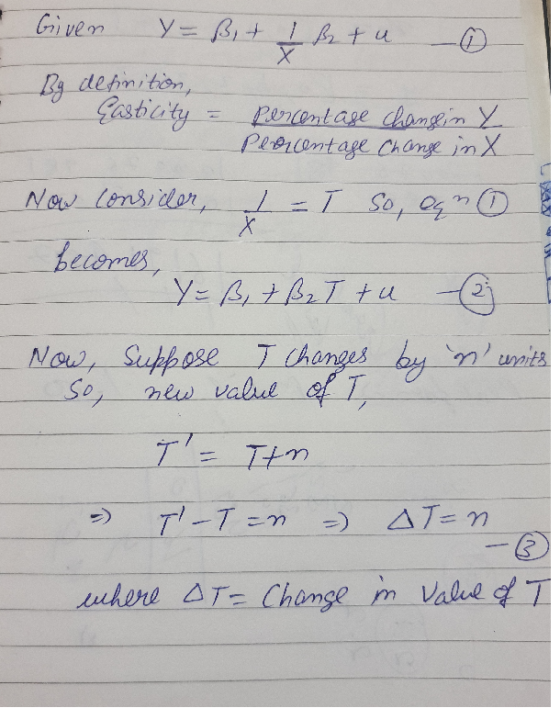
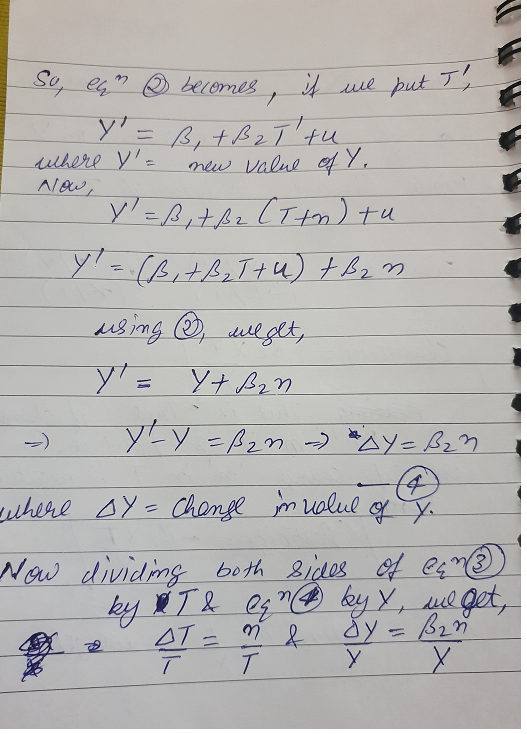
We need to prove
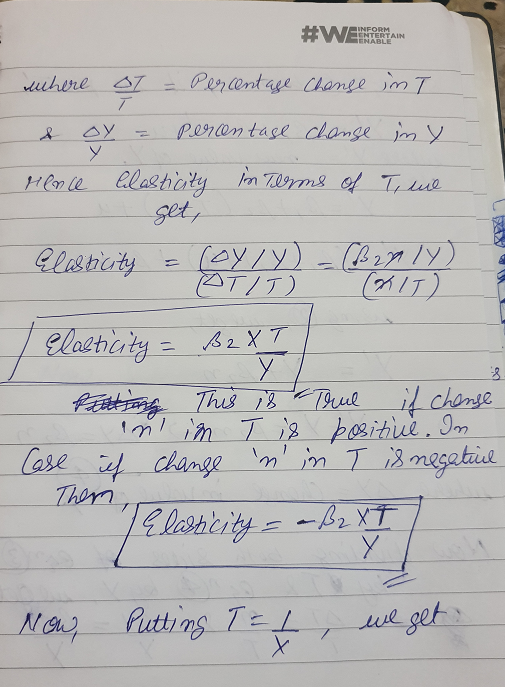
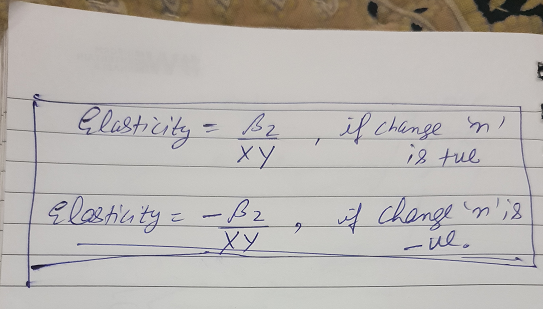
Elasticity of Y w.r.t X = -  2 * (1 / XY)
The negative sign shows that change in X is negative i.e
 = X - n
where n is magnitude of change in X
I have solved for positive change by hand and shown the results for neagtive change as well.
Please find the pics below
-1, the Marshallian elasticity of Y with respect to Px must be equal to O at that optimum. 3. (5 ...
 -1, the Marshallian elasticity of Y with respect to Px must be equal to O at that optimum. 3. (5 pts.) Consider a consumer whose cost function is given by C(Px.P, U)(Px Py)JU2 T/F: "X is a normal good for this consumer."
-1, the Marshallian elasticity of Y with respect to Px must be equal to O at that optimum. 3. (5 pts.) Consider a consumer whose cost function is given by C(Px.P, U)(Px Py)JU2 T/F: "X is a normal...
-1, the Marshallian elasticity of Y with respect to Px must be equal to O at that optimum. 3. (5 pts.) Consider a consumer whose cost function is given by C(Px.P, U)(Px Py)JU2 T/F: "X is a normal good for this consumer."
-1, the Marshallian elasticity of Y with respect to Px must be equal to O at that optimum. 3. (5 pts.) Consider a consumer whose cost function is given by C(Px.P, U)(Px Py)JU2 T/F: "X is a normal...
Prove that x^2+xy+y^2≥0 for all real numbers, x and y. Find the values that result in...
Prove that x^2+xy+y^2≥0 for all real numbers, x and y. Find the values that result in equality.
For what value of x is the elasticity of function y = x^2 -3 equal to...
For what value of x is the elasticity of function y = x^2 -3 equal to 3? Consider only x > 0
Q1/ Use algebraic manipulation to prove that (xy)(x y) x
 Q1/ Use algebraic manipulation to prove that (xy)(x y) x
What is the instantaneous rate of change of z = f(x,y)=x² + xy(with respect to horizontal...
 What is the instantaneous rate of change of z = f(x,y)=x² + xy(with respect to horizontal distance) at the point (2,1) if one is heading directly toward (4,-2)? -8 -3 4 12 b) c) d) e) none of these 113 113 V13 113 a) o What is the average rate of change of z = f(x, y) = x² + xy(with respect to horizontal distance) as one travels from (2,1) to (4,-2)? 2 5 12 c) d) e) none of...
Prove or Disprove the following Let x,y. If x + xy + 1 is even then...
 Prove or Disprove the following
Let x,y. If x + xy
+ 1 is even then x is odd
Prove or Disprove the following
Let x,y. If x + xy
+ 1 is even then x is odd
Assume X and Y are lognormally distributed, prove that XY is lognormally distributed.
Assume X and Y are lognormally distributed, prove that XY is lognormally distributed.
variable X and Y is independent. How to prove that E(XY)=E(X)E(Y) use intgration. There is some...
variable X and Y is independent. How to prove that E(XY)=E(X)E(Y) use intgration. There is some kind double integration and I dont understand it.
Problem 2 Suppose two continuous random variables (X, Y) ~ f(x,y). (1) Prove E(X +Y) =...
 Problem 2 Suppose two continuous random variables (X, Y) ~ f(x,y). (1) Prove E(X +Y) = E(X)+ E(Y). (2) Prove Var(X + Y) = Var(X) + Var(Y)2Cov(X, Y). (3) Prove Cov(X, Y) E(XY)- E(X)E(Y). (4) Prove that if X and Y are independent, i.e., f(x, y) Cov(X, Y) 0. Is the reverse true? (5) Prove Cov (aX b,cY + d) = acCov(X, Y). (6) Prove Cov(X, X) = Var(X) fx (x)fy(y) for any (x,y), then =
Let X, Y E Mn (R). Prove that XY = XY_if and only if there exists...
 Let X, Y E Mn (R). Prove that XY = XY_if and only if there exists an invertible matrix Z so that X = Z In and Y = Z1 + In. Hint: the trace is not involve at all in this problem _
 -1, the Marshallian elasticity of Y with respect to Px must be equal to O at that optimum. 3. (5 pts.) Consider a consumer whose cost function is given by C(Px.P, U)(Px Py)JU2 T/F: "X is a normal good for this consumer."
-1, the Marshallian elasticity of Y with respect to Px must be equal to O at that optimum. 3. (5 pts.) Consider a consumer whose cost function is given by C(Px.P, U)(Px Py)JU2 T/F: "X is a normal...
-1, the Marshallian elasticity of Y with respect to Px must be equal to O at that optimum. 3. (5 pts.) Consider a consumer whose cost function is given by C(Px.P, U)(Px Py)JU2 T/F: "X is a normal good for this consumer."
-1, the Marshallian elasticity of Y with respect to Px must be equal to O at that optimum. 3. (5 pts.) Consider a consumer whose cost function is given by C(Px.P, U)(Px Py)JU2 T/F: "X is a normal...
 Q1/ Use algebraic manipulation to prove that (xy)(x y) x
 What is the instantaneous rate of change of z = f(x,y)=x² + xy(with respect to horizontal distance) at the point (2,1) if one is heading directly toward (4,-2)? -8 -3 4 12 b) c) d) e) none of these 113 113 V13 113 a) o What is the average rate of change of z = f(x, y) = x² + xy(with respect to horizontal distance) as one travels from (2,1) to (4,-2)? 2 5 12 c) d) e) none of...
 Prove or Disprove the following
Let x,y. If x + xy
+ 1 is even then x is odd
Prove or Disprove the following
Let x,y. If x + xy
+ 1 is even then x is odd
 Problem 2 Suppose two continuous random variables (X, Y) ~ f(x,y). (1) Prove E(X +Y) = E(X)+ E(Y). (2) Prove Var(X + Y) = Var(X) + Var(Y)2Cov(X, Y). (3) Prove Cov(X, Y) E(XY)- E(X)E(Y). (4) Prove that if X and Y are independent, i.e., f(x, y) Cov(X, Y) 0. Is the reverse true? (5) Prove Cov (aX b,cY + d) = acCov(X, Y). (6) Prove Cov(X, X) = Var(X) fx (x)fy(y) for any (x,y), then =
 Let X, Y E Mn (R). Prove that XY = XY_if and only if there exists an invertible matrix Z so that X = Z In and Y = Z1 + In. Hint: the trace is not involve at all in this problem _
Most questions answered within 3 hours.
-
Where is the error in this code sequence?
String s1 = "Hello";
String s2 = "ello";...
asked 11 months ago -
Financial data for Joel de Paris, Inc., for last year
follow:
Joel de Paris, Inc.
Balance...
asked 11 months ago -
Consider this reaction:
Al2(SO4)3 (aq)+ BaCl3
(aq) Al2Cl6 (aq)- +
3BaSO4(s) . What is the...
asked 11 months ago -
Suppose that Savneet is considering increasing her
recent random sample from 20 car rentals to 40...
asked 11 months ago -
Trucks arrive at an unloading terminal at an average rate of 120
per hour.
Trucks arrive...
asked 11 months ago -
Why are methanol and ethanol completely soluble in water while
octanol is not very little soluble....
asked 11 months ago -
A facilities manager at a university reads in a research report
that the mean amount of...
asked 11 months ago -
When the CuSO4 is rehydrated by adding water to the anhydrous
compound, is this an endothermic...
asked 11 months ago -
A ray of sunlight is passing from diamond into crown glass; the
angle of incidence is...
asked 11 months ago -
A block of mass 0.249 kg is placed on top of a light, vertical
spring of...
asked 11 months ago -
how do the kidneys compensate in the presences of acidosis
a) trigger hyperventilate
b) reserve acid...
asked 11 months ago -
Question 501 pts
The rental rate of capital to the firm increases. Which of the
following...
asked 11 months ago