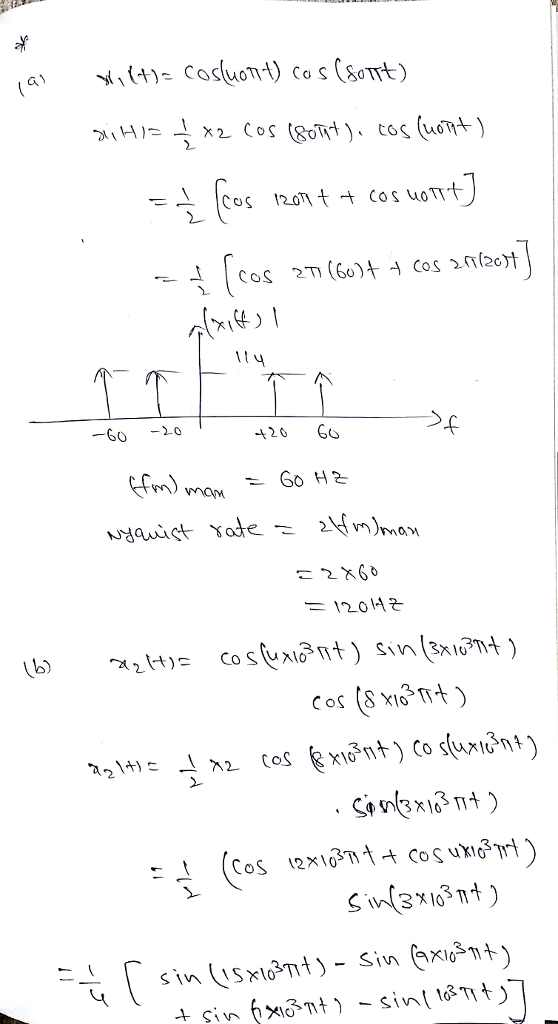
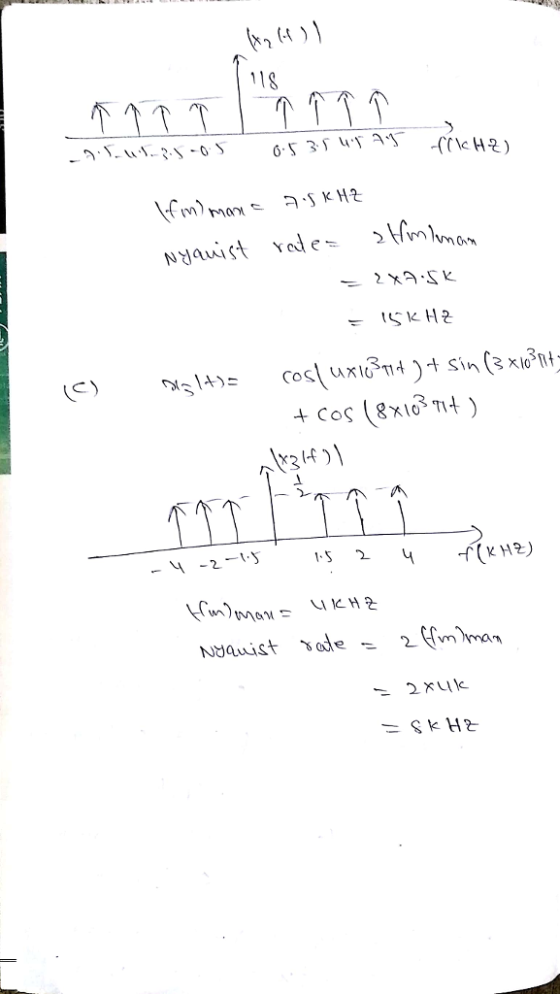
![[15 total pts] Graphical visualization of a signals spectrum can help determine the Nyquist rate for sampling. Consider a signal x,(t) = cos(40t) cos(80t). Sketch the 2-sided complex spectrum and [5 pts] determine the minimum sampling rate that can be used to sample the signal without causing aliasing. [5 pts] Repeat Part a for the signal x2 t) cos(4 x 10³t) sin(3 x 10³Tt) cos(8 x 10Tt). [5 pts] Repeat Part a for the signal x3(t) cos(4 x 10³Trt) sin(3 x 10³Tt) cos(8 x 10³Tmt). a. b. c. COS](http://img.homeworklib.com/questions/60419e80-0229-11ec-820c-8f5cf5ec0e92.png?x-oss-process=image/resize,w_560)
Homework Answers
Add Answer to:
[15 total pts] Graphical visualization of a signal's spectrum can help determine the Nyquist rate for...
Problem 4.(30 pts) Given the analog signal x(t) cos(2 cos(3t)+2 sin(4mt) A.(10 pts) Find the Nyquist...
 Problem 4.(30 pts) Given the analog signal x(t) cos(2 cos(3t)+2 sin(4mt) A.(10 pts) Find the Nyquist frequency (sampling frequency) which guarantees That x() can be recovered from it's sampled version xIn] with no aliasing. B.(10 pts) If the sampling period of Ts 0.4 see is used identify all discrete frequencies Of the signal x(t), also indicate if this sampling period is adequate to recover x(t) from xn] C.(10 pts) Suppose signal x(t) is modulated by signal e(t) = cos(2000mt) what...
4. Find the Nyquist rate for the following signals. For each case sketch the magnitude spectrum...
 4. Find the Nyquist rate for the following signals. For each case sketch the magnitude spectrum of the sampled signal if the sampling rate is 25% higher than the Nyquist rate. a.) ft)sinc E 2T 10 b.) h)=sinc 2T For all the following, use ft) given in part a.) c.) glt)= f(l-7) d.) c(t)- f)cos() 1 e.) x(t)= fit)+ _ sinc (t
4. Find the Nyquist rate for the following signals. For each case sketch the magnitude spectrum of the...
4. Find the Nyquist rate for the following signals. For each case sketch the magnitude spectrum of the sampled signal if the sampling rate is 25% higher than the Nyquist rate. a.) ft)sinc E 2T 10 b.) h)=sinc 2T For all the following, use ft) given in part a.) c.) glt)= f(l-7) d.) c(t)- f)cos() 1 e.) x(t)= fit)+ _ sinc (t
4. Find the Nyquist rate for the following signals. For each case sketch the magnitude spectrum of the...
1. (15) By the Sampling Theorem the Nyquist sampling rate must be twice the highest bandwidth...
 1. (15) By the Sampling Theorem the Nyquist sampling rate must be twice the highest bandwidth of the message signal. For the three message signals below determine the Nyquist rate and the Nyquist interval for each. a) m(t) = 0.5 cos(150 ) + sin(300Ft) + 0.75 cos(350ft) b) m(t) = 2 cos(120rt) sin(3007) c) m(t) = sinc(4000) = sin(400m) Recall: the Fourier transform of a sinc waveform is a rectangular pulse
please show steps, focus on part b more 1. (23 points) Sampling and Aliasing. (a) Find...
 please show steps, focus on part b more
1. (23 points) Sampling and Aliasing. (a) Find the Nyquist sampling rate wn for the given x(t). (Recall that the sampling frequency has to be twice larger than the bandwidth of the signal to recover the signal without loss of information.) i. (5 pts) X(t) = sinc(5000) * cos(7t). ii. (5 pts) r(t) = sin(101) cos(106) iii. (5 pts) (t) = sinc(50000) + cos(56) (b) (8 pts) Let r(t) = sinc(t/h), y(t)...
please show steps, focus on part b more
1. (23 points) Sampling and Aliasing. (a) Find the Nyquist sampling rate wn for the given x(t). (Recall that the sampling frequency has to be twice larger than the bandwidth of the signal to recover the signal without loss of information.) i. (5 pts) X(t) = sinc(5000) * cos(7t). ii. (5 pts) r(t) = sin(101) cos(106) iii. (5 pts) (t) = sinc(50000) + cos(56) (b) (8 pts) Let r(t) = sinc(t/h), y(t)...
10. Find the Fourier transform of a continuous-time signal x(t) = 10e Su(t). Plot the magnitude...
 10. Find the Fourier transform of a continuous-time signal x(t) = 10e Su(t). Plot the magnitude spectrum and the phase spectrum. If the signal is going to be sampled, what should be the minimum sampling frequency so that the aliasing error is less than 0.1 % of the maximum original magnitude at half the sampling frequency. 11. A signal x(t) = 5cos(2nt + 1/6) is sampled at every 0.2 seconds. Find the sequence obtained over the interval 0 st 3...
Signal xo(t) 5 cos (200π1+ 품 ) + 4 sin (300π) is sampled at a rate of Fs = 1 kHz to obtain the discrete-time signal x[n]. (a) Determine the spectrum X(ej ) of x[n] and plot its magnitude as a functi...
 Signal xo(t) 5 cos (200π1+ 품 ) + 4 sin (300π) is sampled at a rate of Fs = 1 kHz to obtain the discrete-time signal x[n]. (a) Determine the spectrum X(ej ) of x[n] and plot its magnitude as a function of ω rad sam in tad and as a function of F in Hz. Explain whether the original signal xe(t) can be recovered from xln]. (b) Repeat part (a) for 500 Hz. (c) Repeat part (a) for 100...
QUESTION 4 a. Determine the frequency spectrum of the signal x(t) b. What is the Nyquist...
 QUESTION 4 a. Determine the frequency spectrum of the signal x(t) b. What is the Nyquist rate for this signal? cos(t) + 5sn3t. me-invariant system defined by, dt dt what will the system output y(t) be? QUESTION 5 The system function of a casual LTI system is given as, 2s a. Find the impulse response of the system. b. Find the step response of the system. A causal discrete-time LTI system is described by, y[n] - (3/4) yin-1+(1/8) yin-21 xn]...
PROBLEM 2 150 pts.] A signal is consist of three sine functions: the first one, ,...
 PROBLEM 2 150 pts.] A signal is consist of three sine functions: the first one, , has a wave frequency of 50 Hz, the second one, 2, has 100 Hz, and the last one, r3, has 200 Hz. However, each function has different amplitude: the amplitude of the first signal component x! is 10 cm, the amplitude of the second signal component xi s 5 cm; and the amplitude of the last signal component t3 is 1 cm. As a...
) + 4 sin(300m), w a) (2 points) Given the signal x(t) = 5 cos(200 period,...
 ) + 4 sin(300m), w a) (2 points) Given the signal x(t) = 5 cos(200 period, T, is needed to avoid aliasing? 3. b) (8 points) If you sample x() with sampling period T/2 where T is your answer to part a), what is the resulting discrete signal, x[n]?
onsider the sampling and reconstruction system shown in the figure. x(t) IdealIdeal) D-to-C Converter Converter Assume...
 onsider the sampling and reconstruction system shown in the figure. x(t) IdealIdeal) D-to-C Converter Converter Assume that the sampling rates of the C-to-D and D-to-C converters are equal, and the input to the Ideal C-to-D converter is x(t) = 2 cos (2m(50)t +π) + cos(2π(150e) a. (5) If the output of the Ideal D-to-C converter is equal to the input x(t) i.e. ()2 cos (2m(50)t +7)+cos(2(150)) b. (5) If the sampling rate is fs = 250 samples/sec, determine the discrete-time...
 Problem 4.(30 pts) Given the analog signal x(t) cos(2 cos(3t)+2 sin(4mt) A.(10 pts) Find the Nyquist frequency (sampling frequency) which guarantees That x() can be recovered from it's sampled version xIn] with no aliasing. B.(10 pts) If the sampling period of Ts 0.4 see is used identify all discrete frequencies Of the signal x(t), also indicate if this sampling period is adequate to recover x(t) from xn] C.(10 pts) Suppose signal x(t) is modulated by signal e(t) = cos(2000mt) what...
 4. Find the Nyquist rate for the following signals. For each case sketch the magnitude spectrum of the sampled signal if the sampling rate is 25% higher than the Nyquist rate. a.) ft)sinc E 2T 10 b.) h)=sinc 2T For all the following, use ft) given in part a.) c.) glt)= f(l-7) d.) c(t)- f)cos() 1 e.) x(t)= fit)+ _ sinc (t
4. Find the Nyquist rate for the following signals. For each case sketch the magnitude spectrum of the...
4. Find the Nyquist rate for the following signals. For each case sketch the magnitude spectrum of the sampled signal if the sampling rate is 25% higher than the Nyquist rate. a.) ft)sinc E 2T 10 b.) h)=sinc 2T For all the following, use ft) given in part a.) c.) glt)= f(l-7) d.) c(t)- f)cos() 1 e.) x(t)= fit)+ _ sinc (t
4. Find the Nyquist rate for the following signals. For each case sketch the magnitude spectrum of the...
 1. (15) By the Sampling Theorem the Nyquist sampling rate must be twice the highest bandwidth of the message signal. For the three message signals below determine the Nyquist rate and the Nyquist interval for each. a) m(t) = 0.5 cos(150 ) + sin(300Ft) + 0.75 cos(350ft) b) m(t) = 2 cos(120rt) sin(3007) c) m(t) = sinc(4000) = sin(400m) Recall: the Fourier transform of a sinc waveform is a rectangular pulse
 please show steps, focus on part b more
1. (23 points) Sampling and Aliasing. (a) Find the Nyquist sampling rate wn for the given x(t). (Recall that the sampling frequency has to be twice larger than the bandwidth of the signal to recover the signal without loss of information.) i. (5 pts) X(t) = sinc(5000) * cos(7t). ii. (5 pts) r(t) = sin(101) cos(106) iii. (5 pts) (t) = sinc(50000) + cos(56) (b) (8 pts) Let r(t) = sinc(t/h), y(t)...
please show steps, focus on part b more
1. (23 points) Sampling and Aliasing. (a) Find the Nyquist sampling rate wn for the given x(t). (Recall that the sampling frequency has to be twice larger than the bandwidth of the signal to recover the signal without loss of information.) i. (5 pts) X(t) = sinc(5000) * cos(7t). ii. (5 pts) r(t) = sin(101) cos(106) iii. (5 pts) (t) = sinc(50000) + cos(56) (b) (8 pts) Let r(t) = sinc(t/h), y(t)...
 10. Find the Fourier transform of a continuous-time signal x(t) = 10e Su(t). Plot the magnitude spectrum and the phase spectrum. If the signal is going to be sampled, what should be the minimum sampling frequency so that the aliasing error is less than 0.1 % of the maximum original magnitude at half the sampling frequency. 11. A signal x(t) = 5cos(2nt + 1/6) is sampled at every 0.2 seconds. Find the sequence obtained over the interval 0 st 3...
 Signal xo(t) 5 cos (200π1+ 품 ) + 4 sin (300π) is sampled at a rate of Fs = 1 kHz to obtain the discrete-time signal x[n]. (a) Determine the spectrum X(ej ) of x[n] and plot its magnitude as a function of ω rad sam in tad and as a function of F in Hz. Explain whether the original signal xe(t) can be recovered from xln]. (b) Repeat part (a) for 500 Hz. (c) Repeat part (a) for 100...
 QUESTION 4 a. Determine the frequency spectrum of the signal x(t) b. What is the Nyquist rate for this signal? cos(t) + 5sn3t. me-invariant system defined by, dt dt what will the system output y(t) be? QUESTION 5 The system function of a casual LTI system is given as, 2s a. Find the impulse response of the system. b. Find the step response of the system. A causal discrete-time LTI system is described by, y[n] - (3/4) yin-1+(1/8) yin-21 xn]...
 PROBLEM 2 150 pts.] A signal is consist of three sine functions: the first one, , has a wave frequency of 50 Hz, the second one, 2, has 100 Hz, and the last one, r3, has 200 Hz. However, each function has different amplitude: the amplitude of the first signal component x! is 10 cm, the amplitude of the second signal component xi s 5 cm; and the amplitude of the last signal component t3 is 1 cm. As a...
 ) + 4 sin(300m), w a) (2 points) Given the signal x(t) = 5 cos(200 period, T, is needed to avoid aliasing? 3. b) (8 points) If you sample x() with sampling period T/2 where T is your answer to part a), what is the resulting discrete signal, x[n]?
 onsider the sampling and reconstruction system shown in the figure. x(t) IdealIdeal) D-to-C Converter Converter Assume that the sampling rates of the C-to-D and D-to-C converters are equal, and the input to the Ideal C-to-D converter is x(t) = 2 cos (2m(50)t +π) + cos(2π(150e) a. (5) If the output of the Ideal D-to-C converter is equal to the input x(t) i.e. ()2 cos (2m(50)t +7)+cos(2(150)) b. (5) If the sampling rate is fs = 250 samples/sec, determine the discrete-time...
Most questions answered within 3 hours.
-
Where is the error in this code sequence?
String s1 = "Hello";
String s2 = "ello";...
asked 10 months ago -
Financial data for Joel de Paris, Inc., for last year
follow:
Joel de Paris, Inc.
Balance...
asked 10 months ago -
Consider this reaction:
Al2(SO4)3 (aq)+ BaCl3
(aq) Al2Cl6 (aq)- +
3BaSO4(s) . What is the...
asked 10 months ago -
Suppose that Savneet is considering increasing her
recent random sample from 20 car rentals to 40...
asked 10 months ago -
Trucks arrive at an unloading terminal at an average rate of 120
per hour.
Trucks arrive...
asked 10 months ago -
Why are methanol and ethanol completely soluble in water while
octanol is not very little soluble....
asked 10 months ago -
A facilities manager at a university reads in a research report
that the mean amount of...
asked 10 months ago -
When the CuSO4 is rehydrated by adding water to the anhydrous
compound, is this an endothermic...
asked 10 months ago -
A ray of sunlight is passing from diamond into crown glass; the
angle of incidence is...
asked 10 months ago -
A block of mass 0.249 kg is placed on top of a light, vertical
spring of...
asked 10 months ago -
how do the kidneys compensate in the presences of acidosis
a) trigger hyperventilate
b) reserve acid...
asked 10 months ago -
Question 501 pts
The rental rate of capital to the firm increases. Which of the
following...
asked 10 months ago