
Homework Answers
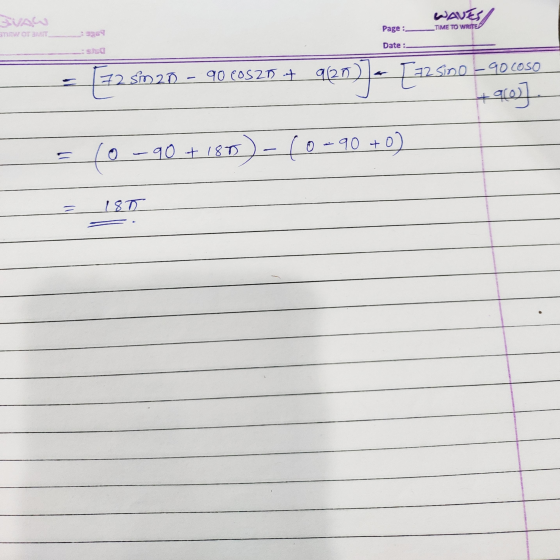
The flux of the curl of the field F is 18π.
The solution is in the images uploaded below.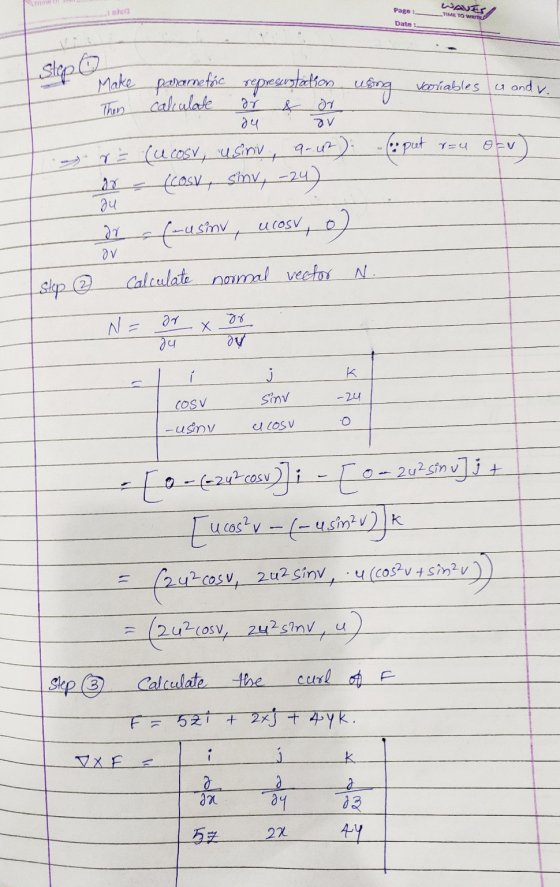
![Date : - OXF = ( ( 2 (47) – 2 (2n) aj (84) - 2 (62) - +*242) (153) =i[u-o] -j [0-5]+ k [20] - = (4, 5,2). step @ calculate (V](http://img.homeworklib.com/questions/a4adcca0-03a5-11ec-94be-6b49e070baa6.png?x-oss-process=image/resize,w_560)
Add Answer to:
Use the surface integral in Stokes' Theorem to calculate the flux of the curl of the...
Use the surface integral in Stokes' Theorem to calculate the flux of the curl of the...
 Use the surface integral in Stokes' Theorem to calculate the flux of the curl of the field F = x2 yi + 2y3zj + 5zk across the surface S: r(1,0) =r cos ei +r sin 0j +rk, Osrs3,0 s0s 2n in the direction with a positive k-component for n. The flux of the curl of the field F is (Type an exact answer, using a as needed.)
Use the surface integral in Stokes' Theorem to calculate the flux of the curl of the...
 Use the surface integral in Stokes' Theorem to calculate the flux of the curl of the field F across the surface in the direction away from the origin. F-3y + (5 - 5x)j + (z? - 2K S: 7,0) = (v10 sin 6 cos 0) (V10 sin sine))+ ( 10 cos •)*, 05058/2,050 2x The flux of the curl of the field F across the surface S in the direction of the outward unit normal nis I (Type an exact...
Evaluate the line integral in Stokes Theorem to evaluate the surface integral J J(VxF)-n ds. Assu...
 Evaluate the line integral in Stokes Theorem to evaluate the surface integral J J(VxF)-n ds. Assume that n points in an upward direction F (xty,y z,z+x) S is the tilted disk enclosed by r()-(3 cost,4sint,7 cos t Rewrite the surface integral as a line integral. Use increasing limits of integration. dt (Type exact answers, using π as needed.) Find the value of the surface integral. JÍs×F).nds-ロ (Type an exact answer, using π as needed.)
Evaluate the line integral in Stokes...
Evaluate the line integral in Stokes Theorem to evaluate the surface integral J J(VxF)-n ds. Assume that n points in an upward direction F (xty,y z,z+x) S is the tilted disk enclosed by r()-(3 cost,4sint,7 cos t Rewrite the surface integral as a line integral. Use increasing limits of integration. dt (Type exact answers, using π as needed.) Find the value of the surface integral. JÍs×F).nds-ロ (Type an exact answer, using π as needed.)
Evaluate the line integral in Stokes...
Show all work and use correct notation for full credit. Stokes' Theorem: Let S be an...
 Show all work and use correct notation for full credit. Stokes' Theorem: Let S be an orientable, piecewise smooth surface, bounded by a simple closed piecewise smooth curve C with positive orientation. Let F be a vector field with component functions that have continuous partial derivatives on an open region in R3 that contains S. Then | | curl(F) . ds F-dr = where curl(F) = ▽ × F. (2 Credits) Let S be the cone given by {(z, y,...
Help Entering Answers (1 point) Verify that Stokes' Theorem is true for the vector field F -yi+ z...
 Verify that Stokes' Theorem is true for the vector field
Help Entering Answers (1 point) Verify that Stokes' Theorem is true for the vector field F -yi+ zj + xkand the surface S the hemisphere x2 + y2 + z2-25, y > 0oriented in the direction of the positive y- axis To verify Stokes' Theorem we will compute the expression on each side. First compute curl F dS curl F The surface S can be parametrized by S(s, t) -...
Verify that Stokes' Theorem is true for the vector field
Help Entering Answers (1 point) Verify that Stokes' Theorem is true for the vector field F -yi+ zj + xkand the surface S the hemisphere x2 + y2 + z2-25, y > 0oriented in the direction of the positive y- axis To verify Stokes' Theorem we will compute the expression on each side. First compute curl F dS curl F The surface S can be parametrized by S(s, t) -...
Verify that the line integral and the surface integral of Stokes Theorem are equal far the following vector field, surface S, and closed curve C. Assume that C has counterlockwise orientation and S h...
 Verify that the line integral and the surface integral of Stokes Theorem are equal far the following vector field, surface S, and closed curve C. Assume that C has counterlockwise orientation and S has a consistentorientation F = 〈y,-x, 11), s is the upper half of the sphere x2 + y2 +22-1 and C is the circle x2 + y2-1 in the xy-plane Construct the line integral of Stokes' Theorem using the parameterization r(t)= 〈cost, sint, O. for 0 sts2r...
Use Stokes' Theorem to evaluate sta curl F. ds. F(x, y, z) = xyzi + xyj...
 Use Stokes' Theorem to evaluate sta curl F. ds. F(x, y, z) = xyzi + xyj + x2yzk, S consists of the top and four sides (but not the bottom of the cube with vertices (+3, +3, +3), oriented outward. Need Help? Read It Watch It Talk to a Tutor Submit Answer 33. [-/2.5 Points] DETAILS SCALC8 16.8.018. MY NOTES ASK YOUR Evaluate le (y + 5 sin(x)) dx + (z2 + 3 cos(y)) dy + x3 dz where C...
Evaluate the line integral - dr by evaluating the surface integral in Stokes Theorem with an...
 Evaluate the line integral - dr by evaluating the surface integral in Stokes Theorem with an appropriate choice of metal Close counterdeckwite orientation when viewed from above С F-6²-82-x².7² -2²) C is the boundary of the square Ix 13. lys 13 in the plane 2 #0 Rewrite the given in integral as a | as a surface integral fro-SSO ds C 5 Evaluate the integral $r..-Type an exact answer
Problem 6 Using Stokes' Theorem, we equate F dr curl F dA. Find curl F- PreviousS...
 Problem 6 Using Stokes' Theorem, we equate F dr curl F dA. Find curl F- PreviousS us Problem ListNext Noting that the surface is given by (1 point) Calculate the circulation, Fdr7in z - 16-x2 - y2, find two ways, directly and using Stokes' Theorem. dA The vector field F = 6y1-6y and C is the boundary of S, the part of the surface dy dx With R giving the region in the xy-plane enclosed by the surface, this gives...
Use the Divergence Theorem to calculate the surface integral ∫∫SF·dS; that is, calculate the flux of F across S.
Use the Divergence Theorem to calculate the surface integral ∫∫SF·dS; that is, calculate the flux of F across S. F(x, y, 2) = eytan(z)i + y√(3 - x2)j + x sin(y) k, S is the surface of the solid that lies above the xy-plane and below the surface z = 2 -x4-y4 , -1 ≤ x ≤ 1, -1 ≤ y ≤ 1
 Use the surface integral in Stokes' Theorem to calculate the flux of the curl of the field F = x2 yi + 2y3zj + 5zk across the surface S: r(1,0) =r cos ei +r sin 0j +rk, Osrs3,0 s0s 2n in the direction with a positive k-component for n. The flux of the curl of the field F is (Type an exact answer, using a as needed.)
 Use the surface integral in Stokes' Theorem to calculate the flux of the curl of the field F across the surface in the direction away from the origin. F-3y + (5 - 5x)j + (z? - 2K S: 7,0) = (v10 sin 6 cos 0) (V10 sin sine))+ ( 10 cos •)*, 05058/2,050 2x The flux of the curl of the field F across the surface S in the direction of the outward unit normal nis I (Type an exact...
 Evaluate the line integral in Stokes Theorem to evaluate the surface integral J J(VxF)-n ds. Assume that n points in an upward direction F (xty,y z,z+x) S is the tilted disk enclosed by r()-(3 cost,4sint,7 cos t Rewrite the surface integral as a line integral. Use increasing limits of integration. dt (Type exact answers, using π as needed.) Find the value of the surface integral. JÍs×F).nds-ロ (Type an exact answer, using π as needed.)
Evaluate the line integral in Stokes...
Evaluate the line integral in Stokes Theorem to evaluate the surface integral J J(VxF)-n ds. Assume that n points in an upward direction F (xty,y z,z+x) S is the tilted disk enclosed by r()-(3 cost,4sint,7 cos t Rewrite the surface integral as a line integral. Use increasing limits of integration. dt (Type exact answers, using π as needed.) Find the value of the surface integral. JÍs×F).nds-ロ (Type an exact answer, using π as needed.)
Evaluate the line integral in Stokes...
 Show all work and use correct notation for full credit. Stokes' Theorem: Let S be an orientable, piecewise smooth surface, bounded by a simple closed piecewise smooth curve C with positive orientation. Let F be a vector field with component functions that have continuous partial derivatives on an open region in R3 that contains S. Then | | curl(F) . ds F-dr = where curl(F) = ▽ × F. (2 Credits) Let S be the cone given by {(z, y,...
 Verify that Stokes' Theorem is true for the vector field
Help Entering Answers (1 point) Verify that Stokes' Theorem is true for the vector field F -yi+ zj + xkand the surface S the hemisphere x2 + y2 + z2-25, y > 0oriented in the direction of the positive y- axis To verify Stokes' Theorem we will compute the expression on each side. First compute curl F dS curl F The surface S can be parametrized by S(s, t) -...
Verify that Stokes' Theorem is true for the vector field
Help Entering Answers (1 point) Verify that Stokes' Theorem is true for the vector field F -yi+ zj + xkand the surface S the hemisphere x2 + y2 + z2-25, y > 0oriented in the direction of the positive y- axis To verify Stokes' Theorem we will compute the expression on each side. First compute curl F dS curl F The surface S can be parametrized by S(s, t) -...
 Verify that the line integral and the surface integral of Stokes Theorem are equal far the following vector field, surface S, and closed curve C. Assume that C has counterlockwise orientation and S has a consistentorientation F = 〈y,-x, 11), s is the upper half of the sphere x2 + y2 +22-1 and C is the circle x2 + y2-1 in the xy-plane Construct the line integral of Stokes' Theorem using the parameterization r(t)= 〈cost, sint, O. for 0 sts2r...
 Use Stokes' Theorem to evaluate sta curl F. ds. F(x, y, z) = xyzi + xyj + x2yzk, S consists of the top and four sides (but not the bottom of the cube with vertices (+3, +3, +3), oriented outward. Need Help? Read It Watch It Talk to a Tutor Submit Answer 33. [-/2.5 Points] DETAILS SCALC8 16.8.018. MY NOTES ASK YOUR Evaluate le (y + 5 sin(x)) dx + (z2 + 3 cos(y)) dy + x3 dz where C...
 Evaluate the line integral - dr by evaluating the surface integral in Stokes Theorem with an appropriate choice of metal Close counterdeckwite orientation when viewed from above С F-6²-82-x².7² -2²) C is the boundary of the square Ix 13. lys 13 in the plane 2 #0 Rewrite the given in integral as a | as a surface integral fro-SSO ds C 5 Evaluate the integral $r..-Type an exact answer
 Problem 6 Using Stokes' Theorem, we equate F dr curl F dA. Find curl F- PreviousS us Problem ListNext Noting that the surface is given by (1 point) Calculate the circulation, Fdr7in z - 16-x2 - y2, find two ways, directly and using Stokes' Theorem. dA The vector field F = 6y1-6y and C is the boundary of S, the part of the surface dy dx With R giving the region in the xy-plane enclosed by the surface, this gives...
Most questions answered within 3 hours.
-
Where is the error in this code sequence?
String s1 = "Hello";
String s2 = "ello";...
asked 10 months ago -
Financial data for Joel de Paris, Inc., for last year
follow:
Joel de Paris, Inc.
Balance...
asked 10 months ago -
Consider this reaction:
Al2(SO4)3 (aq)+ BaCl3
(aq) Al2Cl6 (aq)- +
3BaSO4(s) . What is the...
asked 10 months ago -
Suppose that Savneet is considering increasing her
recent random sample from 20 car rentals to 40...
asked 10 months ago -
Trucks arrive at an unloading terminal at an average rate of 120
per hour.
Trucks arrive...
asked 10 months ago -
Why are methanol and ethanol completely soluble in water while
octanol is not very little soluble....
asked 10 months ago -
A facilities manager at a university reads in a research report
that the mean amount of...
asked 10 months ago -
When the CuSO4 is rehydrated by adding water to the anhydrous
compound, is this an endothermic...
asked 10 months ago -
A ray of sunlight is passing from diamond into crown glass; the
angle of incidence is...
asked 10 months ago -
A block of mass 0.249 kg is placed on top of a light, vertical
spring of...
asked 10 months ago -
how do the kidneys compensate in the presences of acidosis
a) trigger hyperventilate
b) reserve acid...
asked 10 months ago -
Question 501 pts
The rental rate of capital to the firm increases. Which of the
following...
asked 10 months ago