how does segmental propulsion movement differ from direct, fast peristalasis?? digenstion small intestine
Homework Answers
Difference between segmental propulsion movement and fast peristalsis-
SEGMENTAL PROPULSION MOVEMENTS -
It is also known as rhythmic segmental contractions or pendular movements.
These are ring like contractions that appear at fairly regular intervals (rhythmic) along the small intestine involving a localised segment of 1-2 cm by increases in calcium influx.
They are 2 types - eccentric and concentric contractions.
ECCENTRIC CONTRACTIONS-
-Eccentric contractions are mainly due to contraction of outer longitudinal smooth muscle layer.
They are mainly concerned with mixing function i.e food is thoroughly mixed with digestive juices.
-These are localised contractions which occur in several regions at once or sequentially.
-They initially produce a segment shortening and consequently dilates it.
CONCENTRIC CONTRACTIONS-
-Concentric contractions are mainly due to inner circular smooth muscle layer.
-These contractions are mainly concerned with churning action i.e food is divided(segmented) and is propelled towards the large intestine.
-These contractions occur over a segment longer than eccentric contraction segment.
-These contractions cause narrowing of lumen and push the contents away from the constricted segment.
Therefore, by segmental contractions, the food is divided(segmented) and mixed together with digestive juices thoroughly and finally chyme is formed.
FAST PERISTALSIS -
features of peristalsis -
-When intestinal Wall is stretched or distended by food(chyme), a circular constriction forms above it due to contraction of circular muscle layer while the lumen below it is dilated due to contraction of longitudinal muscle layer.
Therefore, intestinal contents move towards the dilated part;then contraction of circular muscles spread to this dilated part which in turn constricted, while the segment below it is dilated by contraction of longitudinal muscle layer.
Several of these wave-like contractions occur simultaneously along the length of the intestine, so that its movement is vermiform(like a worm), therefore, they are called vermicular or peristaltic movements.
Peristalsis is a coordinated reaction in which a wave of contraction preceded by a wave of relaxation passes down a hollow viscus. The contents of viscus as they are propelled along would always enter a segment which had actively relaxed and enlarged to receive them.
Function-These waves propel the intestinal contents towards the
ileo-caecal valve. Each peristaltic wave lasts for 1-2 seconds and
propels the chyme a few centimetres. 
Add Answer to:
how
does segmental propulsion movement differ from direct, fast
peristalasis??
digenstion small intestine
The intestinal phase of digestion controls how fast chyme (undigested food) moves through the small intestine....
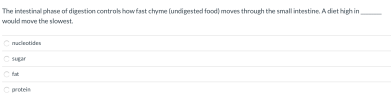 The intestinal phase of digestion controls how fast chyme (undigested food) moves through the small intestine. A diet high in would move the slowest. C nucleotides C sugar Cfat C protein
Observation: Digestive System in Pigs 1. Using these terms (esophagus, large intestine, small intestine, stomach) trace...
 Observation: Digestive System in Pigs 1. Using these terms (esophagus, large intestine, small intestine, stomach) trace the path of food from mouth to the anus small intestine esofhaus large intestine Slorach anus 2. Open the mouth, and insert a blunt probe into the esophagus ( 15.10). Then trace the crophagus stomach 31. Open one side of the stomach and examine its interior surf . Does it appear smooth or rough Snroth L s 4. Find the pyloric sphincter, the muscle...
What is marxist criminology? how does it differ from radical criminology? How does it differ from...
What is marxist criminology? how does it differ from radical criminology? How does it differ from critical criminology?
rse In addition to the small intestine, alcohol is absorbed directly from the: ort O small...
 rse In addition to the small intestine, alcohol is absorbed directly from the: ort O small intestine O mouth stomach esophagus
Question 15 2 pts How does the movement of energy and matter in ecosystems differ? O...
 Question 15 2 pts How does the movement of energy and matter in ecosystems differ? O Matter cycles, remaining within ecosystems, while energy flows, coming from the sun and eventually radiating out into space. Energy cycles, remaining within ecosystems, while matter flows, coming from the sun and eventually radiating out into space. Matter can cycle between living and non-living parts of the ecosystem, while energy is only cycled between non-living parts of the ecosystem. Matter can be transformed, but energy...
2. The drawing to the right represents absorption in the small Lumen of intestine intestine (or the proximal tubule...
 2. The drawing to the right represents absorption in the small Lumen of intestine intestine (or the proximal tubule of the kidney).(7 pts) A B a) What solute is represented by A? What solute is represented by B? What solute is represented by C? b) What type of transport is bringing solute A into the ICF absorptive cell from the lumen? c) What type of transport is removing solute B from the absorptive cell? d) What type of transport is...
Blood transport substances like digested food from (a) Small intestine (b) Large intestine (c) Stomach (d)...
Blood transport substances like digested food from (a) Small intestine (b) Large intestine (c) Stomach (d) Pancreas
1. How does true motility differ from Brownian movement? 2. What could happen if you would...
 1. How does true motility differ from Brownian movement? 2. What could happen if you would touch the bottom of the motility agar with your needle during inoculation? 3 Explain why the following steps are essential during subculturing: a) Flaming the loop or needle prior to and after each inoculation. b) Cooling the loop or needle prior to obtaining the microorganism c) Holding the test tube caps in the hand as opposed placing them on the bench top. d) Flaming...
Fatty acids are transferred from the lumen of the small intestine to the epithelial cells of...
 Fatty acids are transferred from the lumen of the small intestine to the epithelial cells of the small intestine by A primary active transport B. secondary active transport Cosmosis D simple diffusion Click Save and Submit to save and submit. Click Save All Answers to save all answers.
BACKGROUND A 30cm length of distal small intestine, attached to a short length of colon, is...
BACKGROUND A 30cm length of distal small intestine, attached to a short length of colon, is surgically resected from a human patient undergoing surgery for a cancerous tumour in the right colon. The small intestine is separated from the rest of the excised gut and placed in an organ bath filled with warmed, oxygenated Krebs solution, which effectively replaces the blood supply and keeps the tissue alive and active for several hours. (i). The physiologist pushes a soft wad of...
 The intestinal phase of digestion controls how fast chyme (undigested food) moves through the small intestine. A diet high in would move the slowest. C nucleotides C sugar Cfat C protein
 Observation: Digestive System in Pigs 1. Using these terms (esophagus, large intestine, small intestine, stomach) trace the path of food from mouth to the anus small intestine esofhaus large intestine Slorach anus 2. Open the mouth, and insert a blunt probe into the esophagus ( 15.10). Then trace the crophagus stomach 31. Open one side of the stomach and examine its interior surf . Does it appear smooth or rough Snroth L s 4. Find the pyloric sphincter, the muscle...
 rse In addition to the small intestine, alcohol is absorbed directly from the: ort O small intestine O mouth stomach esophagus
 Question 15 2 pts How does the movement of energy and matter in ecosystems differ? O Matter cycles, remaining within ecosystems, while energy flows, coming from the sun and eventually radiating out into space. Energy cycles, remaining within ecosystems, while matter flows, coming from the sun and eventually radiating out into space. Matter can cycle between living and non-living parts of the ecosystem, while energy is only cycled between non-living parts of the ecosystem. Matter can be transformed, but energy...
 2. The drawing to the right represents absorption in the small Lumen of intestine intestine (or the proximal tubule of the kidney).(7 pts) A B a) What solute is represented by A? What solute is represented by B? What solute is represented by C? b) What type of transport is bringing solute A into the ICF absorptive cell from the lumen? c) What type of transport is removing solute B from the absorptive cell? d) What type of transport is...
 1. How does true motility differ from Brownian movement? 2. What could happen if you would touch the bottom of the motility agar with your needle during inoculation? 3 Explain why the following steps are essential during subculturing: a) Flaming the loop or needle prior to and after each inoculation. b) Cooling the loop or needle prior to obtaining the microorganism c) Holding the test tube caps in the hand as opposed placing them on the bench top. d) Flaming...
 Fatty acids are transferred from the lumen of the small intestine to the epithelial cells of the small intestine by A primary active transport B. secondary active transport Cosmosis D simple diffusion Click Save and Submit to save and submit. Click Save All Answers to save all answers.
Most questions answered within 3 hours.
-
Where is the error in this code sequence?
String s1 = "Hello";
String s2 = "ello";...
asked 10 months ago -
Financial data for Joel de Paris, Inc., for last year
follow:
Joel de Paris, Inc.
Balance...
asked 10 months ago -
Consider this reaction:
Al2(SO4)3 (aq)+ BaCl3
(aq) Al2Cl6 (aq)- +
3BaSO4(s) . What is the...
asked 10 months ago -
Suppose that Savneet is considering increasing her
recent random sample from 20 car rentals to 40...
asked 10 months ago -
Trucks arrive at an unloading terminal at an average rate of 120
per hour.
Trucks arrive...
asked 10 months ago -
Why are methanol and ethanol completely soluble in water while
octanol is not very little soluble....
asked 10 months ago -
A facilities manager at a university reads in a research report
that the mean amount of...
asked 10 months ago -
When the CuSO4 is rehydrated by adding water to the anhydrous
compound, is this an endothermic...
asked 10 months ago -
A ray of sunlight is passing from diamond into crown glass; the
angle of incidence is...
asked 10 months ago -
A block of mass 0.249 kg is placed on top of a light, vertical
spring of...
asked 10 months ago -
how do the kidneys compensate in the presences of acidosis
a) trigger hyperventilate
b) reserve acid...
asked 10 months ago -
Question 501 pts
The rental rate of capital to the firm increases. Which of the
following...
asked 10 months ago