
Homework Answers
Add Answer to:
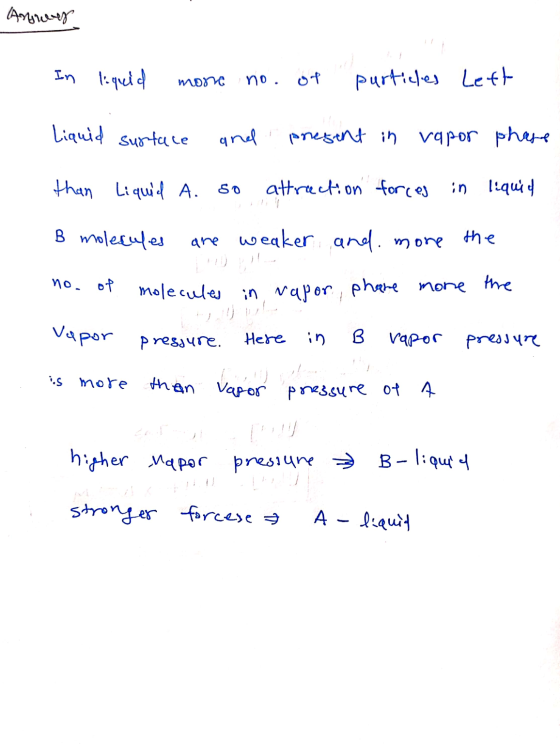
33. Consider the two liquids, A and B, shown in closed containers. Which liquid has the...
You have a solution of two volatile liquids, X and Y. Pure liquid X has a...
You have a solution of two volatile liquids, X and Y. Pure liquid X has a vapor pressure of 410.0 torr and pure liquid Y has a vapor pressure of 150.0 torr at the temperature of the solution. The mole fraction of X in the vapor at equilibrium above the solution is 1.5 times the mole fraction of liquid X in the solution. What is the mole fraction of liquid X in the solution?
5) Answer the following questions using the following information. The vapor pressures of 4 liquids @...
 5) Answer the following questions using the following information. The vapor pressures of 4 liquids @ 25°C, Liquid A = 540 mmHg B = 600 mmHg C = 680 mmHg D = 450 mmHg. a) Which liquid will have the highest normal boiling point? b) Which liquid has the highest vapor pressure? c) As the pressure over the liquids is reduced which liquid will boil first? d) Intermolecular forces(IMF) are greatest between molecules of which liquid?
4. Two liquids, A and B, obey Raoul's law at all concentration. That is PA =...
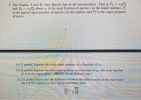 4. Two liquids, A and B, obey Raoul's law at all concentration. That is PA = DAPA and PB = xpPg where r, is the mole fraction of species i in the liquid mixture, P. is the partial vapor pressure of species i in the mixture and P* is the vapor pressure of pure i. (a) (5 points) Express the total vapor pressure as a function of x. (b) (5 points Express the total vapor pressure as a function of...
4. Two liquids, A and B, obey Raoul's law at all concentration. That is PA =...
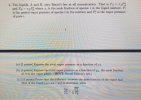 4. Two liquids, A and B, obey Raoul's law at all concentration. That is PA = IAP and Pa rpP where r, is the mole fraction of species i in the liquid mixture, P is the partial vapor pressure of species i in the mixture and P is the vapor pressure of pure i 1 (a) [5 points] Express the total vapor pressure as a function of rA (b) [5 points] Express the total vapor pressure as a function of...
Part A Two liquids, labeled A and B, form an ideal mixture with total vapor pressure...
 Part A Two liquids, labeled A and B, form an ideal mixture with total vapor pressure P = 324.4 torr at a certain composition. At the same temperature, pure liquid A has a vapor pressure of 230 torr, while pure liquid B has a vapor pressure of 380 torr. What is the mole fraction XA of liquid A in this mixture. O 0.183 O 0.420 0.556 O 0.037 0.371
Shown below are six containers that contain various liquids. Blocks of various solids are suspended in...
Shown below are six containers that contain various liquids. Blocks of various solids are suspended in the liquids by being hung from a supporting rod. All of these blocks are the same size, but they have different masses since they are made of different materials. All of the containers have the same volume of liquid but the masses of these liquids vary since the liquids are different. Specific values for the masses of the blocks and the liquids are given...
3. Liquids A and B form an ideal solution. At 25 °C, the vapor pressure of liquid A and B is 13.0 kPa and 26.0 kPa,...
 3. Liquids A and B form an ideal solution. At 25 °C, the vapor pressure of liquid A and B is 13.0 kPa and 26.0 kPa, respectively. The vaporization enthalpy of liquid A and B is 35.0 kJ mol and 15.0 kJ mol respectively. At what temperature do liquids A and B have the same vapor pressure?
A simple distillation is performed to separate liquids X and Y. Liquid X has a vapor...
A simple distillation is performed to separate liquids X and Y. Liquid X has a vapor pressure of 180 Torr at room temperature while liquid Y has a vapor pressure of 55 Torr. Which statement best describes the collected distillate? Note: the distillate is defined as the solution that is collected from the distillation process. It will be equal quantities of X and Y It will be enriched in X relative to the initial mixture It will be 100% pure...
Consider two empty containers A and B whose volumes are 10mL and 20mL respectively. 1mL of...
Consider two empty containers A and B whose volumes are 10mL and 20mL respectively. 1mL of liquid water is put into each container and the temperature of each container is adjusted to 20°C. The gas pressure in container B, which still has some liquid water in it, is found to be 17 torr. How would the pressure in container A AND the amount of liquid water in container A compare to that of container B? Can someone please explain in...
A liquid placed in a closed container will evaporate until equilibrium is reached. At equilibrium, which...
A liquid placed in a closed container will evaporate until equilibrium is reached. At equilibrium, which of the following statements is false? A. The partial pressure exerted by the vapor molecules is called the vapor pressure of the liquid. B. Liquid molecules are still evaporating. C. The number of vapor molecules remains essentially constant. D. The partial pressure of the vapor is constant. E. The boundary (meniscus) between liquid and vapor disappears.
 5) Answer the following questions using the following information. The vapor pressures of 4 liquids @ 25°C, Liquid A = 540 mmHg B = 600 mmHg C = 680 mmHg D = 450 mmHg. a) Which liquid will have the highest normal boiling point? b) Which liquid has the highest vapor pressure? c) As the pressure over the liquids is reduced which liquid will boil first? d) Intermolecular forces(IMF) are greatest between molecules of which liquid?
 4. Two liquids, A and B, obey Raoul's law at all concentration. That is PA = DAPA and PB = xpPg where r, is the mole fraction of species i in the liquid mixture, P. is the partial vapor pressure of species i in the mixture and P* is the vapor pressure of pure i. (a) (5 points) Express the total vapor pressure as a function of x. (b) (5 points Express the total vapor pressure as a function of...
 4. Two liquids, A and B, obey Raoul's law at all concentration. That is PA = IAP and Pa rpP where r, is the mole fraction of species i in the liquid mixture, P is the partial vapor pressure of species i in the mixture and P is the vapor pressure of pure i 1 (a) [5 points] Express the total vapor pressure as a function of rA (b) [5 points] Express the total vapor pressure as a function of...
 Part A Two liquids, labeled A and B, form an ideal mixture with total vapor pressure P = 324.4 torr at a certain composition. At the same temperature, pure liquid A has a vapor pressure of 230 torr, while pure liquid B has a vapor pressure of 380 torr. What is the mole fraction XA of liquid A in this mixture. O 0.183 O 0.420 0.556 O 0.037 0.371
 3. Liquids A and B form an ideal solution. At 25 °C, the vapor pressure of liquid A and B is 13.0 kPa and 26.0 kPa, respectively. The vaporization enthalpy of liquid A and B is 35.0 kJ mol and 15.0 kJ mol respectively. At what temperature do liquids A and B have the same vapor pressure?
Most questions answered within 3 hours.
-
Where is the error in this code sequence?
String s1 = "Hello";
String s2 = "ello";...
asked 11 months ago -
Financial data for Joel de Paris, Inc., for last year
follow:
Joel de Paris, Inc.
Balance...
asked 11 months ago -
Consider this reaction:
Al2(SO4)3 (aq)+ BaCl3
(aq) Al2Cl6 (aq)- +
3BaSO4(s) . What is the...
asked 11 months ago -
Suppose that Savneet is considering increasing her
recent random sample from 20 car rentals to 40...
asked 11 months ago -
Trucks arrive at an unloading terminal at an average rate of 120
per hour.
Trucks arrive...
asked 11 months ago -
Why are methanol and ethanol completely soluble in water while
octanol is not very little soluble....
asked 11 months ago -
A facilities manager at a university reads in a research report
that the mean amount of...
asked 11 months ago -
When the CuSO4 is rehydrated by adding water to the anhydrous
compound, is this an endothermic...
asked 11 months ago -
A ray of sunlight is passing from diamond into crown glass; the
angle of incidence is...
asked 11 months ago -
A block of mass 0.249 kg is placed on top of a light, vertical
spring of...
asked 11 months ago -
how do the kidneys compensate in the presences of acidosis
a) trigger hyperventilate
b) reserve acid...
asked 11 months ago -
Question 501 pts
The rental rate of capital to the firm increases. Which of the
following...
asked 11 months ago