
Homework Answers
Moles/ litre also known as concentration.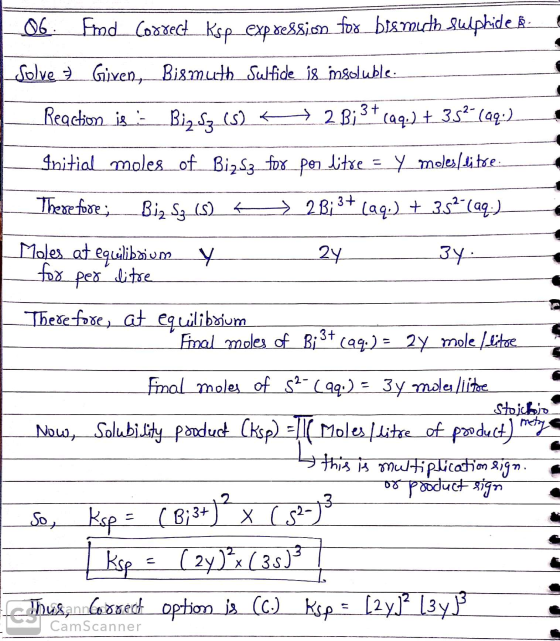
Add Answer to:
6 Insoluble Bismuth Sulfide, undergoes the following reaction: Bi,S, (s) <-> 2Bil+ (aq) + 352+(aq) If...
5. Given the following data: Flask A with 50cm2 surface area contains 100mL of water at...
5. Given the following data: Flask A with 50cm2 surface area contains 100mL of water at 25oC; Flask B with 20cm2 surface area contains 10mL of water at 55oC. In which flask does the water have a lower vapor pressure? A flask A B flask B C both flasks have the same vapor pressure 12. Insoluble Bismuth Sulfide, undergoes the following reaction: Bi2S3 (s) <-> 2Bi3+ (aq) + 3S2+(aq) If y moles/liter of bismuth sulfide dissolves, the correct Ksp expression...
Consider the following reaction at 298K. Fe2+ (aq) + Ni (s) —> Fe (s) + Ni2+...
 Consider the following reaction at 298K. Fe2+ (aq) + Ni (s) —> Fe (s) + Ni2+ (aq) Which of the following statements are correct? Choose all that apply. O K>1 delta Gº > 0 Bºcell > 0 The reaction is reactant-favored. n=2 mol electrons Submit Answer Retry Entire Group 6 m Consider the following reaction at 298K. Pb2+ (aq) + Cu(s) → Pb (s) + Cu2+ (aq) Which of the following statements are correct? Choose all that apply. Eºcell <...
1. A voltaic cell is constructed that is based on the following reaction: Sn2+(aq)+Pb(s)→Sn(s)+Pb2+(aq). A. If...
1. A voltaic cell is constructed that is based on the following reaction: Sn2+(aq)+Pb(s)→Sn(s)+Pb2+(aq). A. If the concentration of Sn2+ in the cathode compartment is 1.30 M and the cell generates an emf of 0.25 V , what is the concentration of Pb2+ in the anode compartment? B. If the anode compartment contains [SO2−4]= 1.30 M in equilibrium with PbSO4(s), what is the Ksp of PbSO4? 2. A voltaic cell utilizes the following reaction: 2Fe3+(aq)+H2(g)→2Fe2+(aq)+2H+(aq). A. What is the emf...
The following chemical reaction takes place in aqueous solution: Fe2(SO4), (aq)+6 KOH(aq) — 2 Fe(OH)3(s)+3 K,...
 The following chemical reaction takes place in aqueous solution: Fe2(SO4), (aq)+6 KOH(aq) — 2 Fe(OH)3(s)+3 K, SO4(aq) Write the net ionic equation for this reaction. 0- Identifying the limiting reactant in a drawing of a mixture The drawing below shows a mixture of molecules: key carbon hydrogen nitrogen sulfur 000000 oxygen chlorine Suppose the following chemical reaction can take place in this mixture: CH,(9)+4S(s) → CS (9)+2 H, S(9) of which reactant are there the most initial moles? Enter its...
Consider the following reaction in aqueous solution: 5 Br−(aq) + BrO3−(aq) + 6 H+(aq) ---> 3...
Consider the following reaction in aqueous solution: 5 Br−(aq) + BrO3−(aq) + 6 H+(aq) ---> 3 Br2(aq) + 3 H2O(l) i) The equation that relates the rate expressions for this reaction in terms of the disappearance of Br−, BrO3− and the formation of Br2 and H2O is (Choose the correct letter.): NOTE: { } is being used to represent the molar concentration. A. R = -1/5{ Δ Br - }/ Δ t = -1/1{ Δ BrO 3- }/ Δ t...
8. Sodium bicarbonate, NaHCO3, undergoes thermal decomposition according to the reaction: 2 NaHCO3 (s) + Na2CO3...
 8. Sodium bicarbonate, NaHCO3, undergoes thermal decomposition according to the reaction: 2 NaHCO3 (s) + Na2CO3 (s) + CO2 (g) + H20 (g). How does the equilibrium position shift as a result of each of the following disturbances? a. 0.20 atm argon is added. b. NaHCO3 (s) is added. c. Mg(CIO)2 is added as a drying agent to remove H2O vapor. d. Dry ice (Solid CO2) is added. e. The volume of the container decreases. f. The temperature of the...
help please? this was the only other information given REPORT SHEET Determination of the Solubility-Product Constant...
 help please?
this was the only other information given
REPORT SHEET Determination of the Solubility-Product Constant for a Sparingly Soluble Salt EXPERIMENT 8 A. Preparation of a Calibration Curve Initial (Cro121 0.0024 M Absorbance 5 mL Volume of 0.0024 M K Cro Total volume 1. I mL 100 mL 2. 100ML 3. 10 mL 100ml 4. 15 mL 100 ML Molar extinction coefficient for [CrO2) [Cro,2) 2.4x100M 12x1044 2.4810M 3.6810M 0.04) 2037.37 0.85 1.13 2. 3. Average molar extinction coefficient...
help please?
this was the only other information given
REPORT SHEET Determination of the Solubility-Product Constant for a Sparingly Soluble Salt EXPERIMENT 8 A. Preparation of a Calibration Curve Initial (Cro121 0.0024 M Absorbance 5 mL Volume of 0.0024 M K Cro Total volume 1. I mL 100 mL 2. 100ML 3. 10 mL 100ml 4. 15 mL 100 ML Molar extinction coefficient for [CrO2) [Cro,2) 2.4x100M 12x1044 2.4810M 3.6810M 0.04) 2037.37 0.85 1.13 2. 3. Average molar extinction coefficient...
 Consider the following reaction at 298K. Fe2+ (aq) + Ni (s) —> Fe (s) + Ni2+ (aq) Which of the following statements are correct? Choose all that apply. O K>1 delta Gº > 0 Bºcell > 0 The reaction is reactant-favored. n=2 mol electrons Submit Answer Retry Entire Group 6 m Consider the following reaction at 298K. Pb2+ (aq) + Cu(s) → Pb (s) + Cu2+ (aq) Which of the following statements are correct? Choose all that apply. Eºcell <...
 The following chemical reaction takes place in aqueous solution: Fe2(SO4), (aq)+6 KOH(aq) — 2 Fe(OH)3(s)+3 K, SO4(aq) Write the net ionic equation for this reaction. 0- Identifying the limiting reactant in a drawing of a mixture The drawing below shows a mixture of molecules: key carbon hydrogen nitrogen sulfur 000000 oxygen chlorine Suppose the following chemical reaction can take place in this mixture: CH,(9)+4S(s) → CS (9)+2 H, S(9) of which reactant are there the most initial moles? Enter its...
 8. Sodium bicarbonate, NaHCO3, undergoes thermal decomposition according to the reaction: 2 NaHCO3 (s) + Na2CO3 (s) + CO2 (g) + H20 (g). How does the equilibrium position shift as a result of each of the following disturbances? a. 0.20 atm argon is added. b. NaHCO3 (s) is added. c. Mg(CIO)2 is added as a drying agent to remove H2O vapor. d. Dry ice (Solid CO2) is added. e. The volume of the container decreases. f. The temperature of the...
 help please?
this was the only other information given
REPORT SHEET Determination of the Solubility-Product Constant for a Sparingly Soluble Salt EXPERIMENT 8 A. Preparation of a Calibration Curve Initial (Cro121 0.0024 M Absorbance 5 mL Volume of 0.0024 M K Cro Total volume 1. I mL 100 mL 2. 100ML 3. 10 mL 100ml 4. 15 mL 100 ML Molar extinction coefficient for [CrO2) [Cro,2) 2.4x100M 12x1044 2.4810M 3.6810M 0.04) 2037.37 0.85 1.13 2. 3. Average molar extinction coefficient...
help please?
this was the only other information given
REPORT SHEET Determination of the Solubility-Product Constant for a Sparingly Soluble Salt EXPERIMENT 8 A. Preparation of a Calibration Curve Initial (Cro121 0.0024 M Absorbance 5 mL Volume of 0.0024 M K Cro Total volume 1. I mL 100 mL 2. 100ML 3. 10 mL 100ml 4. 15 mL 100 ML Molar extinction coefficient for [CrO2) [Cro,2) 2.4x100M 12x1044 2.4810M 3.6810M 0.04) 2037.37 0.85 1.13 2. 3. Average molar extinction coefficient...
Most questions answered within 3 hours.
-
Where is the error in this code sequence?
String s1 = "Hello";
String s2 = "ello";...
asked 10 months ago -
Financial data for Joel de Paris, Inc., for last year
follow:
Joel de Paris, Inc.
Balance...
asked 10 months ago -
Consider this reaction:
Al2(SO4)3 (aq)+ BaCl3
(aq) Al2Cl6 (aq)- +
3BaSO4(s) . What is the...
asked 10 months ago -
Suppose that Savneet is considering increasing her
recent random sample from 20 car rentals to 40...
asked 10 months ago -
Trucks arrive at an unloading terminal at an average rate of 120
per hour.
Trucks arrive...
asked 10 months ago -
Why are methanol and ethanol completely soluble in water while
octanol is not very little soluble....
asked 10 months ago -
A facilities manager at a university reads in a research report
that the mean amount of...
asked 10 months ago -
When the CuSO4 is rehydrated by adding water to the anhydrous
compound, is this an endothermic...
asked 10 months ago -
A ray of sunlight is passing from diamond into crown glass; the
angle of incidence is...
asked 10 months ago -
A block of mass 0.249 kg is placed on top of a light, vertical
spring of...
asked 10 months ago -
how do the kidneys compensate in the presences of acidosis
a) trigger hyperventilate
b) reserve acid...
asked 10 months ago -
Question 501 pts
The rental rate of capital to the firm increases. Which of the
following...
asked 10 months ago