A buffer is made by adding 0.350 mol lactic acid, CH3CH(OH)COOH, and 0.350 mol potassium lactate,...
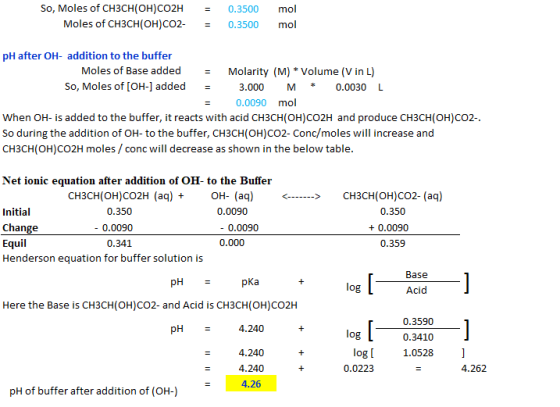
A buffer is made by adding 0.350 mol lactic acid, CH3CH(OH)COOH, and 0.350 mol potassium lactate, CH3CH(OH)COOK, to enough water to make 1.10 L of solution. The pKa is equal to 4.24. Calculate the pH of this solution after 3.0 mL of 3.0 M KOH is added to the buffer.
Homework Answers
Add Answer to:
A buffer is made by adding 0.350 mol lactic acid,
CH3CH(OH)COOH, and 0.350 mol potassium lactate,...
A buffer is made by adding 0.120 mol of lactic acid, (CH3COHCOOH - monoprotic), HC3H5O3, and...
A buffer is made by adding 0.120 mol of lactic acid, (CH3COHCOOH - monoprotic), HC3H5O3, and 0.100 mol of sodium lactate, NaC3H5O3 to enough water to make 1.00 L of solution. The pH of the buffer was calculated in question # 6. A) Calculate the pH of the solution after 0.001 mol of NaOH is added. Ka (lactic acid) = 1.4 x 10⁻⁴. Assume no volume change. B) Calculate the change in pH if 0.001 mol of NaOH is added...
A buffer contains 0.020 mol of lactic acid (pKa = 3.86) and 0.100 mol sodium lactate...
A buffer contains 0.020 mol of lactic acid (pKa = 3.86) and 0.100 mol sodium lactate per liter of aqueous solution. a. Calculate the pH of this buffer. b. Calculate the pH after 8.0 mL of 1.00 M NaOH is added to 1 liter of the buffer (assume the total volume will be 1008 mL).
10 ml containing 1.0 mmole of lactic acid solution, CH3CH(OH)COOH, (pKa=3.86) was titrated with NaOH solution...
10 ml containing 1.0 mmole of lactic acid solution, CH3CH(OH)COOH, (pKa=3.86) was titrated with NaOH solution up to a total volume of 100 ml a. what is the concentration of the base solution required for a full neutralization of the lactic acid? b. what is the pH at the equivalent point? c. what will be the pH of the solution obtained after adding 0.2 mmole of NaOH(S) (SOLID!)
7. Lactic acid (CSH COOH) is a weak monoprotic acid whose K, value is 1.4x10". Its salt potassium lactate is added...
 7. Lactic acid (CSH COOH) is a weak monoprotic acid whose K, value is 1.4x10". Its salt potassium lactate is added to food products as a preservative and to inhibit growth of bacteria. What is the pH of a solution whose molar concentration of potassium lactate (CSHCOO-K) is 0.290 M? Caution! This problem does not say that lactic acid is dissolved in water, it is potassium lactate that is added to the water.
A. What is the pH of 2L of a buffer solution containing 80.0 grams of lactic...
A. What is the pH of 2L of a buffer solution containing 80.0 grams of lactic acid (CH3CH(OH)COOH) (90.08 g/mol) and 100.0 grams of sodium lactate (CH3CH(OH)COONa) (112.06 g/mol)? B. What will be the pH of the solution formed from adding 20mL of 8.0 M HCl to the buffer described in Part A of this question? (Ignore the change in volume) For part A, because we aren't given pKa, am I right to assume that we'd be finding the molarity...
A buffer is prepared by adding 0.15 mol of lactic acid, CH3CHOHCOOH, and 0.20 mol of...
A buffer is prepared by adding 0.15 mol of lactic acid, CH3CHOHCOOH, and 0.20 mol of sodium lactate, Na+CH3CHOHCOO - , to sufficient water to make 1.0 L of buffer solution. The Ka of lactic acid is 1.4 x 10 - 4. Calculate the pH of the buffer.
Lactic acid (CH3CH(OH)COOH) has only one acidic hydrogen which can dissociate as follows: CH3CH(OH)COOH (aq) +...
 Lactic acid (CH3CH(OH)COOH) has only one acidic hydrogen which can dissociate as follows: CH3CH(OH)COOH (aq) + H20 (1) --- H30+ (aq) + CH3CH(OH)COO (aq) A 0.10 M solution of lactic acid has a pH of 2.44. Calculate the Ka. Ка? 10^
Equal volumes of 200 mM lactic acid and 200 mM potassium lactate are mixed to make...
 Equal volumes of 200 mM lactic acid and 200 mM potassium lactate are mixed to make a buffer. The pKa of lactic acid is 3.86 (a) Determine the pH of this buffer and its final concentration. [4 marks] (b) Calculate the concentrations of the buffer components after acid or base is added to bring the pH to 4.5. Assume a negligible change in volume. 6 marks]
A buffer contains 0.010 mol of lactic acid (pKa = 3.86) and 0.050 mol of sodium...
A buffer contains 0.010 mol of lactic acid (pKa = 3.86) and 0.050 mol of sodium lactate per liter. (a) Calculate the pH of the buffer. (b) Calculate the change in pH when 5.0 mL of 0.50 M HCl is added to 1.0 L of the buffer. (c) What pH change would you expect if you added the same quantity of HCl to 1.0 L of pure water?
2.) Consider a 1.00L of buffer that is 0.139M in lactic acid (C3H5O3H) and 0.134M in sodium lactate (C3H5O3- Na+). Calcu...
2.) Consider a 1.00L of buffer that is 0.139M in lactic acid (C3H5O3H) and 0.134M in sodium lactate (C3H5O3- Na+). Calculate the pH of the buffer after adding 0.0500 mol of HCl into the buffer solution. (Assume no volume change) pKa of lactic acid is 3.86
 7. Lactic acid (CSH COOH) is a weak monoprotic acid whose K, value is 1.4x10". Its salt potassium lactate is added to food products as a preservative and to inhibit growth of bacteria. What is the pH of a solution whose molar concentration of potassium lactate (CSHCOO-K) is 0.290 M? Caution! This problem does not say that lactic acid is dissolved in water, it is potassium lactate that is added to the water.
 Lactic acid (CH3CH(OH)COOH) has only one acidic hydrogen which can dissociate as follows: CH3CH(OH)COOH (aq) + H20 (1) --- H30+ (aq) + CH3CH(OH)COO (aq) A 0.10 M solution of lactic acid has a pH of 2.44. Calculate the Ka. Ка? 10^
 Equal volumes of 200 mM lactic acid and 200 mM potassium lactate are mixed to make a buffer. The pKa of lactic acid is 3.86 (a) Determine the pH of this buffer and its final concentration. [4 marks] (b) Calculate the concentrations of the buffer components after acid or base is added to bring the pH to 4.5. Assume a negligible change in volume. 6 marks]
Most questions answered within 3 hours.
-
Where is the error in this code sequence?
String s1 = "Hello";
String s2 = "ello";...
asked 10 months ago -
Financial data for Joel de Paris, Inc., for last year
follow:
Joel de Paris, Inc.
Balance...
asked 10 months ago -
Consider this reaction:
Al2(SO4)3 (aq)+ BaCl3
(aq) Al2Cl6 (aq)- +
3BaSO4(s) . What is the...
asked 10 months ago -
Suppose that Savneet is considering increasing her
recent random sample from 20 car rentals to 40...
asked 10 months ago -
Trucks arrive at an unloading terminal at an average rate of 120
per hour.
Trucks arrive...
asked 10 months ago -
Why are methanol and ethanol completely soluble in water while
octanol is not very little soluble....
asked 10 months ago -
A facilities manager at a university reads in a research report
that the mean amount of...
asked 10 months ago -
When the CuSO4 is rehydrated by adding water to the anhydrous
compound, is this an endothermic...
asked 10 months ago -
A ray of sunlight is passing from diamond into crown glass; the
angle of incidence is...
asked 10 months ago -
A block of mass 0.249 kg is placed on top of a light, vertical
spring of...
asked 10 months ago -
how do the kidneys compensate in the presences of acidosis
a) trigger hyperventilate
b) reserve acid...
asked 10 months ago -
Question 501 pts
The rental rate of capital to the firm increases. Which of the
following...
asked 10 months ago