
Homework Answers
Add Answer to:
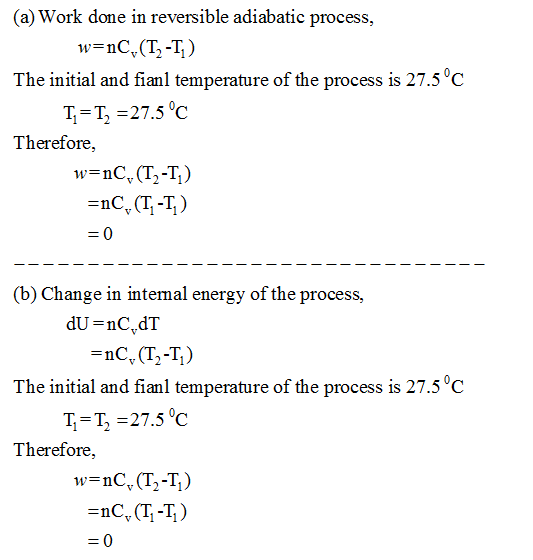
A piston reversibly and adiabatically contracts 3.88 moles of ideal gas to one-tenth of its original...
Vol calculate mol sample of an ideal gas expands reversibly and isothermally to a final OL...
 Vol calculate mol sample of an ideal gas expands reversibly and isothermally to a final OL If the initial pressure is 7.0 am and the temperature is 57.0°C (a) the initial volume of the gas (b) the final pressure of the gas (c) the work done in kJ (5) A 2 50 mol sample of an ideal monoatomic gas at 300K expands adiabatically and reversibly from a volume of 15.0 L to 60.0L Calculate the (a) final temperature of the...
Constant amount of ideal gas is kept inside a cylinder by a piston. Then the gas...
 Constant amount of ideal gas is kept inside a cylinder by a
piston. Then the gas expands adiabatically.
Compare the initial (i) and the final (f) physical quantities of
the gas to each other.
equal to less than greater than The volume Vf
is ... Vi.
equal to less than greater than The entropy
Sf is ... Si.
equal to less than greater than The internal energy
Uf is ... Ui.
equal to less than greater than The pressure
pf is ... pi.
equal...
Constant amount of ideal gas is kept inside a cylinder by a
piston. Then the gas expands adiabatically.
Compare the initial (i) and the final (f) physical quantities of
the gas to each other.
equal to less than greater than The volume Vf
is ... Vi.
equal to less than greater than The entropy
Sf is ... Si.
equal to less than greater than The internal energy
Uf is ... Ui.
equal to less than greater than The pressure
pf is ... pi.
equal...
400 moles of an ideal monatomic gas are kept in a cylinder fitted with a light...
400 moles of an ideal monatomic gas are kept in a cylinder fitted with a light frictionless piston. The gas is maintained at the atmospheric pressure. Heat is added to the gas. The gas consequently expands slowly from an initial volume of 10 m3 to 15 m3. (a) Draw a P-V diagram for this process. (b) Is this thermodynamic process an isothermal expansion, an isobaric expansion or an adiabatic expansion? (c) Calculate the work done by the gas. (d) Calculate...
Ideal Gas: Please show all work and explain (a) An ideal gas expands adiabatically from a...
 Ideal Gas: Please show all work and explain
(a) An ideal gas expands adiabatically from a volume of 2.2 × 10⁻³ m3 to 3.2 × 10⁻³ m3. If the initial pressure and temperature were 5 pressure Pa temperature (b) In an isothermal process, an ideal gas expands from a volume of 2.2 10-3 m3 to 3.2 10-3 m3. If the initial pressure and temperature were 5.0 x 10⁵ Pa and 280 K, respectively, what are the final pressure (in Pa)...
Ideal Gas: Please show all work and explain
(a) An ideal gas expands adiabatically from a volume of 2.2 × 10⁻³ m3 to 3.2 × 10⁻³ m3. If the initial pressure and temperature were 5 pressure Pa temperature (b) In an isothermal process, an ideal gas expands from a volume of 2.2 10-3 m3 to 3.2 10-3 m3. If the initial pressure and temperature were 5.0 x 10⁵ Pa and 280 K, respectively, what are the final pressure (in Pa)...
A sample of n moles of a monatomic ideal gas is expanded isothermally and reversibly at...
A sample of n moles of a monatomic ideal gas is expanded isothermally and reversibly at a constant temperature T from a volume V to 3V. Note that since the temperature of the gas is constant, the internal energy will remain constant. a) Write an expression for the change in entropy ΔS for the system. b) The sample has 7 moles of gas and is kept at a temperature of 305 K. The volume is changed from 0.065 m3 to...
3.20 moles of an ideal gas is contained in a piston with at a volume of...
 3.20 moles of an ideal gas is contained in a piston with at a volume of 275 cm and temperature of 235 °C. It expands at constant pressure, pushing out the piston to a volume of 350 cm². How much work was performed by the gas? 1710 J 0.00 J 3260 J 3690 J
A 2.00 mol sample of a diatomic ideal gas expands slowly and adiabatically from a pressure...
 A 2.00 mol sample of a diatomic ideal gas expands slowly and adiabatically from a pressure of 5.04 atm and a volume of L2 Lto a final volume of 30.8 L (a) What is the final pressure of the gas? 1.44 atm (b) What are the initial and final temperatures? initial 385.72 final 269.39 (c) Find Qfor the gas during this process. 0 (d) Find ??¡nt for the gas during this process. What is the relationship between the internal energy...
We have a container of 1.49 moles of an ideal monatomic gas. The volume of the...
We have a container of 1.49 moles of an ideal monatomic gas. The volume of the container is 15.0 liters, and the temperature of the gas is 21.7◦C. We compress the gas adiabatically to 13.2 liters. (a) Find the final temperature of the gas. Neglect any heat flow into the surroundings. (b) Find the change in internal energy of the gas. (c) Find the work done on the gas. Find (d) the initial and (e) the final pressures of the...
Suppose 3.00 moles of a monatomic ideal gas expand adiabatically
 Suppose 3.00 moles of a monatomic ideal gas expand adiabatically, and its temperature decreases from 397 to 258 K. Determine (a) the work done (including the algebraic sign) by the gas, and (b) the change in its internal energy.
3 moles of an ideal monatomic gas are compressed reversibly and isothermally from an initial volume...
3 moles of an ideal monatomic gas are compressed reversibly and isothermally from an initial volume of 500 l at 30° C to a final volume of 50 l. Calculate: (a) the initial and final pressure of the gas, and (b) ΔQ , ΔW, ΔU, ΔΗ for the compression.
 Vol calculate mol sample of an ideal gas expands reversibly and isothermally to a final OL If the initial pressure is 7.0 am and the temperature is 57.0°C (a) the initial volume of the gas (b) the final pressure of the gas (c) the work done in kJ (5) A 2 50 mol sample of an ideal monoatomic gas at 300K expands adiabatically and reversibly from a volume of 15.0 L to 60.0L Calculate the (a) final temperature of the...
 Constant amount of ideal gas is kept inside a cylinder by a
piston. Then the gas expands adiabatically.
Compare the initial (i) and the final (f) physical quantities of
the gas to each other.
equal to less than greater than The volume Vf
is ... Vi.
equal to less than greater than The entropy
Sf is ... Si.
equal to less than greater than The internal energy
Uf is ... Ui.
equal to less than greater than The pressure
pf is ... pi.
equal...
Constant amount of ideal gas is kept inside a cylinder by a
piston. Then the gas expands adiabatically.
Compare the initial (i) and the final (f) physical quantities of
the gas to each other.
equal to less than greater than The volume Vf
is ... Vi.
equal to less than greater than The entropy
Sf is ... Si.
equal to less than greater than The internal energy
Uf is ... Ui.
equal to less than greater than The pressure
pf is ... pi.
equal...
 Ideal Gas: Please show all work and explain
(a) An ideal gas expands adiabatically from a volume of 2.2 × 10⁻³ m3 to 3.2 × 10⁻³ m3. If the initial pressure and temperature were 5 pressure Pa temperature (b) In an isothermal process, an ideal gas expands from a volume of 2.2 10-3 m3 to 3.2 10-3 m3. If the initial pressure and temperature were 5.0 x 10⁵ Pa and 280 K, respectively, what are the final pressure (in Pa)...
Ideal Gas: Please show all work and explain
(a) An ideal gas expands adiabatically from a volume of 2.2 × 10⁻³ m3 to 3.2 × 10⁻³ m3. If the initial pressure and temperature were 5 pressure Pa temperature (b) In an isothermal process, an ideal gas expands from a volume of 2.2 10-3 m3 to 3.2 10-3 m3. If the initial pressure and temperature were 5.0 x 10⁵ Pa and 280 K, respectively, what are the final pressure (in Pa)...
 3.20 moles of an ideal gas is contained in a piston with at a volume of 275 cm and temperature of 235 °C. It expands at constant pressure, pushing out the piston to a volume of 350 cm². How much work was performed by the gas? 1710 J 0.00 J 3260 J 3690 J
 A 2.00 mol sample of a diatomic ideal gas expands slowly and adiabatically from a pressure of 5.04 atm and a volume of L2 Lto a final volume of 30.8 L (a) What is the final pressure of the gas? 1.44 atm (b) What are the initial and final temperatures? initial 385.72 final 269.39 (c) Find Qfor the gas during this process. 0 (d) Find ??¡nt for the gas during this process. What is the relationship between the internal energy...
Most questions answered within 3 hours.
-
Where is the error in this code sequence?
String s1 = "Hello";
String s2 = "ello";...
asked 10 months ago -
Financial data for Joel de Paris, Inc., for last year
follow:
Joel de Paris, Inc.
Balance...
asked 10 months ago -
Consider this reaction:
Al2(SO4)3 (aq)+ BaCl3
(aq) Al2Cl6 (aq)- +
3BaSO4(s) . What is the...
asked 10 months ago -
Suppose that Savneet is considering increasing her
recent random sample from 20 car rentals to 40...
asked 10 months ago -
Trucks arrive at an unloading terminal at an average rate of 120
per hour.
Trucks arrive...
asked 10 months ago -
Why are methanol and ethanol completely soluble in water while
octanol is not very little soluble....
asked 10 months ago -
A facilities manager at a university reads in a research report
that the mean amount of...
asked 10 months ago -
When the CuSO4 is rehydrated by adding water to the anhydrous
compound, is this an endothermic...
asked 10 months ago -
A ray of sunlight is passing from diamond into crown glass; the
angle of incidence is...
asked 10 months ago -
A block of mass 0.249 kg is placed on top of a light, vertical
spring of...
asked 10 months ago -
how do the kidneys compensate in the presences of acidosis
a) trigger hyperventilate
b) reserve acid...
asked 10 months ago -
Question 501 pts
The rental rate of capital to the firm increases. Which of the
following...
asked 10 months ago