 number
4
number
4Homework Answers
Add Answer to:
number
4
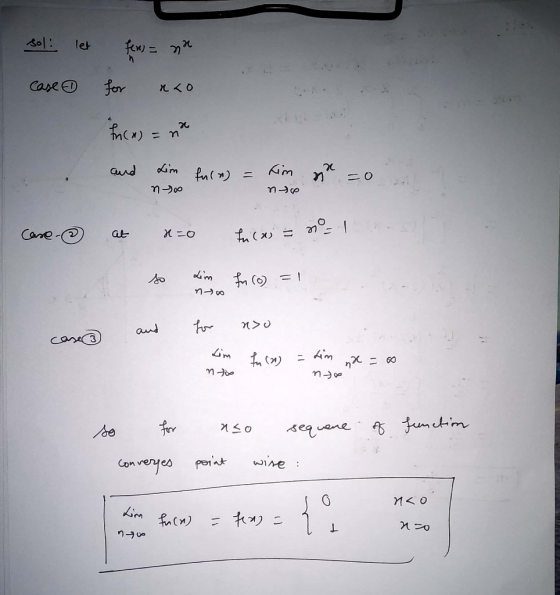
Ex. 3.1. Determine, when possible, the function f(x) to which the following sequences converge...
Problem #10: Which of the following sequences converge? (i) an (-1)n+1 n n2 - 7 (-1)"...
 Problem #10: Which of the following sequences converge? (i) an (-1)n+1 n n2 - 7 (-1)" n2 n? - (iii) an = cos(NT) (iv) an= sin(nn) (ii) an= -9 (A) (i) only (B) (ii) only (C) (i) and (iv) only (D) (i) and (iii) only (E) (ii) and (iii) only (F) (ii) and (iv) only (G) all of them (H) none of them
number 4 as clearly as possible 1. Find the limit of the following sequences (find lim...
 number 4 as clearly as possible
1. Find the limit of the following sequences (find lim an) n n a.) an = n +3 b.) an = V35n n- 2. Determine whether the following series converge or diverge. -3 (n + 2)n + 5 b.) tan-'(n) n2 + 1 a.) 5 nel 3. Determine the radius of convergence and the interval of convergence of the series 2" (x – 3)" n n=1 n=0 (-1)", 2n 4. Using the power series...
number 4 as clearly as possible
1. Find the limit of the following sequences (find lim an) n n a.) an = n +3 b.) an = V35n n- 2. Determine whether the following series converge or diverge. -3 (n + 2)n + 5 b.) tan-'(n) n2 + 1 a.) 5 nel 3. Determine the radius of convergence and the interval of convergence of the series 2" (x – 3)" n n=1 n=0 (-1)", 2n 4. Using the power series...
PLEASE ANSWER ALL NUMBER 3 (Parts A-F) Consider the following list of properties 3. f(x)oo x-+1 ii) lim()2 iv) f(1)-3 v) lim f(x)-n x+1 For each of the following, decide if it is possible for a funct...
 PLEASE ANSWER ALL
NUMBER 3 (Parts A-F)
Consider the following list of properties 3. f(x)oo x-+1 ii) lim()2 iv) f(1)-3 v) lim f(x)-n x+1 For each of the following, decide if it is possible for a function to have the given set of properties. If so, sketch and label a possible graph for the function on the axis provided. If no such function is possible, explain why not. a) (i) and (i) b) (), (ii), and (iv) c) (i), (iii),...
PLEASE ANSWER ALL
NUMBER 3 (Parts A-F)
Consider the following list of properties 3. f(x)oo x-+1 ii) lim()2 iv) f(1)-3 v) lim f(x)-n x+1 For each of the following, decide if it is possible for a function to have the given set of properties. If so, sketch and label a possible graph for the function on the axis provided. If no such function is possible, explain why not. a) (i) and (i) b) (), (ii), and (iv) c) (i), (iii),...
question 17 Determine which of the following relation(s) represent a function: I.y = 5 II. x²...
 question 17
Determine which of the following relation(s) represent a function: I.y = 5 II. x² + y = 9 III. x² + y2 = 7 IV. y = |x] – 5 V.x=1 VI. x = lyſ + 7 a) I, II, IV only b) O II, IV, V only c) O II, III, IV only d) OI, IV, VI only e) OI, V, VI only
question 17
Determine which of the following relation(s) represent a function: I.y = 5 II. x² + y = 9 III. x² + y2 = 7 IV. y = |x] – 5 V.x=1 VI. x = lyſ + 7 a) I, II, IV only b) O II, IV, V only c) O II, III, IV only d) OI, IV, VI only e) OI, V, VI only
number 4 1. Find the limit of the following sequences (find lim an) n n a.)...
 number 4
1. Find the limit of the following sequences (find lim an) n n a.) an = n +3 b.) an = V35n n- 2. Determine whether the following series converge or diverge. -3 (n + 2)n + 5 b.) tan-'(n) n2 + 1 a.) 5 nel 3. Determine the radius of convergence and the interval of convergence of the series 2" (x – 3)" n n=1 n=0 (-1)", 2n 4. Using the power series cos(x) (2n)! (-« <...
number 4
1. Find the limit of the following sequences (find lim an) n n a.) an = n +3 b.) an = V35n n- 2. Determine whether the following series converge or diverge. -3 (n + 2)n + 5 b.) tan-'(n) n2 + 1 a.) 5 nel 3. Determine the radius of convergence and the interval of convergence of the series 2" (x – 3)" n n=1 n=0 (-1)", 2n 4. Using the power series cos(x) (2n)! (-« <...
(35 pls) Determine if each of the following seven series converge or diverge. Do not use...
 (35 pls) Determine if each of the following seven series converge or diverge. Do not use a test for convergence or a test for divergence more than once. If you use the Integral Test, do not bother to show me that you checked the three prerequisites to that test. i) 2(04-) n.1 ii) (-1)"n(2n)! -1 (n + 1) (2n) 21 n=1 n 3 iii) 2+ n-1 iv) n=0 1+en 00 1 v) n-07T +n* vi) (-1)"e" 1+en n=0 vii) Ž(-1)"...
3.5.7 (a,c) 3.5.6. Does the sequence , (c) = nxen converge pointwise to the zero function...
 3.5.7 (a,c)
3.5.6. Does the sequence , (c) = nxen converge pointwise to the zero function for x E R? Does it converge uniformly? 3.5.7. Answer Exercise 3.5.6 when S 1. n< <n +1, (a) u (c) = xe (b) un() = 0, otherwise, S1, n<<n +1/n, (d) vn(x) = S 1/n, 1<x<2n, 10, otherwise, S 1/n, n<3 <2n, - nc-1, -1/n <3 <1/n, (e) Ur (20) = { 10, otherwise, otherwise. (c) un 10, otherwise, i u n ,...
3.5.7 (a,c)
3.5.6. Does the sequence , (c) = nxen converge pointwise to the zero function for x E R? Does it converge uniformly? 3.5.7. Answer Exercise 3.5.6 when S 1. n< <n +1, (a) u (c) = xe (b) un() = 0, otherwise, S1, n<<n +1/n, (d) vn(x) = S 1/n, 1<x<2n, 10, otherwise, S 1/n, n<3 <2n, - nc-1, -1/n <3 <1/n, (e) Ur (20) = { 10, otherwise, otherwise. (c) un 10, otherwise, i u n ,...
a) Given 20.00 mL of 0.2000 M diethylamine (CH3CH2)2NH (Kb = 3.1 x 10⁻⁴), determine the...
a) Given 20.00 mL of 0.2000 M diethylamine (CH3CH2)2NH (Kb = 3.1 x 10⁻⁴), determine the pH for the titration against 0.1000 M Hal at the following HCl volumes: i) 0.0 mL, ii) 1/4 eq pt, iii) 15.00 mL, iv) 20.00 mL, v) 3/4 eq pt, vi) 35.00 mL, vii) at the eq pt, viii) 50.00 mL, ix) 20.00 mL beyond the eq point. b) Use the results of part 'a' to sketch the titration curve. Make the line as...
3 only Ex. 3.2. Determine the values of x € R for which the following series...
 3 only
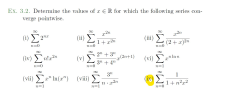
Ex. 3.2. Determine the values of x € R for which the following series con- verge pointwise. 2η (1) Σ2nα (ii) 2η 1+ 2η (2+1)2η n=0 n=0. Με Με Με n=0 | 3η (8) Σ" hete") (vi) Σ. (vii) Σ α ” ln(") n=1 (1) Σεπ 1η-2η 1+0202 = 1
3 only
Ex. 3.2. Determine the values of x € R for which the following series con- verge pointwise. 2η (1) Σ2nα (ii) 2η 1+ 2η (2+1)2η n=0 n=0. Με Με Με n=0 | 3η (8) Σ" hete") (vi) Σ. (vii) Σ α ” ln(") n=1 (1) Σεπ 1η-2η 1+0202 = 1
high light only Ex. 3.2. Determine the values of x E R for which the following...
 high light only
Ex. 3.2. Determine the values of x E R for which the following series con- verge pointwise. n=0 η (2n+1) in Inn n=0 n=0 n=1 (0) Σαλαθι «Σανα) (0) Σαπουν (0 ΣΗ(el) (Σ. ΘΣτε X η • n=1 n=1 n=0.
high light only
Ex. 3.2. Determine the values of x E R for which the following series con- verge pointwise. n=0 η (2n+1) in Inn n=0 n=0 n=1 (0) Σαλαθι «Σανα) (0) Σαπουν (0 ΣΗ(el) (Σ. ΘΣτε X η • n=1 n=1 n=0.
 Problem #10: Which of the following sequences converge? (i) an (-1)n+1 n n2 - 7 (-1)" n2 n? - (iii) an = cos(NT) (iv) an= sin(nn) (ii) an= -9 (A) (i) only (B) (ii) only (C) (i) and (iv) only (D) (i) and (iii) only (E) (ii) and (iii) only (F) (ii) and (iv) only (G) all of them (H) none of them
 number 4 as clearly as possible
1. Find the limit of the following sequences (find lim an) n n a.) an = n +3 b.) an = V35n n- 2. Determine whether the following series converge or diverge. -3 (n + 2)n + 5 b.) tan-'(n) n2 + 1 a.) 5 nel 3. Determine the radius of convergence and the interval of convergence of the series 2" (x – 3)" n n=1 n=0 (-1)", 2n 4. Using the power series...
number 4 as clearly as possible
1. Find the limit of the following sequences (find lim an) n n a.) an = n +3 b.) an = V35n n- 2. Determine whether the following series converge or diverge. -3 (n + 2)n + 5 b.) tan-'(n) n2 + 1 a.) 5 nel 3. Determine the radius of convergence and the interval of convergence of the series 2" (x – 3)" n n=1 n=0 (-1)", 2n 4. Using the power series...
 PLEASE ANSWER ALL
NUMBER 3 (Parts A-F)
Consider the following list of properties 3. f(x)oo x-+1 ii) lim()2 iv) f(1)-3 v) lim f(x)-n x+1 For each of the following, decide if it is possible for a function to have the given set of properties. If so, sketch and label a possible graph for the function on the axis provided. If no such function is possible, explain why not. a) (i) and (i) b) (), (ii), and (iv) c) (i), (iii),...
PLEASE ANSWER ALL
NUMBER 3 (Parts A-F)
Consider the following list of properties 3. f(x)oo x-+1 ii) lim()2 iv) f(1)-3 v) lim f(x)-n x+1 For each of the following, decide if it is possible for a function to have the given set of properties. If so, sketch and label a possible graph for the function on the axis provided. If no such function is possible, explain why not. a) (i) and (i) b) (), (ii), and (iv) c) (i), (iii),...
 question 17
Determine which of the following relation(s) represent a function: I.y = 5 II. x² + y = 9 III. x² + y2 = 7 IV. y = |x] – 5 V.x=1 VI. x = lyſ + 7 a) I, II, IV only b) O II, IV, V only c) O II, III, IV only d) OI, IV, VI only e) OI, V, VI only
question 17
Determine which of the following relation(s) represent a function: I.y = 5 II. x² + y = 9 III. x² + y2 = 7 IV. y = |x] – 5 V.x=1 VI. x = lyſ + 7 a) I, II, IV only b) O II, IV, V only c) O II, III, IV only d) OI, IV, VI only e) OI, V, VI only
 number 4
1. Find the limit of the following sequences (find lim an) n n a.) an = n +3 b.) an = V35n n- 2. Determine whether the following series converge or diverge. -3 (n + 2)n + 5 b.) tan-'(n) n2 + 1 a.) 5 nel 3. Determine the radius of convergence and the interval of convergence of the series 2" (x – 3)" n n=1 n=0 (-1)", 2n 4. Using the power series cos(x) (2n)! (-« <...
number 4
1. Find the limit of the following sequences (find lim an) n n a.) an = n +3 b.) an = V35n n- 2. Determine whether the following series converge or diverge. -3 (n + 2)n + 5 b.) tan-'(n) n2 + 1 a.) 5 nel 3. Determine the radius of convergence and the interval of convergence of the series 2" (x – 3)" n n=1 n=0 (-1)", 2n 4. Using the power series cos(x) (2n)! (-« <...
 (35 pls) Determine if each of the following seven series converge or diverge. Do not use a test for convergence or a test for divergence more than once. If you use the Integral Test, do not bother to show me that you checked the three prerequisites to that test. i) 2(04-) n.1 ii) (-1)"n(2n)! -1 (n + 1) (2n) 21 n=1 n 3 iii) 2+ n-1 iv) n=0 1+en 00 1 v) n-07T +n* vi) (-1)"e" 1+en n=0 vii) Ž(-1)"...
 3.5.7 (a,c)
3.5.6. Does the sequence , (c) = nxen converge pointwise to the zero function for x E R? Does it converge uniformly? 3.5.7. Answer Exercise 3.5.6 when S 1. n< <n +1, (a) u (c) = xe (b) un() = 0, otherwise, S1, n<<n +1/n, (d) vn(x) = S 1/n, 1<x<2n, 10, otherwise, S 1/n, n<3 <2n, - nc-1, -1/n <3 <1/n, (e) Ur (20) = { 10, otherwise, otherwise. (c) un 10, otherwise, i u n ,...
3.5.7 (a,c)
3.5.6. Does the sequence , (c) = nxen converge pointwise to the zero function for x E R? Does it converge uniformly? 3.5.7. Answer Exercise 3.5.6 when S 1. n< <n +1, (a) u (c) = xe (b) un() = 0, otherwise, S1, n<<n +1/n, (d) vn(x) = S 1/n, 1<x<2n, 10, otherwise, S 1/n, n<3 <2n, - nc-1, -1/n <3 <1/n, (e) Ur (20) = { 10, otherwise, otherwise. (c) un 10, otherwise, i u n ,...
 3 only
Ex. 3.2. Determine the values of x € R for which the following series con- verge pointwise. 2η (1) Σ2nα (ii) 2η 1+ 2η (2+1)2η n=0 n=0. Με Με Με n=0 | 3η (8) Σ" hete") (vi) Σ. (vii) Σ α ” ln(") n=1 (1) Σεπ 1η-2η 1+0202 = 1
3 only
Ex. 3.2. Determine the values of x € R for which the following series con- verge pointwise. 2η (1) Σ2nα (ii) 2η 1+ 2η (2+1)2η n=0 n=0. Με Με Με n=0 | 3η (8) Σ" hete") (vi) Σ. (vii) Σ α ” ln(") n=1 (1) Σεπ 1η-2η 1+0202 = 1
 high light only
Ex. 3.2. Determine the values of x E R for which the following series con- verge pointwise. n=0 η (2n+1) in Inn n=0 n=0 n=1 (0) Σαλαθι «Σανα) (0) Σαπουν (0 ΣΗ(el) (Σ. ΘΣτε X η • n=1 n=1 n=0.
high light only
Ex. 3.2. Determine the values of x E R for which the following series con- verge pointwise. n=0 η (2n+1) in Inn n=0 n=0 n=1 (0) Σαλαθι «Σανα) (0) Σαπουν (0 ΣΗ(el) (Σ. ΘΣτε X η • n=1 n=1 n=0.
Most questions answered within 3 hours.
-
Where is the error in this code sequence?
String s1 = "Hello";
String s2 = "ello";...
asked 10 months ago -
Financial data for Joel de Paris, Inc., for last year
follow:
Joel de Paris, Inc.
Balance...
asked 10 months ago -
Consider this reaction:
Al2(SO4)3 (aq)+ BaCl3
(aq) Al2Cl6 (aq)- +
3BaSO4(s) . What is the...
asked 10 months ago -
Suppose that Savneet is considering increasing her
recent random sample from 20 car rentals to 40...
asked 10 months ago -
Trucks arrive at an unloading terminal at an average rate of 120
per hour.
Trucks arrive...
asked 10 months ago -
Why are methanol and ethanol completely soluble in water while
octanol is not very little soluble....
asked 10 months ago -
A facilities manager at a university reads in a research report
that the mean amount of...
asked 10 months ago -
When the CuSO4 is rehydrated by adding water to the anhydrous
compound, is this an endothermic...
asked 10 months ago -
A ray of sunlight is passing from diamond into crown glass; the
angle of incidence is...
asked 10 months ago -
A block of mass 0.249 kg is placed on top of a light, vertical
spring of...
asked 10 months ago -
how do the kidneys compensate in the presences of acidosis
a) trigger hyperventilate
b) reserve acid...
asked 10 months ago -
Question 501 pts
The rental rate of capital to the firm increases. Which of the
following...
asked 10 months ago