
Homework Answers
Add Answer to:
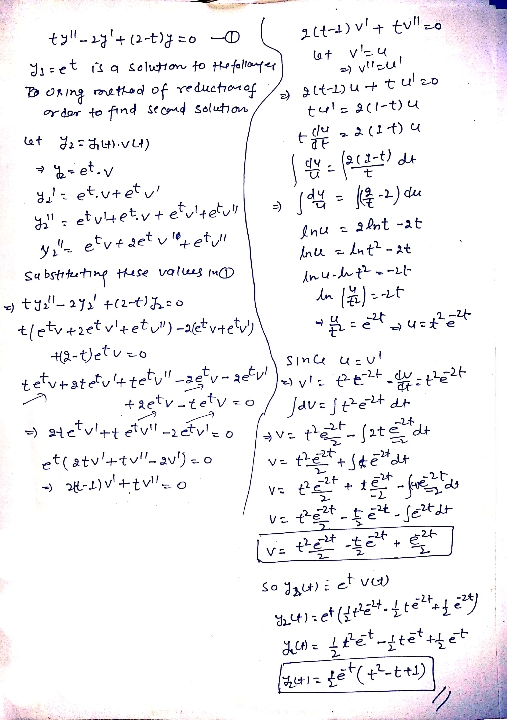
1. The function y (t) = e is a solution to the following equation. Use reduction...
The indicated function yı() is a solution of the given differential equation. Use reduction of order...
 The indicated function yı() is a solution of the given differential equation. Use reduction of order or formula (5) in Section 4.2, Y2 = vy() / e-SP(x) dx dx (5) y?(x) as instructed, to find a second solution y2(x). x?y" + 2xy' – 6y = 0; Y1 = x2 Y2 The indicated function yı(x) is a solution of the given differential equation. 6y" + y' - y = 0; Y1 Fet/3 Use reduction of order or formula (5) in Section...
Find the solution y of the initial value problem 3"(t) = 2 (3(t). y(1) = 0,...
 Find the solution y of the initial value problem 3"(t) = 2 (3(t). y(1) = 0, y' (1) = 1. +3 g(t) = M Solve the initial value problem g(t) g” (t) + 50g (+)? = 0, y(0) = 1, y'(0) = 7. g(t) = Σ Use the reduction order method to find a second solution ya to the differential equation ty" + 12ty' +28 y = 0. knowing that the function yı(t) = + 4 is solution to that...
The indicated function y1(x) is a solution of the given differential equation. Use reduction of order...
The indicated function y1(x) is a solution of the given differential equation. Use reduction of order or formula (5) in Section 4.2, y2 = y1(x) e−∫P(x) dx y 2 1 (x) dx (5) as instructed, to find a second solution y2(x). y'' + 2y' + y = 0; y1 = xe−x y2 =
The indicated function y(x) is a solution of the given differential equation. Use reduction of order...
 The indicated function y(x) is a solution of the given differential equation. Use reduction of order or formula (5) in Section 4.2, re-SP(x) dx as instructed, to find a second solution y2(x). XY" + y = 0; Y- In x
The indicated function y_(x) is a solution of the given differential equation. Use reduction of order...
 The indicated function y_(x) is a solution of the given differential equation. Use reduction of order or formula (5) in Section 4.2, e-SP(x) dx dx Y2 = Y1(x) >> (5) y? (x) as instructed, to find a second solution y2(x). x?y" + 2xy' – 6y = 0; Y=x2 Y2=
3. Consider the differential equation ty" - (t+1)y + y = t?e?', t>0. (a) Find a...
 3. Consider the differential equation ty" - (t+1)y + y = t?e?', t>0. (a) Find a value ofr for which y = et is a solution to the corresponding homogeneous differential equation. (b) Use Reduction of Order to find a second, linearly independent, solution to the correspond- ing homogeneous differential equation. (c) Use Variation of Parameters to find a particular solution to the nonhomogeneous differ- ential equation and then give the general solution to the differential equation.
1. The function: y, = e' is a solution of the homogeneous linear equation: y"-2y'+ y...
 1. The function: y, = e' is a solution of the homogeneous linear equation: y"-2y'+ y = 0. Use Reduction of Order to find a second linearly independent solution, then write the general solution for the differential equation: y" - 2y'+y=0
Use the method of reduction of order to find the solution of the differential equation -...
 Use
the method of reduction of order to find the solution of the
differential equation
- Queskon 1 We conn'der the differenhal equation ty"[+]!=(1+31)yft 4 344 => @ Determine the value of the constant that the function y(t) = eet es a solution of the differennial equation b Find the general solution of the differenkall equation Bute с
Use
the method of reduction of order to find the solution of the
differential equation
- Queskon 1 We conn'der the differenhal equation ty"[+]!=(1+31)yft 4 344 => @ Determine the value of the constant that the function y(t) = eet es a solution of the differennial equation b Find the general solution of the differenkall equation Bute с
(1 point) We know that y(x) = ** is a solution to the differential equation y...
 (1 point) We know that y(x) = ** is a solution to the differential equation y - 12y - 64y = 0 for x € (-0,00) Use the method of reduction of order to find the second solution to y - 12y - 64 y = 0 for x € (-0, 0). (a) After you reduce the second order equation by making the substitution w = C', you get a first order equation of the form w = f(x, w)...
LEl equation. 8. Consider the equation y" + xy' + y = o. a. Pind its general solution y E cnx in the form y Ayx)By2) where y1 and y2 are power series b. Use the ratio test to verify that...
 LEl equation. 8. Consider the equation y" + xy' + y = o. a. Pind its general solution y E cnx in the form y Ayx)By2) where y1 and y2 are power series b. Use the ratio test to verify that the two series y, and yp converge for all x. Write out the theozn in the book both series would converge. 2 , and use this fact c. Show that y,(x) is the series expansion of e , to·ind...
 The indicated function yı() is a solution of the given differential equation. Use reduction of order or formula (5) in Section 4.2, Y2 = vy() / e-SP(x) dx dx (5) y?(x) as instructed, to find a second solution y2(x). x?y" + 2xy' – 6y = 0; Y1 = x2 Y2 The indicated function yı(x) is a solution of the given differential equation. 6y" + y' - y = 0; Y1 Fet/3 Use reduction of order or formula (5) in Section...
 Find the solution y of the initial value problem 3"(t) = 2 (3(t). y(1) = 0, y' (1) = 1. +3 g(t) = M Solve the initial value problem g(t) g” (t) + 50g (+)? = 0, y(0) = 1, y'(0) = 7. g(t) = Σ Use the reduction order method to find a second solution ya to the differential equation ty" + 12ty' +28 y = 0. knowing that the function yı(t) = + 4 is solution to that...
 The indicated function y(x) is a solution of the given differential equation. Use reduction of order or formula (5) in Section 4.2, re-SP(x) dx as instructed, to find a second solution y2(x). XY" + y = 0; Y- In x
 The indicated function y_(x) is a solution of the given differential equation. Use reduction of order or formula (5) in Section 4.2, e-SP(x) dx dx Y2 = Y1(x) >> (5) y? (x) as instructed, to find a second solution y2(x). x?y" + 2xy' – 6y = 0; Y=x2 Y2=
 3. Consider the differential equation ty" - (t+1)y + y = t?e?', t>0. (a) Find a value ofr for which y = et is a solution to the corresponding homogeneous differential equation. (b) Use Reduction of Order to find a second, linearly independent, solution to the correspond- ing homogeneous differential equation. (c) Use Variation of Parameters to find a particular solution to the nonhomogeneous differ- ential equation and then give the general solution to the differential equation.
 1. The function: y, = e' is a solution of the homogeneous linear equation: y"-2y'+ y = 0. Use Reduction of Order to find a second linearly independent solution, then write the general solution for the differential equation: y" - 2y'+y=0
 Use
the method of reduction of order to find the solution of the
differential equation
- Queskon 1 We conn'der the differenhal equation ty"[+]!=(1+31)yft 4 344 => @ Determine the value of the constant that the function y(t) = eet es a solution of the differennial equation b Find the general solution of the differenkall equation Bute с
Use
the method of reduction of order to find the solution of the
differential equation
- Queskon 1 We conn'der the differenhal equation ty"[+]!=(1+31)yft 4 344 => @ Determine the value of the constant that the function y(t) = eet es a solution of the differennial equation b Find the general solution of the differenkall equation Bute с
 (1 point) We know that y(x) = ** is a solution to the differential equation y - 12y - 64y = 0 for x € (-0,00) Use the method of reduction of order to find the second solution to y - 12y - 64 y = 0 for x € (-0, 0). (a) After you reduce the second order equation by making the substitution w = C', you get a first order equation of the form w = f(x, w)...
 LEl equation. 8. Consider the equation y" + xy' + y = o. a. Pind its general solution y E cnx in the form y Ayx)By2) where y1 and y2 are power series b. Use the ratio test to verify that the two series y, and yp converge for all x. Write out the theozn in the book both series would converge. 2 , and use this fact c. Show that y,(x) is the series expansion of e , to·ind...
Most questions answered within 3 hours.
-
Where is the error in this code sequence?
String s1 = "Hello";
String s2 = "ello";...
asked 10 months ago -
Financial data for Joel de Paris, Inc., for last year
follow:
Joel de Paris, Inc.
Balance...
asked 10 months ago -
Consider this reaction:
Al2(SO4)3 (aq)+ BaCl3
(aq) Al2Cl6 (aq)- +
3BaSO4(s) . What is the...
asked 10 months ago -
Suppose that Savneet is considering increasing her
recent random sample from 20 car rentals to 40...
asked 10 months ago -
Trucks arrive at an unloading terminal at an average rate of 120
per hour.
Trucks arrive...
asked 10 months ago -
Why are methanol and ethanol completely soluble in water while
octanol is not very little soluble....
asked 10 months ago -
A facilities manager at a university reads in a research report
that the mean amount of...
asked 10 months ago -
When the CuSO4 is rehydrated by adding water to the anhydrous
compound, is this an endothermic...
asked 10 months ago -
A ray of sunlight is passing from diamond into crown glass; the
angle of incidence is...
asked 10 months ago -
A block of mass 0.249 kg is placed on top of a light, vertical
spring of...
asked 10 months ago -
how do the kidneys compensate in the presences of acidosis
a) trigger hyperventilate
b) reserve acid...
asked 10 months ago -
Question 501 pts
The rental rate of capital to the firm increases. Which of the
following...
asked 10 months ago