
Homework Answers
Add Answer to:
In Exercises 1-4, u and y have the same direction. In each exercise a. Find ul....
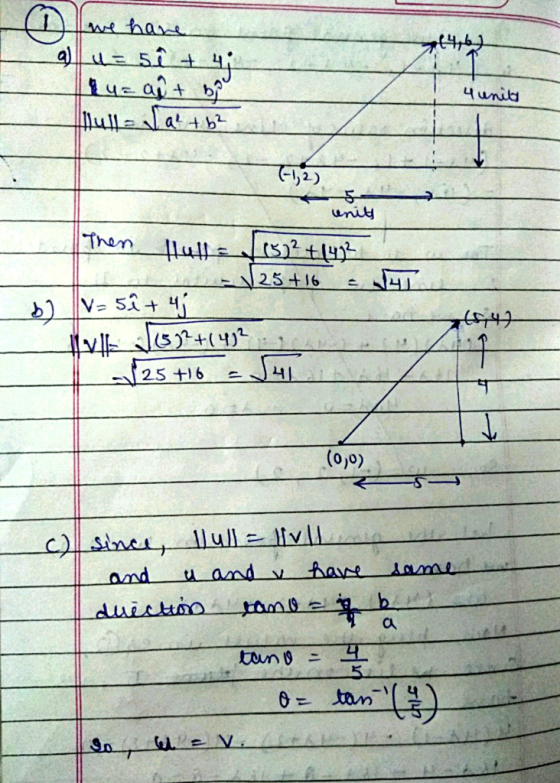
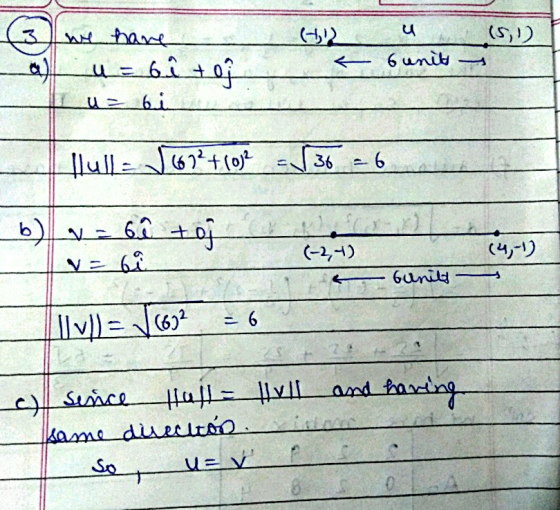
The vectors u and v have the same direction a. Find ul. b. Find lvl c....
 The vectors u and v have the same direction a. Find ul. b. Find lvl c. Is u=v? Explain. a. lu- (Simplify your answer. Type an exact answer, using radicals as needed.) b. IV (Simplify your answer. Type an exact answer, using radicals as needed) c. Is u=v? Explain. Choose the correct answer below O A. No, because the vectors have different magnitudes and the same direction Click to select your answer(s). We were unable to transcribe this image
1. (based on exercise 6.5 on page 301) For each of the following functions, find their first and ...
 1. (based on exercise 6.5 on page 301) For each of the following functions, find their first and second derivatives, and use these to find the function's critical points. Characterize each critical point as a local minimum, maximum, saddle point, or something else. (a) f(x, y-x2-4ry + y2 (b) f(x,y)=x4-4xy+94. (c) f(x, y) 2x3-3z2-62y(x-y-1). (d) f(x, y) = y4-v2 + 2y(1-x) + 1. (e) For the function in item 1d, what is the steepest descent direction at (x, y) (0,0)?...
Find the vector v that has a magnitude OF 4 and is the same direction as...
 Find the vector v that has a magnitude OF 4 and is the same direction as u where u = (-3,-b}
Vector u = (2,-2,-4,-6,2) 1.what is ll u ll 2. find a unit vector that is the same direction of u
vector u = (2,-2,-4,-6,2) 1.what is ll u ll 2. find a unit vector that is the same direction of u
The following has 3 exercises and each exercise consists of multiple parts. please take into consideration...
 The following has 3 exercises and each exercise
consists of multiple parts. please take into consideration all 3
exercises and answer each and every part of each exercise including
the subquestions found in it!!
Exercise 1 Find the Laplace transform of the following functions: 1. f(t) = 5t3e-46 2. f(t) = cos(26)U(t - T) 3. k(t) = {2-1, t<2 t> 2 4. f(t) = etsin (3) Exercise 2 Use Laplace transforms to compute the solution y(t) of the initial value...
The following has 3 exercises and each exercise
consists of multiple parts. please take into consideration all 3
exercises and answer each and every part of each exercise including
the subquestions found in it!!
Exercise 1 Find the Laplace transform of the following functions: 1. f(t) = 5t3e-46 2. f(t) = cos(26)U(t - T) 3. k(t) = {2-1, t<2 t> 2 4. f(t) = etsin (3) Exercise 2 Use Laplace transforms to compute the solution y(t) of the initial value...
Tyā (x,y)メ(0,0) (x,y)= (0,0). if if 1 (d) Given the unit vector u-( find the directional deriv...
 Please do the parts in the given order
tyā (x,y)メ(0,0) (x,y)= (0,0). if if 1 (d) Given the unit vector u-( find the directional derivative of f(x, y) at the 리지, ,- point (to,m) = (0,0), in the direction of the vector a. (e) Find the gradient of f(x, y) at the point (zo,o) (0,0) (c) Find the equation of the tangent plane to the graph of the function z -f(x, y) at the point (x,y,z) (1,0,0).
tyā (x,y)メ(0,0) (x,y)=...
Please do the parts in the given order
tyā (x,y)メ(0,0) (x,y)= (0,0). if if 1 (d) Given the unit vector u-( find the directional derivative of f(x, y) at the 리지, ,- point (to,m) = (0,0), in the direction of the vector a. (e) Find the gradient of f(x, y) at the point (zo,o) (0,0) (c) Find the equation of the tangent plane to the graph of the function z -f(x, y) at the point (x,y,z) (1,0,0).
tyā (x,y)メ(0,0) (x,y)=...
Hello! I need help answering these Partial Differential Equations exercises! Exercise 1 Find the general solution...
 Hello! I need help answering these Partial Differential
Equations exercises!
Exercise 1 Find the general solution of the cquation ury(r, y) 0 in terms of wo arbitrary functions. Exercise 2 Verify that 2c9(s)ds tcontinuously differentiable function. Hint: Here you will need to use iz' ution to the wave equation u2S, where c is a constant and g is 1's rule for differentiating an integral with respect to a parameter that a given urs n the limits of integration: b(t) F(b(t))b'...
Hello! I need help answering these Partial Differential
Equations exercises!
Exercise 1 Find the general solution of the cquation ury(r, y) 0 in terms of wo arbitrary functions. Exercise 2 Verify that 2c9(s)ds tcontinuously differentiable function. Hint: Here you will need to use iz' ution to the wave equation u2S, where c is a constant and g is 1's rule for differentiating an integral with respect to a parameter that a given urs n the limits of integration: b(t) F(b(t))b'...
Problem 8. (1 point) For the function f(x,y) = 4x² + 6xy + 2y”, find and...
 Problem 8. (1 point) For the function f(x,y) = 4x² + 6xy + 2y”, find and classify all critical points. O A. (0,0), Saddle O B. (4,6), Saddle O C. (4,6), Relative Minimum OD. (0,0), Relative Minimum OE. (0,0), Saddle |(4,6), Relative Maximum
Putin uhd e integral lound a r the val- 0 VIIl, 81. EXERCISES Compute the curve integrals of the ...
 No 3
putin uhd e integral lound a r the val- 0 VIIl, 81. EXERCISES Compute the curve integrals of the vector field over the indicated curves. (x,y)=(x2-2xy,y2-2xy) along the, parabola y=x2 from (-2,4) to 2. 0x, y, xz - y) over the line segment from (0,0, 0) to (1, 2, 4), 3, Let r (x2 y2)1/2 Let F(X)-X. Find the integral of F over the circle of radius 2, taken in counterclock wise direction. 4. Let C be a...
No 3
putin uhd e integral lound a r the val- 0 VIIl, 81. EXERCISES Compute the curve integrals of the vector field over the indicated curves. (x,y)=(x2-2xy,y2-2xy) along the, parabola y=x2 from (-2,4) to 2. 0x, y, xz - y) over the line segment from (0,0, 0) to (1, 2, 4), 3, Let r (x2 y2)1/2 Let F(X)-X. Find the integral of F over the circle of radius 2, taken in counterclock wise direction. 4. Let C be a...
Exercises Exercise 4.1. Lete: G → GL(U), ψ: G → GL(V) and : representations of a group G. Suppose...
 Please Complete 4.1.
Exercises Exercise 4.1. Lete: G → GL(U), ψ: G → GL(V) and : representations of a group G. Suppose that Te HomG(φ, ψ) and Se Prove that ST Homc(p.,p). p: G GL(U Xp. Prove tha Exercise 4.2. Let o be a representation of a group G with character Exercise 4.3. Let p: GGL(V) be an irreducible representation Let be the center of G. Show that if a e Z(G), then p(a) Exercise 4.4. Let G be a...
Please Complete 4.1.
Exercises Exercise 4.1. Lete: G → GL(U), ψ: G → GL(V) and : representations of a group G. Suppose that Te HomG(φ, ψ) and Se Prove that ST Homc(p.,p). p: G GL(U Xp. Prove tha Exercise 4.2. Let o be a representation of a group G with character Exercise 4.3. Let p: GGL(V) be an irreducible representation Let be the center of G. Show that if a e Z(G), then p(a) Exercise 4.4. Let G be a...
 The vectors u and v have the same direction a. Find ul. b. Find lvl c. Is u=v? Explain. a. lu- (Simplify your answer. Type an exact answer, using radicals as needed.) b. IV (Simplify your answer. Type an exact answer, using radicals as needed) c. Is u=v? Explain. Choose the correct answer below O A. No, because the vectors have different magnitudes and the same direction Click to select your answer(s). We were unable to transcribe this image
 1. (based on exercise 6.5 on page 301) For each of the following functions, find their first and second derivatives, and use these to find the function's critical points. Characterize each critical point as a local minimum, maximum, saddle point, or something else. (a) f(x, y-x2-4ry + y2 (b) f(x,y)=x4-4xy+94. (c) f(x, y) 2x3-3z2-62y(x-y-1). (d) f(x, y) = y4-v2 + 2y(1-x) + 1. (e) For the function in item 1d, what is the steepest descent direction at (x, y) (0,0)?...
 Find the vector v that has a magnitude OF 4 and is the same direction as u where u = (-3,-b}
 The following has 3 exercises and each exercise
consists of multiple parts. please take into consideration all 3
exercises and answer each and every part of each exercise including
the subquestions found in it!!
Exercise 1 Find the Laplace transform of the following functions: 1. f(t) = 5t3e-46 2. f(t) = cos(26)U(t - T) 3. k(t) = {2-1, t<2 t> 2 4. f(t) = etsin (3) Exercise 2 Use Laplace transforms to compute the solution y(t) of the initial value...
The following has 3 exercises and each exercise
consists of multiple parts. please take into consideration all 3
exercises and answer each and every part of each exercise including
the subquestions found in it!!
Exercise 1 Find the Laplace transform of the following functions: 1. f(t) = 5t3e-46 2. f(t) = cos(26)U(t - T) 3. k(t) = {2-1, t<2 t> 2 4. f(t) = etsin (3) Exercise 2 Use Laplace transforms to compute the solution y(t) of the initial value...
 Please do the parts in the given order
tyā (x,y)メ(0,0) (x,y)= (0,0). if if 1 (d) Given the unit vector u-( find the directional derivative of f(x, y) at the 리지, ,- point (to,m) = (0,0), in the direction of the vector a. (e) Find the gradient of f(x, y) at the point (zo,o) (0,0) (c) Find the equation of the tangent plane to the graph of the function z -f(x, y) at the point (x,y,z) (1,0,0).
tyā (x,y)メ(0,0) (x,y)=...
Please do the parts in the given order
tyā (x,y)メ(0,0) (x,y)= (0,0). if if 1 (d) Given the unit vector u-( find the directional derivative of f(x, y) at the 리지, ,- point (to,m) = (0,0), in the direction of the vector a. (e) Find the gradient of f(x, y) at the point (zo,o) (0,0) (c) Find the equation of the tangent plane to the graph of the function z -f(x, y) at the point (x,y,z) (1,0,0).
tyā (x,y)メ(0,0) (x,y)=...
 Hello! I need help answering these Partial Differential
Equations exercises!
Exercise 1 Find the general solution of the cquation ury(r, y) 0 in terms of wo arbitrary functions. Exercise 2 Verify that 2c9(s)ds tcontinuously differentiable function. Hint: Here you will need to use iz' ution to the wave equation u2S, where c is a constant and g is 1's rule for differentiating an integral with respect to a parameter that a given urs n the limits of integration: b(t) F(b(t))b'...
Hello! I need help answering these Partial Differential
Equations exercises!
Exercise 1 Find the general solution of the cquation ury(r, y) 0 in terms of wo arbitrary functions. Exercise 2 Verify that 2c9(s)ds tcontinuously differentiable function. Hint: Here you will need to use iz' ution to the wave equation u2S, where c is a constant and g is 1's rule for differentiating an integral with respect to a parameter that a given urs n the limits of integration: b(t) F(b(t))b'...
 Problem 8. (1 point) For the function f(x,y) = 4x² + 6xy + 2y”, find and classify all critical points. O A. (0,0), Saddle O B. (4,6), Saddle O C. (4,6), Relative Minimum OD. (0,0), Relative Minimum OE. (0,0), Saddle |(4,6), Relative Maximum
 No 3
putin uhd e integral lound a r the val- 0 VIIl, 81. EXERCISES Compute the curve integrals of the vector field over the indicated curves. (x,y)=(x2-2xy,y2-2xy) along the, parabola y=x2 from (-2,4) to 2. 0x, y, xz - y) over the line segment from (0,0, 0) to (1, 2, 4), 3, Let r (x2 y2)1/2 Let F(X)-X. Find the integral of F over the circle of radius 2, taken in counterclock wise direction. 4. Let C be a...
No 3
putin uhd e integral lound a r the val- 0 VIIl, 81. EXERCISES Compute the curve integrals of the vector field over the indicated curves. (x,y)=(x2-2xy,y2-2xy) along the, parabola y=x2 from (-2,4) to 2. 0x, y, xz - y) over the line segment from (0,0, 0) to (1, 2, 4), 3, Let r (x2 y2)1/2 Let F(X)-X. Find the integral of F over the circle of radius 2, taken in counterclock wise direction. 4. Let C be a...
 Please Complete 4.1.
Exercises Exercise 4.1. Lete: G → GL(U), ψ: G → GL(V) and : representations of a group G. Suppose that Te HomG(φ, ψ) and Se Prove that ST Homc(p.,p). p: G GL(U Xp. Prove tha Exercise 4.2. Let o be a representation of a group G with character Exercise 4.3. Let p: GGL(V) be an irreducible representation Let be the center of G. Show that if a e Z(G), then p(a) Exercise 4.4. Let G be a...
Please Complete 4.1.
Exercises Exercise 4.1. Lete: G → GL(U), ψ: G → GL(V) and : representations of a group G. Suppose that Te HomG(φ, ψ) and Se Prove that ST Homc(p.,p). p: G GL(U Xp. Prove tha Exercise 4.2. Let o be a representation of a group G with character Exercise 4.3. Let p: GGL(V) be an irreducible representation Let be the center of G. Show that if a e Z(G), then p(a) Exercise 4.4. Let G be a...
Most questions answered within 3 hours.
-
Where is the error in this code sequence?
String s1 = "Hello";
String s2 = "ello";...
asked 11 months ago -
Financial data for Joel de Paris, Inc., for last year
follow:
Joel de Paris, Inc.
Balance...
asked 11 months ago -
Consider this reaction:
Al2(SO4)3 (aq)+ BaCl3
(aq) Al2Cl6 (aq)- +
3BaSO4(s) . What is the...
asked 11 months ago -
Suppose that Savneet is considering increasing her
recent random sample from 20 car rentals to 40...
asked 11 months ago -
Trucks arrive at an unloading terminal at an average rate of 120
per hour.
Trucks arrive...
asked 11 months ago -
Why are methanol and ethanol completely soluble in water while
octanol is not very little soluble....
asked 11 months ago -
A facilities manager at a university reads in a research report
that the mean amount of...
asked 11 months ago -
When the CuSO4 is rehydrated by adding water to the anhydrous
compound, is this an endothermic...
asked 11 months ago -
A ray of sunlight is passing from diamond into crown glass; the
angle of incidence is...
asked 11 months ago -
A block of mass 0.249 kg is placed on top of a light, vertical
spring of...
asked 11 months ago -
how do the kidneys compensate in the presences of acidosis
a) trigger hyperventilate
b) reserve acid...
asked 11 months ago -
Question 501 pts
The rental rate of capital to the firm increases. Which of the
following...
asked 11 months ago