

Homework Answers
Can answer only four parts according to HomeworkLib policy

Add Answer to:
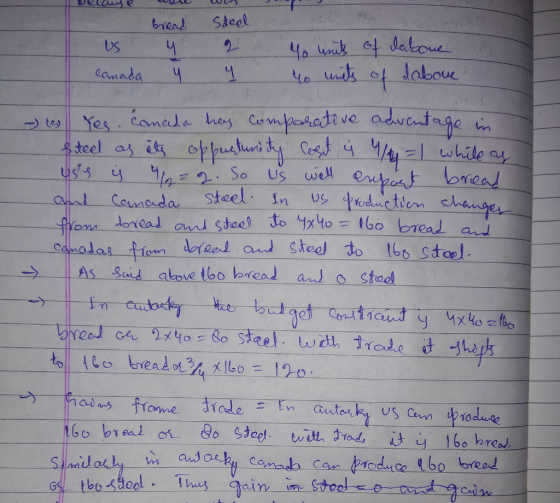
QUESTI ON 1 Consider two countries, the US and Canada, that produce two goods, bread and...
Consider a two countries, Portugal and England, that produce two goods, wine and cheese, with only...
Consider a two countries, Portugal and England, that produce two goods, wine and cheese, with only one factor of production, Labor. In England, one unit of labor can produce 2 units of wine or 1 unit of cheese. In Portugal, one unit of labor can produce 3 units of wine or 1/2 of cheese. There are 100 units of labor in Portugal, and 100 in England. Countries share the same tastes, and there is perfect competition. 1) Fill in the...
PROBLEM 1 Consider the typical HO setting: 2 countries, the United States and Canada, produce two goods,...
PROBLEM 1 Consider the typical HO setting: 2 countries, the United States and Canada, produce two goods, maiz (corn) and cloth, with two factors, land and labor. Both countries share the same tastes and the same technology. Maiz production is land intensive, and therefore cloth production is labor intensive. Furthermore, resource endowments are as follows: in the US there are 100 units of labor and 100 of land, in Canada there are 60 units of labor and 90 of land. Which...
3.1 There are two countries, the US and Canada. The two countries produce tomatoes and corn....
3.1 There are two countries, the US and Canada. The two countries produce tomatoes and corn. A US worker can produce 200 pounds of tomatoes or 50 bushels of corn per year. The US has 300 workers. Canadian workers can produce 160 pounds of tomatoes or 20 bushel of corn per year. Canada has 30 workers. a. Which country has an absolute advantage in produce tomatoes? In corn? b. Which country has a comparative advantage in produce tomatoes? In corn?...
3.1 There are two countries, the US and Canada. The two countries produce tomatoes and corn....
3.1 There are two countries, the US and Canada. The two countries produce tomatoes and corn. A US worker can produce 200 pounds of tomatoes or 50 bushels of corn per year. The US has 300 workers. Canadian workers can produce 160 pounds of tomatoes or 20 bushel of corn per year. Canada has 30 workers. a. Which country has an absolute advantage in produce tomatoes? In corn? (1 point) b. Which country has a comparative advantage in produce tomatoes?...
I need help with this exercise. Two countries, Canada and Indonesia, produce two goods, Computers (C)...
I need help with this exercise. Two countries, Canada and Indonesia, produce two goods, Computers (C) and rice (R) with labour (L) as the only input. The quantities of input required to produce a unit of each output are as follows: Computers Rice Indonesia 8 1 Canada 10 2 L in Canada is = 30, in Indonesia is =40. i) Sketch the PPF in each country (with QC on the horizontal axis). Indicate the intercepts and slope of the PFF...
Consider a world with two countries, Home and Foreign, both able to produce two goods: cloth and tablet computers. The p...
Consider a world with two countries, Home and Foreign, both able to produce two goods: cloth and tablet computers. The production of both goods uses capital and labor in fixed proportions, with the tablets industry using more capital per worker than the cloth industry. The units of each input needed to produce one unit output are given by: capital Labor Cloth 1 2 Tablets 2 1 Both countries have 150 units of capital available for production, but the Home country...
Two countries, Athens and Troy, produce two goods, ships and food, according to the following production...
Two countries, Athens and Troy, produce two goods, ships and food, according to the following production functions: 1 ship = 4 capital + 2 labor 1 food = 1 capital + 3 labor. Athens has 200 units of capital and 100 units of labor available to produce ships and food. Troy has 100 units of capital and 150 units of labor available to produce ships and food. Calculate the limits of production for Athens and Troy. Calculate the...
Only the question a Consider two countries (Home and Foreign) that produce goods 1 (with labor...
 Only the question a
Consider two countries (Home and Foreign) that produce goods 1 (with labor and capitalj and 2 twith labor and land) according to the production functions described in problems 2 and 3 Initially, both countries have the same supply of labor (100 units each), capital, and land The capital stock in Home then grows. This change shifts out both the production curve for good 1 as a function of labor employed (described in problem 2) and the...
Only the question a
Consider two countries (Home and Foreign) that produce goods 1 (with labor and capitalj and 2 twith labor and land) according to the production functions described in problems 2 and 3 Initially, both countries have the same supply of labor (100 units each), capital, and land The capital stock in Home then grows. This change shifts out both the production curve for good 1 as a function of labor employed (described in problem 2) and the...
Consider two countries, A and B. Each country produces only two goods with 1,000 production units:...
Consider two countries, A and B. Each country produces only two goods with 1,000 production units: Wine and Cheese. Country A can produce 400 bottles of wine or 200 pounds of cheese or any combination of two goods. At the same time, country B can produce 1200 bottles of wine or 300 pounds of cheese or any combination of two goods. Suppose that both countries maximize their utility when they consume wine and cheese in equal proportions. 1. a) Absolute...
Two countries produce oil. The per unit production cost of Country 1 is C1 = $2...
 Two countries produce oil. The per unit production cost of Country 1 is C1 = $2 and of country 2 it is C2 = $4. The total demand for oil is Q-40-p where p is the market price of a unit of oil. Each country can only produce either 5 units, 10 units or 15 units. The total production of the two countries in a Nash equilibrium is 10 15 20 25 30
 Only the question a
Consider two countries (Home and Foreign) that produce goods 1 (with labor and capitalj and 2 twith labor and land) according to the production functions described in problems 2 and 3 Initially, both countries have the same supply of labor (100 units each), capital, and land The capital stock in Home then grows. This change shifts out both the production curve for good 1 as a function of labor employed (described in problem 2) and the...
Only the question a
Consider two countries (Home and Foreign) that produce goods 1 (with labor and capitalj and 2 twith labor and land) according to the production functions described in problems 2 and 3 Initially, both countries have the same supply of labor (100 units each), capital, and land The capital stock in Home then grows. This change shifts out both the production curve for good 1 as a function of labor employed (described in problem 2) and the...
 Two countries produce oil. The per unit production cost of Country 1 is C1 = $2 and of country 2 it is C2 = $4. The total demand for oil is Q-40-p where p is the market price of a unit of oil. Each country can only produce either 5 units, 10 units or 15 units. The total production of the two countries in a Nash equilibrium is 10 15 20 25 30
Most questions answered within 3 hours.
-
Where is the error in this code sequence?
String s1 = "Hello";
String s2 = "ello";...
asked 10 months ago -
Financial data for Joel de Paris, Inc., for last year
follow:
Joel de Paris, Inc.
Balance...
asked 10 months ago -
Consider this reaction:
Al2(SO4)3 (aq)+ BaCl3
(aq) Al2Cl6 (aq)- +
3BaSO4(s) . What is the...
asked 10 months ago -
Suppose that Savneet is considering increasing her
recent random sample from 20 car rentals to 40...
asked 10 months ago -
Trucks arrive at an unloading terminal at an average rate of 120
per hour.
Trucks arrive...
asked 10 months ago -
Why are methanol and ethanol completely soluble in water while
octanol is not very little soluble....
asked 10 months ago -
A facilities manager at a university reads in a research report
that the mean amount of...
asked 10 months ago -
When the CuSO4 is rehydrated by adding water to the anhydrous
compound, is this an endothermic...
asked 10 months ago -
A ray of sunlight is passing from diamond into crown glass; the
angle of incidence is...
asked 10 months ago -
A block of mass 0.249 kg is placed on top of a light, vertical
spring of...
asked 10 months ago -
how do the kidneys compensate in the presences of acidosis
a) trigger hyperventilate
b) reserve acid...
asked 10 months ago -
Question 501 pts
The rental rate of capital to the firm increases. Which of the
following...
asked 10 months ago