
find mean and variance ,MGF of one random variable derive that step by step for number 2,3,4.Thank you
Homework Answers
3:
![M_{X}(t)=E(e^{tx})=\int_{0}^{\infty}e^{tx}\cdot \frac{1}{\theta}\cdot e^{-x/\theta}dy=\frac{1}{\theta}\int_{0}^{\infty}e^{-x(1/\theta-t)}dx=\frac{1}{\theta}\left [ \frac{e^{-x(1/\theta-t)}}{1/\theta-1} \right ]_{0}^{\infty}=\frac{1}{\theta}\cdot \frac{1}{1/\theta-t}=\frac{1}{1-\theta t}](http://img.homeworklib.com/questions/3dbd8cf0-053e-11ec-bf91-fb63236662f8.png?x-oss-process=image/resize,w_560)
Hence, MGF is

Differentiating with respect to t gives:

The mean is:

Differentiating with respect to t again gives:

So,

The variance is:
![Var(X)=E(X^{2})-[E(X)]^{2}=\theta^{2}](http://img.homeworklib.com/questions/3ff105e0-053e-11ec-b7ff-d9e0afc095dc.png?x-oss-process=image/resize,w_560)
4:
Here we will use the intergral

-----------
PDF of gamma distribution with parameter  and
and
 is
is

Let us assume
 .
.
So pdf of gamma distribution will be

So MGF will be


So MGF is

Now putting
gives

----------------
Differentiating MGF with respect to t once gives:

Noe putting t=0 in the above equation gives:

Differentiating MGF with respect to t again gives:

Noe putting t=0 in the above equation gives:

Now putting
gives

Therefore variance is:
![Var(X)=E(X^{2})-[E(X)]^{2}=\alpha(\alpha+1)\theta^{2}-\alpha^{2}\theta^{2}=\alpha\theta^{2}](http://img.homeworklib.com/questions/48bddb70-053e-11ec-8761-01129e4dd973.png?x-oss-process=image/resize,w_560)
Add Answer to:
find mean and variance ,MGF of one random variable
derive that step by step for number...
The moment generating function (MGF) for a random variable X is: Mx (t) = E[e'X]. Onc...
 The moment generating function (MGF) for a random variable X is: Mx (t) = E[e'X]. Onc useful property of moment generating functions is that they make it relatively casy to compute weighted sums of independent random variables: Z=aX+BY M26) - Mx(at)My (Bt). (A) Derive the MGF for a Poisson random variable X with parameter 1. (B) Let X be a Poisson random variable with parameter 1, as above, and let y be a Poisson random variable with parameter y. X...
5) Let X be a random variable with mean E(X) = μ < oo and variance...
 5) Let X be a random variable with mean E(X) = μ < oo and variance Var(X) = σ2メ0. For any c> 0, This is a famous result known as Chebyshev's inequality. Suppose that Y,%, x, ar: i.id, iandool wousblsxs writia expliiniacy" iacai 's(%) fh o() airl íinic vaikuitx: Var(X) = σ2メ0. With Υ = n Ση1 Y. show that for any c > 0 Tsisis the celebraed Weak Law of Large Numben
4.48 A Gaussian random variable has mean μ and variance σ2 (a) Show that the moment geneng fnctio...
 Please solve this. Thank you.
4.48 A Gaussian random variable has mean μ and variance σ2 (a) Show that the moment geneng fnction (MGF) for the Gaussian ran dom variable is given by Hint: Use the technique of "completing the square. b) Assume that 0 and use the MGF to compute the first four moments of x a well hvarian, sks, and kurtosis. (c) What are the mean, variance, skewness, and kurtosis for μ 0?
4.48 A Gaussian random variable...
Please solve this. Thank you.
4.48 A Gaussian random variable has mean μ and variance σ2 (a) Show that the moment geneng fnction (MGF) for the Gaussian ran dom variable is given by Hint: Use the technique of "completing the square. b) Assume that 0 and use the MGF to compute the first four moments of x a well hvarian, sks, and kurtosis. (c) What are the mean, variance, skewness, and kurtosis for μ 0?
4.48 A Gaussian random variable...
Suppose that X1,X2, ,Xn are iid N(μ, σ2), where both parameters are unknown. Derive the likelihood...
 Suppose that X1,X2, ,Xn are iid N(μ, σ2), where both parameters are unknown. Derive the likelihood ratio test (LRT) of Ho : σ2 < σ1 versus Ho : σ2 > σ.. (a) Argue that a LRT will reject Ho when w(x)S2 2 0 is large and find the critical value to confer a size α test. (b) Derive the power function of the LRT
A random variable X has the following mgf et M(t)=1−t, t<1. (a) Find the value of ∞ (−1)k E(Xk). (b) Find the value o...
 A random variable X has the following mgf
et
M(t)=1−t, t<1.
(a) Find the value of ∞ (−1)k E(Xk).
(b) Find the value of E(2−X).
(c) Find the value of Var(2−X).
(d) Find the probability P (X > 4).
10. A random variable X has the following mgf М() t 1 1 t (a) Find the value of 1E(Xk) (b) Find the value of E(2X). (c) Find the value of Var(2-X) k 0 k! (d) Find the probability P(X >...
A random variable X has the following mgf
et
M(t)=1−t, t<1.
(a) Find the value of ∞ (−1)k E(Xk).
(b) Find the value of E(2−X).
(c) Find the value of Var(2−X).
(d) Find the probability P (X > 4).
10. A random variable X has the following mgf М() t 1 1 t (a) Find the value of 1E(Xk) (b) Find the value of E(2X). (c) Find the value of Var(2-X) k 0 k! (d) Find the probability P(X >...
EXERCISES the mgf of the random variable X, find P(x < 5.23). d so that P(e...
 EXERCISES the mgf of the random variable X, find P(x < 5.23). d so that P(e < X < d) = 0.95 3.3.1. If (1-2t)-6, t<½, is V3. .3.2. If X is χ2 (5), determine the constants c and and P(X < c) = 0.025.
Given the common probability distributions & moment generating functions NOTES Is very desirable to be used...
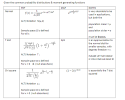 Given the common probability distributions & moment generating functions NOTES Is very desirable to be used in applications but both the PDF MGF Normal ALT/ Notation N(μ,σ) population mean μ and population st dev σ sample space Ω is defined or all X must be known. s an approximation to the normal dist for smaller samples, with degrees freedom v T dist N/A ALT/ Notation T PLEASE LET ME KNOW IF YOU FIND AN MGF Sample space is defined Forx>0...
3. Let X be a continuous random variable with probability density function ax2 + bx f(0)...
 3. Let X be a continuous random variable with probability density function ax2 + bx f(0) = -{ { for 0 < x <1 otherwise 0 where a and b are constants. If E(X) = 0.75, find a, b, and Var(X). 4. Show that an exponential random variable is memoryless. That is, if X is exponential with parameter > 0, then P(X > s+t | X > s) = P(X > t) for s,t> 0 Hint: see example 5.1 in...
Given the common probability distributions & moment generating functions NOTES Is very desirable to be used...
 Given the common probability distributions & moment generating functions NOTES Is very desirable to be used in applications but both the PDF MGF Normal ALT/ Notation N(μ,σ) population mean μ and population st dev σ sample space Ω is defined or all X must be known. s an approximation to the normal dist for smaller samples, with degrees freedom v T dist N/A ALT/ Notation T PLEASE LET ME KNOW IF YOU FIND AN MGF Sample space is defined Forx>0...
Q2. More about operations with expectation and covariances Recall that the variance of random variable X...
 Q2. More about operations with expectation and covariances Recall that the variance of random variable X is defined as Var(X) Ξ E 1(X-E(X))2」, the covariance is Cor(X, Y-E (X-E(X))(Y-E(Y)), and the correlation is Corr(X,Y) Ξ (a) What is the value of EX-E(X))? (Hint: Let μ denote E(X). Then, the parameter μ is a unknown, but fixed value like a constant.) (0.5 pt) b) The following is the proof that Var(X) E(X2) E(X)2: -E(x)-E(x)2 In a similar way, prove that Cov(X,...
 The moment generating function (MGF) for a random variable X is: Mx (t) = E[e'X]. Onc useful property of moment generating functions is that they make it relatively casy to compute weighted sums of independent random variables: Z=aX+BY M26) - Mx(at)My (Bt). (A) Derive the MGF for a Poisson random variable X with parameter 1. (B) Let X be a Poisson random variable with parameter 1, as above, and let y be a Poisson random variable with parameter y. X...
 5) Let X be a random variable with mean E(X) = μ < oo and variance Var(X) = σ2メ0. For any c> 0, This is a famous result known as Chebyshev's inequality. Suppose that Y,%, x, ar: i.id, iandool wousblsxs writia expliiniacy" iacai 's(%) fh o() airl íinic vaikuitx: Var(X) = σ2メ0. With Υ = n Ση1 Y. show that for any c > 0 Tsisis the celebraed Weak Law of Large Numben
 Please solve this. Thank you.
4.48 A Gaussian random variable has mean μ and variance σ2 (a) Show that the moment geneng fnction (MGF) for the Gaussian ran dom variable is given by Hint: Use the technique of "completing the square. b) Assume that 0 and use the MGF to compute the first four moments of x a well hvarian, sks, and kurtosis. (c) What are the mean, variance, skewness, and kurtosis for μ 0?
4.48 A Gaussian random variable...
Please solve this. Thank you.
4.48 A Gaussian random variable has mean μ and variance σ2 (a) Show that the moment geneng fnction (MGF) for the Gaussian ran dom variable is given by Hint: Use the technique of "completing the square. b) Assume that 0 and use the MGF to compute the first four moments of x a well hvarian, sks, and kurtosis. (c) What are the mean, variance, skewness, and kurtosis for μ 0?
4.48 A Gaussian random variable...
 Suppose that X1,X2, ,Xn are iid N(μ, σ2), where both parameters are unknown. Derive the likelihood ratio test (LRT) of Ho : σ2 < σ1 versus Ho : σ2 > σ.. (a) Argue that a LRT will reject Ho when w(x)S2 2 0 is large and find the critical value to confer a size α test. (b) Derive the power function of the LRT
 A random variable X has the following mgf
et
M(t)=1−t, t<1.
(a) Find the value of ∞ (−1)k E(Xk).
(b) Find the value of E(2−X).
(c) Find the value of Var(2−X).
(d) Find the probability P (X > 4).
10. A random variable X has the following mgf М() t 1 1 t (a) Find the value of 1E(Xk) (b) Find the value of E(2X). (c) Find the value of Var(2-X) k 0 k! (d) Find the probability P(X >...
A random variable X has the following mgf
et
M(t)=1−t, t<1.
(a) Find the value of ∞ (−1)k E(Xk).
(b) Find the value of E(2−X).
(c) Find the value of Var(2−X).
(d) Find the probability P (X > 4).
10. A random variable X has the following mgf М() t 1 1 t (a) Find the value of 1E(Xk) (b) Find the value of E(2X). (c) Find the value of Var(2-X) k 0 k! (d) Find the probability P(X >...
 EXERCISES the mgf of the random variable X, find P(x < 5.23). d so that P(e < X < d) = 0.95 3.3.1. If (1-2t)-6, t<½, is V3. .3.2. If X is χ2 (5), determine the constants c and and P(X < c) = 0.025.
 Given the common probability distributions & moment generating functions NOTES Is very desirable to be used in applications but both the PDF MGF Normal ALT/ Notation N(μ,σ) population mean μ and population st dev σ sample space Ω is defined or all X must be known. s an approximation to the normal dist for smaller samples, with degrees freedom v T dist N/A ALT/ Notation T PLEASE LET ME KNOW IF YOU FIND AN MGF Sample space is defined Forx>0...
 3. Let X be a continuous random variable with probability density function ax2 + bx f(0) = -{ { for 0 < x <1 otherwise 0 where a and b are constants. If E(X) = 0.75, find a, b, and Var(X). 4. Show that an exponential random variable is memoryless. That is, if X is exponential with parameter > 0, then P(X > s+t | X > s) = P(X > t) for s,t> 0 Hint: see example 5.1 in...
 Given the common probability distributions & moment generating functions NOTES Is very desirable to be used in applications but both the PDF MGF Normal ALT/ Notation N(μ,σ) population mean μ and population st dev σ sample space Ω is defined or all X must be known. s an approximation to the normal dist for smaller samples, with degrees freedom v T dist N/A ALT/ Notation T PLEASE LET ME KNOW IF YOU FIND AN MGF Sample space is defined Forx>0...
 Q2. More about operations with expectation and covariances Recall that the variance of random variable X is defined as Var(X) Ξ E 1(X-E(X))2」, the covariance is Cor(X, Y-E (X-E(X))(Y-E(Y)), and the correlation is Corr(X,Y) Ξ (a) What is the value of EX-E(X))? (Hint: Let μ denote E(X). Then, the parameter μ is a unknown, but fixed value like a constant.) (0.5 pt) b) The following is the proof that Var(X) E(X2) E(X)2: -E(x)-E(x)2 In a similar way, prove that Cov(X,...
Most questions answered within 3 hours.
-
Where is the error in this code sequence?
String s1 = "Hello";
String s2 = "ello";...
asked 10 months ago -
Financial data for Joel de Paris, Inc., for last year
follow:
Joel de Paris, Inc.
Balance...
asked 10 months ago -
Consider this reaction:
Al2(SO4)3 (aq)+ BaCl3
(aq) Al2Cl6 (aq)- +
3BaSO4(s) . What is the...
asked 10 months ago -
Suppose that Savneet is considering increasing her
recent random sample from 20 car rentals to 40...
asked 10 months ago -
Trucks arrive at an unloading terminal at an average rate of 120
per hour.
Trucks arrive...
asked 10 months ago -
Why are methanol and ethanol completely soluble in water while
octanol is not very little soluble....
asked 10 months ago -
A facilities manager at a university reads in a research report
that the mean amount of...
asked 10 months ago -
When the CuSO4 is rehydrated by adding water to the anhydrous
compound, is this an endothermic...
asked 10 months ago -
A ray of sunlight is passing from diamond into crown glass; the
angle of incidence is...
asked 10 months ago -
A block of mass 0.249 kg is placed on top of a light, vertical
spring of...
asked 10 months ago -
how do the kidneys compensate in the presences of acidosis
a) trigger hyperventilate
b) reserve acid...
asked 10 months ago -
Question 501 pts
The rental rate of capital to the firm increases. Which of the
following...
asked 10 months ago