 I need Help Please.
Homework Answers
Add Answer to:
I need Help Please.
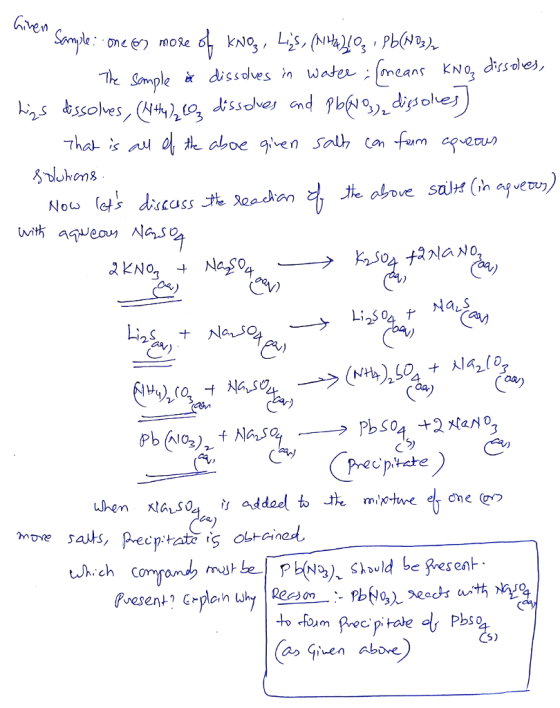
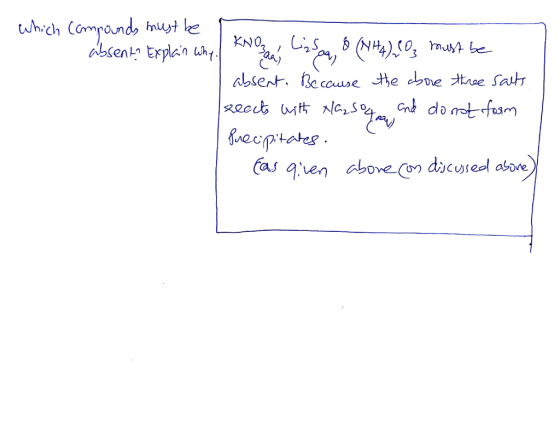
A sample consists of one or more of the following salts: KNO3,...
HELP DETERMINING POSSIBLE SALTS FROM DATA CONCLUSION. Possible salts: Ammonium nitrate, ammonium sulfate, sodium nitrate, potassium...
HELP DETERMINING POSSIBLE SALTS FROM DATA CONCLUSION. Possible salts: Ammonium nitrate, ammonium sulfate, sodium nitrate, potassium sulfide and barium nitrate. Data: The sample completely dissolves in water and is divided into 3 parts. 1. Adding silver nitrate solution results in a black precipitate that is insoluble in NH3. 2. Heating the sample after adding sodium hydroxide produces a gas with the odor of ammonia and which turns litmus paper blue. 3. Adding sodium sulfate solution results in a white precipitate....
Regarding the following salts: NaCN, KNO3, NH4Cl, NaHCO3, Na3PO4, please review the hydrolysis net ionic equations...
Regarding the following salts: NaCN, KNO3, NH4Cl, NaHCO3, Na3PO4, please review the hydrolysis net ionic equations below and provide specific information in sentences regarding why the following salts were classified as acids/bases/neutral -why the salt was classified the way it was (acidic/basic/neutral) -which ions are reacting in each salt/equation and are the ions behaving as an acid or a base -why is the ion behaving that way -and why other ions may not be reactive pls answer all qs for...
i need help answering these qoustions plz?????? Based on the solubility rules given in class, classify...
 i need help answering these qoustions plz??????
Based on the solubility rules given in class, classify the following compounds as solid (s) or aqueous (aq) when added to water: a) Al(OH)3 b) Li3PO4 c) BaSO4 d) (NH4)2CO3 c) Mg(ClO3)2 f) HgCl2 Which combination of reactants results in an acid/base neutralization reaction? a. HNO3(aq) + Zn(s) → b. Mg(C104)2(aq) + NaOH(aq) → c. Ca(s) + H2SO4(aq) - d. H2CO3(aq) + LiOH(aq) → CA OB C What is the net ionic equation...
i need help answering these qoustions plz??????
Based on the solubility rules given in class, classify the following compounds as solid (s) or aqueous (aq) when added to water: a) Al(OH)3 b) Li3PO4 c) BaSO4 d) (NH4)2CO3 c) Mg(ClO3)2 f) HgCl2 Which combination of reactants results in an acid/base neutralization reaction? a. HNO3(aq) + Zn(s) → b. Mg(C104)2(aq) + NaOH(aq) → c. Ca(s) + H2SO4(aq) - d. H2CO3(aq) + LiOH(aq) → CA OB C What is the net ionic equation...
16) Write a balanced net ionic equation for the reaction of H2SO4iag) with Ba(OH)2(g) A) Ba2+(ag)...
 16) Write a balanced net ionic equation for the reaction of H2SO4iag) with Ba(OH)2(g) A) Ba2+(ag) + SO42-(a)- BaSO4) B) 2 H+(aq) SO42-(a) Ba2 (ag) +2 OH-(a)-BaSO4(0 2 H20) C) H2SO4(a) + Ba(OH)2(e) - BaSO40) 2 H20() D) H (ag) OH(ag)--H2O) 16) 17) Write a balanced net ionic equation for the reaction of Pb(NO3)2(ag) with Nal(ag). A) Pb2 (ag)+2 NO3-(4g) +2 Na+ (ag) +2 1-(a4)-- Pb2+(ag)+ 2 1-(a4)+ 2 Na (a) +2 NO3-(a) B) Pb2+(ag) 2 NO3-(a) + 2 Na...
Hello, i did a lab where i was given a sample of contaminated water and must determine the identity of the metals and m...
 Hello, i did a lab where i was given a sample of contaminated water
and must determine the identity of the metals and must percipitate
one out. I was able to determine the identity of metal Y which is
aluminium and metal X which is lithium. Im confused on part 3
though. lithium and alumnium are soluble in almost anything and i
cant use hydroxide or carbonate since lithium is in there, some
help please! I would also like to...
Hello, i did a lab where i was given a sample of contaminated water
and must determine the identity of the metals and must percipitate
one out. I was able to determine the identity of metal Y which is
aluminium and metal X which is lithium. Im confused on part 3
though. lithium and alumnium are soluble in almost anything and i
cant use hydroxide or carbonate since lithium is in there, some
help please! I would also like to...
I need help with questions 4 and 7 please 1 Cation Analysis Prelaboratory Questions DIXON No.2...
 I need help with questions 4 and 7 please
1 Cation Analysis Prelaboratory Questions DIXON No.2 HB 1. Ag, Hg2+, and Pb2+ belong to group I cations. What specific reaction do they all undergo? What is the distinctive observation for this reaction? The observation, that they will occur is that a white preciptate will form. They will react with dilluted HCl. 2. Describe the solubility of compounds AgCl, PbCl2, and HgCl, in a) room temperature water. AGCI PbCl₂ insluable HgzCl₂...
I need help with questions 4 and 7 please
1 Cation Analysis Prelaboratory Questions DIXON No.2 HB 1. Ag, Hg2+, and Pb2+ belong to group I cations. What specific reaction do they all undergo? What is the distinctive observation for this reaction? The observation, that they will occur is that a white preciptate will form. They will react with dilluted HCl. 2. Describe the solubility of compounds AgCl, PbCl2, and HgCl, in a) room temperature water. AGCI PbCl₂ insluable HgzCl₂...
the questions, please. thank you. Report Sheet Reactions in Aqueous Solutions: Metathesis Reactions and Net Tonle...
 the
questions, please.
thank you.
Report Sheet Reactions in Aqueous Solutions: Metathesis Reactions and Net Tonle Equations 2. Crystal shape_ Needles 3. Identity of crystals 4. Temperature of filtrate 52°C 5. Crystal shape of second batch 6. Identity of second batch of crystals 7. Crystal shape of third batch 8. Identity of third batch of crystals QUESTIONS Y. Which of the following reactions are metathesis reactions? (a) 2KCIO, — 2KCI +302 (b) Cu(NO3)2 + Zn — Cu + Zn(NO)2 (c)...
the
questions, please.
thank you.
Report Sheet Reactions in Aqueous Solutions: Metathesis Reactions and Net Tonle Equations 2. Crystal shape_ Needles 3. Identity of crystals 4. Temperature of filtrate 52°C 5. Crystal shape of second batch 6. Identity of second batch of crystals 7. Crystal shape of third batch 8. Identity of third batch of crystals QUESTIONS Y. Which of the following reactions are metathesis reactions? (a) 2KCIO, — 2KCI +302 (b) Cu(NO3)2 + Zn — Cu + Zn(NO)2 (c)...
I need help with these 3 questions. Any explanation would be great too! Thank you! 1....
 I need help with these 3 questions. Any explanation would be
great too! Thank you!
1. Without doing a calculation, predict which of these compounds has the greatest molar solubility in water: AgCI (Ksp=1.8x10⁻¹⁰), AgBr (Ksp 5.0x10⁻¹³), or AgI (Ksp=8.3x10⁻¹⁷). Optional Answers: 1. AgI is the most soluble of the three. 2. AgBr is the most soluble of the three. 3. AgCl is the most soluble of the three 4. All of the compounds are totally insoluble based on their...
I need help with these 3 questions. Any explanation would be
great too! Thank you!
1. Without doing a calculation, predict which of these compounds has the greatest molar solubility in water: AgCI (Ksp=1.8x10⁻¹⁰), AgBr (Ksp 5.0x10⁻¹³), or AgI (Ksp=8.3x10⁻¹⁷). Optional Answers: 1. AgI is the most soluble of the three. 2. AgBr is the most soluble of the three. 3. AgCl is the most soluble of the three 4. All of the compounds are totally insoluble based on their...
I concluded that my unknown was Pb2+. since yellow precipitate formed. can you help me answer...
 I concluded that my unknown was Pb2+. since yellow
precipitate formed. can you help me answer the questions for the
Known and unknown report
Qualitative Analysis: Group I Cations 10 ORECTIVES A Leam some chemistry of Group I cations, R Analyze an unknown for Group I cations. THEORY AND DISCUSSION Group I cations are precipitated as insoluble chlorides: Ag, Pb, Hg2 +Cr-AgCl, PbCh, HgCla The colors of the following species will be helpful in the analysis for Group I cations....
I concluded that my unknown was Pb2+. since yellow
precipitate formed. can you help me answer the questions for the
Known and unknown report
Qualitative Analysis: Group I Cations 10 ORECTIVES A Leam some chemistry of Group I cations, R Analyze an unknown for Group I cations. THEORY AND DISCUSSION Group I cations are precipitated as insoluble chlorides: Ag, Pb, Hg2 +Cr-AgCl, PbCh, HgCla The colors of the following species will be helpful in the analysis for Group I cations....
Part a please Question 3 (30 pts) Lead nitrate (Pb(NO3)2) is a toxic compound used in...
 Part a please
Question 3 (30 pts) Lead nitrate (Pb(NO3)2) is a toxic compound used in lead paints in the past. It has far less use now, in specialized applications such as gold extraction. Unlike most lead salts, lead nitrate is soluble in water, as seen below in the solubility chart. After aqueous gold recovery, it is desired to recover the lead nitrate from the water via crystallization. A 70°C aqueous lead nitrate solution containing 50 wt% lead nitrate and...
Part a please
Question 3 (30 pts) Lead nitrate (Pb(NO3)2) is a toxic compound used in lead paints in the past. It has far less use now, in specialized applications such as gold extraction. Unlike most lead salts, lead nitrate is soluble in water, as seen below in the solubility chart. After aqueous gold recovery, it is desired to recover the lead nitrate from the water via crystallization. A 70°C aqueous lead nitrate solution containing 50 wt% lead nitrate and...
 i need help answering these qoustions plz??????
Based on the solubility rules given in class, classify the following compounds as solid (s) or aqueous (aq) when added to water: a) Al(OH)3 b) Li3PO4 c) BaSO4 d) (NH4)2CO3 c) Mg(ClO3)2 f) HgCl2 Which combination of reactants results in an acid/base neutralization reaction? a. HNO3(aq) + Zn(s) → b. Mg(C104)2(aq) + NaOH(aq) → c. Ca(s) + H2SO4(aq) - d. H2CO3(aq) + LiOH(aq) → CA OB C What is the net ionic equation...
i need help answering these qoustions plz??????
Based on the solubility rules given in class, classify the following compounds as solid (s) or aqueous (aq) when added to water: a) Al(OH)3 b) Li3PO4 c) BaSO4 d) (NH4)2CO3 c) Mg(ClO3)2 f) HgCl2 Which combination of reactants results in an acid/base neutralization reaction? a. HNO3(aq) + Zn(s) → b. Mg(C104)2(aq) + NaOH(aq) → c. Ca(s) + H2SO4(aq) - d. H2CO3(aq) + LiOH(aq) → CA OB C What is the net ionic equation...
 16) Write a balanced net ionic equation for the reaction of H2SO4iag) with Ba(OH)2(g) A) Ba2+(ag) + SO42-(a)- BaSO4) B) 2 H+(aq) SO42-(a) Ba2 (ag) +2 OH-(a)-BaSO4(0 2 H20) C) H2SO4(a) + Ba(OH)2(e) - BaSO40) 2 H20() D) H (ag) OH(ag)--H2O) 16) 17) Write a balanced net ionic equation for the reaction of Pb(NO3)2(ag) with Nal(ag). A) Pb2 (ag)+2 NO3-(4g) +2 Na+ (ag) +2 1-(a4)-- Pb2+(ag)+ 2 1-(a4)+ 2 Na (a) +2 NO3-(a) B) Pb2+(ag) 2 NO3-(a) + 2 Na...
 Hello, i did a lab where i was given a sample of contaminated water
and must determine the identity of the metals and must percipitate
one out. I was able to determine the identity of metal Y which is
aluminium and metal X which is lithium. Im confused on part 3
though. lithium and alumnium are soluble in almost anything and i
cant use hydroxide or carbonate since lithium is in there, some
help please! I would also like to...
Hello, i did a lab where i was given a sample of contaminated water
and must determine the identity of the metals and must percipitate
one out. I was able to determine the identity of metal Y which is
aluminium and metal X which is lithium. Im confused on part 3
though. lithium and alumnium are soluble in almost anything and i
cant use hydroxide or carbonate since lithium is in there, some
help please! I would also like to...
 I need help with questions 4 and 7 please
1 Cation Analysis Prelaboratory Questions DIXON No.2 HB 1. Ag, Hg2+, and Pb2+ belong to group I cations. What specific reaction do they all undergo? What is the distinctive observation for this reaction? The observation, that they will occur is that a white preciptate will form. They will react with dilluted HCl. 2. Describe the solubility of compounds AgCl, PbCl2, and HgCl, in a) room temperature water. AGCI PbCl₂ insluable HgzCl₂...
I need help with questions 4 and 7 please
1 Cation Analysis Prelaboratory Questions DIXON No.2 HB 1. Ag, Hg2+, and Pb2+ belong to group I cations. What specific reaction do they all undergo? What is the distinctive observation for this reaction? The observation, that they will occur is that a white preciptate will form. They will react with dilluted HCl. 2. Describe the solubility of compounds AgCl, PbCl2, and HgCl, in a) room temperature water. AGCI PbCl₂ insluable HgzCl₂...
 the
questions, please.
thank you.
Report Sheet Reactions in Aqueous Solutions: Metathesis Reactions and Net Tonle Equations 2. Crystal shape_ Needles 3. Identity of crystals 4. Temperature of filtrate 52°C 5. Crystal shape of second batch 6. Identity of second batch of crystals 7. Crystal shape of third batch 8. Identity of third batch of crystals QUESTIONS Y. Which of the following reactions are metathesis reactions? (a) 2KCIO, — 2KCI +302 (b) Cu(NO3)2 + Zn — Cu + Zn(NO)2 (c)...
the
questions, please.
thank you.
Report Sheet Reactions in Aqueous Solutions: Metathesis Reactions and Net Tonle Equations 2. Crystal shape_ Needles 3. Identity of crystals 4. Temperature of filtrate 52°C 5. Crystal shape of second batch 6. Identity of second batch of crystals 7. Crystal shape of third batch 8. Identity of third batch of crystals QUESTIONS Y. Which of the following reactions are metathesis reactions? (a) 2KCIO, — 2KCI +302 (b) Cu(NO3)2 + Zn — Cu + Zn(NO)2 (c)...
 I need help with these 3 questions. Any explanation would be
great too! Thank you!
1. Without doing a calculation, predict which of these compounds has the greatest molar solubility in water: AgCI (Ksp=1.8x10⁻¹⁰), AgBr (Ksp 5.0x10⁻¹³), or AgI (Ksp=8.3x10⁻¹⁷). Optional Answers: 1. AgI is the most soluble of the three. 2. AgBr is the most soluble of the three. 3. AgCl is the most soluble of the three 4. All of the compounds are totally insoluble based on their...
I need help with these 3 questions. Any explanation would be
great too! Thank you!
1. Without doing a calculation, predict which of these compounds has the greatest molar solubility in water: AgCI (Ksp=1.8x10⁻¹⁰), AgBr (Ksp 5.0x10⁻¹³), or AgI (Ksp=8.3x10⁻¹⁷). Optional Answers: 1. AgI is the most soluble of the three. 2. AgBr is the most soluble of the three. 3. AgCl is the most soluble of the three 4. All of the compounds are totally insoluble based on their...
 I concluded that my unknown was Pb2+. since yellow
precipitate formed. can you help me answer the questions for the
Known and unknown report
Qualitative Analysis: Group I Cations 10 ORECTIVES A Leam some chemistry of Group I cations, R Analyze an unknown for Group I cations. THEORY AND DISCUSSION Group I cations are precipitated as insoluble chlorides: Ag, Pb, Hg2 +Cr-AgCl, PbCh, HgCla The colors of the following species will be helpful in the analysis for Group I cations....
I concluded that my unknown was Pb2+. since yellow
precipitate formed. can you help me answer the questions for the
Known and unknown report
Qualitative Analysis: Group I Cations 10 ORECTIVES A Leam some chemistry of Group I cations, R Analyze an unknown for Group I cations. THEORY AND DISCUSSION Group I cations are precipitated as insoluble chlorides: Ag, Pb, Hg2 +Cr-AgCl, PbCh, HgCla The colors of the following species will be helpful in the analysis for Group I cations....
 Part a please
Question 3 (30 pts) Lead nitrate (Pb(NO3)2) is a toxic compound used in lead paints in the past. It has far less use now, in specialized applications such as gold extraction. Unlike most lead salts, lead nitrate is soluble in water, as seen below in the solubility chart. After aqueous gold recovery, it is desired to recover the lead nitrate from the water via crystallization. A 70°C aqueous lead nitrate solution containing 50 wt% lead nitrate and...
Part a please
Question 3 (30 pts) Lead nitrate (Pb(NO3)2) is a toxic compound used in lead paints in the past. It has far less use now, in specialized applications such as gold extraction. Unlike most lead salts, lead nitrate is soluble in water, as seen below in the solubility chart. After aqueous gold recovery, it is desired to recover the lead nitrate from the water via crystallization. A 70°C aqueous lead nitrate solution containing 50 wt% lead nitrate and...
Most questions answered within 3 hours.
-
Where is the error in this code sequence?
String s1 = "Hello";
String s2 = "ello";...
asked 10 months ago -
Financial data for Joel de Paris, Inc., for last year
follow:
Joel de Paris, Inc.
Balance...
asked 10 months ago -
Consider this reaction:
Al2(SO4)3 (aq)+ BaCl3
(aq) Al2Cl6 (aq)- +
3BaSO4(s) . What is the...
asked 10 months ago -
Suppose that Savneet is considering increasing her
recent random sample from 20 car rentals to 40...
asked 10 months ago -
Trucks arrive at an unloading terminal at an average rate of 120
per hour.
Trucks arrive...
asked 10 months ago -
Why are methanol and ethanol completely soluble in water while
octanol is not very little soluble....
asked 10 months ago -
A facilities manager at a university reads in a research report
that the mean amount of...
asked 10 months ago -
When the CuSO4 is rehydrated by adding water to the anhydrous
compound, is this an endothermic...
asked 10 months ago -
A ray of sunlight is passing from diamond into crown glass; the
angle of incidence is...
asked 10 months ago -
A block of mass 0.249 kg is placed on top of a light, vertical
spring of...
asked 10 months ago -
how do the kidneys compensate in the presences of acidosis
a) trigger hyperventilate
b) reserve acid...
asked 10 months ago -
Question 501 pts
The rental rate of capital to the firm increases. Which of the
following...
asked 10 months ago