Stock A's stock has a beta of 1.30, and its required return is 16.00%. Stock B's...
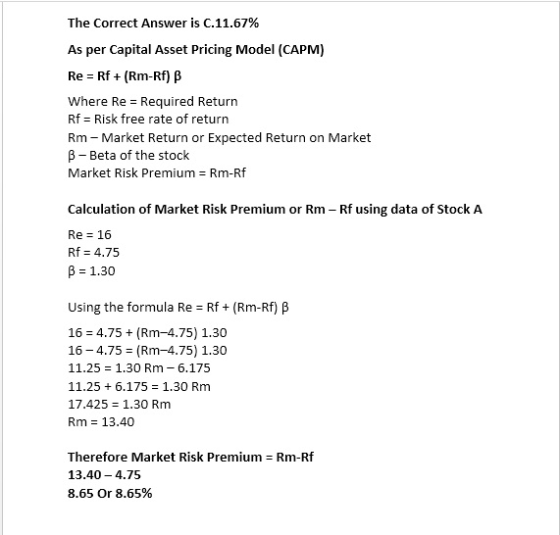
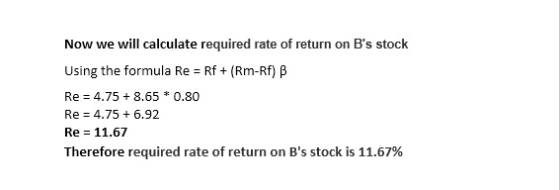
Stock A's stock has a beta of 1.30, and its required return is 16.00%. Stock B's beta is 0.80. If the risk-free rate is 4.75%, what is the required rate of return on B's stock? (Hint: First find the market risk premium.)
Select the correct answer.
|
|||
|
|||
|
|||
|
|||
|
Homework Answers
Add Answer to:
Stock A's stock has a beta of 1.30, and its required return is
16.00%. Stock B's...
Stock A's stock has a beta of 1.30, and its required return is 15.25%. Stock B's...
 Stock A's stock has a beta of 1.30, and its required return is 15.25%. Stock B's beta is 0.80. If the risk-free rate is 2.75%, what is the required rate of return on B's stock? (Hint: First find the market risk premium.) Do not round your intermediate calculations. 9.40% 11.38% 10.44% 10.76% 12.22%
Stock A's stock has a beta of 1.5, and its required return is 12.00%. Stock B's...
 Stock A's stock has a beta of 1.5, and its required return is 12.00%. Stock B's beta is 0.80. If the risk-free rate is 4.75%, what is the required rate of return on B's stock? (Hint: First find the market risk premium using information about stock A.) A. 7.97% O B. 8.62% ○ C. 8.98% ○ D, 9.21% O E. 9.58%
Company A has a beta of 0.70, while Company B's beta is 0.95. The required return...
Company A has a beta of 0.70, while Company B's beta is 0.95. The required return on the stock market is 11.00%, and the risk-free rate is 4.25%. What is the difference between A's and B's required rates of return? Select the correct answer. a. 1.41% b. 1.48% c. 1.55% d. 1.62% e. 1.69%
. Company A has a beta of 0.80, while Company B's beta is 1.25. The required...
. Company A has a beta of 0.80, while Company B's beta is 1.25. The required return on the stock market is 11.00%, and the risk-free rate is 4%. What is the difference between A's and B's required rates of return? Show work
If the current risk-free rate is 6%; Stock A has a beta of 1.0; Stock B...
If the current risk-free rate is 6%; Stock A has a beta of 1.0; Stock B has a beta of 2.0; and the market risk premium, r M – r RF, is positive. Which of the following statements is CORRECT? a. If the risk-free rate increases but the market risk premium stays unchanged, Stock B's required return will increase by more than Stock A's. b. If Stock B's required return is 11%, then the market risk premium is 2.5%. c....
Stock Y has a beta of 1.30 and an expected return of 13.5 percent. Stock Z...
Stock Y has a beta of 1.30 and an expected return of 13.5 percent. Stock Z has a beta of .75 and an expected return of 10.6 percent. If the risk-free rate is 4.75 percent and the market risk premium is 7.25 percent, are these stocks overvalued or undervalued? stock Y = ______ stock Z = ______
Stock Y has a beta of 1.30 and an expected return of 15.3%. Stock Z has...
Stock Y has a beta of 1.30 and an expected return of 15.3%. Stock Z has a beta of 0.70 and an expected return of 9.3%. If the risk-free rate if 5.5% and the market risk premium is 6.8%, are these stocks correctly priced?
15. Newsome's stock has a beta of 1.20, Its required return is 11.50%, and the risk-free rate the required rate of...
 15. Newsome's stock has a beta of 1.20, Its required return is 11.50%, and the risk-free rate the required rate of return on the market? (Hint: First find the market risk premium.) a. 10.30% b. 10.62% c. 10.88% d. 10.15% e. 11.43% d return is 11.50%, and the risk-free rate is 4.30%. What is VRP
Lagard's stock had a required return of 11.75% last year, when the risk-free rate was 5.50%...
Lagard's stock had a required return of 11.75% last year, when the risk-free rate was 5.50% and the market risk premium was 4.75%. Then an increase in investor risk aversion caused the market risk premium to rise by 1.5%. The risk-free rate and the firm's beta remain unchanged. What is the company's new required rate of return? (Hint: First calculate the beta, then find the required return.)
company a has a beta of 0.70 while company b beta is 1.45. the required return...
company a has a beta of 0.70 while company b beta is 1.45. the required return on the stock market is 11.00%. and the risk-free rate is 4.25%. what is the difference between A's and B's required rate of return?
 Stock A's stock has a beta of 1.30, and its required return is 15.25%. Stock B's beta is 0.80. If the risk-free rate is 2.75%, what is the required rate of return on B's stock? (Hint: First find the market risk premium.) Do not round your intermediate calculations. 9.40% 11.38% 10.44% 10.76% 12.22%
 Stock A's stock has a beta of 1.5, and its required return is 12.00%. Stock B's beta is 0.80. If the risk-free rate is 4.75%, what is the required rate of return on B's stock? (Hint: First find the market risk premium using information about stock A.) A. 7.97% O B. 8.62% ○ C. 8.98% ○ D, 9.21% O E. 9.58%
 15. Newsome's stock has a beta of 1.20, Its required return is 11.50%, and the risk-free rate the required rate of return on the market? (Hint: First find the market risk premium.) a. 10.30% b. 10.62% c. 10.88% d. 10.15% e. 11.43% d return is 11.50%, and the risk-free rate is 4.30%. What is VRP
Most questions answered within 3 hours.
-
Where is the error in this code sequence?
String s1 = "Hello";
String s2 = "ello";...
asked 11 months ago -
Financial data for Joel de Paris, Inc., for last year
follow:
Joel de Paris, Inc.
Balance...
asked 11 months ago -
Consider this reaction:
Al2(SO4)3 (aq)+ BaCl3
(aq) Al2Cl6 (aq)- +
3BaSO4(s) . What is the...
asked 11 months ago -
Suppose that Savneet is considering increasing her
recent random sample from 20 car rentals to 40...
asked 11 months ago -
Trucks arrive at an unloading terminal at an average rate of 120
per hour.
Trucks arrive...
asked 11 months ago -
Why are methanol and ethanol completely soluble in water while
octanol is not very little soluble....
asked 11 months ago -
A facilities manager at a university reads in a research report
that the mean amount of...
asked 11 months ago -
When the CuSO4 is rehydrated by adding water to the anhydrous
compound, is this an endothermic...
asked 11 months ago -
A ray of sunlight is passing from diamond into crown glass; the
angle of incidence is...
asked 11 months ago -
A block of mass 0.249 kg is placed on top of a light, vertical
spring of...
asked 11 months ago -
how do the kidneys compensate in the presences of acidosis
a) trigger hyperventilate
b) reserve acid...
asked 11 months ago -
Question 501 pts
The rental rate of capital to the firm increases. Which of the
following...
asked 11 months ago