
Homework Answers
Add Answer to:
2 5 centimeter SR-militer S . O millimeter 100 micrometer 2 gram nanjorams 2 20 Q.2....
0.5. What fraction of the offsprings of two parents with Sickle cell trait would you expect...
 0.5. What fraction of the offsprings of two parents with Sickle cell trait would you expect to have Sickle cell anemia? Q.6. List the major steps you undertake for performing ELISA? 0.7. Describe an ELISA procedure you'll undertake to determine if a person is infected with AIDS virus? Q.3. In the two protein gel electrophoresis labs done in this class, proteins were separated based on their net charge or their size (weight). Explain similarities and differences between these two laboratory...
Protein Electrophoresis Isoelectric Point Proteins, Cytochrome C = 102 Myoglobin = 7.2 Hemoglobin = 6.8 Serum...
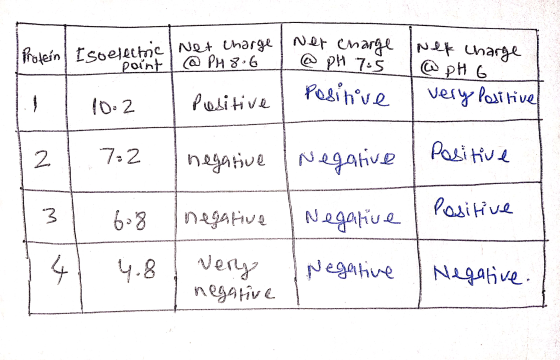
 Protein Electrophoresis Isoelectric Point Proteins, Cytochrome C = 102 Myoglobin = 7.2 Hemoglobin = 6.8 Serum albumin = 4.8 Jusalycine buffer pH = 8.6 Protein Direction Travelled Net Charge Cytochrome C Myoglobin Hemoglobin Serum Albumin Would you expect the same results if you performed the experiment using a buffer with a pH of 6.0? How would the results change? 59 words Focus 3 -- Type here to search
Protein molecules in solution can be separated from each other by taking advantage of their net...
Protein molecules in solution can be separated from each other by taking advantage of their net charges. In the electric field between two electrodes, a positively charged particle moves toward the negative electrode and a negatively charged particle moves toward the positive electrode. This movement, known as electrophoresis, varies with the strength of the electric field, the charge of the particle, the size and shape of the particle, and the buffer/polymer gel combination through which the protein is moving. The...
1. Serum albumin pI=4.8 (blue) 2. Cytochrome C: pI =10.2 &
1. Serum albumin pI=4.8 (blue) 2. Cytochrome C: pI =10.2 3. Hemoglobin (rabbit): pI=6.8 4. Myoglobin: pI=7.2 The pH of the Tris-Glycine buffer used in Part A is 8.6, what is the net charge on the protein molecules in the samples? Which electrode should each sample migrate toward during the electrophoretic separation? (4 points)
Biochem help 2 14. What would be the net charge on the dipeptide Ser-His at pH-...
 Biochem help 2
14. What would be the net charge on the dipeptide Ser-His at pH- 6.04? (Choose the one best answer.) a) 1.5 b) +1; c) +0.5 d) 0 e) -0.5; 15. The pKa of a lysine side chain in a protein ending up on the outside of a globular protein has a different pKa than if the lysine is buried within the interior of a protein. What would be the expected pKa of a side chain of lysine...
Biochem help 2
14. What would be the net charge on the dipeptide Ser-His at pH- 6.04? (Choose the one best answer.) a) 1.5 b) +1; c) +0.5 d) 0 e) -0.5; 15. The pKa of a lysine side chain in a protein ending up on the outside of a globular protein has a different pKa than if the lysine is buried within the interior of a protein. What would be the expected pKa of a side chain of lysine...
 0.5. What fraction of the offsprings of two parents with Sickle cell trait would you expect to have Sickle cell anemia? Q.6. List the major steps you undertake for performing ELISA? 0.7. Describe an ELISA procedure you'll undertake to determine if a person is infected with AIDS virus? Q.3. In the two protein gel electrophoresis labs done in this class, proteins were separated based on their net charge or their size (weight). Explain similarities and differences between these two laboratory...
 Protein Electrophoresis Isoelectric Point Proteins, Cytochrome C = 102 Myoglobin = 7.2 Hemoglobin = 6.8 Serum albumin = 4.8 Jusalycine buffer pH = 8.6 Protein Direction Travelled Net Charge Cytochrome C Myoglobin Hemoglobin Serum Albumin Would you expect the same results if you performed the experiment using a buffer with a pH of 6.0? How would the results change? 59 words Focus 3 -- Type here to search
 Biochem help 2
14. What would be the net charge on the dipeptide Ser-His at pH- 6.04? (Choose the one best answer.) a) 1.5 b) +1; c) +0.5 d) 0 e) -0.5; 15. The pKa of a lysine side chain in a protein ending up on the outside of a globular protein has a different pKa than if the lysine is buried within the interior of a protein. What would be the expected pKa of a side chain of lysine...
Biochem help 2
14. What would be the net charge on the dipeptide Ser-His at pH- 6.04? (Choose the one best answer.) a) 1.5 b) +1; c) +0.5 d) 0 e) -0.5; 15. The pKa of a lysine side chain in a protein ending up on the outside of a globular protein has a different pKa than if the lysine is buried within the interior of a protein. What would be the expected pKa of a side chain of lysine...
Most questions answered within 3 hours.
-
Where is the error in this code sequence?
String s1 = "Hello";
String s2 = "ello";...
asked 10 months ago -
Financial data for Joel de Paris, Inc., for last year
follow:
Joel de Paris, Inc.
Balance...
asked 10 months ago -
Consider this reaction:
Al2(SO4)3 (aq)+ BaCl3
(aq) Al2Cl6 (aq)- +
3BaSO4(s) . What is the...
asked 10 months ago -
Suppose that Savneet is considering increasing her
recent random sample from 20 car rentals to 40...
asked 10 months ago -
Trucks arrive at an unloading terminal at an average rate of 120
per hour.
Trucks arrive...
asked 10 months ago -
Why are methanol and ethanol completely soluble in water while
octanol is not very little soluble....
asked 10 months ago -
A facilities manager at a university reads in a research report
that the mean amount of...
asked 10 months ago -
When the CuSO4 is rehydrated by adding water to the anhydrous
compound, is this an endothermic...
asked 10 months ago -
A ray of sunlight is passing from diamond into crown glass; the
angle of incidence is...
asked 10 months ago -
A block of mass 0.249 kg is placed on top of a light, vertical
spring of...
asked 10 months ago -
how do the kidneys compensate in the presences of acidosis
a) trigger hyperventilate
b) reserve acid...
asked 10 months ago -
Question 501 pts
The rental rate of capital to the firm increases. Which of the
following...
asked 10 months ago