With e-government accountability and information tools provided to the public, think of an e-government service or...
If you have not used a tool or service, think of an e-government tool or service that you would like to see implemented.
Homework Answers
M-governance is a sub-domain of e-governance. It ensures that electronic services are available to people via mobile technologies using devices such as mobile phones. These services bypass the need for traditional physical networks for communications and collaboration. Mobile services are also cheaper as well as accessible in most of the rural areas in India.
Increasing the mobile phone accessibility, adaptability and with the millions of subscription base, governments are promoting and using the mobile phone in delivery the e-Governance services. In the last few years, governments have seen mobile phones can empower citizens and affect the way citizens interact with each other and with society at large. Mobile phones are also considered to be an effective tool in strengthening democracy through better citizen-government interaction, thus influencing the political decision making process and making governments accountable for their activities.
Objective of M-Governance
M-Governance aims at providing fast and easy access of public services to citizens through mobile devices. Mobile services are quickly emerging as the new frontier in transforming government and making it even more accessible and citizen-centric by extending the benefits of remote delivery of government services and information. Delivering timely and accurate information to citizens and an established system of two-way communication between the government and people is one of the keys to strengthening democracy by facilitating enhanced utilisation of public services, participation and empowerment of citizens. The use of mobile technologies has been prominent in government departments especially in agriculture, health care, financial services, retail trading, utilities, communications, manufacturing, transportation and services. Businesses too have woken to the popularity of mobile phones and are introducing services, especially in the Banking sector. Mobile banking is the future because of its cost effectiveness and ability to reach out to customers in remote areas.Today, the ‘Mobile Phone’ is not just used as a communication tool to instantly communicate or send and get text and voice messages. It has emerged as the strongest technology to bridge the digital divide between urban haves and rural have-nots. Within two decades of its launch in India, mobile phone has reached remote rural areas despite hurdles like lack of connectivity and electricity and low level of literacy. On the other side, it has created lakhs of direct and indirect job opportunities for the youth. In the second phase of the development, it has emerged as a delivery channel for different kind of services, and now anyone can transfer money from one bank account to another through their mobile phones. The government and private agencies have also started using ‘Mobile Phone’ to deliver business services to the citizen and customers. The Reserve Bank of India had allowed commercial banks to provide banking services on mobile phones, whereas the Government of India had also approved the ‘Framework for delivering financial services through the mobile phone’ developed by inter-ministerial group. In continuation Government of India has launched mobile seva and its aims to provide government services to the people through mobile phones and tablets. It has been developed as the core infrastructure for enabling the availability of public services through mobile devices. After the launch of 3G technologies in India, citizens are now be able to access health, educational, agricultural, infotainment services on their mobile phones Government of India aims to utilize the massive reach of mobile phones and harness the potential of mobile applications to enable easy and round-the-clock access to public services, especially in the rural areas and to create unique infrastructure as well as application development ecosystem for m-Governance in the country. The Government of India is implementing the “Digital India” programme with a vision to transform India into a digitally empowered society and a knowledge economy. Under the Digital India programme, e-Kranti envisages provisioning of various e-Governance services in the country. The focus of the e- Kranti programme is to transform the e-Governance services by expanding the portfolio of Mission Mode Projects (MMPs) in e-Governance under various Government Departments, undertaking Government Process Reengineering (GPR), work flow automation, introducing latest technologies such as Cloud and mobile platform and focus on integration of services. The Ministry of Electronics and Information Technology developed and notified the framework for Mobile Governance in February, 2012. The m - Governance framework of Government of India aims to utilize the massive reach of mobile phones and harness the potential of mobile applications to enable easy and round - the - clock access to public services, especially in the rural areas. The framework aims to create unique infrastructure as well as application development ecosystem for m - Governance in the country. Following are the main measures laid down by MEIT:
- Web sites of all Government Departments and Agencies shall be made mobile-compliant, using the “One Web” approach.
- Open standards shall be adopted for mobile applications for ensuring the inter-operability of applications across various operating systems and devices as per the Government Policy on Open Standards for e-Governance.
- Uniform/ single pre-designated numbers (long and short codes) shall be used for mobile-based services to ensure convenience.
- All Government Departments and Agencies shall develop and deploy mobile applications for providing all their public services through mobile devices to the extent feasible on the mobile platform. They shall also specify the service levels for such services.
To ensure adoption and implementation of the framework in time bound manner the government developed the Mobile Service Delivery Gateway (MSDG) that is the core infrastructure for enabling the availability of public services in through mobile devices. The MSDG enables delivery of public services over mobile devices through various mobile based channels, such as SMS, USSD, IVRS and mobile applications. The objective of creating the MSDG is to put in place government‐wide shared infrastructure and services to enable rapid development, mainstreaming and deployment of m-Governance services. It enhances interoperability across various public services as well as reduces the total cost of operation of m-Governance services by providing a common pool of resources aggregating the demand for communication and e‐Governance services, and act as a platform for various Government Departments and Agencies to test, rapidly deploy, and easily maintain m-Governance services across the country. The infrastructure is based on open standards and has been developed as a cloud based service. MSDG supports the following delivery channels for development and deployment of mobile-based applications for Government services. As the mobile-based technologies are constantly evolving, more channels may be added in future as the need arises.
- SMS (Short Message Service)
- IVRS (Interactive Voice Response System)
- USSD (Unstructured Supplementary Service Data)
- CBS (Cell Broadcasting Services)
- LBS (Location Based Services)
- Mobile Payment Service
- One Web” means making, as far as possible, the same information and services available to users, irrespective of the device or the browser they are using. This implies that all Government Web sites should be compliant with mobile devices to enable users of such devices to access the same information and services (to the extent possible) as available, say, over the internet through computers.
In this era of mobile phones, we have noticed that mobile technology has significantly changed the life of people, making it more comfortable and efficient. It enhances the capability of delivering business and client-centric government services. Empowering citizens and affecting the way they are interacting with each other and with the society, mobile phones are playing the biggest role and considered as an effective tool in firming equality through better citizen-government interaction. Thus, it impels the political decision-making process and making governments accountable for their activities. A sub-domain of e-governance, M-governance ensures that people can access electronic services through mobile technologies. Electronic services have eliminated the need of a traditional way of communicating and collaborating, making everything a lot simpler. We all know that mobile phones are extremely cheaper and accessible in varied rural areas in India and other Asian countries Gone are the days when mobile phones were used as a communication tool to instantly communicate or send a text message. Now, mobile phones are considered as the robust technology that bridges the gap between urban haves and rural have-nots. It has been almost two decades ago since the mobile phones were launched in India, and today, it has reached remote rural areas in spite of various hurdles such as lack of connectivity, low level of literacy, etc.A highly emerging channel for delivering different services, mobile phones allow people to access various civic services by which they can directly communicate with the government officers and take benefit of citizen services.In an attempt to serve citizens better services through mobile phones, NDMC (New Delhi Municipal Council) has launched the most powerful mobile-based citizen application that is called NDMC-311.Residents of NDMC area can access enormous civic services like report non-emergency issue, access citizen services, get real-time traffic and parking information of NDMC areas, instantly pay their basic amenities bills, find nearby places of their location, etc. using their mobile phone. So, this proved to be a very useful app launched by Indian government.
Add Answer to:
With e-government accountability and information tools provided to
the public, think of an e-government service or...
Answer the following parts in detail: a. What tools and techniques do health care organizations use...
Answer the following parts in detail: a. What tools and techniques do health care organizations use to empower their staff? How do they ensure the tools and techniques they are using are implemented effectively? b. What tools and techniques would you use to motivate your staff if you were the head of a nursing home? Would your tools and techniques differ if you were the head of a hospital? Why do you think those tools and techniques would or wouldn't...
PROBLEMS AND APPLICATIONS 1. Think about the goods and services provided by your local government. a....
 PROBLEMS AND APPLICATIONS 1. Think about the goods and services provided by your local government. a. Using the classification in Figure 1, explain which category each of the following goods falls into: police protection snow plowing • education rural roads • city streets b. Why do you think the government provides items that are not public goods? 4. Wireless, high-speed Internet is provided for free in the airport of the city of Communityville. a. At first, only a few people...
PROBLEMS AND APPLICATIONS 1. Think about the goods and services provided by your local government. a....
 PROBLEMS AND APPLICATIONS 1. Think about the goods and services provided by your local government. a. Using the classification in Figure 1, explain which category each of the following goods falls into: police protection e snow plowing , education e rural roads city streets b. Why do you think the government provides items that are not public goods? 2. Both public goods and common resources involve externalities a. Are the externalities associated with public goods generally positive or negative? Use...
In your opinion, what do you think about public service in Thailand?
In your opinion, what do you think about public service in Thailand? Do we have hope on public service equally provide to people? Yes or no and why?
4. (25 pts) Kali Linux has many tools that you can used for various purposes. See...
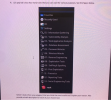 4. (25 pts) Kali Linux has many tools that you can used for various purposes. See the figure below. Favorites Recently Used All ** Settings Q 01 - Information Gathering 02 - Vulnerability Analysis 2003 - Web Application Analysis 04 - Database Assessment 05 - Password Attacks 806 - Wireless Attacks 07 - Reverse Engineering 08 - Exploitation Tools de 09 - Sniffing & Spoofing 10 - Post Exploitation , 11 - Forensics 12.- Reporting Tools 13 - Social Engineering...
1. Do you think it is ethical to use customer information across multiple divisions of the...
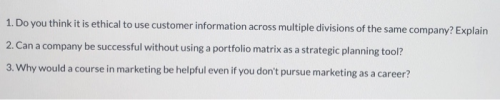 1. Do you think it is ethical to use customer information across multiple divisions of the same company? Explain 2. Can a company be successful without using a portfolio matrix as a strategic planning tool? 3. Why would a course in marketing be helpful even if you don't pursue marketing as a career?
Can you think of ways to use new IS tools like smartphones and social media to...
Can you think of ways to use new IS tools like smartphones and social media to make college processes better? Specify the objective and measure that these IS help improve. For four of these processes, describe the procedures. Does your college have information silos? Which departments keep data needed by processes outside the department?
Nowadays the Web has become the primary means by which the government communicates its information resources...
Nowadays the Web has become the primary means by which the government communicates its information resources to the governed. In the initiation phase, government works on providing its constituencies with a single point of access to government information. The initial attempts at information dissemination takes the form of web portals. Consequently, the Government of Ghana or Nigeria is seeking inputs from its citizenry on how to improve its e-government portals. a. Explain what an e-government portal is and discuss your...
For Healthcare Briefly discuss why you think it would be more efficient to have more public...
For Healthcare Briefly discuss why you think it would be more efficient to have more public goods/services in this area. What trade-offs in private goods and services would you expect to see? What method of paying for the new public goods you propose do you recommend? Why?
In your Critical Thinking, How would you protect patient information? Would you make your information public...
In your Critical Thinking, How would you protect patient information? Would you make your information public if you knew it would make healthcare cheaper? Do you think health information is different from other information we share, and if so, why? Who do you think should access to patient’s records? What do you think would happen if an entire EHR system got destroyed? How would you handle something like that in a clinic?
 PROBLEMS AND APPLICATIONS 1. Think about the goods and services provided by your local government. a. Using the classification in Figure 1, explain which category each of the following goods falls into: police protection snow plowing • education rural roads • city streets b. Why do you think the government provides items that are not public goods? 4. Wireless, high-speed Internet is provided for free in the airport of the city of Communityville. a. At first, only a few people...
 PROBLEMS AND APPLICATIONS 1. Think about the goods and services provided by your local government. a. Using the classification in Figure 1, explain which category each of the following goods falls into: police protection e snow plowing , education e rural roads city streets b. Why do you think the government provides items that are not public goods? 2. Both public goods and common resources involve externalities a. Are the externalities associated with public goods generally positive or negative? Use...
 4. (25 pts) Kali Linux has many tools that you can used for various purposes. See the figure below. Favorites Recently Used All ** Settings Q 01 - Information Gathering 02 - Vulnerability Analysis 2003 - Web Application Analysis 04 - Database Assessment 05 - Password Attacks 806 - Wireless Attacks 07 - Reverse Engineering 08 - Exploitation Tools de 09 - Sniffing & Spoofing 10 - Post Exploitation , 11 - Forensics 12.- Reporting Tools 13 - Social Engineering...
 1. Do you think it is ethical to use customer information across multiple divisions of the same company? Explain 2. Can a company be successful without using a portfolio matrix as a strategic planning tool? 3. Why would a course in marketing be helpful even if you don't pursue marketing as a career?
Most questions answered within 3 hours.
-
Where is the error in this code sequence?
String s1 = "Hello";
String s2 = "ello";...
asked 10 months ago -
Financial data for Joel de Paris, Inc., for last year
follow:
Joel de Paris, Inc.
Balance...
asked 10 months ago -
Consider this reaction:
Al2(SO4)3 (aq)+ BaCl3
(aq) Al2Cl6 (aq)- +
3BaSO4(s) . What is the...
asked 10 months ago -
Suppose that Savneet is considering increasing her
recent random sample from 20 car rentals to 40...
asked 10 months ago -
Trucks arrive at an unloading terminal at an average rate of 120
per hour.
Trucks arrive...
asked 10 months ago -
Why are methanol and ethanol completely soluble in water while
octanol is not very little soluble....
asked 10 months ago -
A facilities manager at a university reads in a research report
that the mean amount of...
asked 10 months ago -
When the CuSO4 is rehydrated by adding water to the anhydrous
compound, is this an endothermic...
asked 10 months ago -
A ray of sunlight is passing from diamond into crown glass; the
angle of incidence is...
asked 10 months ago -
A block of mass 0.249 kg is placed on top of a light, vertical
spring of...
asked 10 months ago -
how do the kidneys compensate in the presences of acidosis
a) trigger hyperventilate
b) reserve acid...
asked 10 months ago -
Question 501 pts
The rental rate of capital to the firm increases. Which of the
following...
asked 10 months ago