
Homework Answers
![to af Apply laplace transform The circuit Vas Apply nodal analyn – 161+ Yes Yes Vasil + Es+cs) = 1681 U(S) rces+25 +R] = RIS](http://img.homeworklib.com/questions/18d941f0-06c6-11ec-8ca7-73453c0ab171.png?x-oss-process=image/resize,w_560)
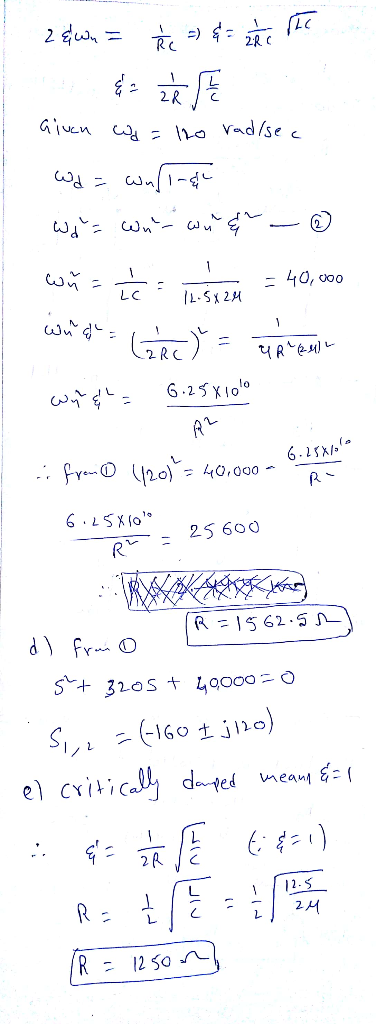
If you have any doubt please make a comment. Thank you
Add Answer to:
8.1 The resistance, inductance, and capacitance in a parallel RLC circuit are 1 kN, 12.5 H,...
= 4.25 uF, and the inductance Consider a series RLC circuit where the resistance R =...
 = 4.25 uF, and the inductance Consider a series RLC circuit where the resistance R = 753 12, the capacitance C L 15.0 mH. Determine the resonance frequency 0 of the circuit. 00 rad/s What is the maximum current Imax when the circuit is at resonance, if the amplitude of the AC driving voltage is 60.0 V? Imax = A
x=1435 1) In the circuit you have a 250 mH inductor, a X 2 resistor and a 10 nF capacitor. Please find: a. Calculate roots of characteristic equation of the voltage response b. Is it over, under,...
 x=1435
1) In the circuit you have a 250 mH inductor, a X 2 resistor and a 10 nF capacitor. Please find: a. Calculate roots of characteristic equation of the voltage response b. Is it over, under, or critically damped? c. What value of R would you add in series with X to yield a damped frequency of 12 krad/sec? d. What value of R would you add in series with X to yield a critically damped response?
1) In...
x=1435
1) In the circuit you have a 250 mH inductor, a X 2 resistor and a 10 nF capacitor. Please find: a. Calculate roots of characteristic equation of the voltage response b. Is it over, under, or critically damped? c. What value of R would you add in series with X to yield a damped frequency of 12 krad/sec? d. What value of R would you add in series with X to yield a critically damped response?
1) In...
Function Generatr Inductor Model Ra R, Figure 1 Series RLC Circuit Preliminary This laboratory wi...
 Function Generatr Inductor Model Ra R, Figure 1 Series RLC Circuit Preliminary This laboratory will demonstrate how varying resistance changes the natural response of a series RLC circuit (Fig. 1). The function generator is modeled as an ideal voltage source v(t) 5 u() V in series with source resistance Rs-50Q. After measurements using an LCR meter, the inductor is modeled as an ideal L 90 mH inductor in series with resistance RL-20Q. The capacitance is C-0.22 μF. 1) Calculate the...
(6) R An RLC circuit with resistance 160 2. capacitance 15 ur inductance 230 ml, frequency...
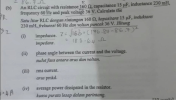 (6) R An RLC circuit with resistance 160 2. capacitance 15 ur inductance 230 ml, frequency 60 Hz and peak voltage 36 V. Calculate the Satu litar RLC dengan rintangan 1602, kapasitans 15 UF, inchikrans 230 ml, frekuensi 60 Hz dan voltan puncak 36 V. Hitung (1) impedance. 7 = /163+C176.84-86.732 impedans. 183-642 (ii) phase angle between the current and the voltage. sudut fasa antara arus dan voltan. (iii) rms current. arus pmkd. (iv) average power dissipated in the resistor....
Consider an RLC circuit with inductance L = 1 H, capacitance C = 0.01 F, and...
 Consider an RLC circuit with inductance L = 1 H, capacitance C = 0.01 F, and resistance R= 12 12. The switch is closed at time t=0 and a voltage of 1 V is applied for 2 seconds. Then, the switch is opened and is kept open. Find the equation for the charge g(t), if both the initial current and the initial charge are zero. (15 Point)
An RLC series circuit has a resistance of R = 330.0 Ω, an inductance L =...
An RLC series circuit has a resistance of R = 330.0 Ω, an inductance L = 0.2000 mH, and a capacitance C = 32.00 nF. (a) What is the resonant frequency? (b) If the capacitor breaks down for peak voltages in excess of 7.000 × 10² V, what is the maximum source voltage amplitude when the circuit is operated at the resonant frequency?
An RLC series circuit has a resistance of R = 330.0 Ω, an inductance L =...
An RLC series circuit has a resistance of R = 330.0 Ω, an inductance L = 0.2000 mH, and a capacitance C = 33.00 nF. (a) What is the resonant frequency? (b) If the capacitor breaks down for peak voltages in excess of 7.000 × 10² V, what is the maximum source voltage amplitude when the circuit is operated at the resonant frequency?
An RLC series circuit has a resistance of R = 325.0 Ω, an inductance L =...
An RLC series circuit has a resistance of R = 325.0 Ω, an inductance L = 0.3000 mH, and a capacitance C = 32.00 nF. (a) What is the resonant frequency? kHz (b) If the capacitor breaks down for peak voltages in excess of 7.000 × 10² V, what is the maximum source voltage amplitude when the circuit is operated at the resonant frequency? kV
An RLC circuit has a capacitance of 0.29 uF. A. What inductance will produce a resonance...
An RLC circuit has a capacitance of 0.29 uF. A. What inductance will produce a resonance frequency of 95 MHz? B. It is desired that the impedance at resonance be one-fifth the impedance at 11 kHz. What value of R should be used to obtain this result? I had some problems with the algebra. Thank you.
A series RLC circuit that has an inductance of 6 mH, a capacitance of 3 μF,...
 A series RLC circuit that has an inductance of 6 mH, a capacitance of 3 μF, and a resistance of 7.2 is driven by an ideal ac voltage source that has a peak emf of 110 V (a) Find the resonant frequency 1.19 rad/s (b) Find the root-means-square current at resonance When the frequency is 8000 rad/s, find the following values. (c) the capacitive and inductive reactances (d) the impedance (e) the root-mean square current. (f) the phase angle δ...
 = 4.25 uF, and the inductance Consider a series RLC circuit where the resistance R = 753 12, the capacitance C L 15.0 mH. Determine the resonance frequency 0 of the circuit. 00 rad/s What is the maximum current Imax when the circuit is at resonance, if the amplitude of the AC driving voltage is 60.0 V? Imax = A
 x=1435
1) In the circuit you have a 250 mH inductor, a X 2 resistor and a 10 nF capacitor. Please find: a. Calculate roots of characteristic equation of the voltage response b. Is it over, under, or critically damped? c. What value of R would you add in series with X to yield a damped frequency of 12 krad/sec? d. What value of R would you add in series with X to yield a critically damped response?
1) In...
x=1435
1) In the circuit you have a 250 mH inductor, a X 2 resistor and a 10 nF capacitor. Please find: a. Calculate roots of characteristic equation of the voltage response b. Is it over, under, or critically damped? c. What value of R would you add in series with X to yield a damped frequency of 12 krad/sec? d. What value of R would you add in series with X to yield a critically damped response?
1) In...
 Function Generatr Inductor Model Ra R, Figure 1 Series RLC Circuit Preliminary This laboratory will demonstrate how varying resistance changes the natural response of a series RLC circuit (Fig. 1). The function generator is modeled as an ideal voltage source v(t) 5 u() V in series with source resistance Rs-50Q. After measurements using an LCR meter, the inductor is modeled as an ideal L 90 mH inductor in series with resistance RL-20Q. The capacitance is C-0.22 μF. 1) Calculate the...
 (6) R An RLC circuit with resistance 160 2. capacitance 15 ur inductance 230 ml, frequency 60 Hz and peak voltage 36 V. Calculate the Satu litar RLC dengan rintangan 1602, kapasitans 15 UF, inchikrans 230 ml, frekuensi 60 Hz dan voltan puncak 36 V. Hitung (1) impedance. 7 = /163+C176.84-86.732 impedans. 183-642 (ii) phase angle between the current and the voltage. sudut fasa antara arus dan voltan. (iii) rms current. arus pmkd. (iv) average power dissipated in the resistor....
 Consider an RLC circuit with inductance L = 1 H, capacitance C = 0.01 F, and resistance R= 12 12. The switch is closed at time t=0 and a voltage of 1 V is applied for 2 seconds. Then, the switch is opened and is kept open. Find the equation for the charge g(t), if both the initial current and the initial charge are zero. (15 Point)
 A series RLC circuit that has an inductance of 6 mH, a capacitance of 3 μF, and a resistance of 7.2 is driven by an ideal ac voltage source that has a peak emf of 110 V (a) Find the resonant frequency 1.19 rad/s (b) Find the root-means-square current at resonance When the frequency is 8000 rad/s, find the following values. (c) the capacitive and inductive reactances (d) the impedance (e) the root-mean square current. (f) the phase angle δ...
Most questions answered within 3 hours.
-
Where is the error in this code sequence?
String s1 = "Hello";
String s2 = "ello";...
asked 10 months ago -
Financial data for Joel de Paris, Inc., for last year
follow:
Joel de Paris, Inc.
Balance...
asked 10 months ago -
Consider this reaction:
Al2(SO4)3 (aq)+ BaCl3
(aq) Al2Cl6 (aq)- +
3BaSO4(s) . What is the...
asked 10 months ago -
Suppose that Savneet is considering increasing her
recent random sample from 20 car rentals to 40...
asked 10 months ago -
Trucks arrive at an unloading terminal at an average rate of 120
per hour.
Trucks arrive...
asked 10 months ago -
Why are methanol and ethanol completely soluble in water while
octanol is not very little soluble....
asked 10 months ago -
A facilities manager at a university reads in a research report
that the mean amount of...
asked 10 months ago -
When the CuSO4 is rehydrated by adding water to the anhydrous
compound, is this an endothermic...
asked 10 months ago -
A ray of sunlight is passing from diamond into crown glass; the
angle of incidence is...
asked 10 months ago -
A block of mass 0.249 kg is placed on top of a light, vertical
spring of...
asked 10 months ago -
how do the kidneys compensate in the presences of acidosis
a) trigger hyperventilate
b) reserve acid...
asked 10 months ago -
Question 501 pts
The rental rate of capital to the firm increases. Which of the
following...
asked 10 months ago