
Homework Answers
Request Answer!
We need at least 10 more requests to produce the answer.
0 / 10 have requested this problem solution
The more requests, the faster the answer.
Add Answer to:
Each firm in a competitive market has a cost function of Cq qq3. There are an...
Each firm in a competitive market has a cost function of C = 10g - 492...
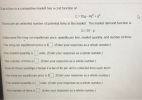 Each firm in a competitive market has a cost function of C = 10g - 492 +93 There are an unlimited number of potential firms in this market. The market demand function is Q = 30 - p. Determine the long-run equilibrium price, quantity per firm, market quantity, and number of firms. The long-run equilibrium price is $ (Enter your response as a whole number) The market quantity is units. (Enter your response as a whole number.) The number of...
Each of the 10 firms in a competitive market has a cost function of C-30+q The...
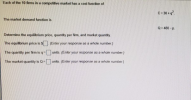 Each of the 10 firms in a competitive market has a cost function of C-30+q The market demand function is Q-480-P Determine the equilibrium price, quantity per firm, and market quantity The equilibrium price is s (Enter your response as a whole number) The quantity per firm is q units. (Enter your response as a whole number) The market quantity is Q-units (Enter your response as a whole number)
Each firm in a perfectly competitive market has long run average cost represented as AC(q) =...
Each firm in a perfectly competitive market has long run average cost represented as AC(q) = 100q- 10+100/q. Long run marginal cost is MC=200q-10. The market demand is Qd = 2150-5P. Find the long run equilibrium output per firm, q*, the long run equilibrium price, P*, and the number of firms in the industry, n*. P = 190; Q = 1200; q =1 , n = 1200
Suppose there is a monopolistically competitive market with n identical firms, such that each firm produces the same quantity, q. Further, the market is in the monopolistically competitive long-run e...
 Suppose there is a monopolistically competitive market with n identical firms, such that each firm produces the same quantity, q. Further, the market is in the monopolistically competitive long-run equilibrium. You are given the following: Inverse market demand: P 10-Q Total market output: Qnxq Marginal revenue: MR 10n+ 1)xq Total cost: C(q)-5+q Marginal cost: MC 2xq In long-run equilibrium, each firm earns zero economic profit. In long-run equilibrium, the number of firms, n, is and each firm produces units) of...
Long Run Equilibrium 4. Suppose each firm in a perfectly competitive industry has the same long...
Long Run Equilibrium 4. Suppose each firm in a perfectly competitive industry has the same long run total cost function T C(q) = 16+q^2 . The market demand curve is QD = 100−P. (a) What 3 equations define a Long Run Perfectly Competitive Equilibrium? (b) How much quantity q ∗ does each firm produce in Long Run Perfectly Competitive Equilibrium? (c) What is the market price P ∗ in this equilibrium? (d) Find the market quantity Q∗ . ( e)...
2. A competitive industry has 12 identical firms, each one has a total variable cost function...
 2. A competitive industry has 12 identical firms, each one has a total variable cost function TVC(a) 402 and a marginal cost function MC(a) 40+q, the firm's fixed cost.s are entirely non-sunk (that is, must be paid only if q >0) and equal to 50. (a) Calculate the price below which the firm will produce q 0. (b) The market demand is QD(p) 360-2p. What is the short-run equilibrium price and quantity supplied by each firm? Calculate each firm's proft...
1. Each firm in a perfectly competitive industry has the long-run total cost function c(y) =...
1. Each firm in a perfectly competitive industry has the long-run total cost function c(y) = 3y - (y^2/3) + (y^3/27) Demand is given by the inverse demand curve p = 15 - (Qd/600). Calculate, for the long-run equilibrium, a. The price b.The market quantity c. The number of firms d. The profit for each firm
5. Each firm in a competitive market has a cost function TC() 102q+ and there are...
 5. Each firm in a competitive market has a cost function TC() 102q+ and there are n = 20 firms in the short run. The short-run equilibrium price is p-5. What happens in the long-run equilibrium as compared to the short-run equilibrium (a) Does the equilibrium price increase or decrease? Explain (b) Does the number of firms increase or decrease? Explain (c) Does the output of a single firm increase or decrease? Explain (d) Does the total market output increase...
i) The long run cost function for each firm in a perfectly competitive market is c(q)...
 i) The long run cost function for each firm in a perfectly competitive market is c(q) = 2^1.5+16q^0.5, LMC = 1.59^0.5+ 8q^-0.5, market demand curve is Q=1600-2p. Find price (p) of output and the level of output (q) produced by the firm in a long run equilibrium. Find the long run average cost curve for the firm. ii) what happens in the long run if the market demand curve shifts to Q=160-20p?/ -A competitive industry is in long run equilibrium....
Suppose that each firm in a competitive industry has the following costs: Total Cost: TC =...
 Suppose that each firm in a competitive industry has the following costs:Total Cost: TC=50+1/2 q2Marginal Cost: MC=qwhere q is an individual firm's quantity produced.The market demand curve for this product is:Demand QD=160-4 Pwhere P is the price and Q is the total quantity of the good.Each firm's fixed cost is $_______ What is each firm's variable cost?1/2 q50+1/2 q1/2 q^{2}qWhich of the following represents the equation for each firm's average total cost?50/q+1/2 q50+1/2 q50/q1/2 qComplete the following table by computing the...
 Each firm in a competitive market has a cost function of C = 10g - 492 +93 There are an unlimited number of potential firms in this market. The market demand function is Q = 30 - p. Determine the long-run equilibrium price, quantity per firm, market quantity, and number of firms. The long-run equilibrium price is $ (Enter your response as a whole number) The market quantity is units. (Enter your response as a whole number.) The number of...
 Each of the 10 firms in a competitive market has a cost function of C-30+q The market demand function is Q-480-P Determine the equilibrium price, quantity per firm, and market quantity The equilibrium price is s (Enter your response as a whole number) The quantity per firm is q units. (Enter your response as a whole number) The market quantity is Q-units (Enter your response as a whole number)
 Suppose there is a monopolistically competitive market with n identical firms, such that each firm produces the same quantity, q. Further, the market is in the monopolistically competitive long-run equilibrium. You are given the following: Inverse market demand: P 10-Q Total market output: Qnxq Marginal revenue: MR 10n+ 1)xq Total cost: C(q)-5+q Marginal cost: MC 2xq In long-run equilibrium, each firm earns zero economic profit. In long-run equilibrium, the number of firms, n, is and each firm produces units) of...
 2. A competitive industry has 12 identical firms, each one has a total variable cost function TVC(a) 402 and a marginal cost function MC(a) 40+q, the firm's fixed cost.s are entirely non-sunk (that is, must be paid only if q >0) and equal to 50. (a) Calculate the price below which the firm will produce q 0. (b) The market demand is QD(p) 360-2p. What is the short-run equilibrium price and quantity supplied by each firm? Calculate each firm's proft...
 5. Each firm in a competitive market has a cost function TC() 102q+ and there are n = 20 firms in the short run. The short-run equilibrium price is p-5. What happens in the long-run equilibrium as compared to the short-run equilibrium (a) Does the equilibrium price increase or decrease? Explain (b) Does the number of firms increase or decrease? Explain (c) Does the output of a single firm increase or decrease? Explain (d) Does the total market output increase...
 i) The long run cost function for each firm in a perfectly competitive market is c(q) = 2^1.5+16q^0.5, LMC = 1.59^0.5+ 8q^-0.5, market demand curve is Q=1600-2p. Find price (p) of output and the level of output (q) produced by the firm in a long run equilibrium. Find the long run average cost curve for the firm. ii) what happens in the long run if the market demand curve shifts to Q=160-20p?/ -A competitive industry is in long run equilibrium....
Most questions answered within 3 hours.
-
Where is the error in this code sequence?
String s1 = "Hello";
String s2 = "ello";...
asked 11 months ago -
Financial data for Joel de Paris, Inc., for last year
follow:
Joel de Paris, Inc.
Balance...
asked 11 months ago -
Consider this reaction:
Al2(SO4)3 (aq)+ BaCl3
(aq) Al2Cl6 (aq)- +
3BaSO4(s) . What is the...
asked 11 months ago -
Suppose that Savneet is considering increasing her
recent random sample from 20 car rentals to 40...
asked 11 months ago -
Trucks arrive at an unloading terminal at an average rate of 120
per hour.
Trucks arrive...
asked 11 months ago -
Why are methanol and ethanol completely soluble in water while
octanol is not very little soluble....
asked 11 months ago -
A facilities manager at a university reads in a research report
that the mean amount of...
asked 11 months ago -
When the CuSO4 is rehydrated by adding water to the anhydrous
compound, is this an endothermic...
asked 11 months ago -
A ray of sunlight is passing from diamond into crown glass; the
angle of incidence is...
asked 11 months ago -
A block of mass 0.249 kg is placed on top of a light, vertical
spring of...
asked 11 months ago -
how do the kidneys compensate in the presences of acidosis
a) trigger hyperventilate
b) reserve acid...
asked 11 months ago -
Question 501 pts
The rental rate of capital to the firm increases. Which of the
following...
asked 11 months ago