
Homework Answers
Add Answer to:
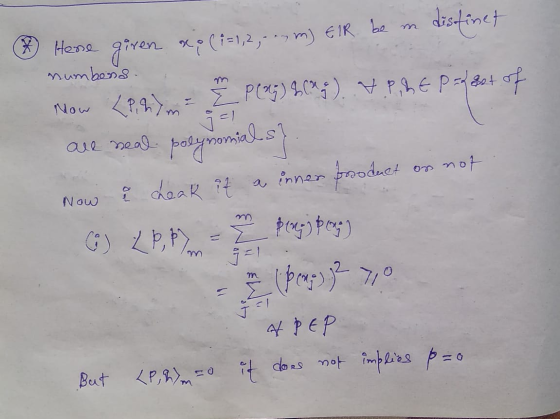
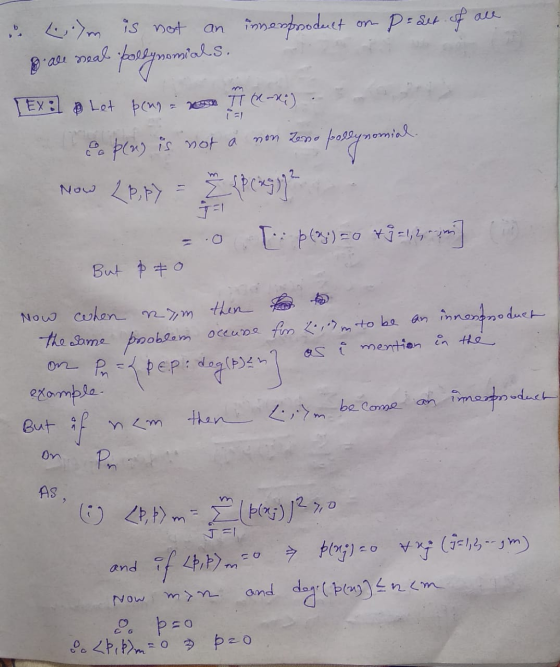
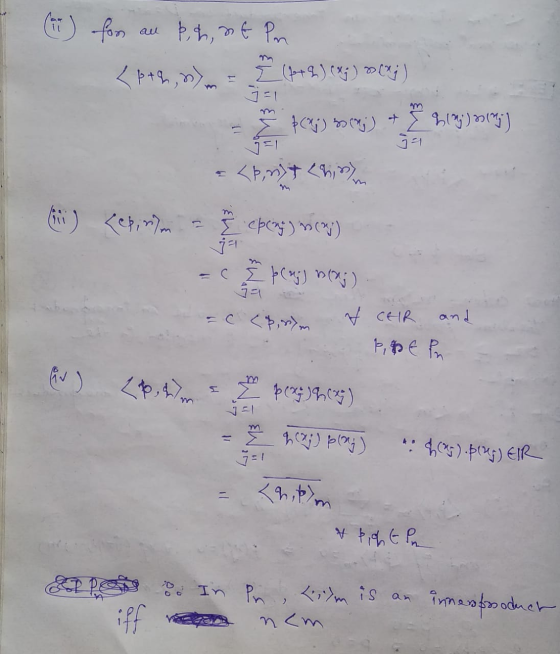
1. Let 21,...,m ER be m distinct real numbers. Define m (p, q)m = p(x;) g(x3),...
Q6 (4+3+3+ 6=16 marks) Let Xo, X1, X2 be three distinct real numbers. For polynomials p(x)...
 Q6 (4+3+3+ 6=16 marks) Let Xo, X1, X2 be three distinct real numbers. For polynomials p(x) and q(x), define < p(x),q(x) >= p(xo)q(x0) + p(x1)q(x1) + p(x2)q(22). Let p(n) denote the vector space of all polynomials with degree more no than n. (i) Show that < .. > is an inner product in P(2). (ii) Is < ... > an inner product in P(3)? Explain why. (iii) Is <,:> an inner product in P(1)? Explain why. (iv) Consider Xo =...
5. For t ER, define the evaluation map evt : Pn(R) + R given by evt(p(x))...
 5. For t ER, define the evaluation map evt : Pn(R) + R given by evt(p(x)) = p(t). Here we consider R as the vector space R1. (a) Prove evt is a linear map. (b) For part (b), let n= 4. Write down a polynomial p e ker(ev3). (c) For any t, the set of polynomials Ut = {p E Pn(R) : p(t) = 0} is a subspace. What is the dimension of Ut (in terms of n)? Justify your...
Exercise 13. For each pair of polynomials p(x), q(x) E P define (p, q) р(«)q(2) dx....
 Exercise 13. For each pair of polynomials p(x), q(x) E P define (p, q) р(«)q(2) dx. -1 inner product (i) Prove that (p, q) defines on P3 an orthogonal (ii) Show that 1, х are (iii) Find the angle between 1 and 1 + x.
Exercise 13. For each pair of polynomials p(x), q(x) E P define (p, q) р(«)q(2) dx. -1 inner product (i) Prove that (p, q) defines on P3 an orthogonal (ii) Show that 1, х are...
Exercise 13. For each pair of polynomials p(x), q(x) E P define (p, q) р(«)q(2) dx. -1 inner product (i) Prove that (p, q) defines on P3 an orthogonal (ii) Show that 1, х are (iii) Find the angle between 1 and 1 + x.
Exercise 13. For each pair of polynomials p(x), q(x) E P define (p, q) р(«)q(2) dx. -1 inner product (i) Prove that (p, q) defines on P3 an orthogonal (ii) Show that 1, х are...
(2) Let Pn [x] = {p € P[x] : degp <n}, where P[x] is the set...
 (2) Let Pn [x] = {p € P[x] : degp <n}, where P[x] is the set of all polynomials. Let the polynomials li() defined by II;tilt - a;) i=0,1,...11 bi(T) = 11: a; - aj) where aj, j = 0,1,..., are distinct real numbers and aia . Show that (d) The change of basis transformation from the standard basis ', j = 0,1,...,n to l; () is given by the Vandermonde matrix (1 00 ... am 1 01 .01 1...
6. Let p;(xi = 0,... , n}, with degp;(x) = i, be a set of orthogonal polynomials with respect to the inner product f f(...
 6. Let p;(xi = 0,... , n}, with degp;(x) = i, be a set of orthogonal polynomials with respect to the inner product f f(x)g(x) dx. Given a < b, let q(x) be the line mapping a to -1 and b to 1. Prove {p;(q(x))|i = 0,... , n} is a set of orthogonal polynomials with respect to the inner product f(x)g(x) dz, satisfying deg p;(q(x))= i -
6. Let p;(xi = 0,... , n}, with degp;(x) = i, be...
6. Let p;(xi = 0,... , n}, with degp;(x) = i, be a set of orthogonal polynomials with respect to the inner product f f(x)g(x) dx. Given a < b, let q(x) be the line mapping a to -1 and b to 1. Prove {p;(q(x))|i = 0,... , n} is a set of orthogonal polynomials with respect to the inner product f(x)g(x) dz, satisfying deg p;(q(x))= i -
6. Let p;(xi = 0,... , n}, with degp;(x) = i, be...
1. (10 points) For the following questions, let p, q, r e Z be distinct positive...
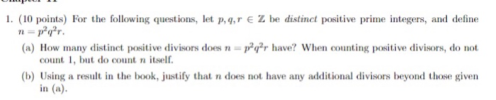 1. (10 points) For the following questions, let p, q, r e Z be distinct positive prime integers, and define n=p?q?r. (a) How many distinct positive divisors does n = pq?r have? When counting positive divisors, do not count 1, but do count n itself (b) Using a result in the book, justify that n does not have any additional divisors beyond those given in (a).
1. Let Xn ER be a sequence of real numbers. (a) Prove that if Xn is...
 1. Let Xn ER be a sequence of real numbers. (a) Prove that if Xn is an increasing sequence bounded above, that is, if for all n, xn < Xn+1 and there exists M E R such that for all n E N, Xn < M, then limny Xn = sup{Xnin EN}. (b) Prove that if Xn is a decreasing sequence bounded below, that is, if for all n, Xn+1 < xn and there exists M ER such that for...
2. Consider the polynomial p = x3 + x +4 € Z5 [2]. Let q =...
 2. Consider the polynomial p = x3 + x +4 € Z5 [2]. Let q = 3x +2 € Z5 [2]. (a) Is p reducible or irreducible? Prove your claim. (b) Are there any degree 2 polynomials in [g],? Explain. (c) List all degree 3 polynomials in [g]p. (d) (ungraded for thought) How many degree 4 polynomials are in (q),? Degree 5?
(3) Let m,n E N. Let p(x), i -1, ..., m, be polynomials with real coefficients in the variables -(x,..., rn). Prove that pi(r) p(a) Un (r)」 is a continuously differentiable map from R" to R"...
 (3) Let m,n E N. Let p(x), i -1, ..., m, be polynomials with real coefficients in the variables -(x,..., rn). Prove that pi(r) p(a) Un (r)」 is a continuously differentiable map from R" to R". (Suggestion: Use Theorem 9.21.)
(3) Let m,n E N. Let p(x), i -1, ..., m, be polynomials with real coefficients in the variables -(x,..., rn). Prove that pi(r) p(a) Un (r)」 is a continuously differentiable map from R" to R". (Suggestion: Use Theorem 9.21.)
(3) Let m,n E N. Let p(x), i -1, ..., m, be polynomials with real coefficients in the variables -(x,..., rn). Prove that pi(r) p(a) Un (r)」 is a continuously differentiable map from R" to R". (Suggestion: Use Theorem 9.21.)
7. Let p and q be distinct odd primes. Let a є Z with god(a, M)...
 7. Let p and q be distinct odd primes. Let a є Z with god(a, M) = 1. Prove that if there exists b E ZM such that b2 a] in Zp, then there are exactly four distinct [r] E Zp such that Zp
 Q6 (4+3+3+ 6=16 marks) Let Xo, X1, X2 be three distinct real numbers. For polynomials p(x) and q(x), define < p(x),q(x) >= p(xo)q(x0) + p(x1)q(x1) + p(x2)q(22). Let p(n) denote the vector space of all polynomials with degree more no than n. (i) Show that < .. > is an inner product in P(2). (ii) Is < ... > an inner product in P(3)? Explain why. (iii) Is <,:> an inner product in P(1)? Explain why. (iv) Consider Xo =...
 5. For t ER, define the evaluation map evt : Pn(R) + R given by evt(p(x)) = p(t). Here we consider R as the vector space R1. (a) Prove evt is a linear map. (b) For part (b), let n= 4. Write down a polynomial p e ker(ev3). (c) For any t, the set of polynomials Ut = {p E Pn(R) : p(t) = 0} is a subspace. What is the dimension of Ut (in terms of n)? Justify your...
 Exercise 13. For each pair of polynomials p(x), q(x) E P define (p, q) р(«)q(2) dx. -1 inner product (i) Prove that (p, q) defines on P3 an orthogonal (ii) Show that 1, х are (iii) Find the angle between 1 and 1 + x.
Exercise 13. For each pair of polynomials p(x), q(x) E P define (p, q) р(«)q(2) dx. -1 inner product (i) Prove that (p, q) defines on P3 an orthogonal (ii) Show that 1, х are...
Exercise 13. For each pair of polynomials p(x), q(x) E P define (p, q) р(«)q(2) dx. -1 inner product (i) Prove that (p, q) defines on P3 an orthogonal (ii) Show that 1, х are (iii) Find the angle between 1 and 1 + x.
Exercise 13. For each pair of polynomials p(x), q(x) E P define (p, q) р(«)q(2) dx. -1 inner product (i) Prove that (p, q) defines on P3 an orthogonal (ii) Show that 1, х are...
 (2) Let Pn [x] = {p € P[x] : degp <n}, where P[x] is the set of all polynomials. Let the polynomials li() defined by II;tilt - a;) i=0,1,...11 bi(T) = 11: a; - aj) where aj, j = 0,1,..., are distinct real numbers and aia . Show that (d) The change of basis transformation from the standard basis ', j = 0,1,...,n to l; () is given by the Vandermonde matrix (1 00 ... am 1 01 .01 1...
 6. Let p;(xi = 0,... , n}, with degp;(x) = i, be a set of orthogonal polynomials with respect to the inner product f f(x)g(x) dx. Given a < b, let q(x) be the line mapping a to -1 and b to 1. Prove {p;(q(x))|i = 0,... , n} is a set of orthogonal polynomials with respect to the inner product f(x)g(x) dz, satisfying deg p;(q(x))= i -
6. Let p;(xi = 0,... , n}, with degp;(x) = i, be...
6. Let p;(xi = 0,... , n}, with degp;(x) = i, be a set of orthogonal polynomials with respect to the inner product f f(x)g(x) dx. Given a < b, let q(x) be the line mapping a to -1 and b to 1. Prove {p;(q(x))|i = 0,... , n} is a set of orthogonal polynomials with respect to the inner product f(x)g(x) dz, satisfying deg p;(q(x))= i -
6. Let p;(xi = 0,... , n}, with degp;(x) = i, be...
 1. (10 points) For the following questions, let p, q, r e Z be distinct positive prime integers, and define n=p?q?r. (a) How many distinct positive divisors does n = pq?r have? When counting positive divisors, do not count 1, but do count n itself (b) Using a result in the book, justify that n does not have any additional divisors beyond those given in (a).
 1. Let Xn ER be a sequence of real numbers. (a) Prove that if Xn is an increasing sequence bounded above, that is, if for all n, xn < Xn+1 and there exists M E R such that for all n E N, Xn < M, then limny Xn = sup{Xnin EN}. (b) Prove that if Xn is a decreasing sequence bounded below, that is, if for all n, Xn+1 < xn and there exists M ER such that for...
 2. Consider the polynomial p = x3 + x +4 € Z5 [2]. Let q = 3x +2 € Z5 [2]. (a) Is p reducible or irreducible? Prove your claim. (b) Are there any degree 2 polynomials in [g],? Explain. (c) List all degree 3 polynomials in [g]p. (d) (ungraded for thought) How many degree 4 polynomials are in (q),? Degree 5?
 (3) Let m,n E N. Let p(x), i -1, ..., m, be polynomials with real coefficients in the variables -(x,..., rn). Prove that pi(r) p(a) Un (r)」 is a continuously differentiable map from R" to R". (Suggestion: Use Theorem 9.21.)
(3) Let m,n E N. Let p(x), i -1, ..., m, be polynomials with real coefficients in the variables -(x,..., rn). Prove that pi(r) p(a) Un (r)」 is a continuously differentiable map from R" to R". (Suggestion: Use Theorem 9.21.)
(3) Let m,n E N. Let p(x), i -1, ..., m, be polynomials with real coefficients in the variables -(x,..., rn). Prove that pi(r) p(a) Un (r)」 is a continuously differentiable map from R" to R". (Suggestion: Use Theorem 9.21.)
 7. Let p and q be distinct odd primes. Let a є Z with god(a, M) = 1. Prove that if there exists b E ZM such that b2 a] in Zp, then there are exactly four distinct [r] E Zp such that Zp
Most questions answered within 3 hours.
-
Where is the error in this code sequence?
String s1 = "Hello";
String s2 = "ello";...
asked 10 months ago -
Financial data for Joel de Paris, Inc., for last year
follow:
Joel de Paris, Inc.
Balance...
asked 10 months ago -
Consider this reaction:
Al2(SO4)3 (aq)+ BaCl3
(aq) Al2Cl6 (aq)- +
3BaSO4(s) . What is the...
asked 10 months ago -
Suppose that Savneet is considering increasing her
recent random sample from 20 car rentals to 40...
asked 10 months ago -
Trucks arrive at an unloading terminal at an average rate of 120
per hour.
Trucks arrive...
asked 10 months ago -
Why are methanol and ethanol completely soluble in water while
octanol is not very little soluble....
asked 10 months ago -
A facilities manager at a university reads in a research report
that the mean amount of...
asked 10 months ago -
When the CuSO4 is rehydrated by adding water to the anhydrous
compound, is this an endothermic...
asked 10 months ago -
A ray of sunlight is passing from diamond into crown glass; the
angle of incidence is...
asked 10 months ago -
A block of mass 0.249 kg is placed on top of a light, vertical
spring of...
asked 10 months ago -
how do the kidneys compensate in the presences of acidosis
a) trigger hyperventilate
b) reserve acid...
asked 10 months ago -
Question 501 pts
The rental rate of capital to the firm increases. Which of the
following...
asked 10 months ago