
Homework Answers

Add Answer to:
The block of glass (n = 1.5) shown in cross section in Fig. below is surrounded...
A block of glass with flat sides is surrounded by air. A ray of light traveling...
A block of glass with flat sides is surrounded by air. A ray of light traveling in the glass (refractive index na) is incident on the flat interface with air at the top surface of the block of glass. You observe that no light is refracted into the air if the incident ray in the glass has an angle of incidence (measured relative to the normal to the surface of the glass) greater than 35.5°. What is the refractive index...
3. (15 points) A light ray is traveling horizontally through air and hits the rectangular glass block shown to the right. The block has a triangular, air-filled cavity within it. You may take the...
 3. (15 points) A light ray is traveling horizontally through air and hits the rectangular glass block shown to the right. The block has a triangular, air-filled cavity within it. You may take the index of refraction of air to be mair 1 and the index of refraction of glass to be nglass 1.5 40° く enters the glass block. Sketch this refracted ray on the diagram to the right. a. Calculate the angle of traction when the light ray...
A lens made of glass (n. - 1.52) is coated with a thin film of MgF,...
 A lens made of glass (n. - 1.52) is coated with a thin film of MgF, (n = 1.38) of thickness t. Visible light is incident normally on the coated lens as in the figure below. Glass thin film Incident An illustration shows a rectangular cross- section of glass lens oriented such that a thin film of thickness tcoats its left side. A ray of light directed to the right is perpendicularly incident upon the left side of the film....
Problem 1 A glass prism, surrounded by air, has an index of refraction of 1.36. ZABC...
 Problem 1 A glass prism, surrounded by air, has an index of refraction of 1.36. ZABC 90°. A ray of light enters the prism at face AB, 70° to the normal as shown. Calculate the angle 0to the normal at which the ray emerges from face BC. 79.5° 70°
An optical fiber consisting of a core made of glass (n = 1.667) surrounded by a...
An optical fiber consisting of a core made of glass (n = 1.667) surrounded by a crown glass lining (n = 1.523). A ray of light in the air enters the fiber at an angle φ 1 with respect to the normal one. What is φ 1 if this light also affects the core cladding interface at an angle that barely exceeds the critical angle?
A glass prism has a cross section of an isosceles triangle with a = 55.2º. A...
 A glass prism has a cross section of an isosceles triangle with a = 55.2º. A light beam is incident at an angle of 0 = 53.2° and passes through the prism parallel to the base of the triangle as shown in the figure. What is the index of refraction of the glass? (Recall that the sum of all the internal angles of a triangle is 180°.).
A block of plastic (n = 1.6) is immersed in water as shown in image below....
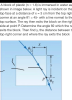 A block of plastic (n = 1.6) is immersed in water as shown in image below. A light ray is incident on the top face at a distance of x = 3 cm from the top righ corner at an angle 01 = 45° with a line normal to the top surface. The ray then exits the block on the righ side at point P. Determine the angle 02 which the ra exits the block. Then find y, the distance...
Prism- light
The equilateral glass prism shown has an index of refraction of 1.54. The prism is surrounded by air. A ray of light is incident on the middle of the left face of theprism. What is the smallest angle of incidence for which the ray of light will emerge from the right face of the prism?
A glass prism has a cross section of an isosceles triangle with α = 58.1°. A...
A glass prism has a cross section of an isosceles triangle with α = 58.1°. A light beam is incident at an angle of θ = 49.5° and passes through the prism parallel to the base of the triangle as shown in the figure. What is the index of refraction of the glass? (Recall that the sum of all the internal angles of a triangle is 180°.)
Problem Light is directed from air (n=1) into a glass tube (n=1.3). A section is shown...
 Problem Light is directed from air (n=1) into a glass tube (n=1.3). A section is shown below. What is the nex that ensures that no light escapes the horizontal side of the tube. a. Draw a ray diagram travelling through the tube b. Set = critical angle at horizontal side of tube at n=1.3 and ne1 interface c. Use Snell's law to find X.
 3. (15 points) A light ray is traveling horizontally through air and hits the rectangular glass block shown to the right. The block has a triangular, air-filled cavity within it. You may take the index of refraction of air to be mair 1 and the index of refraction of glass to be nglass 1.5 40° く enters the glass block. Sketch this refracted ray on the diagram to the right. a. Calculate the angle of traction when the light ray...
 A lens made of glass (n. - 1.52) is coated with a thin film of MgF, (n = 1.38) of thickness t. Visible light is incident normally on the coated lens as in the figure below. Glass thin film Incident An illustration shows a rectangular cross- section of glass lens oriented such that a thin film of thickness tcoats its left side. A ray of light directed to the right is perpendicularly incident upon the left side of the film....
 Problem 1 A glass prism, surrounded by air, has an index of refraction of 1.36. ZABC 90°. A ray of light enters the prism at face AB, 70° to the normal as shown. Calculate the angle 0to the normal at which the ray emerges from face BC. 79.5° 70°
 A glass prism has a cross section of an isosceles triangle with a = 55.2º. A light beam is incident at an angle of 0 = 53.2° and passes through the prism parallel to the base of the triangle as shown in the figure. What is the index of refraction of the glass? (Recall that the sum of all the internal angles of a triangle is 180°.).
 A block of plastic (n = 1.6) is immersed in water as shown in image below. A light ray is incident on the top face at a distance of x = 3 cm from the top righ corner at an angle 01 = 45° with a line normal to the top surface. The ray then exits the block on the righ side at point P. Determine the angle 02 which the ra exits the block. Then find y, the distance...
 Problem Light is directed from air (n=1) into a glass tube (n=1.3). A section is shown below. What is the nex that ensures that no light escapes the horizontal side of the tube. a. Draw a ray diagram travelling through the tube b. Set = critical angle at horizontal side of tube at n=1.3 and ne1 interface c. Use Snell's law to find X.
Most questions answered within 3 hours.
-
Where is the error in this code sequence?
String s1 = "Hello";
String s2 = "ello";...
asked 11 months ago -
Financial data for Joel de Paris, Inc., for last year
follow:
Joel de Paris, Inc.
Balance...
asked 11 months ago -
Consider this reaction:
Al2(SO4)3 (aq)+ BaCl3
(aq) Al2Cl6 (aq)- +
3BaSO4(s) . What is the...
asked 11 months ago -
Suppose that Savneet is considering increasing her
recent random sample from 20 car rentals to 40...
asked 11 months ago -
Trucks arrive at an unloading terminal at an average rate of 120
per hour.
Trucks arrive...
asked 11 months ago -
Why are methanol and ethanol completely soluble in water while
octanol is not very little soluble....
asked 11 months ago -
A facilities manager at a university reads in a research report
that the mean amount of...
asked 11 months ago -
When the CuSO4 is rehydrated by adding water to the anhydrous
compound, is this an endothermic...
asked 11 months ago -
A ray of sunlight is passing from diamond into crown glass; the
angle of incidence is...
asked 11 months ago -
A block of mass 0.249 kg is placed on top of a light, vertical
spring of...
asked 11 months ago -
how do the kidneys compensate in the presences of acidosis
a) trigger hyperventilate
b) reserve acid...
asked 11 months ago -
Question 501 pts
The rental rate of capital to the firm increases. Which of the
following...
asked 11 months ago