
Homework Answers
Add Answer to:
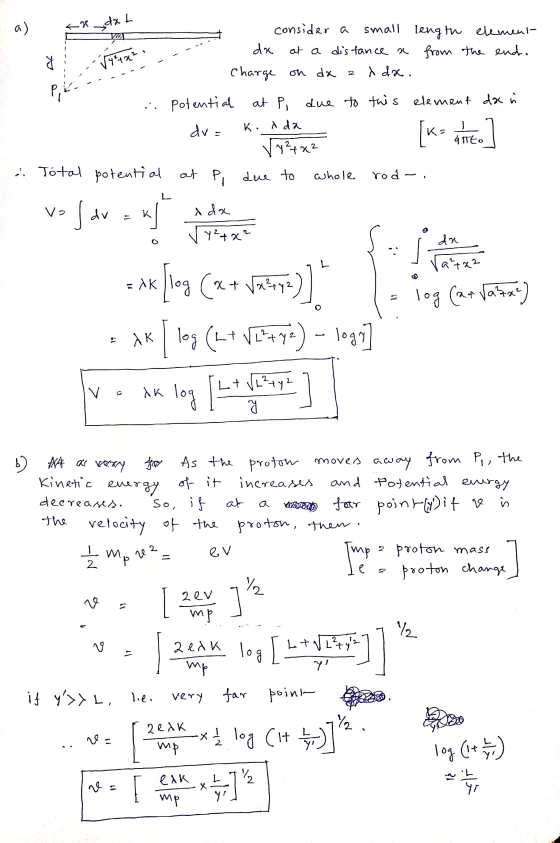
2. In the figure to the right, a non-conducting, uniformly charged, straight rod has a charge...
In the figure at the right, a non-conducting rod of length L = 12.0 cm has...
In the figure at the right, a non-conducting rod of length L = 12.0 cm has a charge –q = –3.24 fC uniformly distributed along its length. Point P is at a distance a = 8.15 cm from the rod. (a) What is the linear charge density of the rod? (b) What is the magnitude of the electric field produced at point P? (c) What is the direction (relative to the positive direction of the x-axis) of the electric field...
Consider a rod that is not uniformly charged, but rather has a charge density that increases...
 Consider a rod that is not uniformly charged, but rather has a charge density that increases linearly from right to left over the length of the rod: 2q λ(x) = x. L2 This means that a point charge at position x has a charge dq-λ (x)dx. The rod and its coordinate system are shown below. The total length of the rod is L. Answer the following in terms of q, L, d, and fundamental constants. λ dx correspond to? Evaluate...
For Problems 4-5: Consider a uniformly-charged rod of length L 12.0 cm and total charge (which...
 For Problems 4-5: Consider a uniformly-charged rod of length L 12.0 cm and total charge (which is not known) P4. The electric field on the perpendicular bisector of this rod, 5.00 cm from it, is be 3.2 × 10⁴ N/C. Calculate。 measured to 5.00 cm P5. What is the electric field created by this rod at a point 5.00 cm from the rod, along a line perpendicular to the end of the rod?
The electric field near the middle of a long, thin, uniformly charged rod is 3.40×10⁴ N/C...
The electric field near the middle of a long, thin, uniformly charged rod is 3.40×10⁴ N/C at a distance of 7.64 cm from the rod. If the rod's length is 12.7 m, what is the charge on the rod?
The electric field near the middle of a long, thin, uniformly charged rod is 3.93×10⁴ N/C...
The electric field near the middle of a long, thin, uniformly charged rod is 3.93×10⁴ N/C at a distance of 6.60 cm from the rod. If the rod's length is 24.7 m, what is the charge on the rod?
The electric field near the middle of a long, thin, uniformly charged rod is 2.45×10⁴ N/C...
The electric field near the middle of a long, thin, uniformly charged rod is 2.45×10⁴ N/C at a distance of 9.55 cm from the rod. If the rod's length is 14.4 m, what is the charge on the rod?
A very long solid non-conducting cylinder of radius R1 is uniformly charged with a charge density p.
 A very long solid non-conducting cylinder of radius R1 is uniformly charged with a charge density p. It is surrounded by a concentric cylindrical tube of inner radius R2 and outer radius R3 as shown in the figure below, and it too carries a uniform charge density p. Determine the electric field as a function of the distance r from the center of the cylinders for R.
A thin rod of length a has been charged uniformly with a total charge Q. Point...
A thin rod of length a has been charged uniformly with a total charge Q. Point P has a distance b from the left end of the rod. Find the x and y components of the electric field produced by the rod at point P.
A rod 12.0 cm long is uniformly charged and has a total charge of -21.0 μC
A rod 12.0 cm long is uniformly charged and has a total charge of -21.0 μC. Determine the magnitude and direction of the electric field along the axis of the rod at a point 38.0 cm from its center.
A rod 12.0 cm long is uniformly charged and has a total charge of -20.0 µC....
A rod 12.0 cm long is uniformly charged and has a total charge of -20.0 µC. Determine the magnitude and direction of the electric field along the axis of the rod at a point 36.0 cm from its center.
 Consider a rod that is not uniformly charged, but rather has a charge density that increases linearly from right to left over the length of the rod: 2q λ(x) = x. L2 This means that a point charge at position x has a charge dq-λ (x)dx. The rod and its coordinate system are shown below. The total length of the rod is L. Answer the following in terms of q, L, d, and fundamental constants. λ dx correspond to? Evaluate...
 For Problems 4-5: Consider a uniformly-charged rod of length L 12.0 cm and total charge (which is not known) P4. The electric field on the perpendicular bisector of this rod, 5.00 cm from it, is be 3.2 × 10⁴ N/C. Calculate。 measured to 5.00 cm P5. What is the electric field created by this rod at a point 5.00 cm from the rod, along a line perpendicular to the end of the rod?
 A very long solid non-conducting cylinder of radius R1 is uniformly charged with a charge density p. It is surrounded by a concentric cylindrical tube of inner radius R2 and outer radius R3 as shown in the figure below, and it too carries a uniform charge density p. Determine the electric field as a function of the distance r from the center of the cylinders for R.
Most questions answered within 3 hours.
-
Where is the error in this code sequence?
String s1 = "Hello";
String s2 = "ello";...
asked 11 months ago -
Financial data for Joel de Paris, Inc., for last year
follow:
Joel de Paris, Inc.
Balance...
asked 11 months ago -
Consider this reaction:
Al2(SO4)3 (aq)+ BaCl3
(aq) Al2Cl6 (aq)- +
3BaSO4(s) . What is the...
asked 11 months ago -
Suppose that Savneet is considering increasing her
recent random sample from 20 car rentals to 40...
asked 11 months ago -
Trucks arrive at an unloading terminal at an average rate of 120
per hour.
Trucks arrive...
asked 11 months ago -
Why are methanol and ethanol completely soluble in water while
octanol is not very little soluble....
asked 11 months ago -
A facilities manager at a university reads in a research report
that the mean amount of...
asked 11 months ago -
When the CuSO4 is rehydrated by adding water to the anhydrous
compound, is this an endothermic...
asked 11 months ago -
A ray of sunlight is passing from diamond into crown glass; the
angle of incidence is...
asked 11 months ago -
A block of mass 0.249 kg is placed on top of a light, vertical
spring of...
asked 11 months ago -
how do the kidneys compensate in the presences of acidosis
a) trigger hyperventilate
b) reserve acid...
asked 11 months ago -
Question 501 pts
The rental rate of capital to the firm increases. Which of the
following...
asked 11 months ago