1. UPS ships millions of packages in a specific 1-ft^3 packing container. Let Y = amount...
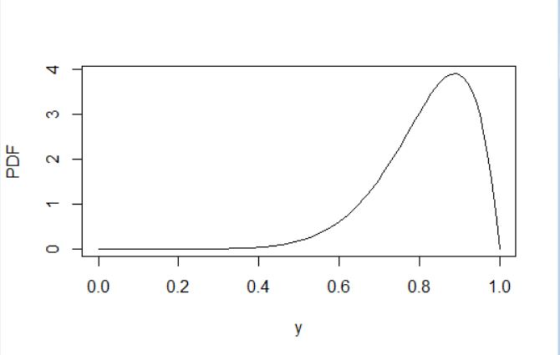
1. UPS ships millions of packages in a specific 1-ft^3 packing container. Let Y = amount of space (in ft^3 ) occupied in this container. The probability density function (pdf) of Y is given by fY (y) = 90y 8 (1 − y), 0 < y < 1. 0, otherwise.
(a) Graph the pdf of Y . If you want, you can use this R code below: y = seq(0,1,0.01) pdf = 90*y^8*(1-y) plot(y,pdf,type="l",xlab="y",ylab="PDF") abline(h=0) # puts horizontal line at 0 abline(v=1,lty=2) # puts vertical line at 1; "lty" option alters line type
(b) Find the probability that the contents of a randomly selected 1-ft3 packing container will occupy less than 1/2 of the volume of the container; i.e., calculate P(Y < 0.5). Shade in the corresponding region on your pdf in part (a) showing this probability.
(c) Find the mean and variance of Y . Indicate the units of each quantity. Place an “×” on the horizontal axis of your pdf in part (a) indicating where E(Y ) falls.
(d) I calculated the median of this distribution to be 0.8377 ft3 . Write out an equation (involving an integral) that when solved will give this answer. Make sure you say “what is being solved for” in your equation. You don’t have to try to solve the equation.
Homework Answers
a)
b)


c)



var(Y) = E(Y^2) - E(Y)^2
= 15/22 -(9/11)^2
= 0.012396
d)

Add Answer to:
1. UPS ships millions of packages in a specific 1-ft^3 packing
container. Let Y = amount...
Let X denote the amount of space occupied by an article placed in a 1-ft3 packing...
 Let X denote the amount of space occupied by an article placed in a 1-ft3 packing container. The pdf of X is belovw otherwise Adapt the following R code to graph the PDF in R Where the pdf is fx)x( -x) 0< 1 ### R Code a-a ; b b ; ### You must plug in values for a and b. r-seq (0,1,0.0!) # Defines range of X from 0 to 1 pdf = function(x)(a*x^b"(1-x)} # Creates the pdf function...
Will rate!! Let X denote the amount of space occupied by an article placed in a...
 Will rate!!
Let X denote the amount of space occupied by an article placed in a 1-ft3 packing container. The pdf of X is below. 72x'(1-x) 0 0<x<1 otherwise f(x) = Adapt the following R code to graph the PDF in R. axb(1-x) 0 < x < 1 otherwise where the pdf is f(x) = ### R Code a-a ; b-b , # # # You must plug in values for a and b. r-seq(0, 1,0.01) # Defines range of...
Will rate!!
Let X denote the amount of space occupied by an article placed in a 1-ft3 packing container. The pdf of X is below. 72x'(1-x) 0 0<x<1 otherwise f(x) = Adapt the following R code to graph the PDF in R. axb(1-x) 0 < x < 1 otherwise where the pdf is f(x) = ### R Code a-a ; b-b , # # # You must plug in values for a and b. r-seq(0, 1,0.01) # Defines range of...
Let X denote the amount of space occupied by an article placed in a 1-ft3 packing...
Let X denote the amount of space occupied by an article placed in a 1-ft3 packing container. The pdf of X is below. f(x) = 72x7(1 − x) 0 < x < 1 0 otherwise (a) Graph the pdf. Obtain the cdf of X. F(x) = 0 x < 0 0 ≤ x ≤ 1 1 x > 1 (a) Using the cdf from (a), what is P(0.3 < X ≤ 0.6)? (Round your answer to four...
Let X denote the amount of space occupied by an article placed in a 1-ft packing...
 Let X denote the amount of space occupied by an article placed in a 1-ft packing container. The pdf of X is below. | 42x5(1 - x) 0<x< 1 otherwise (b) What is PIX S 0.6) [i.e., F(0.6)]? (Round your answer to four decimal places.) (c) Using the cdf from (a), what is P(0.3<XS 0.6)? (Round your answer to four decimal places.)
Let X denote the amount of space occupied by an article placed in a 1-ft packing...
 Let X denote the amount of space occupied by an article placed in a 1-ft packing container. The pdf of X is below. 56x6(1 - x) 0 x 1 f(x) = otherwise Obtain the cdf of X. 0 0 > X F(x) 0 s x s 1 1 x > 1 Graph the cdf of X F(x) F(x) 1.0 1.0 0.8 0.8 0.6 0.6 0.4 0.4 0.2 0.2 1.0 0.8 0.6 0.4 0.2 1.0 0.8 0,6 0.4 0.2 F(x F(x)...
Let X denote the amount of space occupied by an article placed in a 1-ft3 packing...
Let X denote the amount of space occupied by an article placed in a 1-ft3 packing container. The pdf of X is below. f(x) = 90x8(1 − x) 0 < x < 1 0 otherwise (a) Graph the pdf. Obtain the cdf of X. F(x) = 0 x < 0 0 ≤ x ≤ 1 1 x > 1 Graph the cdf of X. (b) What is P(X ≤ 0.65) [i.e., F(0.65)]? (Round your answer to four decimal places.)...
2. Let X denote the amount of space occupied by an article placed in a 1-ft...
 2. Let X denote the amount of space occupied by an article placed in a 1-ft packing container. The pdf of X is f(x)=90x8 (1 – x) for 0<x< 1 and zero otherwise a) What is the CDF of X b) What is P(X < 0.5) ? c) What is P(0.25 <X < 0.5? And P(0.25 < X <0.5) ? d) Compute E(X)and V(X) e) What is the probability that X is more than one standard deviation from its mean...
I can't find the solution for (i), I tried the hint but still lost Let X...
 I can't find the solution for
(i), I tried the hint but still lost
Let X denote the amount of space occupied by an article placed in a 1-ft3 packing container. The pdf of X is below 90x8(1-x) 0 0<x<1 otherwise rx) = Adapt the following R code to graph the PDF in R. here the pdf is fx)-ax*u-x) 0<x<1 otherwise ### R Code a-a ; b-b ; ### You must plug in values for a and b. r seq(0,1,0,01)...
I can't find the solution for
(i), I tried the hint but still lost
Let X denote the amount of space occupied by an article placed in a 1-ft3 packing container. The pdf of X is below 90x8(1-x) 0 0<x<1 otherwise rx) = Adapt the following R code to graph the PDF in R. here the pdf is fx)-ax*u-x) 0<x<1 otherwise ### R Code a-a ; b-b ; ### You must plug in values for a and b. r seq(0,1,0,01)...
 Let X denote the amount of space occupied by an article placed in a 1-ft3 packing container. The pdf of X is belovw otherwise Adapt the following R code to graph the PDF in R Where the pdf is fx)x( -x) 0< 1 ### R Code a-a ; b b ; ### You must plug in values for a and b. r-seq (0,1,0.0!) # Defines range of X from 0 to 1 pdf = function(x)(a*x^b"(1-x)} # Creates the pdf function...
 Will rate!!
Let X denote the amount of space occupied by an article placed in a 1-ft3 packing container. The pdf of X is below. 72x'(1-x) 0 0<x<1 otherwise f(x) = Adapt the following R code to graph the PDF in R. axb(1-x) 0 < x < 1 otherwise where the pdf is f(x) = ### R Code a-a ; b-b , # # # You must plug in values for a and b. r-seq(0, 1,0.01) # Defines range of...
Will rate!!
Let X denote the amount of space occupied by an article placed in a 1-ft3 packing container. The pdf of X is below. 72x'(1-x) 0 0<x<1 otherwise f(x) = Adapt the following R code to graph the PDF in R. axb(1-x) 0 < x < 1 otherwise where the pdf is f(x) = ### R Code a-a ; b-b , # # # You must plug in values for a and b. r-seq(0, 1,0.01) # Defines range of...
 Let X denote the amount of space occupied by an article placed in a 1-ft packing container. The pdf of X is below. | 42x5(1 - x) 0<x< 1 otherwise (b) What is PIX S 0.6) [i.e., F(0.6)]? (Round your answer to four decimal places.) (c) Using the cdf from (a), what is P(0.3<XS 0.6)? (Round your answer to four decimal places.)
 Let X denote the amount of space occupied by an article placed in a 1-ft packing container. The pdf of X is below. 56x6(1 - x) 0 x 1 f(x) = otherwise Obtain the cdf of X. 0 0 > X F(x) 0 s x s 1 1 x > 1 Graph the cdf of X F(x) F(x) 1.0 1.0 0.8 0.8 0.6 0.6 0.4 0.4 0.2 0.2 1.0 0.8 0.6 0.4 0.2 1.0 0.8 0,6 0.4 0.2 F(x F(x)...
 2. Let X denote the amount of space occupied by an article placed in a 1-ft packing container. The pdf of X is f(x)=90x8 (1 – x) for 0<x< 1 and zero otherwise a) What is the CDF of X b) What is P(X < 0.5) ? c) What is P(0.25 <X < 0.5? And P(0.25 < X <0.5) ? d) Compute E(X)and V(X) e) What is the probability that X is more than one standard deviation from its mean...
 I can't find the solution for
(i), I tried the hint but still lost
Let X denote the amount of space occupied by an article placed in a 1-ft3 packing container. The pdf of X is below 90x8(1-x) 0 0<x<1 otherwise rx) = Adapt the following R code to graph the PDF in R. here the pdf is fx)-ax*u-x) 0<x<1 otherwise ### R Code a-a ; b-b ; ### You must plug in values for a and b. r seq(0,1,0,01)...
I can't find the solution for
(i), I tried the hint but still lost
Let X denote the amount of space occupied by an article placed in a 1-ft3 packing container. The pdf of X is below 90x8(1-x) 0 0<x<1 otherwise rx) = Adapt the following R code to graph the PDF in R. here the pdf is fx)-ax*u-x) 0<x<1 otherwise ### R Code a-a ; b-b ; ### You must plug in values for a and b. r seq(0,1,0,01)...
Most questions answered within 3 hours.
-
Where is the error in this code sequence?
String s1 = "Hello";
String s2 = "ello";...
asked 11 months ago -
Financial data for Joel de Paris, Inc., for last year
follow:
Joel de Paris, Inc.
Balance...
asked 11 months ago -
Consider this reaction:
Al2(SO4)3 (aq)+ BaCl3
(aq) Al2Cl6 (aq)- +
3BaSO4(s) . What is the...
asked 11 months ago -
Suppose that Savneet is considering increasing her
recent random sample from 20 car rentals to 40...
asked 11 months ago -
Trucks arrive at an unloading terminal at an average rate of 120
per hour.
Trucks arrive...
asked 11 months ago -
Why are methanol and ethanol completely soluble in water while
octanol is not very little soluble....
asked 11 months ago -
A facilities manager at a university reads in a research report
that the mean amount of...
asked 11 months ago -
When the CuSO4 is rehydrated by adding water to the anhydrous
compound, is this an endothermic...
asked 11 months ago -
A ray of sunlight is passing from diamond into crown glass; the
angle of incidence is...
asked 11 months ago -
A block of mass 0.249 kg is placed on top of a light, vertical
spring of...
asked 11 months ago -
how do the kidneys compensate in the presences of acidosis
a) trigger hyperventilate
b) reserve acid...
asked 11 months ago -
Question 501 pts
The rental rate of capital to the firm increases. Which of the
following...
asked 11 months ago