
Homework Answers
Add Answer to:
WO! OPEN ENDED OUESTIONS (23 POINTS) Department of Physics 2-3 points in a commercial mass spectrometer....
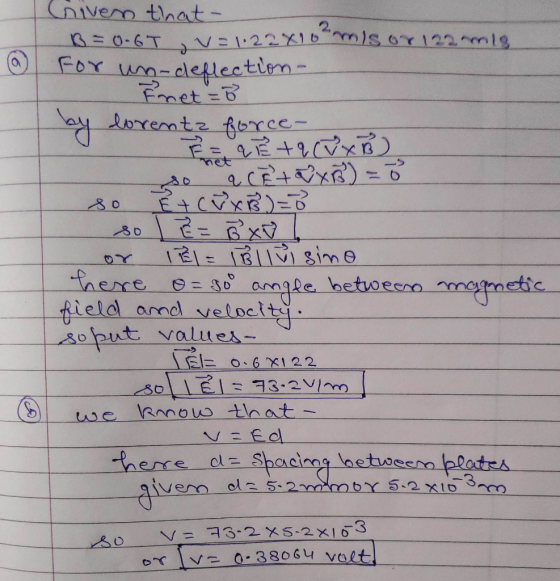
In the Bainbridge mass spectrometer (Figure 1) , the magnetic-field magnitude in the velocity selector is...
 In the Bainbridge mass spectrometer (Figure 1) , the
magnetic-field magnitude in the velocity selector is
0.510 T , and ions having a speed of 1.82×10⁶m/s pass through
undeflected.
A) What is the electric-field magnitude in the velocity
selector?
b) If the separation of the plates
is 5.20mm, what is the potential difference between the plates?
Figure 1of 1 ㄧㄨㄨㄨ
In the Bainbridge mass spectrometer (Figure 1) , the
magnetic-field magnitude in the velocity selector is
0.510 T , and ions having a speed of 1.82×10⁶m/s pass through
undeflected.
A) What is the electric-field magnitude in the velocity
selector?
b) If the separation of the plates
is 5.20mm, what is the potential difference between the plates?
Figure 1of 1 ㄧㄨㄨㄨ
Tipler6 26.P.042. Before entering a mass spectrometer, ions pass through a velocity selector consisting of parallel...
Tipler6 26.P.042. Before entering a mass spectrometer, ions pass through a velocity selector consisting of parallel plates separated by 1.5 mm and having a potential difference of 150 V. The magnetic field between the plates is 0.42 T. The magnetic field in the mass spectrometer is 1.2 T. (a) Find the speed of the ions entering the mass spectrometer. ___ m/s (b) Find the difference in the diameters of the orbits of singly ionized 238U and 235U. (The mass of...
Consider the mass spectrometer shown schematically in the figure below. The magnitude of the electric field...
Consider the mass spectrometer shown schematically in the figure below. The magnitude of the electric field between the plates of the velocity selector is 2.20 103 V/m, and the magnetic field in both the velocity selector and the deflection chamber has a magnitude of 0.030 0 T. Calculate the radius of the path for a singly charged ion having a mass m = 2.34 10-26 kg.
Consider the mass spectrometer shown schematically in the figure below. The magnitude of the electric field...
 Consider the mass spectrometer shown schematically in the figure
below. The magnitude of the electric field between the plates of
the velocity selector is 2.20 103 V/m, and the magnetic field in
both the velocity selector and the deflection chamber has a
magnitude of 0.0450 T. Calculate the radius of the path for a
singly charged ion having a mass m = 2.36
10-26 kg.
m
Consider the mass spectrometer shown schematically in the figure
below. The magnitude of the electric field between the plates of
the velocity selector is 2.20 103 V/m, and the magnetic field in
both the velocity selector and the deflection chamber has a
magnitude of 0.0450 T. Calculate the radius of the path for a
singly charged ion having a mass m = 2.36
10-26 kg.
m
Consider the mass spectrometer shown schematically in the figure below. The magnitude of the electric field...
 Consider the mass spectrometer shown schematically in the figure
below. The magnitude of the electric field between the plates of
the velocity selector is 3.00 103 V/m, and the magnetic field in
both the velocity selector and the deflection chamber has a
magnitude of 0.040 0 T. Calculate the radius of the path for a
singly charged ion having a mass m = 1.82 10-26 kg
Consider the mass spectrometer shown schematically in the figure below. The magnitude of the...
Consider the mass spectrometer shown schematically in the figure
below. The magnitude of the electric field between the plates of
the velocity selector is 3.00 103 V/m, and the magnetic field in
both the velocity selector and the deflection chamber has a
magnitude of 0.040 0 T. Calculate the radius of the path for a
singly charged ion having a mass m = 1.82 10-26 kg
Consider the mass spectrometer shown schematically in the figure below. The magnitude of the...
Consider the mass spectrometer shown schematically in the figure below. The magnitude of the electric field...
 Consider the mass spectrometer shown schematically in the figure below. The magnitude of the electric field between the plates of the velocity selector is 2.60 x 10³ V/m, and the magnetic field in both the velocity selector and the deflection chamber has a magnitude of 0.0400 T. Calculate the radius of the path for a singly charged ion having a mass m = 2.50 x 10⁻²⁶ kg. Bo, in * * * * * x * * * * *...
Problem 1 chemists to determine the composition of a sample. Let's explore one type of mass spectrometer, which u...
 Problem 1 chemists to determine the composition of a sample. Let's explore one type of mass spectrometer, which uses electric and magnetic fields. For each step below, sketch a diagram to help you with the analysis Mass spectrometers, which separate ions based on mass, are often used by a. In Step 1 of mass spectrometry, an accelerator releases a charged particle from rest near one plate of a charged parallel-plate capacitor, so that the particle accelerates toward the other plate...
3. Fill the blanks and the Proof - J.J. Thomson's experiment to fine the charge-to-mass ratio of the tt) (25 po...
 3. Fill the blanks and the Proof - J.J. Thomson's experiment to fine the charge-to-mass ratio of the tt) (25 points) electron (i.e. e/m; The first is the experiment of Joseph John Thomson, who first demonstrated that atoms are actually composed of aggregates of charged particles. Prior to his work, it was believed that atoms were the fundamental building blocks of matter. The first evidence contrary to this notion came when people began studying the properties of atoms in large...
 In the Bainbridge mass spectrometer (Figure 1) , the
magnetic-field magnitude in the velocity selector is
0.510 T , and ions having a speed of 1.82×10⁶m/s pass through
undeflected.
A) What is the electric-field magnitude in the velocity
selector?
b) If the separation of the plates
is 5.20mm, what is the potential difference between the plates?
Figure 1of 1 ㄧㄨㄨㄨ
In the Bainbridge mass spectrometer (Figure 1) , the
magnetic-field magnitude in the velocity selector is
0.510 T , and ions having a speed of 1.82×10⁶m/s pass through
undeflected.
A) What is the electric-field magnitude in the velocity
selector?
b) If the separation of the plates
is 5.20mm, what is the potential difference between the plates?
Figure 1of 1 ㄧㄨㄨㄨ
 Consider the mass spectrometer shown schematically in the figure
below. The magnitude of the electric field between the plates of
the velocity selector is 2.20 103 V/m, and the magnetic field in
both the velocity selector and the deflection chamber has a
magnitude of 0.0450 T. Calculate the radius of the path for a
singly charged ion having a mass m = 2.36
10-26 kg.
m
Consider the mass spectrometer shown schematically in the figure
below. The magnitude of the electric field between the plates of
the velocity selector is 2.20 103 V/m, and the magnetic field in
both the velocity selector and the deflection chamber has a
magnitude of 0.0450 T. Calculate the radius of the path for a
singly charged ion having a mass m = 2.36
10-26 kg.
m
 Consider the mass spectrometer shown schematically in the figure
below. The magnitude of the electric field between the plates of
the velocity selector is 3.00 103 V/m, and the magnetic field in
both the velocity selector and the deflection chamber has a
magnitude of 0.040 0 T. Calculate the radius of the path for a
singly charged ion having a mass m = 1.82 10-26 kg
Consider the mass spectrometer shown schematically in the figure below. The magnitude of the...
Consider the mass spectrometer shown schematically in the figure
below. The magnitude of the electric field between the plates of
the velocity selector is 3.00 103 V/m, and the magnetic field in
both the velocity selector and the deflection chamber has a
magnitude of 0.040 0 T. Calculate the radius of the path for a
singly charged ion having a mass m = 1.82 10-26 kg
Consider the mass spectrometer shown schematically in the figure below. The magnitude of the...
 Consider the mass spectrometer shown schematically in the figure below. The magnitude of the electric field between the plates of the velocity selector is 2.60 x 10³ V/m, and the magnetic field in both the velocity selector and the deflection chamber has a magnitude of 0.0400 T. Calculate the radius of the path for a singly charged ion having a mass m = 2.50 x 10⁻²⁶ kg. Bo, in * * * * * x * * * * *...
 Problem 1 chemists to determine the composition of a sample. Let's explore one type of mass spectrometer, which uses electric and magnetic fields. For each step below, sketch a diagram to help you with the analysis Mass spectrometers, which separate ions based on mass, are often used by a. In Step 1 of mass spectrometry, an accelerator releases a charged particle from rest near one plate of a charged parallel-plate capacitor, so that the particle accelerates toward the other plate...
 3. Fill the blanks and the Proof - J.J. Thomson's experiment to fine the charge-to-mass ratio of the tt) (25 points) electron (i.e. e/m; The first is the experiment of Joseph John Thomson, who first demonstrated that atoms are actually composed of aggregates of charged particles. Prior to his work, it was believed that atoms were the fundamental building blocks of matter. The first evidence contrary to this notion came when people began studying the properties of atoms in large...
Most questions answered within 3 hours.
-
Where is the error in this code sequence?
String s1 = "Hello";
String s2 = "ello";...
asked 11 months ago -
Financial data for Joel de Paris, Inc., for last year
follow:
Joel de Paris, Inc.
Balance...
asked 11 months ago -
Consider this reaction:
Al2(SO4)3 (aq)+ BaCl3
(aq) Al2Cl6 (aq)- +
3BaSO4(s) . What is the...
asked 11 months ago -
Suppose that Savneet is considering increasing her
recent random sample from 20 car rentals to 40...
asked 11 months ago -
Trucks arrive at an unloading terminal at an average rate of 120
per hour.
Trucks arrive...
asked 11 months ago -
Why are methanol and ethanol completely soluble in water while
octanol is not very little soluble....
asked 11 months ago -
A facilities manager at a university reads in a research report
that the mean amount of...
asked 11 months ago -
When the CuSO4 is rehydrated by adding water to the anhydrous
compound, is this an endothermic...
asked 11 months ago -
A ray of sunlight is passing from diamond into crown glass; the
angle of incidence is...
asked 11 months ago -
A block of mass 0.249 kg is placed on top of a light, vertical
spring of...
asked 11 months ago -
how do the kidneys compensate in the presences of acidosis
a) trigger hyperventilate
b) reserve acid...
asked 11 months ago -
Question 501 pts
The rental rate of capital to the firm increases. Which of the
following...
asked 11 months ago