


Homework Answers
 For
query do comment. Thank you. Like Please
For
query do comment. Thank you. Like Please
Add Answer to:
state the equation that you use
Semiconductor Germanium has a density of 5323 a. cm- and...
could you please answer all parts of this question. like and comment are rewarded. A3. (a)...
 could you please answer all
parts of this question. like and comment are rewarded.
A3. (a) In a proton-antiproton collider experiment, the p and p beams have equal and opposite momenta. In the experiment, the following process occurs p+p+ Dº + Dº The Dº meson is unstable and decays via Dº + K+ + The K+ meson has a lifetime of tK = 1.23 x 10⁻⁸s and a decay length of 6.50 m in the rest frame of the Dº...
could you please answer all
parts of this question. like and comment are rewarded.
A3. (a) In a proton-antiproton collider experiment, the p and p beams have equal and opposite momenta. In the experiment, the following process occurs p+p+ Dº + Dº The Dº meson is unstable and decays via Dº + K+ + The K+ meson has a lifetime of tK = 1.23 x 10⁻⁸s and a decay length of 6.50 m in the rest frame of the Dº...
4. (5pt +15 pt) (Required for PHY803 students only. +10 pts extra credit for PHY493 students.)...
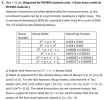 4. (5pt +15 pt) (Required for PHY803 students only. +10 pts extra credit for PHY493 students.) Hadronic resonances are often labeled with the resonance mass, as the constituent quarks can be in a spin 0state, leading to a higher mass. This is commonly denoted as X(M) for a particle X with mass M in units of Mev The Λ0(1116) has the following decays: Decay Decay Mode Number Branching Fraction 0.639 t 0.005 0.358 + 0.005 0.00084 ± 0.00014 0.00175+0.00015 0.000832+...
Question 1 (a) A convex lens with a focal length of 15 cm is placed 25...
 Question 1 (a) A convex lens with a focal length of 15 cm is placed 25 cm from a lighted object. At what distance will an image be formed? Will it be real? (b) An object is placed 10 cm from a concave mirror. The focal length is 5 cm. Determine the image distance and the magnification of the image. (c) Light in vacuum is incident on the surface of a glass slab. In the vacuum, the beam makes an...
I can answer the multiple choice, I just need help with the fill ins. Question 1...
 I can answer the multiple choice, I just need help with the fill
ins.
Question 1 (1 Point) This assignment is set up for sequential assessment. Complete each question and submit the answer before moving on to the next question. Correct answers for each question will be made available once the maximum number of attempts have been made for each submission. Nuclear Physics - Nuclear Structure Nuclear Structure Z O Proton r=ro41/3 radius N Neutron A = Z+N A ro...
I can answer the multiple choice, I just need help with the fill
ins.
Question 1 (1 Point) This assignment is set up for sequential assessment. Complete each question and submit the answer before moving on to the next question. Correct answers for each question will be made available once the maximum number of attempts have been made for each submission. Nuclear Physics - Nuclear Structure Nuclear Structure Z O Proton r=ro41/3 radius N Neutron A = Z+N A ro...
I can answer the multiple choice, I just need help with the fill ins. Question 1...
 I can answer the multiple choice, I just need help with the fill
ins.
Question 1 (1 Point) This assignment is set up for sequential assessment. Complete each question and submit the answer before moving on to the next question. Correct answers for each question will be made available once the maximum number of attempts have been made for each submission. Nuclear Physics - Nuclear Structure Nuclear Structure Z O Proton r=ro41/3 radius N Neutron A = Z+N A ro...
I can answer the multiple choice, I just need help with the fill
ins.
Question 1 (1 Point) This assignment is set up for sequential assessment. Complete each question and submit the answer before moving on to the next question. Correct answers for each question will be made available once the maximum number of attempts have been made for each submission. Nuclear Physics - Nuclear Structure Nuclear Structure Z O Proton r=ro41/3 radius N Neutron A = Z+N A ro...
a) solve q value b/c) draw Feynman diagram 3. (a) Calculate the Q-value (in MeV) for...
 a) solve q value
b/c) draw Feynman diagram
3. (a) Calculate the Q-value (in MeV) for the following reaction (see the table on page 4): p+ → Aº + Kº + Tº (c) Draw a possible Feynman diagram for the reaction above at the quark level. The quark composition of the particles are as follows: p: uud, nt :ūd, Aº: uds, Kº: ds, Tº: uū. Partide name Symbol Anti- particle Spin Mass (MeV/c) B L L . S antiparticles have...
a) solve q value
b/c) draw Feynman diagram
3. (a) Calculate the Q-value (in MeV) for the following reaction (see the table on page 4): p+ → Aº + Kº + Tº (c) Draw a possible Feynman diagram for the reaction above at the quark level. The quark composition of the particles are as follows: p: uud, nt :ūd, Aº: uds, Kº: ds, Tº: uū. Partide name Symbol Anti- particle Spin Mass (MeV/c) B L L . S antiparticles have...
could you please answer all parts of this question. like and comment are rewarded. Compulsory question:...
 could you please answer all
parts of this question. like and comment are rewarded.
Compulsory question: [8] A1. (a) Consider the following processes (i) + +n+p+et te (ii) H+ e + e + D (iii) + +et+ve (iv) K+ + + + V Use conservation laws to determine which of these processes are allowed. For processes that are not allowed, state which conservation laws are violated. For processes that are allowed, specify by which interaction (electromagnetic, weak or strong) they...
could you please answer all
parts of this question. like and comment are rewarded.
Compulsory question: [8] A1. (a) Consider the following processes (i) + +n+p+et te (ii) H+ e + e + D (iii) + +et+ve (iv) K+ + + + V Use conservation laws to determine which of these processes are allowed. For processes that are not allowed, state which conservation laws are violated. For processes that are allowed, specify by which interaction (electromagnetic, weak or strong) they...
A) You will investigate the PP-I chain leading to the formation of helium and energy from the fus...
 A) You will investigate the PP-I chain leading to the formation of helium and energy from the fusion of 1) Demonstrate that I u of mass (1/12)mC, atom) has an equivalent rest mass of answers Qi, Q2, and Qs in MeV. Be careful with Qi-beware of the leptons! hydrogen in the cores of lower mass main sequence stars such as our Sun. 931.4940954 MeV/c (match at least the first 4 digits past decimal) Calculate the Q value for each step...
The ideal gas law, discovered experimentally, is an equation of state that relates the observable state variables of the gas. pressure, temperature, and density
 The ideal gas law, discovered experimentally, is an equation of state that relates the observable state variables of the gas. pressure, temperature, and density (or quantity per volume$$ \eta V=N k_{\mathrm{B}} T(\mathrm{or} p V=n \mathrm{RT}) $$Where \(N\) is the number of atoms, \(n\) is the number of moles, and \(R\) and \(k_{\mathrm{B}}\) are ideal gas constants such that \(R=N_{\mathrm{A}} k_{\mathrm{B}}\), where \(N_{A}\) is Avogadro's number. In this problem. you should use Boltzmann's constant instead of the gas constant \(R\).Remaıkably. the...
This problem is concerned with evaluating some improper integrals. In particular you will use an ...
 This problem is concerned with evaluating some improper integrals. In particular you will use an improper integral over an interval of infinite length to evaluate an integral of a function not defined at one end point. This will involve a special function「which arises in many applications in the sciences. a. Evaluate Jo (log z) dr. b. Explain how you would evaluate Jr*(log x)7 dr, but do not actually compute it. Would your method work if the exponent'8, were replaced by...
 could you please answer all
parts of this question. like and comment are rewarded.
A3. (a) In a proton-antiproton collider experiment, the p and p beams have equal and opposite momenta. In the experiment, the following process occurs p+p+ Dº + Dº The Dº meson is unstable and decays via Dº + K+ + The K+ meson has a lifetime of tK = 1.23 x 10⁻⁸s and a decay length of 6.50 m in the rest frame of the Dº...
could you please answer all
parts of this question. like and comment are rewarded.
A3. (a) In a proton-antiproton collider experiment, the p and p beams have equal and opposite momenta. In the experiment, the following process occurs p+p+ Dº + Dº The Dº meson is unstable and decays via Dº + K+ + The K+ meson has a lifetime of tK = 1.23 x 10⁻⁸s and a decay length of 6.50 m in the rest frame of the Dº...
 4. (5pt +15 pt) (Required for PHY803 students only. +10 pts extra credit for PHY493 students.) Hadronic resonances are often labeled with the resonance mass, as the constituent quarks can be in a spin 0state, leading to a higher mass. This is commonly denoted as X(M) for a particle X with mass M in units of Mev The Λ0(1116) has the following decays: Decay Decay Mode Number Branching Fraction 0.639 t 0.005 0.358 + 0.005 0.00084 ± 0.00014 0.00175+0.00015 0.000832+...
 Question 1 (a) A convex lens with a focal length of 15 cm is placed 25 cm from a lighted object. At what distance will an image be formed? Will it be real? (b) An object is placed 10 cm from a concave mirror. The focal length is 5 cm. Determine the image distance and the magnification of the image. (c) Light in vacuum is incident on the surface of a glass slab. In the vacuum, the beam makes an...
 I can answer the multiple choice, I just need help with the fill
ins.
Question 1 (1 Point) This assignment is set up for sequential assessment. Complete each question and submit the answer before moving on to the next question. Correct answers for each question will be made available once the maximum number of attempts have been made for each submission. Nuclear Physics - Nuclear Structure Nuclear Structure Z O Proton r=ro41/3 radius N Neutron A = Z+N A ro...
I can answer the multiple choice, I just need help with the fill
ins.
Question 1 (1 Point) This assignment is set up for sequential assessment. Complete each question and submit the answer before moving on to the next question. Correct answers for each question will be made available once the maximum number of attempts have been made for each submission. Nuclear Physics - Nuclear Structure Nuclear Structure Z O Proton r=ro41/3 radius N Neutron A = Z+N A ro...
 I can answer the multiple choice, I just need help with the fill
ins.
Question 1 (1 Point) This assignment is set up for sequential assessment. Complete each question and submit the answer before moving on to the next question. Correct answers for each question will be made available once the maximum number of attempts have been made for each submission. Nuclear Physics - Nuclear Structure Nuclear Structure Z O Proton r=ro41/3 radius N Neutron A = Z+N A ro...
I can answer the multiple choice, I just need help with the fill
ins.
Question 1 (1 Point) This assignment is set up for sequential assessment. Complete each question and submit the answer before moving on to the next question. Correct answers for each question will be made available once the maximum number of attempts have been made for each submission. Nuclear Physics - Nuclear Structure Nuclear Structure Z O Proton r=ro41/3 radius N Neutron A = Z+N A ro...
 a) solve q value
b/c) draw Feynman diagram
3. (a) Calculate the Q-value (in MeV) for the following reaction (see the table on page 4): p+ → Aº + Kº + Tº (c) Draw a possible Feynman diagram for the reaction above at the quark level. The quark composition of the particles are as follows: p: uud, nt :ūd, Aº: uds, Kº: ds, Tº: uū. Partide name Symbol Anti- particle Spin Mass (MeV/c) B L L . S antiparticles have...
a) solve q value
b/c) draw Feynman diagram
3. (a) Calculate the Q-value (in MeV) for the following reaction (see the table on page 4): p+ → Aº + Kº + Tº (c) Draw a possible Feynman diagram for the reaction above at the quark level. The quark composition of the particles are as follows: p: uud, nt :ūd, Aº: uds, Kº: ds, Tº: uū. Partide name Symbol Anti- particle Spin Mass (MeV/c) B L L . S antiparticles have...
 could you please answer all
parts of this question. like and comment are rewarded.
Compulsory question: [8] A1. (a) Consider the following processes (i) + +n+p+et te (ii) H+ e + e + D (iii) + +et+ve (iv) K+ + + + V Use conservation laws to determine which of these processes are allowed. For processes that are not allowed, state which conservation laws are violated. For processes that are allowed, specify by which interaction (electromagnetic, weak or strong) they...
could you please answer all
parts of this question. like and comment are rewarded.
Compulsory question: [8] A1. (a) Consider the following processes (i) + +n+p+et te (ii) H+ e + e + D (iii) + +et+ve (iv) K+ + + + V Use conservation laws to determine which of these processes are allowed. For processes that are not allowed, state which conservation laws are violated. For processes that are allowed, specify by which interaction (electromagnetic, weak or strong) they...
 A) You will investigate the PP-I chain leading to the formation of helium and energy from the fusion of 1) Demonstrate that I u of mass (1/12)mC, atom) has an equivalent rest mass of answers Qi, Q2, and Qs in MeV. Be careful with Qi-beware of the leptons! hydrogen in the cores of lower mass main sequence stars such as our Sun. 931.4940954 MeV/c (match at least the first 4 digits past decimal) Calculate the Q value for each step...
 The ideal gas law, discovered experimentally, is an equation of state that relates the observable state variables of the gas. pressure, temperature, and density (or quantity per volume$$ \eta V=N k_{\mathrm{B}} T(\mathrm{or} p V=n \mathrm{RT}) $$Where \(N\) is the number of atoms, \(n\) is the number of moles, and \(R\) and \(k_{\mathrm{B}}\) are ideal gas constants such that \(R=N_{\mathrm{A}} k_{\mathrm{B}}\), where \(N_{A}\) is Avogadro's number. In this problem. you should use Boltzmann's constant instead of the gas constant \(R\).Remaıkably. the...
 This problem is concerned with evaluating some improper integrals. In particular you will use an improper integral over an interval of infinite length to evaluate an integral of a function not defined at one end point. This will involve a special function「which arises in many applications in the sciences. a. Evaluate Jo (log z) dr. b. Explain how you would evaluate Jr*(log x)7 dr, but do not actually compute it. Would your method work if the exponent'8, were replaced by...
Most questions answered within 3 hours.
-
Where is the error in this code sequence?
String s1 = "Hello";
String s2 = "ello";...
asked 10 months ago -
Financial data for Joel de Paris, Inc., for last year
follow:
Joel de Paris, Inc.
Balance...
asked 10 months ago -
Consider this reaction:
Al2(SO4)3 (aq)+ BaCl3
(aq) Al2Cl6 (aq)- +
3BaSO4(s) . What is the...
asked 10 months ago -
Suppose that Savneet is considering increasing her
recent random sample from 20 car rentals to 40...
asked 10 months ago -
Trucks arrive at an unloading terminal at an average rate of 120
per hour.
Trucks arrive...
asked 10 months ago -
Why are methanol and ethanol completely soluble in water while
octanol is not very little soluble....
asked 10 months ago -
A facilities manager at a university reads in a research report
that the mean amount of...
asked 10 months ago -
When the CuSO4 is rehydrated by adding water to the anhydrous
compound, is this an endothermic...
asked 10 months ago -
A ray of sunlight is passing from diamond into crown glass; the
angle of incidence is...
asked 10 months ago -
A block of mass 0.249 kg is placed on top of a light, vertical
spring of...
asked 10 months ago -
how do the kidneys compensate in the presences of acidosis
a) trigger hyperventilate
b) reserve acid...
asked 10 months ago -
Question 501 pts
The rental rate of capital to the firm increases. Which of the
following...
asked 10 months ago