| Be sure to answer all parts. The molecular scene at right depicts the relative concentrations of H3O+ (purple) and OH− (green) in an aqueous solution at 25° C. (Counter ions and solvent molecules are omitted for clarity.)
|


Homework Answers
Solution:
Part A:
Number of H3O+ ions, n1 = 2
Number of OH- ions, n2 = 20
Ratio of their concentrations,
![[H3O+] [OH-] n1 na](http://img.homeworklib.com/questions/8d732f90-084c-11ec-9424-67dbc1cbf4ba.png?x-oss-process=image/resize,w_560)
![[H30+] 2 [OH-] 20](http://img.homeworklib.com/questions/8df5a8e0-084c-11ec-a4e5-8126758e2169.png?x-oss-process=image/resize,w_560)
![T0 = -HO) [+o®H]](http://img.homeworklib.com/questions/8e7384a0-084c-11ec-9800-5d72613e479c.png?x-oss-process=image/resize,w_560)
We know that
Kw = [H3O+] × [OH-]
10-14 = [H3O+] × [OH-]
10-14 = [H3O+] × ([H3O+]/0.1)
([H3O+])2 = 1015
[H2O+] = 0.00000003162
pH = - log [H3O+]
pH = - log(0.00000003162)
pH = 7.50
Part B:
pH of the solution = 4.90
We know that
pH + pOH = 14
4.90 + pOH = 14
pOH = 9.1
or - log[OH-] = 9.1
[OH-] = 10-9.1
[OH-] = 794.328234724 x 10⁻¹²
Also,
Kw = [H3O+] × [OH-]
10-14 = [H3O+] × [OH-]
10-14 = [H3O+] × (7.94328 x 10⁻¹⁰)
[H3O+] = 0.00001258925
Therefore,
![[H3O+] OH- 1 0.00001258925 794.328234724 * 10-12](http://img.homeworklib.com/questions/8ef02750-084c-11ec-9c34-6b1ff3b95ab6.png?x-oss-process=image/resize,w_560)
![[H30*] 2 = 15848.9267 ОН-](http://img.homeworklib.com/questions/8f715dd0-084c-11ec-84df-2b16c0b53f70.png?x-oss-process=image/resize,w_560)
![[H30*] он-1 = 1,58489 х 10](http://img.homeworklib.com/questions/8fecdfa0-084c-11ec-b761-d1181f11b119.png?x-oss-process=image/resize,w_560)
1.58489 x 10⁴ ions would have to be draw forevery OH-for the given solution.
Add Answer to:
Be sure to answer all parts.
The molecular scene at right depicts the relative concentrations of...
Enter your answer in the provided box. The two molecular scenes below depict the relative concentrations...
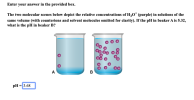 Enter your answer in the provided box. The two molecular scenes below depict the relative concentrations of Hz0(purple) in solutions of the same volume (with counterions and solvent molecules omitted for clarity). If the pH in beaker A is 5.32, what is the pH in beaker B? pH = 3.68
1. Be sure to answer all parts. The pH of a saturated solution of a metal...
1. Be sure to answer all parts. The pH of a saturated solution of a metal hydroxide MOH is 10.30. Calculate the Ksp for this compound. __×10___ Enter your answer in scientific notation 2. Be sure to answer all parts. Calculate the concentration of ions in the following saturated solutions: (a) [I−]in AgI solution with [Ag+] = 1.6 ×10⁻⁹M __× 10__M(Enter your answer in scientific notation.) (b) [Al3+]in Al(OH)3 solutions with [OH−]= 3.4 ×10⁻⁹M ___×10___M(Enter your answer in scientific notation.)...
Be sure to answer all parts. An aqueous solution of a strong base has pH 10.88...
Be sure to answer all parts. An aqueous solution of a strong base has pH 10.88 at 25°C. Calculate the concentration of base in the solution: (a) if the base is LiOH. [LiOH] = M (b) if the base is Ba(OH)2. [Ba(OH)2] = × 10 M (Enter your answer in scientific notation.)
Be sure to answer all parts. Calculate the concentrations of H2C204, HC204, C204-, and I' ions...
 Be sure to answer all parts. Calculate the concentrations of H2C204, HC204, C204-, and I' ions in a 0.171 M oxalic acid solution at 25°C. (Ka, = 6.5 x 10⁻² and Ka, = 6.1 x 10⁻⁵ for oxalic acid.) [H2C2041 = [HC204)= [C20,27= [H"]= M. M * 10 M M (Enter your answer in scientific notation.)
10 attempts left Check my work Be sure to answer all parts. Calculate the concentrations of...
 10 attempts left Check my work Be sure to answer all parts. Calculate the concentrations of H2C204, HC20, C20, and H at 25°C. (Ka, 6.5 x 10 and Ka, 6.1 x 10⁵ for oxalic acid.) ions in a 0.183 M oxalic acid solution = [H2C2041= м [HC2041= м [C2021= x 10 м [H*] м (Enter your answer in scientific notation.)
please answer all questions. In the laboratory you are given the task of separating Ba and...
 please answer all questions.
In the laboratory you are given the task of separating Ba and Agions in aqueous solution For each reagent listed below indicate if it can be used to separate the ions. Type "Y" for yes or "N" for no. If the reagent CAN be used to separate the ions, give the formula of the precipitate. If it cannot, type "No" Yor N Reagent Formula of Precipitate if YES КОН K2SO4 In the laboratory you are given...
please answer all questions.
In the laboratory you are given the task of separating Ba and Agions in aqueous solution For each reagent listed below indicate if it can be used to separate the ions. Type "Y" for yes or "N" for no. If the reagent CAN be used to separate the ions, give the formula of the precipitate. If it cannot, type "No" Yor N Reagent Formula of Precipitate if YES КОН K2SO4 In the laboratory you are given...
following reaction the unshaded spheres represent H atoms. Huz CO₃ H₂O H2O a o- H -c...
 following reaction the unshaded spheres represent H atoms. Huz CO₃ H₂O H2O a o- H -c 0-0 8) 8) Identify the Bronsted-Lowry acid/base conjugate pairs (1)/(4) and (2)/(3) B) (1)/(3) and (2)/(4) C) (1)/(2) and (3)/(4) 9) Arrange the following 0.10 M aqueous solutions in order of increasing pH: NaOH, HBr, NaCH3CO2, KBr, NH4Br. A) NaOH, NaCH3CO2, KBr, NH4Br, HB B) HBr, KBr, NH Br, NaCH3CO2, NaOH C) NaOH, NaCH3CO2, NH Br, KBr, HB D) HBr, NH4Br, KBr, NaCH3CO2, NaOH...
5. When all of the sample to be collected has left the column, will the drop...
 5. When all of the sample to be collected has left the
column, will the drop of solution coming off the tip of the column
be acidic, basic or neutral?
6. How many H+ ions would be displaced from the ion
exchange column by 1 Cu2+ ion?
7. Binding sites on the ion exchange resin are saturated
with which ion before the sample solution is added?
8. Ions are displaced from the resin binding sites by
any ion that has...
5. When all of the sample to be collected has left the
column, will the drop of solution coming off the tip of the column
be acidic, basic or neutral?
6. How many H+ ions would be displaced from the ion
exchange column by 1 Cu2+ ion?
7. Binding sites on the ion exchange resin are saturated
with which ion before the sample solution is added?
8. Ions are displaced from the resin binding sites by
any ion that has...
Titration: Acids and Bases 2. How can you determine which acid is diprotic? 3. using the...
 Titration: Acids and Bases
2. How can you determine which acid is diprotic?
3. using the answers to questions one and two, which acid is
diprotic?
4. Which base has more hydroxide ions per molecule?
Acid Volume Base Base Initial Volume (mL) Base Final Volume (mL) Volume of Base Used (mL) Acid: Base Ratio Acid 1 20 mL Base 1 50 mL 34.5 15.5 4:3 Acid 2 20 mL Base 1 Acid 1 20 mL Base 2 Acid 2 20...
Titration: Acids and Bases
2. How can you determine which acid is diprotic?
3. using the answers to questions one and two, which acid is
diprotic?
4. Which base has more hydroxide ions per molecule?
Acid Volume Base Base Initial Volume (mL) Base Final Volume (mL) Volume of Base Used (mL) Acid: Base Ratio Acid 1 20 mL Base 1 50 mL 34.5 15.5 4:3 Acid 2 20 mL Base 1 Acid 1 20 mL Base 2 Acid 2 20...
Mechanism An explanation for the mechanism is given in page 376 and 377. It says the...
 Mechanism An explanation for the mechanism is given in page 376 and 377. It says the reaction is not a free radical reaction, it is faster in acids and it requires HCIO and most likely Cl2 (elemental chlorine). Bleach is a basic solution of NaOCI sodium hypochlorite). It is made by the following reaction: 2 NaOH+ Cl2 <>NaoCI+NaCI + H20 Using your knowledge of equilibriums, what is the role of the acetic acid? (4 points) Hypochlorous acid is obtained from...
 Enter your answer in the provided box. The two molecular scenes below depict the relative concentrations of Hz0(purple) in solutions of the same volume (with counterions and solvent molecules omitted for clarity). If the pH in beaker A is 5.32, what is the pH in beaker B? pH = 3.68
 Be sure to answer all parts. Calculate the concentrations of H2C204, HC204, C204-, and I' ions in a 0.171 M oxalic acid solution at 25°C. (Ka, = 6.5 x 10⁻² and Ka, = 6.1 x 10⁻⁵ for oxalic acid.) [H2C2041 = [HC204)= [C20,27= [H"]= M. M * 10 M M (Enter your answer in scientific notation.)
 10 attempts left Check my work Be sure to answer all parts. Calculate the concentrations of H2C204, HC20, C20, and H at 25°C. (Ka, 6.5 x 10 and Ka, 6.1 x 10⁵ for oxalic acid.) ions in a 0.183 M oxalic acid solution = [H2C2041= м [HC2041= м [C2021= x 10 м [H*] м (Enter your answer in scientific notation.)
 please answer all questions.
In the laboratory you are given the task of separating Ba and Agions in aqueous solution For each reagent listed below indicate if it can be used to separate the ions. Type "Y" for yes or "N" for no. If the reagent CAN be used to separate the ions, give the formula of the precipitate. If it cannot, type "No" Yor N Reagent Formula of Precipitate if YES КОН K2SO4 In the laboratory you are given...
please answer all questions.
In the laboratory you are given the task of separating Ba and Agions in aqueous solution For each reagent listed below indicate if it can be used to separate the ions. Type "Y" for yes or "N" for no. If the reagent CAN be used to separate the ions, give the formula of the precipitate. If it cannot, type "No" Yor N Reagent Formula of Precipitate if YES КОН K2SO4 In the laboratory you are given...
 following reaction the unshaded spheres represent H atoms. Huz CO₃ H₂O H2O a o- H -c 0-0 8) 8) Identify the Bronsted-Lowry acid/base conjugate pairs (1)/(4) and (2)/(3) B) (1)/(3) and (2)/(4) C) (1)/(2) and (3)/(4) 9) Arrange the following 0.10 M aqueous solutions in order of increasing pH: NaOH, HBr, NaCH3CO2, KBr, NH4Br. A) NaOH, NaCH3CO2, KBr, NH4Br, HB B) HBr, KBr, NH Br, NaCH3CO2, NaOH C) NaOH, NaCH3CO2, NH Br, KBr, HB D) HBr, NH4Br, KBr, NaCH3CO2, NaOH...
 5. When all of the sample to be collected has left the
column, will the drop of solution coming off the tip of the column
be acidic, basic or neutral?
6. How many H+ ions would be displaced from the ion
exchange column by 1 Cu2+ ion?
7. Binding sites on the ion exchange resin are saturated
with which ion before the sample solution is added?
8. Ions are displaced from the resin binding sites by
any ion that has...
5. When all of the sample to be collected has left the
column, will the drop of solution coming off the tip of the column
be acidic, basic or neutral?
6. How many H+ ions would be displaced from the ion
exchange column by 1 Cu2+ ion?
7. Binding sites on the ion exchange resin are saturated
with which ion before the sample solution is added?
8. Ions are displaced from the resin binding sites by
any ion that has...
 Titration: Acids and Bases
2. How can you determine which acid is diprotic?
3. using the answers to questions one and two, which acid is
diprotic?
4. Which base has more hydroxide ions per molecule?
Acid Volume Base Base Initial Volume (mL) Base Final Volume (mL) Volume of Base Used (mL) Acid: Base Ratio Acid 1 20 mL Base 1 50 mL 34.5 15.5 4:3 Acid 2 20 mL Base 1 Acid 1 20 mL Base 2 Acid 2 20...
Titration: Acids and Bases
2. How can you determine which acid is diprotic?
3. using the answers to questions one and two, which acid is
diprotic?
4. Which base has more hydroxide ions per molecule?
Acid Volume Base Base Initial Volume (mL) Base Final Volume (mL) Volume of Base Used (mL) Acid: Base Ratio Acid 1 20 mL Base 1 50 mL 34.5 15.5 4:3 Acid 2 20 mL Base 1 Acid 1 20 mL Base 2 Acid 2 20...
 Mechanism An explanation for the mechanism is given in page 376 and 377. It says the reaction is not a free radical reaction, it is faster in acids and it requires HCIO and most likely Cl2 (elemental chlorine). Bleach is a basic solution of NaOCI sodium hypochlorite). It is made by the following reaction: 2 NaOH+ Cl2 <>NaoCI+NaCI + H20 Using your knowledge of equilibriums, what is the role of the acetic acid? (4 points) Hypochlorous acid is obtained from...
Most questions answered within 3 hours.
-
Where is the error in this code sequence?
String s1 = "Hello";
String s2 = "ello";...
asked 10 months ago -
Financial data for Joel de Paris, Inc., for last year
follow:
Joel de Paris, Inc.
Balance...
asked 10 months ago -
Consider this reaction:
Al2(SO4)3 (aq)+ BaCl3
(aq) Al2Cl6 (aq)- +
3BaSO4(s) . What is the...
asked 10 months ago -
Suppose that Savneet is considering increasing her
recent random sample from 20 car rentals to 40...
asked 10 months ago -
Trucks arrive at an unloading terminal at an average rate of 120
per hour.
Trucks arrive...
asked 10 months ago -
Why are methanol and ethanol completely soluble in water while
octanol is not very little soluble....
asked 10 months ago -
A facilities manager at a university reads in a research report
that the mean amount of...
asked 10 months ago -
When the CuSO4 is rehydrated by adding water to the anhydrous
compound, is this an endothermic...
asked 10 months ago -
A ray of sunlight is passing from diamond into crown glass; the
angle of incidence is...
asked 10 months ago -
A block of mass 0.249 kg is placed on top of a light, vertical
spring of...
asked 10 months ago -
how do the kidneys compensate in the presences of acidosis
a) trigger hyperventilate
b) reserve acid...
asked 10 months ago -
Question 501 pts
The rental rate of capital to the firm increases. Which of the
following...
asked 10 months ago