
Homework Answers
1) The least amount of time to complete all tasks = 0 + 1 + 1 + 2 + 2 + 3 = 9
2) The latest time that E can start = 4 (when the path is A -> B -> C -> D -> E)
Add Answer to:
The scheduling graph represented below has tasks that can be completed in 1 unit of time....
1 - [30 pts] Scheduling Algorithms Comparison Assume that we have 5 independent and aperiodic tasks...
 1 - [30 pts] Scheduling Algorithms Comparison Assume that we have 5 independent and aperiodic tasks (T1, ... , Ts) and they arrive to the system at times indicated below. Each task will run for the amount of execution time listed and is assigned a priority ranging from 0 (highest) to 10 (lowest), i.e. lower value means higher priority. There are no other tasks scheduled to arrive to the system until T1, ... , Ts complete. Task Arrival Time Execution...
Assume that for this project to be completed, five independent tasks must be completed. These tasks...
Assume that for this project to be completed, five independent tasks must be completed. These tasks are proceeding in parallel by five different subcontractors. To keep it simple, let's assume that each task takes between 1 and 5 months to complete (uniformly distributed, i.e. equally likely to take any amount of time between 1 and 5 months). So, the mean time to complete each task is 3 months and the probability of any given task taking 3 months or longer...
.8-6. A project consists of 12 activities, represented by the project network below, where number by each arc repres...
 .8-6. A project consists of 12 activities, represented by the project network below, where number by each arc represents the duration (in days) of the associated activity 4 12 4 12 10 a) Find the earliest time, latest time, and slack for each event as well as the slack for each activity. Also identify the critical path. (b) The project has been scheduled to be completed in the minimum possible time.If all previous activities have begun as early as possible...
The table below shows the output from a system that uses PERT for project scheduling. The...
 The table below shows the output from a system that uses PERT for project scheduling. The project involves 12 interdependent activities and all times are reported in weeks. Based on the information provided, answer the following questions: IMMEDIATE EXPECTED ACTIVITY PREDECESSORS TIME EARLIEST EARLIEST LATEST LATEST START FINISH START FINISH 16 BNS lolos 12 4 31 28 43 32 10 6 38 D, J, K (a) What is the minimum expected time required to complete the project? (b) How is...
The motion of an object is represented on a graph of position with respect to time....
The motion of an object is represented on a graph of position with respect to time. How can the speed of the object be determined? Choose the correct answer: 1. Find the area between the line/graph and the y-axis. 2. Find the absolute value of the slope of the graph. 3. Find the slope of the graph. 4. Find the absolute value of the area between the line/graph and the y-axis. 5. Find the area between the line/graph and the...
Consider the set process, Find average time of following Scheduling Algorithm
Consider the set process. There arrival time start from 0, Consider your seat number as burst time also consider all time value in seconds. Find average time of following Scheduling Algorithm. Note (quantum=2) (a) Longest Remaining time first (LRTF) (Preemptive) (b) Round Robin Scheduling (LRTF) (Non- Preemptive)
Question E (8 points): 1. Construct an EDF schedule with HVDF scheduling policy for the following...
 Question E (8 points): 1. Construct an EDF schedule with HVDF scheduling policy for the following tasks. What is the total value obtained? Ti-(cipi): T (6,24); T2- (4, 8); T3- (4, 8); T4- (4, 12). The values of these tasks are 2, 3, 1, and 2 respectively. Note: Schedule tasks based on deadline as the primary criteria for priority assignment (EDF); if there is a tie in priority, then choose the task with HVDF (High Value Density First) basis. 2....
1. Consider the following table providing the needed tasks to completing a successful project. Th...
 1. Consider the following table providing the needed tasks to completing a successful project. The first column provides the name of the task, the second column states the time to complete that task and the third column tells when a task can begin. Task Time to Condition to start task complete #1 #2 #3 #4 #5 #6 #7 #8 #9 #10 #11 #12 #13 #14 #15 #16 #17 #18 #19 7 days None 5 days 8 daysNone 4 days 3...
The oscillation represented by the graph below has a frequency of 0.300 Hz, an amplitude of...
 The oscillation represented by the graph below has a frequency of 0.300 Hz, an amplitude of 2.00 m and the displacement whent-0 is 1.50 m. The oscillation can be represented by an equation of the ormy" γ sin (+や). Calculate the vai e in radians of the phase shift, calculate the value (n radians) of the phase shift. agiving your answer to giving your answer to 3 significant figures do not include the units with your answer. Just the numerical...
Question 6 (1 point) In the following Earliest Start Time (EST) graph, assume each unit of...
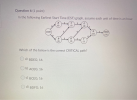 Question 6 (1 point) In the following Earliest Start Time (EST) graph, assume each unit of time is an hour. 4040 Which of the below is the correct CRITICAL path? O a) BDEG: 16 Ob) ACEG: 16 Oc) BCEG: 16 Od) BDFG: 16
 1 - [30 pts] Scheduling Algorithms Comparison Assume that we have 5 independent and aperiodic tasks (T1, ... , Ts) and they arrive to the system at times indicated below. Each task will run for the amount of execution time listed and is assigned a priority ranging from 0 (highest) to 10 (lowest), i.e. lower value means higher priority. There are no other tasks scheduled to arrive to the system until T1, ... , Ts complete. Task Arrival Time Execution...
 .8-6. A project consists of 12 activities, represented by the project network below, where number by each arc represents the duration (in days) of the associated activity 4 12 4 12 10 a) Find the earliest time, latest time, and slack for each event as well as the slack for each activity. Also identify the critical path. (b) The project has been scheduled to be completed in the minimum possible time.If all previous activities have begun as early as possible...
 The table below shows the output from a system that uses PERT for project scheduling. The project involves 12 interdependent activities and all times are reported in weeks. Based on the information provided, answer the following questions: IMMEDIATE EXPECTED ACTIVITY PREDECESSORS TIME EARLIEST EARLIEST LATEST LATEST START FINISH START FINISH 16 BNS lolos 12 4 31 28 43 32 10 6 38 D, J, K (a) What is the minimum expected time required to complete the project? (b) How is...
 Question E (8 points): 1. Construct an EDF schedule with HVDF scheduling policy for the following tasks. What is the total value obtained? Ti-(cipi): T (6,24); T2- (4, 8); T3- (4, 8); T4- (4, 12). The values of these tasks are 2, 3, 1, and 2 respectively. Note: Schedule tasks based on deadline as the primary criteria for priority assignment (EDF); if there is a tie in priority, then choose the task with HVDF (High Value Density First) basis. 2....
 1. Consider the following table providing the needed tasks to completing a successful project. The first column provides the name of the task, the second column states the time to complete that task and the third column tells when a task can begin. Task Time to Condition to start task complete #1 #2 #3 #4 #5 #6 #7 #8 #9 #10 #11 #12 #13 #14 #15 #16 #17 #18 #19 7 days None 5 days 8 daysNone 4 days 3...
 The oscillation represented by the graph below has a frequency of 0.300 Hz, an amplitude of 2.00 m and the displacement whent-0 is 1.50 m. The oscillation can be represented by an equation of the ormy" γ sin (+や). Calculate the vai e in radians of the phase shift, calculate the value (n radians) of the phase shift. agiving your answer to giving your answer to 3 significant figures do not include the units with your answer. Just the numerical...
 Question 6 (1 point) In the following Earliest Start Time (EST) graph, assume each unit of time is an hour. 4040 Which of the below is the correct CRITICAL path? O a) BDEG: 16 Ob) ACEG: 16 Oc) BCEG: 16 Od) BDFG: 16
Most questions answered within 3 hours.
-
Where is the error in this code sequence?
String s1 = "Hello";
String s2 = "ello";...
asked 10 months ago -
Financial data for Joel de Paris, Inc., for last year
follow:
Joel de Paris, Inc.
Balance...
asked 10 months ago -
Consider this reaction:
Al2(SO4)3 (aq)+ BaCl3
(aq) Al2Cl6 (aq)- +
3BaSO4(s) . What is the...
asked 10 months ago -
Suppose that Savneet is considering increasing her
recent random sample from 20 car rentals to 40...
asked 10 months ago -
Trucks arrive at an unloading terminal at an average rate of 120
per hour.
Trucks arrive...
asked 10 months ago -
Why are methanol and ethanol completely soluble in water while
octanol is not very little soluble....
asked 10 months ago -
A facilities manager at a university reads in a research report
that the mean amount of...
asked 10 months ago -
When the CuSO4 is rehydrated by adding water to the anhydrous
compound, is this an endothermic...
asked 10 months ago -
A ray of sunlight is passing from diamond into crown glass; the
angle of incidence is...
asked 10 months ago -
A block of mass 0.249 kg is placed on top of a light, vertical
spring of...
asked 10 months ago -
how do the kidneys compensate in the presences of acidosis
a) trigger hyperventilate
b) reserve acid...
asked 10 months ago -
Question 501 pts
The rental rate of capital to the firm increases. Which of the
following...
asked 10 months ago