
Homework Answers


Add Answer to:
URGENTT!!!
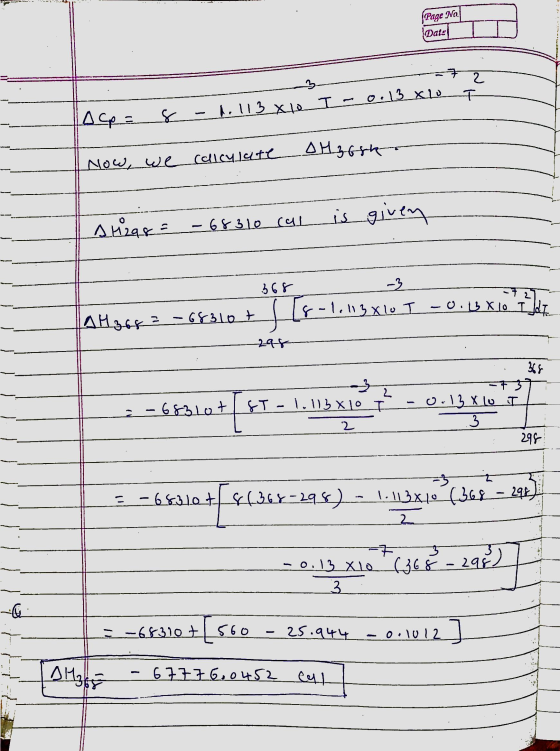
Question 3: The formation reaction of 1 mole of liquid water is given below: H2(g)...
Given the following heat of formation values, calculate the heat of reaction for the following: C3H8(g)...
 Given the following heat of formation values, calculate the heat of reaction for the following: C3H8(g) + O2(g) CO2(g) + H2O(1). AfH values in kJ/mol: C3H8(g): -103.8, O2(g): 0, CO2(g): -393.5, H2O(l): -285.8. 3.613 x 10² kJ/mol -2.220 103 kJ/mol 1.413* 102 kJ/mol -5.755 x 10² kJ/mol If a lighter contains 4.0 mL of liquid butane (density of butane = 0.8 g/cm3), how much heat can we get out of it, from the combustion of butane? 2 C4H 10(g) +...
4. The standard enthalpy of formation of NH3 (g) is -46.11 kJ mol-' at 298 K....
 4. The standard enthalpy of formation of NH3 (g) is -46.11 kJ mol-' at 298 K. Given the heat capacity data below and the data in Problem 2, calculate the standard enthalpy of formation at 1200 K Cp.m (H2 (9))/ J mol K-1 = 29.1 - (0.84 x 10- K-)T Cpm (N2 (g))/ J mol K-1 = 26.98 +(5.9 x 10-'K-!)T
Which of the following is not a formation reaction? 1/2H2(g) + 1/2 Brale) > HBr(g) H2(g)...
 Which of the following is not a formation reaction? 1/2H2(g) + 1/2 Brale) > HBr(g) H2(g) + 1/2O2(g) → H20(4) Ca(s) + 1/2O2(g) → Cao(s) • 4Al(s) + 3/202(g) → Al2O3(s) H2O(l) +SO3(l) → H2SO4()
The vaporization of 1 mole of liquid water (the system) at 100.9°C, 1.00 atm, is endothermic....
The vaporization of 1 mole of liquid water (the system) at 100.9°C, 1.00 atm, is endothermic. H2O(l)+40.7kJ H2O(g) Assume that at exactly 100.0°C and 1.00 atm total pressure, 1.00 mole of liquid water and 1.00 mole of water vapor occupy 18.80 mL and 30.62 L, respectively. Calculate the work done on or by the system when 1.25 mol of liquid H2O vaporizes. (answer in joules) I got -3874.9 J but the homework system keeps saying it is wrong.
Given the information below, calculate ∆?∘?,298.15? and ∆?∘?,400? for the following reaction: ??(?) + 2???(?) →...
 Given the information below,
calculate ∆?∘?,298.15? and ∆?∘?,400? for the following
reaction:
??(?) + 2???(?) → ?2(?) + ????2(?)
Assume that heat capacities are constant over the desired
temperature range. All molar enthalpies of formation are at
298.15K.
∆?∘ Mg(g) ? = 147.1 kJ/mol
∆?∘ HCl(g) ? = -92.3 kJ/mol
∆?∘ H2(g) ? = 0 kJ/mol
∆?∘ MgCl2(s) = -641.3 kJ/mol
Cp,m Mg(g) = 20.8 J mol-1 K-1
Cp,m HCl(g) = 29.1 J mol-1 K-1
Cp,m H2(g) = 28.8 J...
Given the information below,
calculate ∆?∘?,298.15? and ∆?∘?,400? for the following
reaction:
??(?) + 2???(?) → ?2(?) + ????2(?)
Assume that heat capacities are constant over the desired
temperature range. All molar enthalpies of formation are at
298.15K.
∆?∘ Mg(g) ? = 147.1 kJ/mol
∆?∘ HCl(g) ? = -92.3 kJ/mol
∆?∘ H2(g) ? = 0 kJ/mol
∆?∘ MgCl2(s) = -641.3 kJ/mol
Cp,m Mg(g) = 20.8 J mol-1 K-1
Cp,m HCl(g) = 29.1 J mol-1 K-1
Cp,m H2(g) = 28.8 J...
Which of the following statements is false concerning the reaction of hydrogen gas and oxygen gas given below? H2(g)+1...
 Which of the following statements is false concerning the reaction
of hydrogen gas and oxygen gas given below?
H2(g)+1/2O2(g)>H2O
Which of the following statements is false concerning the reaction of hydrogen gas and oxygen gas given below? H2(g) +029) - H20(1; AH = -285.8 kJ Select one: a. For the reaction H2(g) + O2(g) - H2O(g), AH is not equal to -285 b. If the equation is reversed, AH becomes +285.8 kJ. If the equation is multiplied by 2, AH...
Which of the following statements is false concerning the reaction
of hydrogen gas and oxygen gas given below?
H2(g)+1/2O2(g)>H2O
Which of the following statements is false concerning the reaction of hydrogen gas and oxygen gas given below? H2(g) +029) - H20(1; AH = -285.8 kJ Select one: a. For the reaction H2(g) + O2(g) - H2O(g), AH is not equal to -285 b. If the equation is reversed, AH becomes +285.8 kJ. If the equation is multiplied by 2, AH...
Part 1) Use the following equations to calculate the heat of the reaction for the formation...
Part 1) Use the following equations to calculate the heat of the reaction for the formation of ethane (C2H6). C2H6(g) + 7/2 O2(g) → 2CO2(g) + 3 H2O(l) ∆ Ho = -1560 kJ C(gr) + O2(g) → CO2(g) ∆ Ho = -394 kJ H2(g) + 1/2 O2(g) → H2O(l) ∆ Ho = -286 kJ Calculate ∆Ho for the following reaction: 2 C(gr) + 3H2(g) → C2H6(g) ethane Use kJ for your answer. ΔHo = Part 2) Find the heat of...
The reaction for the formation of ammonia is shown as: N2(g) + 3 H2(g) ⇄ 2...
The reaction for the formation of ammonia is shown as: N2(g) + 3 H2(g) ⇄ 2 NH3(g) Kc=? Write the equilibrium constant expression (Kc) for this reaction. Calculate the value of Kc at 500. K for the formation of ammonia in part a) using the following measured concentrations for the equilibrium mixture: [N2] = 3.0 x 10-‐2 M; [H2] = 3.7 x 10-‐2 M; [NH3] = 1.6 x 10-‐2 M. [1.7 x 10²] Now, calculate the value of Kc for the formation of...
1. How much heat is required at constant pressure to melt 1 mole of ice at...
 1. How much heat is required at constant pressure to melt 1 mole of ice at -25 C to steam at 125° C? boiling point 100c melting point 0.000'C specific heat capacities are gas(steam) 2.08, liquid 4.184 solid (ice) 2.11. All in units of JigC AH(100°C) 40.7 kJ/mol AHu (0.000°C)-6.01 kJ/mol 2. Calculate AHrxn for the reaction: CH4(g)4 Cl2(g) -CC4(g) 4 HCl (g) + Use the following reactions and given AH's: CH4(g) AH =-74.6 kJ 2 H2(g) C(s) C(s)2 Cl2(g)...
Physical Chemistry Calculate the change in entropy when one mole of metallic aluminum is heated at...
 Physical Chemistry
Calculate the change in entropy when one mole of metallic aluminum is heated at one bar pressure from an initial temperature of 25 °C to a final temperature of 750 °C. The molar heat capacities of solid and liquid aluminum at one bar pressure are 29.2 J mol K1 and 31.75 J mol K, respectively. The specific enthalpy of fusion of aluminum at its melting point (660.46 °C) is 396.57 J g1. The molar mass of aluminum is...
Physical Chemistry
Calculate the change in entropy when one mole of metallic aluminum is heated at one bar pressure from an initial temperature of 25 °C to a final temperature of 750 °C. The molar heat capacities of solid and liquid aluminum at one bar pressure are 29.2 J mol K1 and 31.75 J mol K, respectively. The specific enthalpy of fusion of aluminum at its melting point (660.46 °C) is 396.57 J g1. The molar mass of aluminum is...
 Given the following heat of formation values, calculate the heat of reaction for the following: C3H8(g) + O2(g) CO2(g) + H2O(1). AfH values in kJ/mol: C3H8(g): -103.8, O2(g): 0, CO2(g): -393.5, H2O(l): -285.8. 3.613 x 10² kJ/mol -2.220 103 kJ/mol 1.413* 102 kJ/mol -5.755 x 10² kJ/mol If a lighter contains 4.0 mL of liquid butane (density of butane = 0.8 g/cm3), how much heat can we get out of it, from the combustion of butane? 2 C4H 10(g) +...
 4. The standard enthalpy of formation of NH3 (g) is -46.11 kJ mol-' at 298 K. Given the heat capacity data below and the data in Problem 2, calculate the standard enthalpy of formation at 1200 K Cp.m (H2 (9))/ J mol K-1 = 29.1 - (0.84 x 10- K-)T Cpm (N2 (g))/ J mol K-1 = 26.98 +(5.9 x 10-'K-!)T
 Which of the following is not a formation reaction? 1/2H2(g) + 1/2 Brale) > HBr(g) H2(g) + 1/2O2(g) → H20(4) Ca(s) + 1/2O2(g) → Cao(s) • 4Al(s) + 3/202(g) → Al2O3(s) H2O(l) +SO3(l) → H2SO4()
 Given the information below,
calculate ∆?∘?,298.15? and ∆?∘?,400? for the following
reaction:
??(?) + 2???(?) → ?2(?) + ????2(?)
Assume that heat capacities are constant over the desired
temperature range. All molar enthalpies of formation are at
298.15K.
∆?∘ Mg(g) ? = 147.1 kJ/mol
∆?∘ HCl(g) ? = -92.3 kJ/mol
∆?∘ H2(g) ? = 0 kJ/mol
∆?∘ MgCl2(s) = -641.3 kJ/mol
Cp,m Mg(g) = 20.8 J mol-1 K-1
Cp,m HCl(g) = 29.1 J mol-1 K-1
Cp,m H2(g) = 28.8 J...
Given the information below,
calculate ∆?∘?,298.15? and ∆?∘?,400? for the following
reaction:
??(?) + 2???(?) → ?2(?) + ????2(?)
Assume that heat capacities are constant over the desired
temperature range. All molar enthalpies of formation are at
298.15K.
∆?∘ Mg(g) ? = 147.1 kJ/mol
∆?∘ HCl(g) ? = -92.3 kJ/mol
∆?∘ H2(g) ? = 0 kJ/mol
∆?∘ MgCl2(s) = -641.3 kJ/mol
Cp,m Mg(g) = 20.8 J mol-1 K-1
Cp,m HCl(g) = 29.1 J mol-1 K-1
Cp,m H2(g) = 28.8 J...
 Which of the following statements is false concerning the reaction
of hydrogen gas and oxygen gas given below?
H2(g)+1/2O2(g)>H2O
Which of the following statements is false concerning the reaction of hydrogen gas and oxygen gas given below? H2(g) +029) - H20(1; AH = -285.8 kJ Select one: a. For the reaction H2(g) + O2(g) - H2O(g), AH is not equal to -285 b. If the equation is reversed, AH becomes +285.8 kJ. If the equation is multiplied by 2, AH...
Which of the following statements is false concerning the reaction
of hydrogen gas and oxygen gas given below?
H2(g)+1/2O2(g)>H2O
Which of the following statements is false concerning the reaction of hydrogen gas and oxygen gas given below? H2(g) +029) - H20(1; AH = -285.8 kJ Select one: a. For the reaction H2(g) + O2(g) - H2O(g), AH is not equal to -285 b. If the equation is reversed, AH becomes +285.8 kJ. If the equation is multiplied by 2, AH...
 1. How much heat is required at constant pressure to melt 1 mole of ice at -25 C to steam at 125° C? boiling point 100c melting point 0.000'C specific heat capacities are gas(steam) 2.08, liquid 4.184 solid (ice) 2.11. All in units of JigC AH(100°C) 40.7 kJ/mol AHu (0.000°C)-6.01 kJ/mol 2. Calculate AHrxn for the reaction: CH4(g)4 Cl2(g) -CC4(g) 4 HCl (g) + Use the following reactions and given AH's: CH4(g) AH =-74.6 kJ 2 H2(g) C(s) C(s)2 Cl2(g)...
 Physical Chemistry
Calculate the change in entropy when one mole of metallic aluminum is heated at one bar pressure from an initial temperature of 25 °C to a final temperature of 750 °C. The molar heat capacities of solid and liquid aluminum at one bar pressure are 29.2 J mol K1 and 31.75 J mol K, respectively. The specific enthalpy of fusion of aluminum at its melting point (660.46 °C) is 396.57 J g1. The molar mass of aluminum is...
Physical Chemistry
Calculate the change in entropy when one mole of metallic aluminum is heated at one bar pressure from an initial temperature of 25 °C to a final temperature of 750 °C. The molar heat capacities of solid and liquid aluminum at one bar pressure are 29.2 J mol K1 and 31.75 J mol K, respectively. The specific enthalpy of fusion of aluminum at its melting point (660.46 °C) is 396.57 J g1. The molar mass of aluminum is...
Most questions answered within 3 hours.
-
Where is the error in this code sequence?
String s1 = "Hello";
String s2 = "ello";...
asked 11 months ago -
Financial data for Joel de Paris, Inc., for last year
follow:
Joel de Paris, Inc.
Balance...
asked 11 months ago -
Consider this reaction:
Al2(SO4)3 (aq)+ BaCl3
(aq) Al2Cl6 (aq)- +
3BaSO4(s) . What is the...
asked 11 months ago -
Suppose that Savneet is considering increasing her
recent random sample from 20 car rentals to 40...
asked 11 months ago -
Trucks arrive at an unloading terminal at an average rate of 120
per hour.
Trucks arrive...
asked 11 months ago -
Why are methanol and ethanol completely soluble in water while
octanol is not very little soluble....
asked 11 months ago -
A facilities manager at a university reads in a research report
that the mean amount of...
asked 11 months ago -
When the CuSO4 is rehydrated by adding water to the anhydrous
compound, is this an endothermic...
asked 11 months ago -
A ray of sunlight is passing from diamond into crown glass; the
angle of incidence is...
asked 11 months ago -
A block of mass 0.249 kg is placed on top of a light, vertical
spring of...
asked 11 months ago -
how do the kidneys compensate in the presences of acidosis
a) trigger hyperventilate
b) reserve acid...
asked 11 months ago -
Question 501 pts
The rental rate of capital to the firm increases. Which of the
following...
asked 11 months ago