
Homework Answers

Add Answer to:
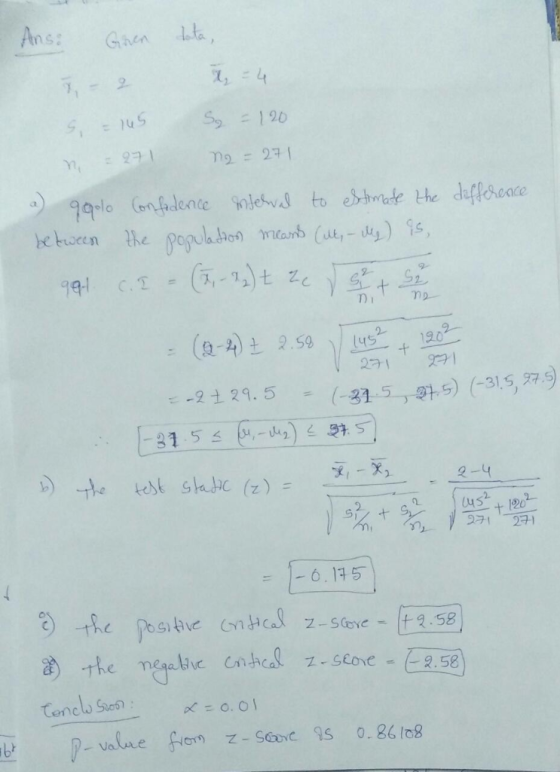
(1 point) In order to compare the means of two populations, independent random samples of 271...
(1 point) (Give answers to at least two decimal places. For simplicity, use the standard normal...
 (1 point) (Give answers to at least two decimal places. For simplicity, use the standard normal distribution bacause the samples are both large.) In order to compare the means of two populations, independent random samples of 4 observations are selected from each population, with the following results: Sample 1 Sample 2 81 -15582-125 Use a 97 % confidence interval to estimate the difference between the population means (M1-12). -304.502 (b) Test the null hypothesis: H0 the test statistic z The...
(1 point) In order to compare the means of two populations, independent random samples of 202...
 (1 point) In order to compare the means of two populations, independent random samples of 202 observations are selected from each population, with the following results: Sample 1 Sample 2 x1 = 4 x2 = 1 $1 = 105 s2 = 150 (a) Use a 90 % confidence interval to estimate the difference between the population means (41-42). < (41 - M2) (b) Test the null hypothesis: Ho : (41 - H2) = 0 versus the alternative hypothesis: H:(W1 -...
In order to compare the means of two populations, independent random samples of 400 observations are...
In order to compare the means of two populations, independent random samples of 400 observations are selected from each population, with the results found in the table to the right. Complete parts a through e below. Sample 1 overbar x = 5,305 s1= 154 Sample 2 overbar x = 5,266 s2 = 199 a. Use a 95% confidence interval to estimate the difference between the population means (mu 1 - mu 2). Interpret the confidence interval. The confidence interval is...
(2 points) In order to compare the means of two populations, independent random samples of 49...
 (2 points) In order to compare the means of two populations, independent random samples of 49 observations are selected from each population, with the following results: Sample 1 Sample 2 x = 1 *2 = 3 S = 195 140 s2 = (a) Use a 97 % confidence interval to estimate the difference between the population means (41 - H2). ( 4- 42) (b) Test the null hypothesis: H :(#1 - 12) = 0 versus the alternative hypothesis: H, :(...
(1 point) (Give answers to at least two decimal places. For simplicity, use the standard normal...
 (1 point) (Give answers to at least two decimal places. For simplicity, use the standard normal distribution bacause the samples are both large.) In order to compare the means of two populations, independent random samples of 93 observations are selected from each population, with the following results: Sample 1 Sample 2 s1 = 170 s2 = 195 (a) Use a 98 % confidence interval to estimate the difference between the population means ( ) - Test the null hypothesis: Ho...
(1 point) (Give answers to at least two decimal places. For simplicity, use the standard normal...
 (1 point) (Give answers to at least two decimal places. For simplicity, use the standard normal distribution bacause the samples are both large.) In order to compare the means of two populations, independent random samples of 246 observations are selected from each population, with the following results: Sample 1 Sample 2 (a) Use a 96 % confidence interval to estimate the difference between the population means (M1-M2). (b) Test the null hypothesis: Ho : (41-42-0 versus the alternative hypothesis: 11...
9.6 in order to compare the means of two populations, inde- NW pendent random samples of 400 observations are selected from each population, with the following results Sample 1 Sample 2 $.240 s2 200...
 9.6 in order to compare the means of two populations, inde- NW pendent random samples of 400 observations are selected from each population, with the following results Sample 1 Sample 2 $.240 s2 200 5,275 1150 a. Use a 95% confidence interval to estimate the dif- ference between the population means (μ,-μ Interpret the confidence interval. b. Test the null hypothesis Ho (μι-μ)--0 versus the c. Suppose the test in part b were conducted with the d. Test thenull hypothesis...
In order to compare the means of two populations, independent random samples of 220 observations are...
In order to compare the means of two populations, independent random samples of 220 observations are selected from each population, with the following results: Sample 1 Sample 2 ?⎯⎯⎯1=0 ?⎯⎯⎯2=5 ?1=165 ?2=200 (a) Use a 97 % confidence interval to estimate the difference between the population means (?1−?2). ≤(?1−?2)≤ (b) Test the null hypothesis: ?0:(?1−?2)=0 versus the alternative hypothesis: ??:(?1−?2)≠0. Using ?=0.03, give the following: the test statistic ?= The final conclusion is: A. There is not sufficient evidence to...
(1 point) Independent random samples, each containing 800 observations, were selected from two binomial populations. The...
 (1 point) Independent random samples, each containing 800 observations, were selected from two binomial populations. The samples from populations 1 and 2 produced 581 and 221 successes, respectively. (a) Test Ho : (p1 – P2) = 0 against Ha : (Pi – P2) # 0. Use a = 0.01 test statistic = rejection region |z| > The final conclusion is # 0. A. We can reject the null hypothesis that (p1 – P2) = 0 and accept that (p1 –...
come from populations (1 point) Test t mean. Assume that the samples are independent simple random samples. Use a significance level of a 0.01 Sample 1: n1 15, 1-28.4, 81-6.07 Sample 2: n2 10, 2 22,...
 come from populations (1 point) Test t mean. Assume that the samples are independent simple random samples. Use a significance level of a 0.01 Sample 1: n1 15, 1-28.4, 81-6.07 Sample 2: n2 10, 2 22, 82 8.92 (a) The degree of freedom is (b) The standardized test statistic is (c) The final conclusion is O A. We can reject the null hypothesis that (14-Ha) 0 and accept that (M1-μ2) 0 B. There is not sufficient evidence to reject the...
 (1 point) (Give answers to at least two decimal places. For simplicity, use the standard normal distribution bacause the samples are both large.) In order to compare the means of two populations, independent random samples of 4 observations are selected from each population, with the following results: Sample 1 Sample 2 81 -15582-125 Use a 97 % confidence interval to estimate the difference between the population means (M1-12). -304.502 (b) Test the null hypothesis: H0 the test statistic z The...
 (1 point) In order to compare the means of two populations, independent random samples of 202 observations are selected from each population, with the following results: Sample 1 Sample 2 x1 = 4 x2 = 1 $1 = 105 s2 = 150 (a) Use a 90 % confidence interval to estimate the difference between the population means (41-42). < (41 - M2) (b) Test the null hypothesis: Ho : (41 - H2) = 0 versus the alternative hypothesis: H:(W1 -...
 (2 points) In order to compare the means of two populations, independent random samples of 49 observations are selected from each population, with the following results: Sample 1 Sample 2 x = 1 *2 = 3 S = 195 140 s2 = (a) Use a 97 % confidence interval to estimate the difference between the population means (41 - H2). ( 4- 42) (b) Test the null hypothesis: H :(#1 - 12) = 0 versus the alternative hypothesis: H, :(...
 (1 point) (Give answers to at least two decimal places. For simplicity, use the standard normal distribution bacause the samples are both large.) In order to compare the means of two populations, independent random samples of 93 observations are selected from each population, with the following results: Sample 1 Sample 2 s1 = 170 s2 = 195 (a) Use a 98 % confidence interval to estimate the difference between the population means ( ) - Test the null hypothesis: Ho...
 (1 point) (Give answers to at least two decimal places. For simplicity, use the standard normal distribution bacause the samples are both large.) In order to compare the means of two populations, independent random samples of 246 observations are selected from each population, with the following results: Sample 1 Sample 2 (a) Use a 96 % confidence interval to estimate the difference between the population means (M1-M2). (b) Test the null hypothesis: Ho : (41-42-0 versus the alternative hypothesis: 11...
 9.6 in order to compare the means of two populations, inde- NW pendent random samples of 400 observations are selected from each population, with the following results Sample 1 Sample 2 $.240 s2 200 5,275 1150 a. Use a 95% confidence interval to estimate the dif- ference between the population means (μ,-μ Interpret the confidence interval. b. Test the null hypothesis Ho (μι-μ)--0 versus the c. Suppose the test in part b were conducted with the d. Test thenull hypothesis...
 (1 point) Independent random samples, each containing 800 observations, were selected from two binomial populations. The samples from populations 1 and 2 produced 581 and 221 successes, respectively. (a) Test Ho : (p1 – P2) = 0 against Ha : (Pi – P2) # 0. Use a = 0.01 test statistic = rejection region |z| > The final conclusion is # 0. A. We can reject the null hypothesis that (p1 – P2) = 0 and accept that (p1 –...
 come from populations (1 point) Test t mean. Assume that the samples are independent simple random samples. Use a significance level of a 0.01 Sample 1: n1 15, 1-28.4, 81-6.07 Sample 2: n2 10, 2 22, 82 8.92 (a) The degree of freedom is (b) The standardized test statistic is (c) The final conclusion is O A. We can reject the null hypothesis that (14-Ha) 0 and accept that (M1-μ2) 0 B. There is not sufficient evidence to reject the...
Most questions answered within 3 hours.
-
Where is the error in this code sequence?
String s1 = "Hello";
String s2 = "ello";...
asked 11 months ago -
Financial data for Joel de Paris, Inc., for last year
follow:
Joel de Paris, Inc.
Balance...
asked 11 months ago -
Consider this reaction:
Al2(SO4)3 (aq)+ BaCl3
(aq) Al2Cl6 (aq)- +
3BaSO4(s) . What is the...
asked 11 months ago -
Suppose that Savneet is considering increasing her
recent random sample from 20 car rentals to 40...
asked 11 months ago -
Trucks arrive at an unloading terminal at an average rate of 120
per hour.
Trucks arrive...
asked 11 months ago -
Why are methanol and ethanol completely soluble in water while
octanol is not very little soluble....
asked 11 months ago -
A facilities manager at a university reads in a research report
that the mean amount of...
asked 11 months ago -
When the CuSO4 is rehydrated by adding water to the anhydrous
compound, is this an endothermic...
asked 11 months ago -
A ray of sunlight is passing from diamond into crown glass; the
angle of incidence is...
asked 11 months ago -
A block of mass 0.249 kg is placed on top of a light, vertical
spring of...
asked 11 months ago -
how do the kidneys compensate in the presences of acidosis
a) trigger hyperventilate
b) reserve acid...
asked 11 months ago -
Question 501 pts
The rental rate of capital to the firm increases. Which of the
following...
asked 11 months ago