
Homework Answers
Request Answer!
We need at least 10 more requests to produce the answer.
0 / 10 have requested this problem solution
The more requests, the faster the answer.
Use the References IU Lessor Luc IUI Enter electrons as e. Use smallest possible integer coefficients. If a box is...
 Use the References IU Lessor Luc IUI Enter electrons as e. Use smallest possible integer coefficients. If a box is not needed, leave it blank. For the following electron-transfer reaction: 3Pb2+ (aq) + 2Al(s) — 3Pb(s) + 2A1+ (aq) The oxidation half-reaction is: The reduction half-reaction is:
#11. The Big Three Corporation manufactures three products (LUC, PLA, and JOS) from a joint process....
 #11. The Big Three Corporation manufactures three products (LUC, PLA, and JOS) from a joint process. The three products are in industrial grade form at the split-off point. They can either be sold at that point or processed further into premium grade. Costs related to each batch of this production process is as follows: LUC PLA JOS Sales Price at split-off point $16 $12 $5 Allocated joint costs $6,000 $6,000 $6,000 Sales Price after further processing $20 $18 $14 $5,000...
The "graying of America" will substantially increase the fraction of the popu-- lation that is retired...
 The "graying of America" will substantially increase the fraction of the popu-- lation that is retired in the decades to come. To illustrate the implications for U.S. living standards, suppose that over the 46 years following 2006 the share of the population that is working returns to its 1960 level, while average labor productivity increases by as much as it did during 1960-2006. Under this sce- nario, what would be the net change in real GDP per person between 2006...
6. Assume that the current dollar-Euro exchange rate (Ese) i equal to 1, the real exchange...
 6. Assume that the current dollar-Euro exchange rate (Ese) i equal to 1, the real exchange rate (qua/tur) = 1.26, the price level equals 2 in the U.S. and 2.5 in Europe. Assume that relative PPP holds. a. If inflation is 5% in the u.s. but 28 in Europe, what will be the price levels in the U.S. and Europe a year from now? b. What will be the nominal exchange rate (Ese) a year from now? c. What will...
11) Given the following reactions A+FC+2D 2E+F2D E+FB AH=-622.3 kJ AH = -285.8 kJ AH=-187.8 kJ...
 11) Given the following reactions A+FC+2D 2E+F2D E+FB AH=-622.3 kJ AH = -285.8 kJ AH=-187.8 kJ the enthalpy of the reaction A + 2B C+ 4D iskJ.
D 606 K E) 171 K 7. Predict the signs of AH, AS, and AG for...
 D 606 K E) 171 K 7. Predict the signs of AH, AS, and AG for the combustion of hydrogen gas at 25°C. 2 H20() 2 H2)+ O2(9) A) AH <0, AS <0, AG < 0 B) AH> 0, AS < 0, AG> 0 C) AH> 0, AS < 0, AG < 0 D) AH< 0, AS> 0, AG < 0 E) AH < 0, AS> 0, AG < 0
a. b. Consider the follow equations: A+B →D AH° = -70.0 kJ E +2 F →...
 a.
b.
Consider the follow equations: A+B →D AH° = -70.0 kJ E +2 F → A AH° = -20.0 kJ C + E +2D AH° = -300.0 kJ Calculate the AHⓇ for the reaction: C+2 F → 3 A +2 B Calculate the enthalpy of reaction for the process: D+FG+M A + B + C +G AH° = 100.0 kJ AC+F AH° = -300.0 kJ D+M+B AH° = -150.0 kJ
a.
b.
Consider the follow equations: A+B →D AH° = -70.0 kJ E +2 F → A AH° = -20.0 kJ C + E +2D AH° = -300.0 kJ Calculate the AHⓇ for the reaction: C+2 F → 3 A +2 B Calculate the enthalpy of reaction for the process: D+FG+M A + B + C +G AH° = 100.0 kJ AC+F AH° = -300.0 kJ D+M+B AH° = -150.0 kJ
2. Determine the error associated with the following ah)e-be calculation: (c-e a 8.5 0.5, b 5.008...
 2. Determine the error associated with the following ah)e-be calculation: (c-e a 8.5 0.5, b 5.008 0.082, c 100.30.1, d- 208.21 54 ± 0.1892, e = 87.65 ± 0.65 -1125.88 0.07 mL
2. Determine the error associated with the following ah)e-be calculation: (c-e a 8.5 0.5, b 5.008 0.082, c 100.30.1, d- 208.21 54 ± 0.1892, e = 87.65 ± 0.65 -1125.88 0.07 mL
2. Determine the error associated with the following ah)e-be calculation: (c-e a 8.5 0.5, b 5.008 0.082, c 100.30.1, d- 208.21 54 ± 0.1892, e = 87.65 ± 0.65 -1125.88 0.07 mL
AH 20. HESS'S LAW. Calculate the AH for the reaction: IF.) → Fle) + Flel Use...
 AH 20. HESS'S LAW. Calculate the AH for the reaction: IF.) → Fle) + Flel Use the following data: a. IF(g) + Fle) → 1f3(E) AH = -390 kJ b. IF(g) + 2F2(e) → Fle) AH = -745 +1135 - 1135
Sapling Learning AH = - 590.0 kJ AH,= - 74.8 kJ Consider these reactions, where M...
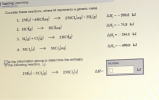 Sapling Learning AH = - 590.0 kJ AH,= - 74.8 kJ Consider these reactions, where M represents a generic metal 1. 2M(s) + 6HClaq) 2MC (aq)+382(e) 2. HCLg) → HC4) 3. Hz(8)+chle → 2HCLg) 4. MCI,(s) → MCila) AH, - - 184.6 kJ AH,= - 490.0 kJ Number e the information above to determine the enthalpy or the following reaction. W 2M(s)+31(e) → 2MC),() AH AH-
 Use the References IU Lessor Luc IUI Enter electrons as e. Use smallest possible integer coefficients. If a box is not needed, leave it blank. For the following electron-transfer reaction: 3Pb2+ (aq) + 2Al(s) — 3Pb(s) + 2A1+ (aq) The oxidation half-reaction is: The reduction half-reaction is:
 #11. The Big Three Corporation manufactures three products (LUC, PLA, and JOS) from a joint process. The three products are in industrial grade form at the split-off point. They can either be sold at that point or processed further into premium grade. Costs related to each batch of this production process is as follows: LUC PLA JOS Sales Price at split-off point $16 $12 $5 Allocated joint costs $6,000 $6,000 $6,000 Sales Price after further processing $20 $18 $14 $5,000...
 The "graying of America" will substantially increase the fraction of the popu-- lation that is retired in the decades to come. To illustrate the implications for U.S. living standards, suppose that over the 46 years following 2006 the share of the population that is working returns to its 1960 level, while average labor productivity increases by as much as it did during 1960-2006. Under this sce- nario, what would be the net change in real GDP per person between 2006...
 6. Assume that the current dollar-Euro exchange rate (Ese) i equal to 1, the real exchange rate (qua/tur) = 1.26, the price level equals 2 in the U.S. and 2.5 in Europe. Assume that relative PPP holds. a. If inflation is 5% in the u.s. but 28 in Europe, what will be the price levels in the U.S. and Europe a year from now? b. What will be the nominal exchange rate (Ese) a year from now? c. What will...
 11) Given the following reactions A+FC+2D 2E+F2D E+FB AH=-622.3 kJ AH = -285.8 kJ AH=-187.8 kJ the enthalpy of the reaction A + 2B C+ 4D iskJ.
 D 606 K E) 171 K 7. Predict the signs of AH, AS, and AG for the combustion of hydrogen gas at 25°C. 2 H20() 2 H2)+ O2(9) A) AH <0, AS <0, AG < 0 B) AH> 0, AS < 0, AG> 0 C) AH> 0, AS < 0, AG < 0 D) AH< 0, AS> 0, AG < 0 E) AH < 0, AS> 0, AG < 0
 a.
b.
Consider the follow equations: A+B →D AH° = -70.0 kJ E +2 F → A AH° = -20.0 kJ C + E +2D AH° = -300.0 kJ Calculate the AHⓇ for the reaction: C+2 F → 3 A +2 B Calculate the enthalpy of reaction for the process: D+FG+M A + B + C +G AH° = 100.0 kJ AC+F AH° = -300.0 kJ D+M+B AH° = -150.0 kJ
a.
b.
Consider the follow equations: A+B →D AH° = -70.0 kJ E +2 F → A AH° = -20.0 kJ C + E +2D AH° = -300.0 kJ Calculate the AHⓇ for the reaction: C+2 F → 3 A +2 B Calculate the enthalpy of reaction for the process: D+FG+M A + B + C +G AH° = 100.0 kJ AC+F AH° = -300.0 kJ D+M+B AH° = -150.0 kJ
 2. Determine the error associated with the following ah)e-be calculation: (c-e a 8.5 0.5, b 5.008 0.082, c 100.30.1, d- 208.21 54 ± 0.1892, e = 87.65 ± 0.65 -1125.88 0.07 mL
2. Determine the error associated with the following ah)e-be calculation: (c-e a 8.5 0.5, b 5.008 0.082, c 100.30.1, d- 208.21 54 ± 0.1892, e = 87.65 ± 0.65 -1125.88 0.07 mL
2. Determine the error associated with the following ah)e-be calculation: (c-e a 8.5 0.5, b 5.008 0.082, c 100.30.1, d- 208.21 54 ± 0.1892, e = 87.65 ± 0.65 -1125.88 0.07 mL
 AH 20. HESS'S LAW. Calculate the AH for the reaction: IF.) → Fle) + Flel Use the following data: a. IF(g) + Fle) → 1f3(E) AH = -390 kJ b. IF(g) + 2F2(e) → Fle) AH = -745 +1135 - 1135
 Sapling Learning AH = - 590.0 kJ AH,= - 74.8 kJ Consider these reactions, where M represents a generic metal 1. 2M(s) + 6HClaq) 2MC (aq)+382(e) 2. HCLg) → HC4) 3. Hz(8)+chle → 2HCLg) 4. MCI,(s) → MCila) AH, - - 184.6 kJ AH,= - 490.0 kJ Number e the information above to determine the enthalpy or the following reaction. W 2M(s)+31(e) → 2MC),() AH AH-
Most questions answered within 3 hours.
-
Where is the error in this code sequence?
String s1 = "Hello";
String s2 = "ello";...
asked 10 months ago -
Financial data for Joel de Paris, Inc., for last year
follow:
Joel de Paris, Inc.
Balance...
asked 10 months ago -
Consider this reaction:
Al2(SO4)3 (aq)+ BaCl3
(aq) Al2Cl6 (aq)- +
3BaSO4(s) . What is the...
asked 10 months ago -
Suppose that Savneet is considering increasing her
recent random sample from 20 car rentals to 40...
asked 10 months ago -
Trucks arrive at an unloading terminal at an average rate of 120
per hour.
Trucks arrive...
asked 10 months ago -
Why are methanol and ethanol completely soluble in water while
octanol is not very little soluble....
asked 10 months ago -
A facilities manager at a university reads in a research report
that the mean amount of...
asked 10 months ago -
When the CuSO4 is rehydrated by adding water to the anhydrous
compound, is this an endothermic...
asked 10 months ago -
A ray of sunlight is passing from diamond into crown glass; the
angle of incidence is...
asked 10 months ago -
A block of mass 0.249 kg is placed on top of a light, vertical
spring of...
asked 10 months ago -
how do the kidneys compensate in the presences of acidosis
a) trigger hyperventilate
b) reserve acid...
asked 10 months ago -
Question 501 pts
The rental rate of capital to the firm increases. Which of the
following...
asked 10 months ago