Question 1 [The Constitution] is made for people of fundamentally differing views, and the accident of...
Question 1
[The Constitution] is made for people of fundamentally differing views, and the accident of our finding certain opinions natural and familiar or novel and even shocking ought not to conclude our judgment upon the question whether statutes embodying them conflict with the Constitution of the United States.
This quote from the 1905 dissent to the Lochner v. New York decision tells us that
Question 1 options:
|
|||
|
|||
|
|||
|
Question 2 (1 point)
The Ninth Amendment to the U.S. Constitution reads:
The enumeration in the Constitution, of certain rights, shall not be construed to deny or disparage others retained by the people.
What was the primary reason James Madison argued that it should be included in the Bill of Rights (the first ten amendments to the U.S. Constitution)?
Question 2 options:
|
|||
|
|||
|
|||
|
Question 3 (1 point)
In Griswold v. Connecticut, a case from 1965 concerning whether married people had the right to purchase and use contraception, the Supreme Court used the argument of “marital privacy” to assert the right to purchase and use contraception. The opinion drew on the Ninth Amendment. The Justices wrote:
The Ninth Amendment to the Constitution may be regarded by some as a recent discovery, and may be forgotten by others, but, since 1791, it has been a basic part of the Constitution which we are sworn to uphold. To hold that a right so basic and fundamental and so deep-rooted in our society as the right of privacy in marriage may be infringed because that right is not guaranteed in so many words by the first eight amendments to the Constitution is to ignore the Ninth Amendment, and to give it no effect whatsoever. Moreover, a judicial construction that this fundamental right is not protected by the Constitution because it is not mentioned in explicit terms by one of the first eight amendments or elsewhere in the Constitution would violate the Ninth Amendment, which specifically states that "[t]he enumeration in the Constitution, of certain rights, shall not be construed to deny or disparage others retained by the people."
This passage references what are called “unenumerated rights.” Based on reading the passage, an unenumerated right is
Question 3 options:
|
|||
|
|||
|
|||
|
Question 4 (1 point)
According to this blog post [http://blogs.archives.gov/prologue/?p=12888], the 14thAmendment has been used in which 20th century Supreme Court cases:
Question 4 options:
|
|||
|
|||
|
|||
|
Question 5 (1 point)
Which of the following does the 14th Amendment NOT provide
Question 5 options:
|
|||
|
|||
|
|||
|
Question 6 (1 point)
Sarah Weddington, attorney for Jane Roe, references a number of places in the Constitution where the right to decide whether to terminate a pregnancy resides. Which of the following is NOT cited by her:
Question 6 options:
|
|||
|
|||
|
|||
|
Question 7 (1 point)
Listen to Floyd’s argument (http://www.c-span.org/video/?59719-1/roe-v-wade-1971-oral-argument - timestamp 59:20-1:02:50) and answer the following question:
Floyd claims the Constitution both recognizes rights that are and rights that are not absolute. How does his reference to “the freedom of one’s body” illustrate what he sees as rights that are not absolute:
Question 7 options:
|
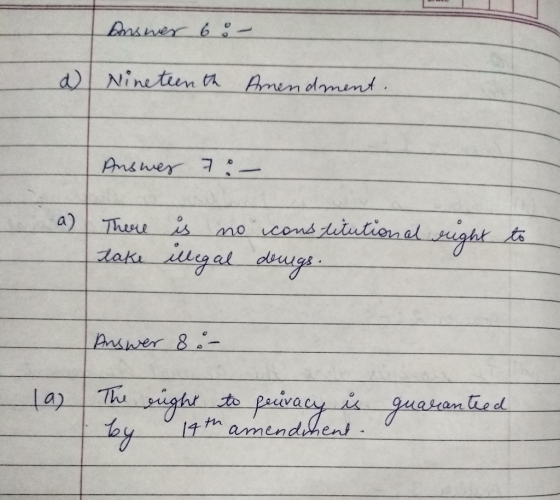
There is no Constitutional right to take illegal drugs |
|
|
There is no Constitutional right to sell your organs |
|
|
There is no Constitutional right to health care |
|
|
There is no Constitutional right to use your body to harm someone else |
Question 8 (1 point)
Which of the following best captures the reasoning of the Court to justify a right to privacy?
Question 8 options:
|
|||
|
|||
|
|||
|
Question 9 (1 point)
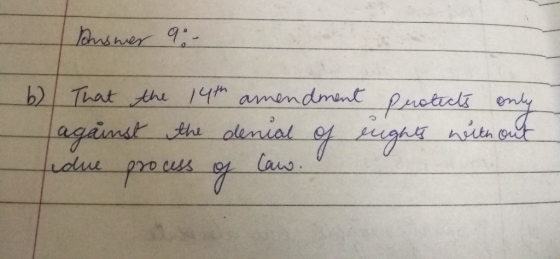
What is the source of Rehnquist’s objection to the Majority opinion use of the 14thamendment?
Question 9 options:
|
|||
|
|||
|
|||
|
Question 10 (1 point)
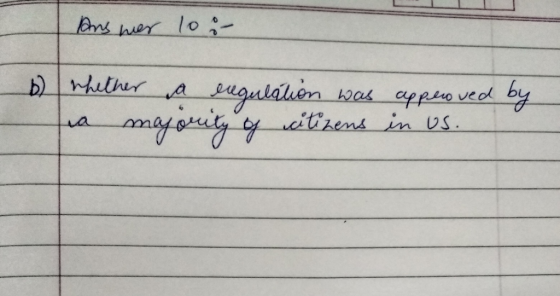
How would Justice Rehnquist suggest we test whether or not a regulation improperly infringes upon the liberty protected in the Fourteenth Amendment?
Question 10 options:
|
|||
|
|||
|
|||
|
Homework Answers

Add Answer to:
Question 1
[The Constitution] is made for people of fundamentally
differing views, and the accident of...
Question 1: Discuss the 14th Amendment and the right to privacy. Include the relevant portion of the 14hAmendment. Also discuss the relevant Supreme Court cases. Question 2 Discuss the right of s...
 Question 1: Discuss the 14th Amendment and the right to privacy. Include the relevant portion of the 14hAmendment. Also discuss the relevant Supreme Court cases. Question 2 Discuss the right of self-defense of person and property. Question 3: Discuss the differences and similarities between civil and criminal law. Question 4:Disuss capital punishment including its common law and constitutional history. Question 5. Discuss the 14th Amendment and the Bill of Rights. Include the relevant portion of the Amendment. Include John Marshall's...
Question 1 (2 points) The US Constitution establishes a federal system of government in which all...
Question 1 (2 points) The US Constitution establishes a federal system of government in which all rights not specifically granted to the Federal government are retained by the states. Question 1 options: True False Question 2 (2 points) The United States Constitution guarantees anybody who is accused of committing a crime the right to Question 2 options: chose their judge trial by jury delay their trial select their own jury Question 3 (2 points) The number of amendments the States...
Question 1 What is the name of the Constitutional doctrine that helps prevent any one branch...
Question 1 What is the name of the Constitutional doctrine that helps prevent any one branch of government from becoming too powerful? A. Reserved powers B. Checks and balances C. Federalism D. Delegated powers 1 points Question 2 What rights are guaranteed under the First Amendment of the U.S. Constitution? (select all that apply) A. Freedom of speech B. Freedom of religion C. Freedom to assemble D. Freedom of the press Question 3 What type of speech is fighting words...
1. Which of the following is contained in the 14th Amendment and was likely an inspiration...
1. Which of the following is contained in the 14th Amendment and was likely an inspiration for Martin Luther King Jr.’s “Letter form a Birmingham Jail” :The guarantee that citizens have the right to a speedy and public trial regardless of gender, race, or age A. The principle that all people should be equal under the law, as embodied in the equal B. Protection clause C. The guarantee that all people, regardless of race, religion, gender or sexual orientation, have...
1. Which article and section of the U.S. Constitution outlines the concept of extradition (returning fugitives...
1. Which article and section of the U.S. Constitution outlines the concept of extradition (returning fugitives to the state where the crime occurred). 2. A member of the Senate can kill a bill by talking it to death in a procedure known as a 3. Who acts as the President of the Senate? 4. Who is the current Speaker of the House of Representatives? 5. Which of the following are a Constitutional requirement for becoming president of the United States?...
Question 10 (1 point) In the Constitution of 1787, the people elected only: members of the...
 Question 10 (1 point) In the Constitution of 1787, the people elected only: members of the House of Representatives Ba the President Senators Supreme Court judges
Question 1 1 pts Which of the first ten amendments to the Constitution speaks directly to...
 Question 1 1 pts Which of the first ten amendments to the Constitution speaks directly to the issue of federalism or the division of power between the states and the national government? First Fifth Ninth O Tenth Question 2 1 pts McCulloch v. Maryland (1819) is often remembered for The doctrine of "implied powers" The insistence that the Constitution be given a "strict construction" that would allow Congress to exercise only those powers expressly delegated to it The advocacy of...
19. A defendant can use the necessity defense of the idea for a crime or pinated not with the defendant but with a...
 19. A defendant can use the necessity defense of the idea for a crime or pinated not with the defendant but with a police officer or other government official who suggested it to the defendant, and the defendant would not otherwise have committed the crime. 20. The Sarbanes-Oxley Act was created specifically to combat white-collar crime. MULTIPLE CHOICE QUESTIONS (Please identify the letter of the choice that best completes the statement or answers the question 21. According to the principle...
The national government has the implied power to undertake actions necessary to carry out its expressly...
 The national government has the implied power to undertake actions necessary to carry out its expressly designated powers. O a. True O b. False Local governments, including cities, exercise police powers. O a. True O b. False Under the full faith and credit clause, any judicial decision in one state with respect to contract rights will be honored and enforced in all states. O a. True O b. False The system of checks and balances in the U.S. Constitution allows...
Please Help me Answer The 3 questions on the Last Page Now !!!!! One more viewpoint...
 Please Help me Answer The 3 questions on the Last Page Now
!!!!!
One more viewpoint of the 6th Amendment to tie it back to the Ist! Amendment from last week. Look at the case summary and facts for Carey v. Musladin, 549 U.S. 70,127 S. Ct. 649 (2006) A defendant in a murder trial is not deprived of his Sixth Amendment right to an impartial jury if courtroom spectators wear buttons showing a picture of the deceased. Facts Matthew...
Please Help me Answer The 3 questions on the Last Page Now
!!!!!
One more viewpoint of the 6th Amendment to tie it back to the Ist! Amendment from last week. Look at the case summary and facts for Carey v. Musladin, 549 U.S. 70,127 S. Ct. 649 (2006) A defendant in a murder trial is not deprived of his Sixth Amendment right to an impartial jury if courtroom spectators wear buttons showing a picture of the deceased. Facts Matthew...
 Question 1: Discuss the 14th Amendment and the right to privacy. Include the relevant portion of the 14hAmendment. Also discuss the relevant Supreme Court cases. Question 2 Discuss the right of self-defense of person and property. Question 3: Discuss the differences and similarities between civil and criminal law. Question 4:Disuss capital punishment including its common law and constitutional history. Question 5. Discuss the 14th Amendment and the Bill of Rights. Include the relevant portion of the Amendment. Include John Marshall's...
 Question 10 (1 point) In the Constitution of 1787, the people elected only: members of the House of Representatives Ba the President Senators Supreme Court judges
 Question 1 1 pts Which of the first ten amendments to the Constitution speaks directly to the issue of federalism or the division of power between the states and the national government? First Fifth Ninth O Tenth Question 2 1 pts McCulloch v. Maryland (1819) is often remembered for The doctrine of "implied powers" The insistence that the Constitution be given a "strict construction" that would allow Congress to exercise only those powers expressly delegated to it The advocacy of...
 19. A defendant can use the necessity defense of the idea for a crime or pinated not with the defendant but with a police officer or other government official who suggested it to the defendant, and the defendant would not otherwise have committed the crime. 20. The Sarbanes-Oxley Act was created specifically to combat white-collar crime. MULTIPLE CHOICE QUESTIONS (Please identify the letter of the choice that best completes the statement or answers the question 21. According to the principle...
 The national government has the implied power to undertake actions necessary to carry out its expressly designated powers. O a. True O b. False Local governments, including cities, exercise police powers. O a. True O b. False Under the full faith and credit clause, any judicial decision in one state with respect to contract rights will be honored and enforced in all states. O a. True O b. False The system of checks and balances in the U.S. Constitution allows...
 Please Help me Answer The 3 questions on the Last Page Now
!!!!!
One more viewpoint of the 6th Amendment to tie it back to the Ist! Amendment from last week. Look at the case summary and facts for Carey v. Musladin, 549 U.S. 70,127 S. Ct. 649 (2006) A defendant in a murder trial is not deprived of his Sixth Amendment right to an impartial jury if courtroom spectators wear buttons showing a picture of the deceased. Facts Matthew...
Please Help me Answer The 3 questions on the Last Page Now
!!!!!
One more viewpoint of the 6th Amendment to tie it back to the Ist! Amendment from last week. Look at the case summary and facts for Carey v. Musladin, 549 U.S. 70,127 S. Ct. 649 (2006) A defendant in a murder trial is not deprived of his Sixth Amendment right to an impartial jury if courtroom spectators wear buttons showing a picture of the deceased. Facts Matthew...
Most questions answered within 3 hours.
-
Where is the error in this code sequence?
String s1 = "Hello";
String s2 = "ello";...
asked 11 months ago -
Financial data for Joel de Paris, Inc., for last year
follow:
Joel de Paris, Inc.
Balance...
asked 11 months ago -
Consider this reaction:
Al2(SO4)3 (aq)+ BaCl3
(aq) Al2Cl6 (aq)- +
3BaSO4(s) . What is the...
asked 11 months ago -
Suppose that Savneet is considering increasing her
recent random sample from 20 car rentals to 40...
asked 11 months ago -
Trucks arrive at an unloading terminal at an average rate of 120
per hour.
Trucks arrive...
asked 11 months ago -
Why are methanol and ethanol completely soluble in water while
octanol is not very little soluble....
asked 11 months ago -
A facilities manager at a university reads in a research report
that the mean amount of...
asked 11 months ago -
When the CuSO4 is rehydrated by adding water to the anhydrous
compound, is this an endothermic...
asked 11 months ago -
A ray of sunlight is passing from diamond into crown glass; the
angle of incidence is...
asked 11 months ago -
A block of mass 0.249 kg is placed on top of a light, vertical
spring of...
asked 11 months ago -
how do the kidneys compensate in the presences of acidosis
a) trigger hyperventilate
b) reserve acid...
asked 11 months ago -
Question 501 pts
The rental rate of capital to the firm increases. Which of the
following...
asked 11 months ago