Assume that the comparative-cost ratios of two products—baby formula and tuna fish—are as follows in the...
Assume that the comparative-cost ratios of two
products—baby formula and tuna fish—are as follows in the nations
of Canswicki and Tunata:
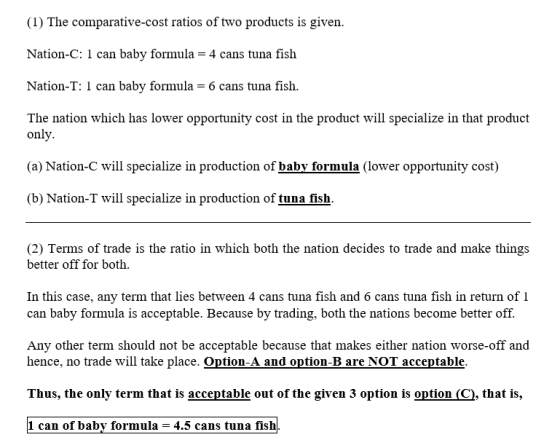
Canswicki: 1 can baby formula = 4 cans tuna fish
Tunata: 1 can baby formula = 6 cans tuna fish
1) In what product should each nation
specialize?
a) Canswicki should produce: _____
b) Tunata should produce: _____
2) Would the following terms of trade be acceptable to both
nations?
a. 1 can baby formula ≡ 3 cans tuna fish:
Acceptable or Not acceptable
b. 1 can baby formula ≡ 7 can tuna
fish: Acceptable or Not acceptable
c. 1 can baby formula ≡ 4.5 cans tuna fish:
Acceptable or Not acceptable
Homework Answers
Add Answer to:
Assume that the comparative-cost ratios of two
products—baby formula and tuna fish—are as follows in the...
4. Tariffs reduce the volume of imports. Do tariffs also reduce the volume of exports? Explain...
4. Tariffs reduce the volume of imports. Do tariffs also reduce the volume of exports? Explain your answer. ` 5. Suppose that the comparative-cost ratios of two products-mangoes and sardines-are as follows in the hypothetical nations of Mangolia and Sardinia. Mangolia: 1mango = 2 cans of sardines Sardinia: 1 mango = 4 cans of sardines In what product should each nation specialize Explain why the terms of trade of 1 mango = 3 cans of sardines would be acceptable to...
According to the principle of comparative advantage, a nation should specialize in producing those products which
According to the principle of comparative advantage, a nation should specialize in producing those products which other nations are unable to produce are hardest to protect through trade barriers it can produce at the lower opportunity cost than its trading partner use the scarcest resources
Nation Alpha has a comparative advantage in product X, and nation Beta has a comparative dvantage...
 Nation Alpha has a comparative advantage in product X, and nation Beta has a comparative dvantage in product Y. Trade in the two products will only benefit the two nations the exchange ratio of X for Y is fixed the terms of trade increase in both nations. there is excess capacity in both economies. the prices charged for X and Y reflect their domestic opportunity costs. Question 8 (1 point) The nation needs to prevent foreign nations from selling their...
Suppose that France and Austria both produce fish and olives. France's opportunity cost of producing a crate of olives is 4 pounds of fish
17. Terms of trade Suppose that France and Austria both produce fish and olives. France's opportunity cost of producing a crate of olives is 4 pounds of fish while Austria's opportunity cost of producing a crate of olives is 11 pounds of fish. By comparing the opportunity cost of producing olives in the two countries, you can tell that _______ has a comparative advantage in the production of olives and _______ has a comparative advantage in the production of fish. Suppose that France and Austria...
If the fictitious country of Islandia puts all of its production resources into fish, it can...
 If the fictitious country of Islandia puts all of its production resources into fish, it can produce 35 units of fish. If it puts all of its production resources into coconuts, it can produce 70 units of coconuts. If the fictitious country of Mountania puts all of its production resources into fish, it can produce 30 units of fish. If it puts all of its production resources into coconuts, it can produce 80 units of coconuts. Assume that both countries...
Suppose that Greece and Austria both produce fish and cheese. Greece's opportunity cost of producing a pound of cheese is 4 pounds of fish while
3. Terms of trade Suppose that Greece and Austria both produce fish and cheese. Greece's opportunity cost of producing a pound of cheese is 4 pounds of fish while Austria's opportunity cost of producing a pound of cheese is 10 pounds of fish. By comparing the opportunity cost of producing cheese in the two countries, you can tell that _______ has a comparative advantage in the production of cheese and _______ has a comparative advantage in the production of fish. Suppose that Greece and Austria...
Assume: 1) only two commodities are produced; 2) there are constant ratios of input to output...
Assume: 1) only two commodities are produced; 2) there are constant ratios of input to output whatever the level of output of coffee and bananas; and 3) competition prevails in all markets. Labor hours per keg of coffee Labor hours per kilogram of bananas Persia 20 12 Carthage 8 6 Which nation has an absolute advantage in coffee production? Which nation has an absolute advantage in bananas production? Persia’s opportunity cost to produce an additional keg of coffee is _________...
The following hypothetical production possibilities tables are for China and the United States. Assume that before...
 The following hypothetical production possibilities tables are for China and the United States. Assume that before specialization and trade the optimal product mix for China is alternative D and for the United States is alternative S. Product China Production Possibilities A B DEF 80,000 64,000 48,000 32,000 16,000 0 32 64 96 128 160 Chemicals(tons) Product Apparel Chemicals(tons) U.S. Production Possibilities R S T U 240,000 192,000 144,000 96,0000 0 48 96 144 V 48,000 192 W 0 240 Instructions:...
Let's assume that Germany produces one piece of furniture in 20 hours and Ethiopia produces the...
Let's assume that Germany produces one piece of furniture in 20 hours and Ethiopia produces the same product in 5 hours. Also, Germany produces a piece of clothing in 8 hours and Ethiopia produces the same product in 4 hours. Then: A. Germany has a comparative advantage in producing clothing and should produce and sell clothing in exchange for furniture made by Ethiopia. B. Ethiopia has a comparative advantage in making clothing and should specialize in and sell clothing to...
0/1 pts Question 1 Incorrect Suppose that two economies, Eugene and Portland, may engage in trade....
 0/1 pts Question 1 Incorrect Suppose that two economies, Eugene and Portland, may engage in trade. Each economy produces two goods, Beer and Coffee. All resources are identical (so each economy will have a straight-line PPF). Eugene may use its resources to produce up to 12 Beer or 8 Coffee. Portland may use its resources to produce up to 400 Beer or 300 Coffee. Which good should each economy specialize in? There is no reason for either economy to specialize...
 Nation Alpha has a comparative advantage in product X, and nation Beta has a comparative dvantage in product Y. Trade in the two products will only benefit the two nations the exchange ratio of X for Y is fixed the terms of trade increase in both nations. there is excess capacity in both economies. the prices charged for X and Y reflect their domestic opportunity costs. Question 8 (1 point) The nation needs to prevent foreign nations from selling their...
 If the fictitious country of Islandia puts all of its production resources into fish, it can produce 35 units of fish. If it puts all of its production resources into coconuts, it can produce 70 units of coconuts. If the fictitious country of Mountania puts all of its production resources into fish, it can produce 30 units of fish. If it puts all of its production resources into coconuts, it can produce 80 units of coconuts. Assume that both countries...
 The following hypothetical production possibilities tables are for China and the United States. Assume that before specialization and trade the optimal product mix for China is alternative D and for the United States is alternative S. Product China Production Possibilities A B DEF 80,000 64,000 48,000 32,000 16,000 0 32 64 96 128 160 Chemicals(tons) Product Apparel Chemicals(tons) U.S. Production Possibilities R S T U 240,000 192,000 144,000 96,0000 0 48 96 144 V 48,000 192 W 0 240 Instructions:...
 0/1 pts Question 1 Incorrect Suppose that two economies, Eugene and Portland, may engage in trade. Each economy produces two goods, Beer and Coffee. All resources are identical (so each economy will have a straight-line PPF). Eugene may use its resources to produce up to 12 Beer or 8 Coffee. Portland may use its resources to produce up to 400 Beer or 300 Coffee. Which good should each economy specialize in? There is no reason for either economy to specialize...
Most questions answered within 3 hours.
-
Where is the error in this code sequence?
String s1 = "Hello";
String s2 = "ello";...
asked 11 months ago -
Financial data for Joel de Paris, Inc., for last year
follow:
Joel de Paris, Inc.
Balance...
asked 11 months ago -
Consider this reaction:
Al2(SO4)3 (aq)+ BaCl3
(aq) Al2Cl6 (aq)- +
3BaSO4(s) . What is the...
asked 11 months ago -
Suppose that Savneet is considering increasing her
recent random sample from 20 car rentals to 40...
asked 11 months ago -
Trucks arrive at an unloading terminal at an average rate of 120
per hour.
Trucks arrive...
asked 11 months ago -
Why are methanol and ethanol completely soluble in water while
octanol is not very little soluble....
asked 11 months ago -
A facilities manager at a university reads in a research report
that the mean amount of...
asked 11 months ago -
When the CuSO4 is rehydrated by adding water to the anhydrous
compound, is this an endothermic...
asked 11 months ago -
A ray of sunlight is passing from diamond into crown glass; the
angle of incidence is...
asked 11 months ago -
A block of mass 0.249 kg is placed on top of a light, vertical
spring of...
asked 11 months ago -
how do the kidneys compensate in the presences of acidosis
a) trigger hyperventilate
b) reserve acid...
asked 11 months ago -
Question 501 pts
The rental rate of capital to the firm increases. Which of the
following...
asked 11 months ago