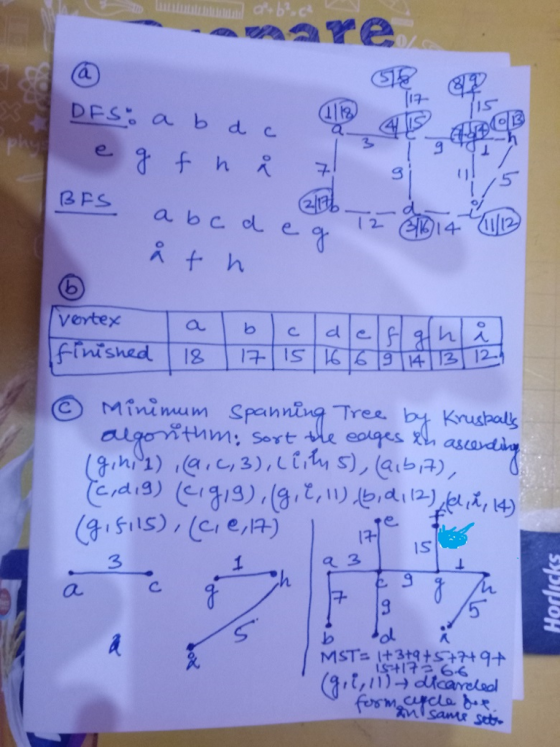
![Consider the graph at right. 17 15 [a] In what order are the vertices visited using DFS 319 1 starting from vertex a? Where a choice exists, use alphabetical order. What if you use BFS? [b A vertex x is finished when the recursive call DFS (x) terminates. In what order are the vertices finished? (This is different from the order in which they are visited, when DFS (x) is called.) [c] In what order are edges added to the minimum 12 14 spanning tree by Kruskals algorithm? List the edges by giving their endpoints.](http://img.homeworklib.com/questions/21ee32f0-0a65-11ec-9f9d-ddfd6df1b492.png?x-oss-process=image/resize,w_560)
Homework Answers
Add Answer to:
Consider the graph at right. 17 15 [a] In what order are the vertices visited using...
Show the operation of depth-first search (DFS) on the graph of Figure 1 starting from vertex...
 Show the operation of depth-first search (DFS) on the graph of Figure 1 starting from vertex q. Always process vertices in alphabetical order. Show the discovery and finish times for each vertex, and the classification of each edge. (b) A depth-first forest classifies the edges of a graph into tree, back, forward, and cross edges. A breadth-first search (BFS) tree can also be used to classify the edges reachable from the source of the search into the same four categories....
Question II - Graph Traversal and Minimum Spanning Trees [40 Points] Consider the following graph: B...
 Question II - Graph Traversal and Minimum Spanning Trees [40 Points] Consider the following graph: B 10 1 4 1 H 9 4 a) Traverse the graph starting from vertex A, and using the Breadth-First Search algorithm. Show the traversal result and the data structure you are using. [10 Points] b) Traverse the graph starting from vertex A, and using the Depth-First Search (Post-order) algorithm. Show the traversal result and the data structure you are using. [10 Points] c) Apply...
#include <iostream> #include <queue> using namespace std; class Graph { public: Graph(int n); ~Graph(); void addEdge(int...
 #include <iostream>
#include <queue>
using namespace std;
class Graph {
public:
Graph(int n);
~Graph();
void addEdge(int src, int tar);
void BFTraversal();
void DFTraversal();
void printVertices();
void printEdges();
private:
int vertexCount;
int edgeCount;
bool** adjMat;
void BFS(int n, bool marked[]);
void DFS(int n, bool marked[]);
};
Graph::Graph(int n=0) {
vertexCount = n;
edgeCount = 0;
if(n == 0)
adjMat = 0;
else {
adjMat = new bool* [n];
for(int i=0; i < n; i++)
adjMat[i] = new bool [n];
for(int i=0;...
#include <iostream>
#include <queue>
using namespace std;
class Graph {
public:
Graph(int n);
~Graph();
void addEdge(int src, int tar);
void BFTraversal();
void DFTraversal();
void printVertices();
void printEdges();
private:
int vertexCount;
int edgeCount;
bool** adjMat;
void BFS(int n, bool marked[]);
void DFS(int n, bool marked[]);
};
Graph::Graph(int n=0) {
vertexCount = n;
edgeCount = 0;
if(n == 0)
adjMat = 0;
else {
adjMat = new bool* [n];
for(int i=0; i < n; i++)
adjMat[i] = new bool [n];
for(int i=0;...
3. Given a directed graph G < V E >, we define its transpose Gr < V.E1 > to be the graph such tha...
 3. Given a directed graph G < V E >, we define its transpose Gr < V.E1 > to be the graph such that ET-{ < v, u >:< u, v >EE). In other words, GT has the same number of edges as in G, but the directions of the edges are reversed. Draw the transpose of the following graph: ta Perform DFS on the original graph G, and write down the start and finish times for each vertex in...
Consider the weighted graph below: Demonstrate Prim's algorithm starting from vertex A. Write the edges in...
 Consider the weighted graph below: Demonstrate Prim's algorithm starting from vertex A. Write the edges in the order they were added to the minimum spanning tree. Demonstrate Dijkstra's algorithm on the graph, using vertex A as the source. Write the vertices in the order which they are marked and compute all distances at each step.
Use Kruskal's algorithm to find a minimum spanning tree for the graph. Indicate the order in which edges are added to form the tree.
 Use Kruskal's algorithm to find a minimum spanning tree for the graph. Indicate the order in which edges are added to form the tree. In what order were the edges added? (Enter your answer as a comma-separated list of sets.)
Run BFS on the graph above starting from vertex 0 and list the vertices in order...
 Run BFS on the graph above
starting from vertex 0 and list the vertices in order of their
first visit.. Assume the adjacency list is in descending sorted
order based on the label of the vertices. For example, when
iterating through the edges pointing from 0, first consider the
edge 0 → 6, then 0 → 3, and finally 0 → 1.
راه من . 3 و 10 5
Run BFS on the graph above
starting from vertex 0 and list the vertices in order of their
first visit.. Assume the adjacency list is in descending sorted
order based on the label of the vertices. For example, when
iterating through the edges pointing from 0, first consider the
edge 0 → 6, then 0 → 3, and finally 0 → 1.
راه من . 3 و 10 5
Please clearly show vertex set, edge set, and endpoint. When drawing graph label each vertices and...
 Please clearly show vertex set, edge set, and endpoint. When
drawing graph label each vertices and edge.Thanks
Create a binary tree with a height 9 with 9 terminal vertices or explain why no such graph exists. If the graph exists, draw the graph, label the vertices and edges. To answer the question in the box below. write the vertex set, the edge set, and the edge-endpoint function. You can copy (Ctrl-C) and paste(Ctrl-V) the table to use in your answer...
Please clearly show vertex set, edge set, and endpoint. When
drawing graph label each vertices and edge.Thanks
Create a binary tree with a height 9 with 9 terminal vertices or explain why no such graph exists. If the graph exists, draw the graph, label the vertices and edges. To answer the question in the box below. write the vertex set, the edge set, and the edge-endpoint function. You can copy (Ctrl-C) and paste(Ctrl-V) the table to use in your answer...
Consider the following weighted graph G:
 Consider the following weighted graph G: Use Prim's algorithm to find a minimal spanning tree T of this graph starting at the vertex s. You do not need to show every step of the algorithm, but to receive full credit you should: list the edges of T in the order in which they're added; redraw G and indicate which edges belong to T; compute the cost of T.
Question 22 Which of the following is a requirement for Dijkstra's algorithm Positive weights The graph...
 Question 22 Which of the following is a requirement for Dijkstra's algorithm Positive weights The graph should be sparse The graph should be acyclic The graph should not be symmetrical Question 23 Why is the traversal of a graph different from a tree? DFS of a graph uses stack, but in order traversal of a tree is recursive BFS of a graph uses queue, but a time efficient BF5 of a tree is recursive There can be a loop in...
 Show the operation of depth-first search (DFS) on the graph of Figure 1 starting from vertex q. Always process vertices in alphabetical order. Show the discovery and finish times for each vertex, and the classification of each edge. (b) A depth-first forest classifies the edges of a graph into tree, back, forward, and cross edges. A breadth-first search (BFS) tree can also be used to classify the edges reachable from the source of the search into the same four categories....
 Question II - Graph Traversal and Minimum Spanning Trees [40 Points] Consider the following graph: B 10 1 4 1 H 9 4 a) Traverse the graph starting from vertex A, and using the Breadth-First Search algorithm. Show the traversal result and the data structure you are using. [10 Points] b) Traverse the graph starting from vertex A, and using the Depth-First Search (Post-order) algorithm. Show the traversal result and the data structure you are using. [10 Points] c) Apply...
 #include <iostream>
#include <queue>
using namespace std;
class Graph {
public:
Graph(int n);
~Graph();
void addEdge(int src, int tar);
void BFTraversal();
void DFTraversal();
void printVertices();
void printEdges();
private:
int vertexCount;
int edgeCount;
bool** adjMat;
void BFS(int n, bool marked[]);
void DFS(int n, bool marked[]);
};
Graph::Graph(int n=0) {
vertexCount = n;
edgeCount = 0;
if(n == 0)
adjMat = 0;
else {
adjMat = new bool* [n];
for(int i=0; i < n; i++)
adjMat[i] = new bool [n];
for(int i=0;...
#include <iostream>
#include <queue>
using namespace std;
class Graph {
public:
Graph(int n);
~Graph();
void addEdge(int src, int tar);
void BFTraversal();
void DFTraversal();
void printVertices();
void printEdges();
private:
int vertexCount;
int edgeCount;
bool** adjMat;
void BFS(int n, bool marked[]);
void DFS(int n, bool marked[]);
};
Graph::Graph(int n=0) {
vertexCount = n;
edgeCount = 0;
if(n == 0)
adjMat = 0;
else {
adjMat = new bool* [n];
for(int i=0; i < n; i++)
adjMat[i] = new bool [n];
for(int i=0;...
 3. Given a directed graph G < V E >, we define its transpose Gr < V.E1 > to be the graph such that ET-{ < v, u >:< u, v >EE). In other words, GT has the same number of edges as in G, but the directions of the edges are reversed. Draw the transpose of the following graph: ta Perform DFS on the original graph G, and write down the start and finish times for each vertex in...
 Consider the weighted graph below: Demonstrate Prim's algorithm starting from vertex A. Write the edges in the order they were added to the minimum spanning tree. Demonstrate Dijkstra's algorithm on the graph, using vertex A as the source. Write the vertices in the order which they are marked and compute all distances at each step.
 Run BFS on the graph above
starting from vertex 0 and list the vertices in order of their
first visit.. Assume the adjacency list is in descending sorted
order based on the label of the vertices. For example, when
iterating through the edges pointing from 0, first consider the
edge 0 → 6, then 0 → 3, and finally 0 → 1.
راه من . 3 و 10 5
Run BFS on the graph above
starting from vertex 0 and list the vertices in order of their
first visit.. Assume the adjacency list is in descending sorted
order based on the label of the vertices. For example, when
iterating through the edges pointing from 0, first consider the
edge 0 → 6, then 0 → 3, and finally 0 → 1.
راه من . 3 و 10 5
 Please clearly show vertex set, edge set, and endpoint. When
drawing graph label each vertices and edge.Thanks
Create a binary tree with a height 9 with 9 terminal vertices or explain why no such graph exists. If the graph exists, draw the graph, label the vertices and edges. To answer the question in the box below. write the vertex set, the edge set, and the edge-endpoint function. You can copy (Ctrl-C) and paste(Ctrl-V) the table to use in your answer...
Please clearly show vertex set, edge set, and endpoint. When
drawing graph label each vertices and edge.Thanks
Create a binary tree with a height 9 with 9 terminal vertices or explain why no such graph exists. If the graph exists, draw the graph, label the vertices and edges. To answer the question in the box below. write the vertex set, the edge set, and the edge-endpoint function. You can copy (Ctrl-C) and paste(Ctrl-V) the table to use in your answer...
 Question 22 Which of the following is a requirement for Dijkstra's algorithm Positive weights The graph should be sparse The graph should be acyclic The graph should not be symmetrical Question 23 Why is the traversal of a graph different from a tree? DFS of a graph uses stack, but in order traversal of a tree is recursive BFS of a graph uses queue, but a time efficient BF5 of a tree is recursive There can be a loop in...
Most questions answered within 3 hours.
-
Where is the error in this code sequence?
String s1 = "Hello";
String s2 = "ello";...
asked 11 months ago -
Financial data for Joel de Paris, Inc., for last year
follow:
Joel de Paris, Inc.
Balance...
asked 11 months ago -
Consider this reaction:
Al2(SO4)3 (aq)+ BaCl3
(aq) Al2Cl6 (aq)- +
3BaSO4(s) . What is the...
asked 11 months ago -
Suppose that Savneet is considering increasing her
recent random sample from 20 car rentals to 40...
asked 11 months ago -
Trucks arrive at an unloading terminal at an average rate of 120
per hour.
Trucks arrive...
asked 11 months ago -
Why are methanol and ethanol completely soluble in water while
octanol is not very little soluble....
asked 11 months ago -
A facilities manager at a university reads in a research report
that the mean amount of...
asked 11 months ago -
When the CuSO4 is rehydrated by adding water to the anhydrous
compound, is this an endothermic...
asked 11 months ago -
A ray of sunlight is passing from diamond into crown glass; the
angle of incidence is...
asked 11 months ago -
A block of mass 0.249 kg is placed on top of a light, vertical
spring of...
asked 11 months ago -
how do the kidneys compensate in the presences of acidosis
a) trigger hyperventilate
b) reserve acid...
asked 11 months ago -
Question 501 pts
The rental rate of capital to the firm increases. Which of the
following...
asked 11 months ago