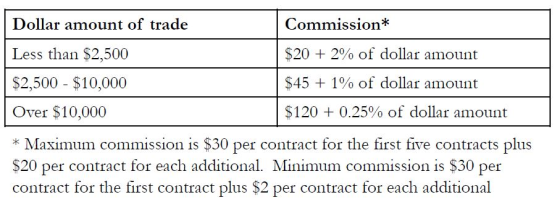
1) Using the table, what is the commission if an investor buys 15 call option contracts with a strike price of $30, if the option price is $4.00?
2)Now let’s assume the day before the option expires, the stock is trading at $40 per share. If the investor sells the options for $10.05 (makes the offsetting trade), how much is the net profit?
**I am Not understanding how I will use strike price in part 1 and stock price in the part 2
contract size= 100
I know it is ambiguous, but that is how it was posted in lecture notes examples.
Another similar example done in class; for reference;
If you buy 100 call option contracts that cost $0.50 per option, what is the commission? What if the option costs $5.00 each?
Solution:
Option price = $0.50
Total dollar amount = ($0.50)*(100 contracts)*(100 options/contract) = $5,000
Commission = $45+(1%)*($5,000) = $95
Compare this to the minimum and maximum commission:
Minimum = $30*1 + $2*99 = $228
Maximum = $30*5+$20*95 = $2,050
Therefore the commission will be $228 (since $95 is below the minimum)
Option price = $5.00
Total dollar amount = ($5.00)*100*100 = $50,000
Commission = $120 + 0.25%*($50,000) = $245
Therefore the commission will be $245.
(Note: since this is still 100 contracts, the max and min are the
same as in the first part)
Homework Answers
Request Answer!
We need at least 10 more requests to produce the answer.
0 / 10 have requested this problem solution
The more requests, the faster the answer.
Add Answer to:
1) Using the table, what is the commission if an investor buys
15 call option contracts...
An investor buys a two-month XYZ call option contract with a $25 strike price, and sells...
An investor buys a two-month XYZ call option contract with a $25 strike price, and sells a two month XYZ call option contract with a $30 strike price. The premium is $2 for the call with the $25 strike price. The premium is $1 for the call with the $30 strike price. What is the maximum potential profit for this position?
1:An investor buys a call at a price of $6.50 with an exercise price of $60....
1:An investor buys a call at a price of $6.50 with an exercise price of $60. At what stock price will the investor break even on the purchase of the call? 2:An investor purchases a stock for $50 and a put for $0.50 with a strike price of $46. The investor sells a call for $0.50 with a strike price of $59. What is the maximum profit and loss for this position? (Loss amount should be indicated by a minus...
An investor buys a ratio spread of 1-year European calls. He buys 1 call option with...
An investor buys a ratio spread of 1-year European calls. He buys 1 call option with strike price 40 and sells 2 call options with strike price 50. Option prices are Strike price Call option premium 40 10 50 5 Determine the investor's profit if the ending price of the underlying stock is (a) 45, (b) 55, (c) 65. (math Finance)
The current price of a stock is $31.50 per share, and six-month European call options on...
 The current price of a stock is $31.50 per share, and six-month European call options on the stock with a strike price of $32.50 are currently trading at $3.60. An investor, who has $10,000 of capital to invest, believes that the price of the stock will increase by 20% over the next six months. The investor is trying to decide between two strategies - buying shares or buying call options. What return will each strategy produce after six months, if...
Stephen just bought 1 contract of put options and, at the same time, 2 contracts of...
Stephen just bought 1 contract of put options and, at the same time, 2 contracts of call options on the Swiss francs (SF) at the strike price of 60 cents per franc. Each option contract is for SF 12,000. The option will expire in three months. The put premium is 2.50 cents per SF and the call premium is 2.00 cents per SF. (1) Diagram the ‘combined’ dollar profit schedule against the future spot exchange rate. (2) Compute and show...
A Canadian investor owns 300 shares of Scotiabank (BNS) and wants to protect herself against a...
A Canadian investor owns 300 shares of Scotiabank (BNS) and wants to protect herself against a large drop in the stock’s price between now and the end of the year. i. Should she buy BNS stock put options or call options? ii. To protect herself with a maximum loss of about 10% below the current market price, what strike price should she choose? iii. What expiry date should she choose? iv. How many contracts would she need to buy? v....
a) An investor looks at market reports and sees you can but Rio Tinto call option...
a) An investor looks at market reports and sees you can but Rio Tinto call option over 1000 shares at $8 with a strike price of $88 and a 6 month expiry. After 4 months the physical price goes to $100. What can the investor do to achieve the best outcome? With aid of a diagram identify and quantify the gains/losses of the writer and buyer? b)Using a diagram, explain how the gains and losses of both the buyers and...
Question 7: 1. Both a call option and a put option are currently traded on stock...
 Question 7:
1. Both a call option and a put option are currently traded on stock AXT. Both options have a strike price of $90 and maturity (T) of three months. The call premium (Co) is $2.75, the put premium (Po) is $4.12, and the underlying stock price (So) is $89.50. Assume that you trade one contract that has 100 shares when you calculate profit or loss. What will be your profit (or loss) if you take a long position...
Question 7:
1. Both a call option and a put option are currently traded on stock AXT. Both options have a strike price of $90 and maturity (T) of three months. The call premium (Co) is $2.75, the put premium (Po) is $4.12, and the underlying stock price (So) is $89.50. Assume that you trade one contract that has 100 shares when you calculate profit or loss. What will be your profit (or loss) if you take a long position...
A trader buys 10 Put Option contracts (1 contract is 100 shares) on AAPL with March...
 A trader buys 10 Put Option contracts (1 contract is 100 shares) on AAPL with March 2019 expiration and strike price $150. The price of the option was $4.50. What are trader's potential gains and losses? O A Unlimited loss, gain is limited to $4,500 O B ossis limited to $150,000, gain is limited to $4,500. O C Unlimited profit, loss is limited to $4,500 O D Profit is limited to $145,500, loss is limited to $4,500
In time 0, an investor takes a calendar spread by selling two-year European call option and...
In time 0, an investor takes a calendar spread by selling two-year European call option and buying three-year European call option. These two options have the same strike price of $80 and are for the same stock that pays no dividends. The two-year option sells for $5 and the three-year option sells for $7. Two years later, the stock price turns out to be $90. The risk-free rate is 2% per annum. What is the minimum of the profit from...
 The current price of a stock is $31.50 per share, and six-month European call options on the stock with a strike price of $32.50 are currently trading at $3.60. An investor, who has $10,000 of capital to invest, believes that the price of the stock will increase by 20% over the next six months. The investor is trying to decide between two strategies - buying shares or buying call options. What return will each strategy produce after six months, if...
 Question 7:
1. Both a call option and a put option are currently traded on stock AXT. Both options have a strike price of $90 and maturity (T) of three months. The call premium (Co) is $2.75, the put premium (Po) is $4.12, and the underlying stock price (So) is $89.50. Assume that you trade one contract that has 100 shares when you calculate profit or loss. What will be your profit (or loss) if you take a long position...
Question 7:
1. Both a call option and a put option are currently traded on stock AXT. Both options have a strike price of $90 and maturity (T) of three months. The call premium (Co) is $2.75, the put premium (Po) is $4.12, and the underlying stock price (So) is $89.50. Assume that you trade one contract that has 100 shares when you calculate profit or loss. What will be your profit (or loss) if you take a long position...
 A trader buys 10 Put Option contracts (1 contract is 100 shares) on AAPL with March 2019 expiration and strike price $150. The price of the option was $4.50. What are trader's potential gains and losses? O A Unlimited loss, gain is limited to $4,500 O B ossis limited to $150,000, gain is limited to $4,500. O C Unlimited profit, loss is limited to $4,500 O D Profit is limited to $145,500, loss is limited to $4,500
Most questions answered within 3 hours.
-
Where is the error in this code sequence?
String s1 = "Hello";
String s2 = "ello";...
asked 11 months ago -
Financial data for Joel de Paris, Inc., for last year
follow:
Joel de Paris, Inc.
Balance...
asked 11 months ago -
Consider this reaction:
Al2(SO4)3 (aq)+ BaCl3
(aq) Al2Cl6 (aq)- +
3BaSO4(s) . What is the...
asked 11 months ago -
Suppose that Savneet is considering increasing her
recent random sample from 20 car rentals to 40...
asked 11 months ago -
Trucks arrive at an unloading terminal at an average rate of 120
per hour.
Trucks arrive...
asked 11 months ago -
Why are methanol and ethanol completely soluble in water while
octanol is not very little soluble....
asked 11 months ago -
A facilities manager at a university reads in a research report
that the mean amount of...
asked 11 months ago -
When the CuSO4 is rehydrated by adding water to the anhydrous
compound, is this an endothermic...
asked 11 months ago -
A ray of sunlight is passing from diamond into crown glass; the
angle of incidence is...
asked 11 months ago -
A block of mass 0.249 kg is placed on top of a light, vertical
spring of...
asked 11 months ago -
how do the kidneys compensate in the presences of acidosis
a) trigger hyperventilate
b) reserve acid...
asked 11 months ago -
Question 501 pts
The rental rate of capital to the firm increases. Which of the
following...
asked 11 months ago