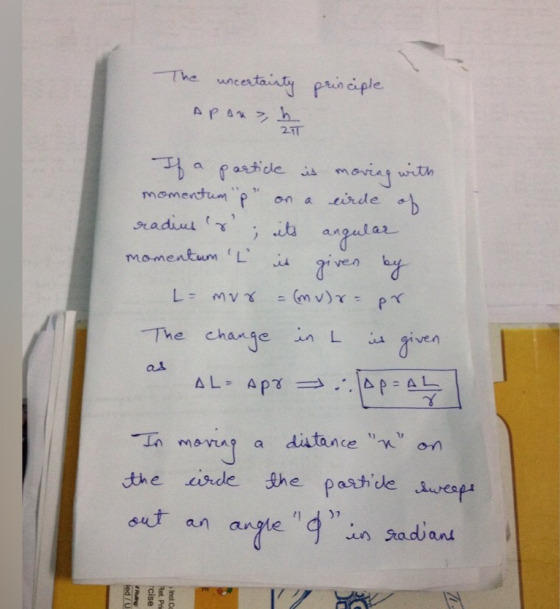
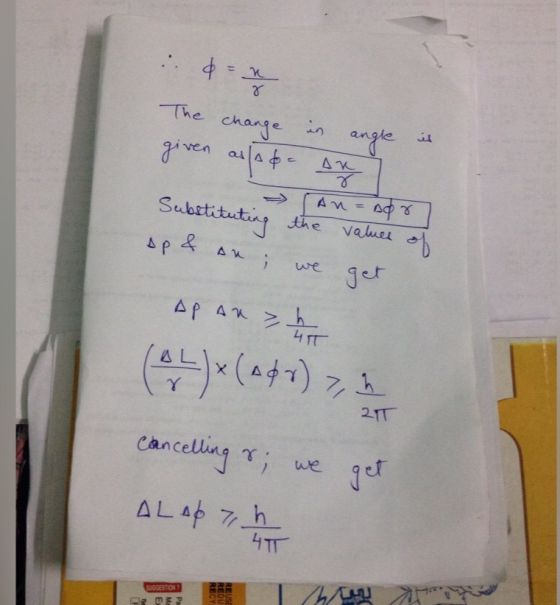
From the relation Δp.Δx ≥ h/4π show that for a particle moving in a circle ΔL.Δθ...
From the relation Δp.Δx ≥ h/4π show that for a particle moving in a circle ΔL.Δθ ≥ h/4π. The quantity ΔL is the uncertainty in the angular momentum and Δθ is the uncertainty in the angle.
Homework Answers
Add Answer to:
From the relation Δp.Δx ≥ h/4π show that for a particle moving
in a circle ΔL.Δθ...
3. (a) Show that for a freely moving matter particle (in a zero potential energy region)...
 3. (a) Show that for a freely moving matter particle (in a zero potential energy region) that the wave function: Ψ(x, t) ei(kx-at) is a solution to the time-dependent Schrödinger equation if the angular frequency o(k) is a function of the wavenumber k, given by hk2 o(k) = (b) Show that the group velocity vg for a packet of waves having o(k) from part (a) is equal to the particle velocity v from the non-relativistic momentum relation p = mv....
What is the magnitude of the angular momentum of a 1.0-g particle moving counterclockwise (as viewed...
 What is the magnitude of the angular momentum of a 1.0-g particle moving counterclockwise (as viewed from above) with an angular speed of 5 pi rad/s in a horizontal circle of radius 16 cm ? Express your answer using two significant figures. L = kg middot m^2/s What is the direction of the angular momentum upward downward
Show that for any central force, a particle moving in a curved path and acted upon...
Show that for any central force, a particle moving in a curved path and acted upon by that central force has constant angular momentum about the force center.
long thin rod length h A particle, with mass m, is moving through space with constant...
 long thin rod length h A particle, with mass m, is moving through space with constant velocity v, as shown in the diagram. COM It eventually collides with and sticks to the end of a long thin uniform rod, which has mass M and length /h and is initially at rest. The mass of the particle (m) is negligible compared with the mass of the rod. (a) Show the angular momentum of the particle about the COM of the rod...
You observe a 2.0 kg particle moving at a constant speed of 3.6 m/s in a...
You observe a 2.0 kg particle moving at a constant speed of 3.6 m/s in a clockwise direction around a circle of radius 4.0 m. (a) What is its angular momentum about the center of the circle? kg·m2/s (b) What is its moment of inertia about an axis through the center of the circle and perpendicular to the plane of the motion? kg·m2 (c) What is the angular velocity of the particle? rad/s
Tutorial: Angular Momentum and Torque III. Angular Momentum The angular momentum of a point particle is...
 Tutorial: Angular Momentum and Torque III. Angular Momentum The angular momentum of a point particle is defined by: L = ixp. Here, is a vector that points from the point of rotation (or point around which the angular momentum is calculated) to the location of the particle and p = mb is the linear momentum of the particle. A Your little brother Joey is playing with his toy airplane. The airplane is tied to a string and its motor makes...
You observe a 2.0 kg particle moving at a constant speed of 3.5 m/s around a...
 You observe a 2.0 kg particle moving at a constant speed of 3.5 m/s around a circle of 4.0 m radius. What is the magnitude of the angular momentum about the center of the circle? Your Answer: Answer units
A 1.6 kg particle moves in a circle of radius 3.1 m. As you look down...
A 1.6 kg particle moves in a circle of radius 3.1 m. As you look down on the plane of its orbit, the particle is initially moving clockwise. If we call the clockwise direction positive, the particle's angular momentum relative to the center of the circle varies with time according to L(t) = 10 N · m·s - (5.0 N · m)t. (a) Find the magnitude and direction of the torque acting on the particle in N · m. Is...
A particle of charge q and mass m, moving with a constant speed v and perpendicular...
A particle of charge q and mass m, moving with a constant speed v and perpendicular to a constant magnetic field B, follows a circular path. If the angular momentum about the center of this circle is quantized such that mvr=nl, where n is a non-zero integer, determine: b. An expression for the allowed energy states of the particle.
A particle with a mass of 9 kg moves in a circle with a radius of...
A particle with a mass of 9 kg moves in a circle with a radius of 0.18 m and a tangential speed of 13 m/s. What is the angular momentum of the particle in kg-m2/s?
 3. (a) Show that for a freely moving matter particle (in a zero potential energy region) that the wave function: Ψ(x, t) ei(kx-at) is a solution to the time-dependent Schrödinger equation if the angular frequency o(k) is a function of the wavenumber k, given by hk2 o(k) = (b) Show that the group velocity vg for a packet of waves having o(k) from part (a) is equal to the particle velocity v from the non-relativistic momentum relation p = mv....
 What is the magnitude of the angular momentum of a 1.0-g particle moving counterclockwise (as viewed from above) with an angular speed of 5 pi rad/s in a horizontal circle of radius 16 cm ? Express your answer using two significant figures. L = kg middot m^2/s What is the direction of the angular momentum upward downward
 long thin rod length h A particle, with mass m, is moving through space with constant velocity v, as shown in the diagram. COM It eventually collides with and sticks to the end of a long thin uniform rod, which has mass M and length /h and is initially at rest. The mass of the particle (m) is negligible compared with the mass of the rod. (a) Show the angular momentum of the particle about the COM of the rod...
 Tutorial: Angular Momentum and Torque III. Angular Momentum The angular momentum of a point particle is defined by: L = ixp. Here, is a vector that points from the point of rotation (or point around which the angular momentum is calculated) to the location of the particle and p = mb is the linear momentum of the particle. A Your little brother Joey is playing with his toy airplane. The airplane is tied to a string and its motor makes...
 You observe a 2.0 kg particle moving at a constant speed of 3.5 m/s around a circle of 4.0 m radius. What is the magnitude of the angular momentum about the center of the circle? Your Answer: Answer units
Most questions answered within 3 hours.
-
Where is the error in this code sequence?
String s1 = "Hello";
String s2 = "ello";...
asked 11 months ago -
Financial data for Joel de Paris, Inc., for last year
follow:
Joel de Paris, Inc.
Balance...
asked 11 months ago -
Consider this reaction:
Al2(SO4)3 (aq)+ BaCl3
(aq) Al2Cl6 (aq)- +
3BaSO4(s) . What is the...
asked 11 months ago -
Suppose that Savneet is considering increasing her
recent random sample from 20 car rentals to 40...
asked 11 months ago -
Trucks arrive at an unloading terminal at an average rate of 120
per hour.
Trucks arrive...
asked 11 months ago -
Why are methanol and ethanol completely soluble in water while
octanol is not very little soluble....
asked 11 months ago -
A facilities manager at a university reads in a research report
that the mean amount of...
asked 11 months ago -
When the CuSO4 is rehydrated by adding water to the anhydrous
compound, is this an endothermic...
asked 11 months ago -
A ray of sunlight is passing from diamond into crown glass; the
angle of incidence is...
asked 11 months ago -
A block of mass 0.249 kg is placed on top of a light, vertical
spring of...
asked 11 months ago -
how do the kidneys compensate in the presences of acidosis
a) trigger hyperventilate
b) reserve acid...
asked 11 months ago -
Question 501 pts
The rental rate of capital to the firm increases. Which of the
following...
asked 11 months ago