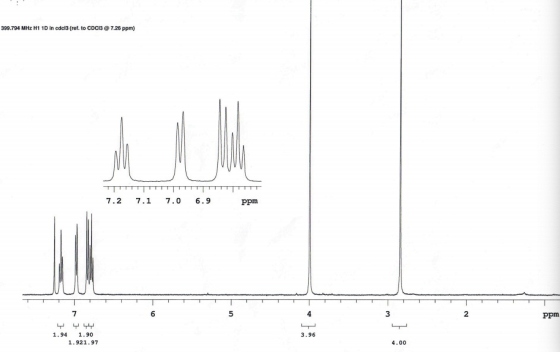
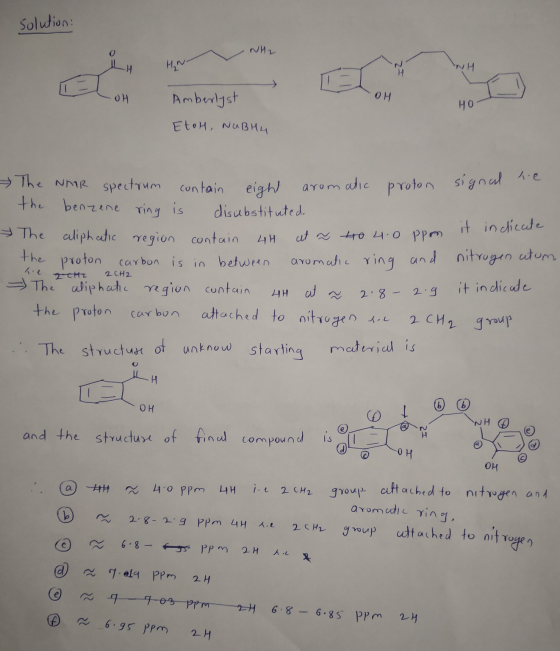
- Analyze the attached product NMR spectrum. Justify the structure of your final product and deduce the identity of your unknown starting material.
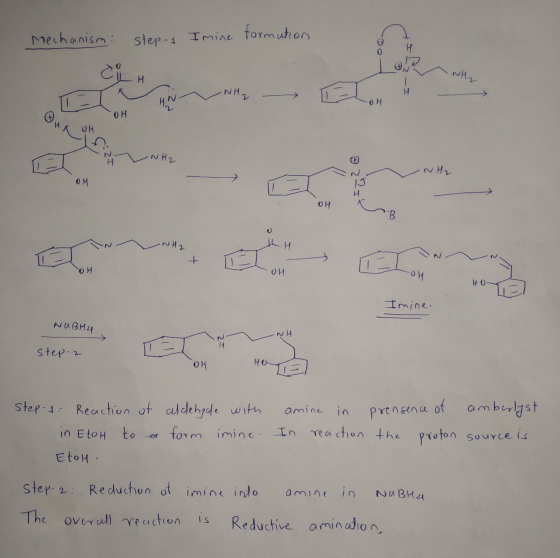
- Provide a reaction mechanism using the starting material that you deduced in Qu. 1.

Homework Answers
Add Answer to:
Analyze the attached product NMR spectrum. Justify the
structure of your final product and deduce the...
q1.At the end of this reaction, the procedure asks you to add 10 mL of 2M...
 q1.At the end of this reaction, the procedure asks you to add 10
mL of 2M HCl, what is the purpose of this? Use reaction schemes to
illustrate your answer.
q2.As part of the workup procedure for this reaction, you are
asked to add 10 % NaOH to the aqueous phases before extracting with
ethyl acetate. What is the purpose of this? Use structures help
illustrate your answer
-NH₂ H2N -ΝΗ HN- ОН Amberlyst 15 Ethanol, NaBH4 -OH HO- R...
q1.At the end of this reaction, the procedure asks you to add 10
mL of 2M HCl, what is the purpose of this? Use reaction schemes to
illustrate your answer.
q2.As part of the workup procedure for this reaction, you are
asked to add 10 % NaOH to the aqueous phases before extracting with
ethyl acetate. What is the purpose of this? Use structures help
illustrate your answer
-NH₂ H2N -ΝΗ HN- ОН Amberlyst 15 Ethanol, NaBH4 -OH HO- R...
What is the reaction product(s) of oleic acid & sodium methoxide? Show the structure(s). Part A:...
What is the reaction product(s) of oleic acid & sodium methoxide? Show the structure(s). Part A: Acid Catalyzed Fischer Esterification of Free Fatty Acids Add 20 mL of canola oil and a magnetic stir bar to a 125-mL Erlenmeyer flask, and place the flask on a magnetic stirring plate. Add 2–3 mL of methanol and up to three drops of concentrated sulfuric acid Perform this step with caution, as this is a strong acid! Immerse a thermometer into the reaction...
Organic chemistry post-lab question: "Why is important to add the alkyl halide dropwise in your reaction?...
 Organic chemistry post-lab question: "Why is important
to add the alkyl halide dropwise in your reaction? (Hint: your
reaction is not heated, but you still need a water-cooled
condenser!)" Please answer in detail!
Here is a copy of the experiment, thank you!
The Grignard reaction is an important synthetic process by which a carbon-carbon bond is formed. Magnesium metal is first reacted with an organic halide. The resultant organo-magnesium halide (Grignard reagent) is then combined with a carbonyl compound, ultimately...
Organic chemistry post-lab question: "Why is important
to add the alkyl halide dropwise in your reaction? (Hint: your
reaction is not heated, but you still need a water-cooled
condenser!)" Please answer in detail!
Here is a copy of the experiment, thank you!
The Grignard reaction is an important synthetic process by which a carbon-carbon bond is formed. Magnesium metal is first reacted with an organic halide. The resultant organo-magnesium halide (Grignard reagent) is then combined with a carbonyl compound, ultimately...
Predict the product(s) of the reactions for experiment B... 8. At reflux: At room temperature: TEMP Group B Subst...
 Predict the product(s) of the reactions for experiment B... 8. At reflux: At room temperature: TEMP Group B Substitution or Elimination As you have learned in lecture, substitution reactions and elimination reactions are competing reactions and the outcome of any reaction depends on several factors, most importantly tem- peratune, and the structure of the alkyl halide. This group will examine competition between substitution ánd elimimation reaction. Br NaOCH3 + (3-bromopropyl)benzene In a 25 mL round-bottom flask, add 2 mL of...
Post Lab Questions what is the purpose of glacial acetic acid in this reaction? (5 points)...
 Post Lab Questions what is the purpose of glacial acetic acid in this reaction? (5 points) 2. How does KI-starch paper work? What is the source of the dark color 3. What is the purpose of adding saturated aqueous sodium bisult What reaction is taking place? Write out the bar my saturated aqueous sodium bisulfite to the reaction mixture? is taking place? Write out the balanced equation for this reaction. Why do you e kl-starch paper test after adding the...
For the nitration of methyl benzoate: a. Which product did you get? What evidence do you...
 For the nitration of methyl benzoate:
a. Which product did you get? What evidence do you have for
this?
b. Was your product pure? What evidence do you have for this?
Explain your evidence.
c. Draw the mechanism for the product you got.
For the bromination of acetanilide:
a. Which product did you get? What evidence do you have for
this?
b. Was your product pure? What evidence do you have for this?
Explain your evidence.
c. Draw the mechanism...
For the nitration of methyl benzoate:
a. Which product did you get? What evidence do you have for
this?
b. Was your product pure? What evidence do you have for this?
Explain your evidence.
c. Draw the mechanism for the product you got.
For the bromination of acetanilide:
a. Which product did you get? What evidence do you have for
this?
b. Was your product pure? What evidence do you have for this?
Explain your evidence.
c. Draw the mechanism...
what would be the percent yield if the final weight of my product is 0.1357g this...
 what would be the percent yield if the final weight of my product
is 0.1357g this is a green chemistry wittig reaction to produce
1,4-diphenyl-1,3-butadiene from benzyltriphenylphosphonium chloride
and trans- cinnamaledyde using sodium hydroxide as the base
You will be using a Green Chemistry Wittig reaction (NOT Wittig-Horner Emmons reaction) to produce 1,4-diphenyl-1,3-butadiene starting with benzyltriphenylphosphonium chloride and trans- cinnamaledyde using sodium hydroxide as the base. This reaction is considered a "green" reaction, because an aqueous solution will be used...
what would be the percent yield if the final weight of my product
is 0.1357g this is a green chemistry wittig reaction to produce
1,4-diphenyl-1,3-butadiene from benzyltriphenylphosphonium chloride
and trans- cinnamaledyde using sodium hydroxide as the base
You will be using a Green Chemistry Wittig reaction (NOT Wittig-Horner Emmons reaction) to produce 1,4-diphenyl-1,3-butadiene starting with benzyltriphenylphosphonium chloride and trans- cinnamaledyde using sodium hydroxide as the base. This reaction is considered a "green" reaction, because an aqueous solution will be used...
Part A of experiment: Working in the fume hood, combine 4.0 mL of 10% NaOH solution and 4 mL EtOH in a 50 mL round bot...
 Part A of experiment:
Working in the fume hood, combine 4.0 mL of 10% NaOH solution
and 4 mL EtOH in a 50 mL round bottom flask.
Dissolve 1.0 mL (8.6 mmol) of acetophenone into your
solution.
Add 1.0 mL (9.8 mmol) of benzaldehyde and a magnetic stir bar to
your flask. Clamp the flask
above a stir plate.
Monitor the reaction for 45 minutes by TLC. Acetophenone needs
to be diluted prior to TLC, and
cannot be spotted neat....
Part A of experiment:
Working in the fume hood, combine 4.0 mL of 10% NaOH solution
and 4 mL EtOH in a 50 mL round bottom flask.
Dissolve 1.0 mL (8.6 mmol) of acetophenone into your
solution.
Add 1.0 mL (9.8 mmol) of benzaldehyde and a magnetic stir bar to
your flask. Clamp the flask
above a stir plate.
Monitor the reaction for 45 minutes by TLC. Acetophenone needs
to be diluted prior to TLC, and
cannot be spotted neat....
For the portion of the procedure shown below, create a flow chart for the acid-base extraction...
 For the portion of the procedure shown below, create a
flow chart for the acid-base extraction at the end of the Grignard
Reaction. Start your flow chart with the crude reaction (see below)
mixture before addition of HCl and continue it until the product is
recovered. Depict the desired organic product, in its correct form
at each step of the procedure.
Crude reaction mixture procedure for reference: To
the flask add Mg turnings (120 mg, 4.94 mmol) to the flask...
For the portion of the procedure shown below, create a
flow chart for the acid-base extraction at the end of the Grignard
Reaction. Start your flow chart with the crude reaction (see below)
mixture before addition of HCl and continue it until the product is
recovered. Depict the desired organic product, in its correct form
at each step of the procedure.
Crude reaction mixture procedure for reference: To
the flask add Mg turnings (120 mg, 4.94 mmol) to the flask...
convert from moles to g or ml no structure was given the starting product is ketal...
 convert from moles to g or ml
no structure was given
the starting product is ketal alcohol
yes convert 0.01 moles of the starting material into
grams or ml
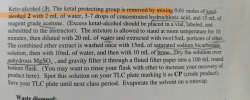
Keto-alcohol (3). The ketal protecting group is removed by mixing 0.01 moles of ketal- alcohol 2 with 2 mL of water, 5-7 drops of concentrated hydrochloric acid, and 15 mL of reagent grade acetone. (Excess ketal-alcohol should be placed in a vial, labeled, and submitted to the instructor). The mixture is...
convert from moles to g or ml
no structure was given
the starting product is ketal alcohol
yes convert 0.01 moles of the starting material into
grams or ml
Keto-alcohol (3). The ketal protecting group is removed by mixing 0.01 moles of ketal- alcohol 2 with 2 mL of water, 5-7 drops of concentrated hydrochloric acid, and 15 mL of reagent grade acetone. (Excess ketal-alcohol should be placed in a vial, labeled, and submitted to the instructor). The mixture is...
 q1.At the end of this reaction, the procedure asks you to add 10
mL of 2M HCl, what is the purpose of this? Use reaction schemes to
illustrate your answer.
q2.As part of the workup procedure for this reaction, you are
asked to add 10 % NaOH to the aqueous phases before extracting with
ethyl acetate. What is the purpose of this? Use structures help
illustrate your answer
-NH₂ H2N -ΝΗ HN- ОН Amberlyst 15 Ethanol, NaBH4 -OH HO- R...
q1.At the end of this reaction, the procedure asks you to add 10
mL of 2M HCl, what is the purpose of this? Use reaction schemes to
illustrate your answer.
q2.As part of the workup procedure for this reaction, you are
asked to add 10 % NaOH to the aqueous phases before extracting with
ethyl acetate. What is the purpose of this? Use structures help
illustrate your answer
-NH₂ H2N -ΝΗ HN- ОН Amberlyst 15 Ethanol, NaBH4 -OH HO- R...
 Organic chemistry post-lab question: "Why is important
to add the alkyl halide dropwise in your reaction? (Hint: your
reaction is not heated, but you still need a water-cooled
condenser!)" Please answer in detail!
Here is a copy of the experiment, thank you!
The Grignard reaction is an important synthetic process by which a carbon-carbon bond is formed. Magnesium metal is first reacted with an organic halide. The resultant organo-magnesium halide (Grignard reagent) is then combined with a carbonyl compound, ultimately...
Organic chemistry post-lab question: "Why is important
to add the alkyl halide dropwise in your reaction? (Hint: your
reaction is not heated, but you still need a water-cooled
condenser!)" Please answer in detail!
Here is a copy of the experiment, thank you!
The Grignard reaction is an important synthetic process by which a carbon-carbon bond is formed. Magnesium metal is first reacted with an organic halide. The resultant organo-magnesium halide (Grignard reagent) is then combined with a carbonyl compound, ultimately...
 Predict the product(s) of the reactions for experiment B... 8. At reflux: At room temperature: TEMP Group B Substitution or Elimination As you have learned in lecture, substitution reactions and elimination reactions are competing reactions and the outcome of any reaction depends on several factors, most importantly tem- peratune, and the structure of the alkyl halide. This group will examine competition between substitution ánd elimimation reaction. Br NaOCH3 + (3-bromopropyl)benzene In a 25 mL round-bottom flask, add 2 mL of...
 Post Lab Questions what is the purpose of glacial acetic acid in this reaction? (5 points) 2. How does KI-starch paper work? What is the source of the dark color 3. What is the purpose of adding saturated aqueous sodium bisult What reaction is taking place? Write out the bar my saturated aqueous sodium bisulfite to the reaction mixture? is taking place? Write out the balanced equation for this reaction. Why do you e kl-starch paper test after adding the...
 For the nitration of methyl benzoate:
a. Which product did you get? What evidence do you have for
this?
b. Was your product pure? What evidence do you have for this?
Explain your evidence.
c. Draw the mechanism for the product you got.
For the bromination of acetanilide:
a. Which product did you get? What evidence do you have for
this?
b. Was your product pure? What evidence do you have for this?
Explain your evidence.
c. Draw the mechanism...
For the nitration of methyl benzoate:
a. Which product did you get? What evidence do you have for
this?
b. Was your product pure? What evidence do you have for this?
Explain your evidence.
c. Draw the mechanism for the product you got.
For the bromination of acetanilide:
a. Which product did you get? What evidence do you have for
this?
b. Was your product pure? What evidence do you have for this?
Explain your evidence.
c. Draw the mechanism...
 what would be the percent yield if the final weight of my product
is 0.1357g this is a green chemistry wittig reaction to produce
1,4-diphenyl-1,3-butadiene from benzyltriphenylphosphonium chloride
and trans- cinnamaledyde using sodium hydroxide as the base
You will be using a Green Chemistry Wittig reaction (NOT Wittig-Horner Emmons reaction) to produce 1,4-diphenyl-1,3-butadiene starting with benzyltriphenylphosphonium chloride and trans- cinnamaledyde using sodium hydroxide as the base. This reaction is considered a "green" reaction, because an aqueous solution will be used...
what would be the percent yield if the final weight of my product
is 0.1357g this is a green chemistry wittig reaction to produce
1,4-diphenyl-1,3-butadiene from benzyltriphenylphosphonium chloride
and trans- cinnamaledyde using sodium hydroxide as the base
You will be using a Green Chemistry Wittig reaction (NOT Wittig-Horner Emmons reaction) to produce 1,4-diphenyl-1,3-butadiene starting with benzyltriphenylphosphonium chloride and trans- cinnamaledyde using sodium hydroxide as the base. This reaction is considered a "green" reaction, because an aqueous solution will be used...
 Part A of experiment:
Working in the fume hood, combine 4.0 mL of 10% NaOH solution
and 4 mL EtOH in a 50 mL round bottom flask.
Dissolve 1.0 mL (8.6 mmol) of acetophenone into your
solution.
Add 1.0 mL (9.8 mmol) of benzaldehyde and a magnetic stir bar to
your flask. Clamp the flask
above a stir plate.
Monitor the reaction for 45 minutes by TLC. Acetophenone needs
to be diluted prior to TLC, and
cannot be spotted neat....
Part A of experiment:
Working in the fume hood, combine 4.0 mL of 10% NaOH solution
and 4 mL EtOH in a 50 mL round bottom flask.
Dissolve 1.0 mL (8.6 mmol) of acetophenone into your
solution.
Add 1.0 mL (9.8 mmol) of benzaldehyde and a magnetic stir bar to
your flask. Clamp the flask
above a stir plate.
Monitor the reaction for 45 minutes by TLC. Acetophenone needs
to be diluted prior to TLC, and
cannot be spotted neat....
 For the portion of the procedure shown below, create a
flow chart for the acid-base extraction at the end of the Grignard
Reaction. Start your flow chart with the crude reaction (see below)
mixture before addition of HCl and continue it until the product is
recovered. Depict the desired organic product, in its correct form
at each step of the procedure.
Crude reaction mixture procedure for reference: To
the flask add Mg turnings (120 mg, 4.94 mmol) to the flask...
For the portion of the procedure shown below, create a
flow chart for the acid-base extraction at the end of the Grignard
Reaction. Start your flow chart with the crude reaction (see below)
mixture before addition of HCl and continue it until the product is
recovered. Depict the desired organic product, in its correct form
at each step of the procedure.
Crude reaction mixture procedure for reference: To
the flask add Mg turnings (120 mg, 4.94 mmol) to the flask...
 convert from moles to g or ml
no structure was given
the starting product is ketal alcohol
yes convert 0.01 moles of the starting material into
grams or ml
Keto-alcohol (3). The ketal protecting group is removed by mixing 0.01 moles of ketal- alcohol 2 with 2 mL of water, 5-7 drops of concentrated hydrochloric acid, and 15 mL of reagent grade acetone. (Excess ketal-alcohol should be placed in a vial, labeled, and submitted to the instructor). The mixture is...
convert from moles to g or ml
no structure was given
the starting product is ketal alcohol
yes convert 0.01 moles of the starting material into
grams or ml
Keto-alcohol (3). The ketal protecting group is removed by mixing 0.01 moles of ketal- alcohol 2 with 2 mL of water, 5-7 drops of concentrated hydrochloric acid, and 15 mL of reagent grade acetone. (Excess ketal-alcohol should be placed in a vial, labeled, and submitted to the instructor). The mixture is...
Most questions answered within 3 hours.
-
Where is the error in this code sequence?
String s1 = "Hello";
String s2 = "ello";...
asked 10 months ago -
Financial data for Joel de Paris, Inc., for last year
follow:
Joel de Paris, Inc.
Balance...
asked 10 months ago -
Consider this reaction:
Al2(SO4)3 (aq)+ BaCl3
(aq) Al2Cl6 (aq)- +
3BaSO4(s) . What is the...
asked 10 months ago -
Suppose that Savneet is considering increasing her
recent random sample from 20 car rentals to 40...
asked 10 months ago -
Trucks arrive at an unloading terminal at an average rate of 120
per hour.
Trucks arrive...
asked 10 months ago -
Why are methanol and ethanol completely soluble in water while
octanol is not very little soluble....
asked 10 months ago -
A facilities manager at a university reads in a research report
that the mean amount of...
asked 10 months ago -
When the CuSO4 is rehydrated by adding water to the anhydrous
compound, is this an endothermic...
asked 10 months ago -
A ray of sunlight is passing from diamond into crown glass; the
angle of incidence is...
asked 10 months ago -
A block of mass 0.249 kg is placed on top of a light, vertical
spring of...
asked 10 months ago -
how do the kidneys compensate in the presences of acidosis
a) trigger hyperventilate
b) reserve acid...
asked 10 months ago -
Question 501 pts
The rental rate of capital to the firm increases. Which of the
following...
asked 10 months ago