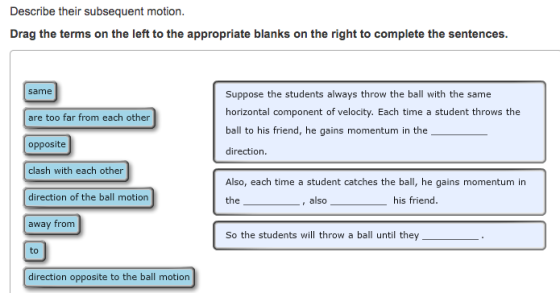
Two students stand at rest, facing each other on frictionless skates. They then start tossing a heavy ball back and forth between them.
Homework Answers
opposite
in the direction of ball motion
away from
are too far from each other
Add Answer to:
Two students stand at rest, facing each other on frictionless
skates. They then start tossing a...
Two students stand at rest, facing each other on frictionless skates. They then start tossing a...
 Two students stand at rest, facing each other on frictionless
skates. They then start tossing a heavy ball back and forth between
them.
Two students stand at rest, facing each other on frictionless skates. They then start tossing a heavy ball back and forth between them. Drag the terms on the left to the appropriate blanks on the right to complete the sentences. Suppose the students always throw the ball with the same horizontal component of velocity. Each time a...
Two students stand at rest, facing each other on frictionless
skates. They then start tossing a heavy ball back and forth between
them.
Two students stand at rest, facing each other on frictionless skates. They then start tossing a heavy ball back and forth between them. Drag the terms on the left to the appropriate blanks on the right to complete the sentences. Suppose the students always throw the ball with the same horizontal component of velocity. Each time a...
9.6 Conceptual Question 9.6 Part A Two students stand at rest, facing each other on frictionless...
 9.6
Conceptual Question 9.6 Part A Two students stand at rest, facing each other on frictionless skates. They then start tossing a heavy ball back and forth between them Describe their subsequent motion Drag the terms on the left to the appropriate blanks on the right to complete the sentences Reset Help away from Suppose the students always throw the ball with the same horizontal component of velocity. Each time a student throws the ball to his friend, he gains...
9.6
Conceptual Question 9.6 Part A Two students stand at rest, facing each other on frictionless skates. They then start tossing a heavy ball back and forth between them Describe their subsequent motion Drag the terms on the left to the appropriate blanks on the right to complete the sentences Reset Help away from Suppose the students always throw the ball with the same horizontal component of velocity. Each time a student throws the ball to his friend, he gains...
You and a friend are each wearing roller skates. You stand facing each other on a...
You and a friend are each wearing roller skates. You stand facing each other on a smooth level surface and begin tossing a heavy ball back and forth. Why do you drift apart?
Need help with momentum and calculations Two physics 7B students are testing the laws of physics...
 Need help with momentum and calculations
Two physics 7B students are testing the laws of physics on ice, where friction is negligible. Initially Manuel is skating East with momentum of 100 kgm/s. He is also holding a ball which weighs 5 times less than him (m_M = 5m_b). Jaz is skating West with initial momentum of 120 kgm/s. She weighs four times more than the ball (m_J = 4m_b). Initial conditions are draw here. When filling in the momentum charts...
Need help with momentum and calculations
Two physics 7B students are testing the laws of physics on ice, where friction is negligible. Initially Manuel is skating East with momentum of 100 kgm/s. He is also holding a ball which weighs 5 times less than him (m_M = 5m_b). Jaz is skating West with initial momentum of 120 kgm/s. She weighs four times more than the ball (m_J = 4m_b). Initial conditions are draw here. When filling in the momentum charts...
Two students are on a balcony a distance h above the street. One student throws a...
Two students are on a balcony a distance h above the street. One student throws a ball vertically downward at a speed vi; at the same time, the other student throws a ball vertically upward at the same speed. Answer the following symbolically in terms of vi, g, h, and t. (Take upward to be the positive direction.) (a) What is the time interval between when the first ball strikes the ground and the second ball strikes the ground? Δt...
Two students are on a balcony a distance h above the street. One student throws a...
Two students are on a balcony a distance h above the street. One student throws a ball vertically downward at a speed vi ; at the same time, the other student throws a ball vertically upward at the same speed. Answer the following symbolically in terms of vi , g, h, and t. (a) What is the time interval between when the first ball strikes the ground and the second ball strikes the ground? (b) Find the velocity of each...
#4-7 Two ice skaters stand facing each other at rest on a frozen pond. They push...
 #4-7
Two ice skaters stand facing each other at rest on a frozen pond. They push off against one another and the 48 kg skater acquires a speed of 0.69 m/s If the other skater acquires a speed of 0.81 m/s, what is her mass in kilograms? kg My Notes Ask Your Teacher -/2 points HAFColPhys1 8.2WA019. O5 Submissiens Used A man holding a rock sits on a sled that is sliding across a frozen lake (negligible friction) with a...
#4-7
Two ice skaters stand facing each other at rest on a frozen pond. They push off against one another and the 48 kg skater acquires a speed of 0.69 m/s If the other skater acquires a speed of 0.81 m/s, what is her mass in kilograms? kg My Notes Ask Your Teacher -/2 points HAFColPhys1 8.2WA019. O5 Submissiens Used A man holding a rock sits on a sled that is sliding across a frozen lake (negligible friction) with a...
using parametric equations and ange 6. Chris and Linda are standing 78 feet apart. At the same time, they each throw a softball toward each other. her ball with an initial velocity of 45 ft per se...
 using parametric equations
and ange 6. Chris and Linda are standing 78 feet apart. At the same time, they each throw a softball toward each other. her ball with an initial velocity of 45 ft per second with an angle of inelination of 44. Chris throws her ball with an initial velocity of 41 feet per second with an angle of inclination of 39 a. Find two sets of parametric equations that represent a model of the problem situation. b....
using parametric equations
and ange 6. Chris and Linda are standing 78 feet apart. At the same time, they each throw a softball toward each other. her ball with an initial velocity of 45 ft per second with an angle of inelination of 44. Chris throws her ball with an initial velocity of 41 feet per second with an angle of inclination of 39 a. Find two sets of parametric equations that represent a model of the problem situation. b....
Two ice skaters, with masses of 73kg and 55kg , stand facing each other on a 18-m-wide frozen river. The skaters push o...
Two ice skaters, with masses of 73kg and 55kg , stand facing each other on a 18-m-wide frozen river. The skaters push off against each other, glide backward straight toward the river's edges, and reach the edges at exactly the same time. how far did the 73kg skater glide?
Two objects with masses represented by m1 and m2 approach each other on a horizontal frictionless...
Two objects with masses represented by m1 and m2 approach each other on a horizontal frictionless table with the same constant speed, v0, as measured by a laboratory observer. The objects undergo a perfectly elastic collision, and it is observed that after the collision, m2 moves off in a direction opposite its original motion with some constant speed v, and m1 is stationary. Determine the following. (a) the ratio of the two masses, m1/m2 (b) the ratio of their speeds,...
 Two students stand at rest, facing each other on frictionless
skates. They then start tossing a heavy ball back and forth between
them.
Two students stand at rest, facing each other on frictionless skates. They then start tossing a heavy ball back and forth between them. Drag the terms on the left to the appropriate blanks on the right to complete the sentences. Suppose the students always throw the ball with the same horizontal component of velocity. Each time a...
Two students stand at rest, facing each other on frictionless
skates. They then start tossing a heavy ball back and forth between
them.
Two students stand at rest, facing each other on frictionless skates. They then start tossing a heavy ball back and forth between them. Drag the terms on the left to the appropriate blanks on the right to complete the sentences. Suppose the students always throw the ball with the same horizontal component of velocity. Each time a...
 9.6
Conceptual Question 9.6 Part A Two students stand at rest, facing each other on frictionless skates. They then start tossing a heavy ball back and forth between them Describe their subsequent motion Drag the terms on the left to the appropriate blanks on the right to complete the sentences Reset Help away from Suppose the students always throw the ball with the same horizontal component of velocity. Each time a student throws the ball to his friend, he gains...
9.6
Conceptual Question 9.6 Part A Two students stand at rest, facing each other on frictionless skates. They then start tossing a heavy ball back and forth between them Describe their subsequent motion Drag the terms on the left to the appropriate blanks on the right to complete the sentences Reset Help away from Suppose the students always throw the ball with the same horizontal component of velocity. Each time a student throws the ball to his friend, he gains...
 Need help with momentum and calculations
Two physics 7B students are testing the laws of physics on ice, where friction is negligible. Initially Manuel is skating East with momentum of 100 kgm/s. He is also holding a ball which weighs 5 times less than him (m_M = 5m_b). Jaz is skating West with initial momentum of 120 kgm/s. She weighs four times more than the ball (m_J = 4m_b). Initial conditions are draw here. When filling in the momentum charts...
Need help with momentum and calculations
Two physics 7B students are testing the laws of physics on ice, where friction is negligible. Initially Manuel is skating East with momentum of 100 kgm/s. He is also holding a ball which weighs 5 times less than him (m_M = 5m_b). Jaz is skating West with initial momentum of 120 kgm/s. She weighs four times more than the ball (m_J = 4m_b). Initial conditions are draw here. When filling in the momentum charts...
 #4-7
Two ice skaters stand facing each other at rest on a frozen pond. They push off against one another and the 48 kg skater acquires a speed of 0.69 m/s If the other skater acquires a speed of 0.81 m/s, what is her mass in kilograms? kg My Notes Ask Your Teacher -/2 points HAFColPhys1 8.2WA019. O5 Submissiens Used A man holding a rock sits on a sled that is sliding across a frozen lake (negligible friction) with a...
#4-7
Two ice skaters stand facing each other at rest on a frozen pond. They push off against one another and the 48 kg skater acquires a speed of 0.69 m/s If the other skater acquires a speed of 0.81 m/s, what is her mass in kilograms? kg My Notes Ask Your Teacher -/2 points HAFColPhys1 8.2WA019. O5 Submissiens Used A man holding a rock sits on a sled that is sliding across a frozen lake (negligible friction) with a...
 using parametric equations
and ange 6. Chris and Linda are standing 78 feet apart. At the same time, they each throw a softball toward each other. her ball with an initial velocity of 45 ft per second with an angle of inelination of 44. Chris throws her ball with an initial velocity of 41 feet per second with an angle of inclination of 39 a. Find two sets of parametric equations that represent a model of the problem situation. b....
using parametric equations
and ange 6. Chris and Linda are standing 78 feet apart. At the same time, they each throw a softball toward each other. her ball with an initial velocity of 45 ft per second with an angle of inelination of 44. Chris throws her ball with an initial velocity of 41 feet per second with an angle of inclination of 39 a. Find two sets of parametric equations that represent a model of the problem situation. b....
Most questions answered within 3 hours.
-
Where is the error in this code sequence?
String s1 = "Hello";
String s2 = "ello";...
asked 10 months ago -
Financial data for Joel de Paris, Inc., for last year
follow:
Joel de Paris, Inc.
Balance...
asked 10 months ago -
Consider this reaction:
Al2(SO4)3 (aq)+ BaCl3
(aq) Al2Cl6 (aq)- +
3BaSO4(s) . What is the...
asked 10 months ago -
Suppose that Savneet is considering increasing her
recent random sample from 20 car rentals to 40...
asked 10 months ago -
Trucks arrive at an unloading terminal at an average rate of 120
per hour.
Trucks arrive...
asked 10 months ago -
Why are methanol and ethanol completely soluble in water while
octanol is not very little soluble....
asked 10 months ago -
A facilities manager at a university reads in a research report
that the mean amount of...
asked 10 months ago -
When the CuSO4 is rehydrated by adding water to the anhydrous
compound, is this an endothermic...
asked 10 months ago -
A ray of sunlight is passing from diamond into crown glass; the
angle of incidence is...
asked 10 months ago -
A block of mass 0.249 kg is placed on top of a light, vertical
spring of...
asked 10 months ago -
how do the kidneys compensate in the presences of acidosis
a) trigger hyperventilate
b) reserve acid...
asked 10 months ago -
Question 501 pts
The rental rate of capital to the firm increases. Which of the
following...
asked 10 months ago