How to fix this public class BingoNode{ private Bingo game; private BingoNode next; // constructor...
How to fix this
public class BingoNode{
private Bingo game;
private BingoNode next;
// constructor
public class BingoNode(String game){
super()
this.game = game;
next = null;
}
I got this
BingoNode1.java:12: error: '{' expected
public class BingoNode(String game){
^
BingoNode1.java:13: error: illegal start of type
super()
^
BingoNode1.java:14: error: <identifier> expected
this.game = game;
^
BingoNode1.java:15: error: <identifier> expected
next = null;
Homework Answers
public class BingoNode {
    private Bingo game;
    private BingoNode next;

    // constructor
    public BingoNode(Bingo game) {
        super();
        this.game = game;
        next = null;
    }
}
Add Answer to:
How to fix this
public class BingoNode{
private Bingo game;
private BingoNode next;
// constructor...
public class Person{ private Disease currentDisease; private String name; private Point position; private List<Susceptible> othersInfected; public...
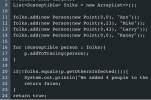 public class Person{
private Disease currentDisease;
private String name;
private Point position;
private List<Susceptible> othersInfected;
public Person(Point position,String name){
this.position =position;
this.name = name;
List<Susceptible> othersInfected = new
ArrayList<>();
}
public void addToTracing(Susceptible person){
othersInfected.add(person);
}
public List<Susceptible> getOthersInfected(){
return this.othersInfected;
}
}
I got nullpointerException error when using addToTracing method,
how do I fix it
9 List<Susceptible> folks = new ArrayList<>(); 10 11 folks.add(new Person (new Point(0,0), "Ann")); 12 folks.add(new Person (new Point(4,23), "Mike")); 13 folks.add(new Person (new Point(0,43),...
public class Person{
private Disease currentDisease;
private String name;
private Point position;
private List<Susceptible> othersInfected;
public Person(Point position,String name){
this.position =position;
this.name = name;
List<Susceptible> othersInfected = new
ArrayList<>();
}
public void addToTracing(Susceptible person){
othersInfected.add(person);
}
public List<Susceptible> getOthersInfected(){
return this.othersInfected;
}
}
I got nullpointerException error when using addToTracing method,
how do I fix it
9 List<Susceptible> folks = new ArrayList<>(); 10 11 folks.add(new Person (new Point(0,0), "Ann")); 12 folks.add(new Person (new Point(4,23), "Mike")); 13 folks.add(new Person (new Point(0,43),...
I receive an error illegal start of expression starting at "public class Ingredient {". How would...
I receive an error illegal start of expression starting at "public class Ingredient {". How would I fix this error? * * To change this license header, choose License Headers in Project Properties. * To change this template file, choose Tools | Templates * and open the template in the editor. */ package SteppingStones; /** * * * * @author jennifer.cook_snhu * */ public class SteppingStone2_IngredientCalculator { /** * * @param args the command line arguments ...
1. private Node head; private Node tail; public class Node { String name; Node next; Node...
1. private Node head; private Node tail; public class Node { String name; Node next; Node prev; } public void displayInReverse(){ //write your code here to display names in reverse } 2. public class NodeOne { String name; NodeOne next; public NodeOne(String name) { this.name = name; } } // Complete the code snippet below so that the delete method works properly public void delete(String name) { NodeOne temp = head, prev = head; while (temp != null) { if...
Need to do Concat public Node next; public Node prev; } //...
Need to do Concat public Node next; public Node prev; } // constructor public DSIDequeue() { left = right = null; N = 0; } public boolean isEmpty() { return N == 0; } public int size() { return N; } public void addLeft(double item) { Node n = new Node(item, null, null); if (isEmpty()) { ...
Is there any way that I can call method in other class without constructor in java?...
Is there any way that I can call method in other class without constructor in java? public class Chest { private String contents; public String getContents() { return contents; } public void setContents(String contents) { this.contents = contents; } I need to set content and print out in the main method, but it keep gives me a error message when I try Chest.setContents("Gold"); on main class. I suppose...
package rectangle; public class Rectangle { private int height; private int width; public...
package rectangle; public class Rectangle { private int height; private int width; public Rectangle(int aHeight, int aWidth) { super(); height = aHeight; width = aWidth; } public int getHeight() { return height; } public int getWidth() { return width; } public void setHeight(int aHeight) { height = aHeight; } public void setWidth(int aWidth) { width = aWidth; } public int...
import java.util.LinkedList; public class testprintOut { private static LinkedList[] array; public static void main(String[] args) {...
import java.util.LinkedList; public class testprintOut { private static LinkedList[] array; public static void main(String[] args) { int nelems = 5; array = new LinkedList[nelems]; for (int i = 0; i < nelems; i++) { array[i] = new LinkedList<String>(); } array[0]=["ab"]; System.out.println(array[0]); } } //I want to create array of linked lists so how do I create them and print them out efficiently? //Syntax error on token "=", Expression expected after this token Also, is this how I can put them...
For Questions 1-3: consider the following code: public class A { private int number; protected String...
For Questions 1-3: consider the following code: public class A { private int number; protected String name; public double price; public A() { System.out.println(“A() called”); } private void foo1() { System.out.println(“A version of foo1() called”); } protected int foo2() { Sysem.out.println(“A version of foo2() called); return number; } public String foo3() { System.out.println(“A version of foo3() called”); Return “Hi”; } }//end class A public class B extends A { private char service; public B() { super(); System.out.println(“B() called”);...
For Questions 1-3: consider the following code: public class A { private int number; protected String...
For Questions 1-3: consider the following code: public class A { private int number; protected String name; public double price; public A() { System.out.println(“A() called”); } private void foo1() { System.out.println(“A version of foo1() called”); } protected int foo2() { Sysem.out.println(“A version of foo2() called); return number; } public String foo3() { System.out.println(“A version of foo3() called”); Return “Hi”; } }//end class A public class B extends A { private char service; public B() { super(); System.out.println(“B() called”); } public...
public class LinkedList { // The LinkedList Node class private class Node{...
public class LinkedList { // The LinkedList Node class private class Node{ int data; Node next; Node(int gdata) { this.data = gdata; this.next = null; } } // The LinkedList fields Node head; // Constructor LinkedList(int gdata) { this.head = new Node(gdata); }...
 public class Person{
private Disease currentDisease;
private String name;
private Point position;
private List<Susceptible> othersInfected;
public Person(Point position,String name){
this.position =position;
this.name = name;
List<Susceptible> othersInfected = new
ArrayList<>();
}
public void addToTracing(Susceptible person){
othersInfected.add(person);
}
public List<Susceptible> getOthersInfected(){
return this.othersInfected;
}
}
I got nullpointerException error when using addToTracing method,
how do I fix it
9 List<Susceptible> folks = new ArrayList<>(); 10 11 folks.add(new Person (new Point(0,0), "Ann")); 12 folks.add(new Person (new Point(4,23), "Mike")); 13 folks.add(new Person (new Point(0,43),...
public class Person{
private Disease currentDisease;
private String name;
private Point position;
private List<Susceptible> othersInfected;
public Person(Point position,String name){
this.position =position;
this.name = name;
List<Susceptible> othersInfected = new
ArrayList<>();
}
public void addToTracing(Susceptible person){
othersInfected.add(person);
}
public List<Susceptible> getOthersInfected(){
return this.othersInfected;
}
}
I got nullpointerException error when using addToTracing method,
how do I fix it
9 List<Susceptible> folks = new ArrayList<>(); 10 11 folks.add(new Person (new Point(0,0), "Ann")); 12 folks.add(new Person (new Point(4,23), "Mike")); 13 folks.add(new Person (new Point(0,43),...
Most questions answered within 3 hours.
-
Where is the error in this code sequence?
String s1 = "Hello";
String s2 = "ello";...
asked 10 months ago -
Financial data for Joel de Paris, Inc., for last year
follow:
Joel de Paris, Inc.
Balance...
asked 10 months ago -
Consider this reaction:
Al2(SO4)3 (aq)+ BaCl3
(aq) Al2Cl6 (aq)- +
3BaSO4(s) . What is the...
asked 10 months ago -
Suppose that Savneet is considering increasing her
recent random sample from 20 car rentals to 40...
asked 10 months ago -
Trucks arrive at an unloading terminal at an average rate of 120
per hour.
Trucks arrive...
asked 10 months ago -
Why are methanol and ethanol completely soluble in water while
octanol is not very little soluble....
asked 10 months ago -
A facilities manager at a university reads in a research report
that the mean amount of...
asked 10 months ago -
When the CuSO4 is rehydrated by adding water to the anhydrous
compound, is this an endothermic...
asked 10 months ago -
A ray of sunlight is passing from diamond into crown glass; the
angle of incidence is...
asked 10 months ago -
A block of mass 0.249 kg is placed on top of a light, vertical
spring of...
asked 10 months ago -
how do the kidneys compensate in the presences of acidosis
a) trigger hyperventilate
b) reserve acid...
asked 10 months ago -
Question 501 pts
The rental rate of capital to the firm increases. Which of the
following...
asked 10 months ago