Thank you for taking time to review this. Please answer the questions below with this information....
Thank you for taking time to review this. Please answer the questions below with this information. Please indicate 1, 2, or 3 next to your answer. Please put on this site, not a picture of the answer written on paper, sometimes it is difficult to read.
Plastic cup A
Mass of cup, water, and stirrer: 57.02g
Mass of sodium bicarbonate: 1.05g
Mass of citric acid: 0.77g
Total mass: 59.02
Mass of cup, the solution, and stirrer after reaction: 58.53g
Difference: 0.49g
H3C6H5O7(aq) + 3NaHCO3(aq) --->Na3C6H5O7(aq) + 3H2O(l) + 3CO2(g)
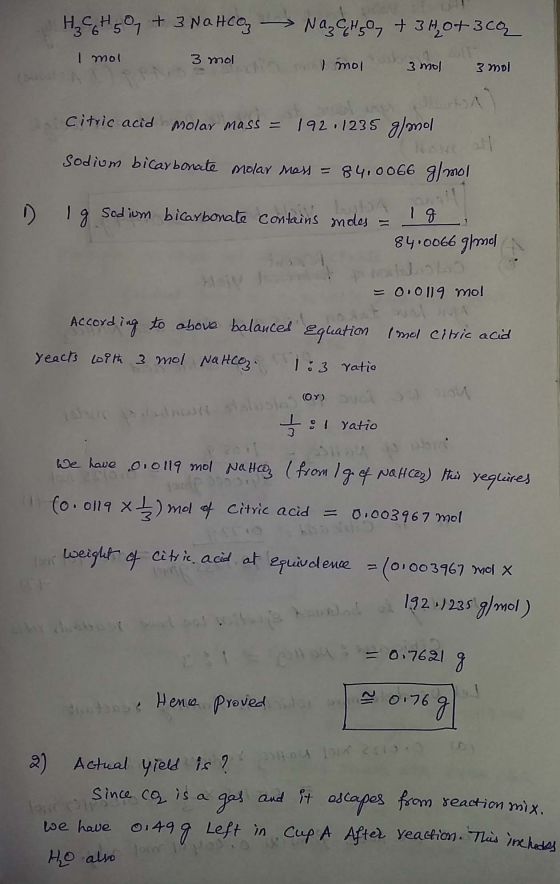
1) Show that the equivalence amount of citric acid for 1.00 g of sodium bicarbonate is 0.76 g
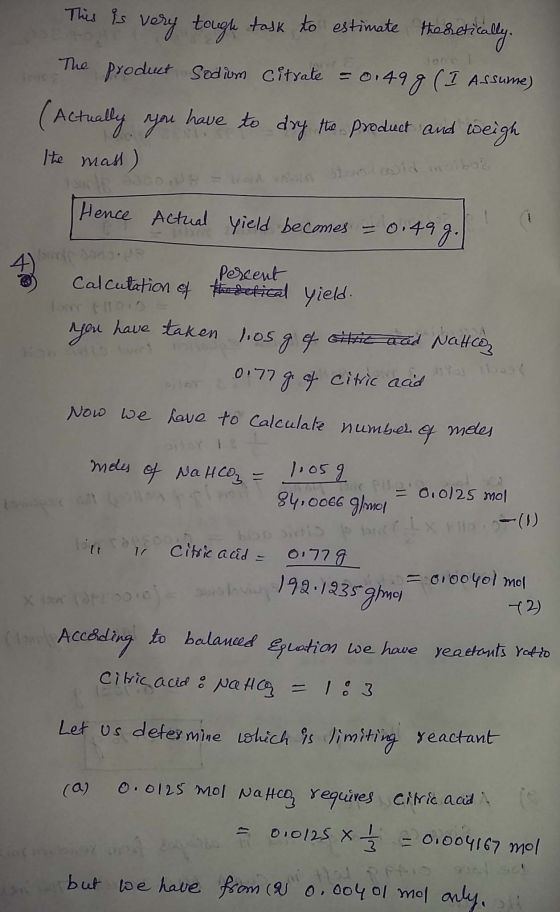
2) What is the actual yield in this cup A experiment according to your data?
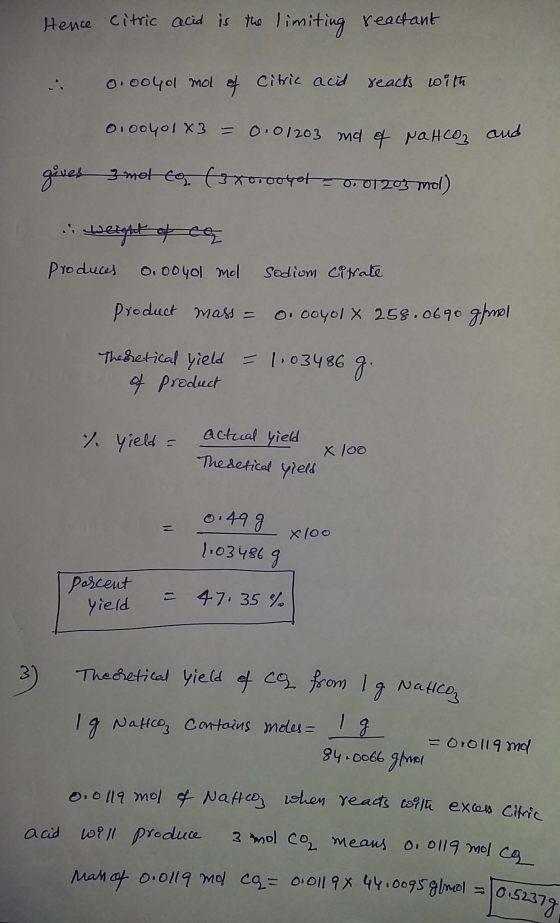
3) Calculate the theoretical yield of carbon dioxide from 1.00g of sodium bicarbonate
4) Calculate the percentage yield in the plastic cup A experiment
2) Calculate the percentage yield in the plastic cup A
Homework Answers
Hey sorry for inconvenience caused by some other experts who doesn't meet legible penman ship. I request you to accept my penman as it is very clearer to understand. Typing here takes a lot of time for me as i am not familiar with typing much.
Add Answer to:
Thank you for taking time to review this. Please answer the
questions below with this information....
The fizz produced when an AlkaSeltzer® tablet is dissolved in water is due to the reaction...
The fizz produced when an AlkaSeltzer® tablet is dissolved in water is due to the reaction between sodium bicarbonate, NaHCO3, and a triprotic organic acid, citric acid, H3C6H5O7. The products of this reaction are carbon dioxide gas, water, and sodium citrate. 3 NaHCO3 (aq) + H3C6H5O7 (aq)→ 3 CO2 (g) + 3 H2O(l) + Na3C6H5O7 (aq) In an experiment 1.00 g of sodium bicarbonate and 1.00 g of citric acid are allowed to react. A.Which of the five compounds in...
I have completed this lab (Experiment 13 Acid and Base, Part 2) and want feedback on...
I have completed this lab (Experiment 13 Acid and Base, Part 2) and want feedback on if I doing the equations correctly? I have included my answers in the question. Are these correct? Pour about an inch of lemon juice into one jar and label it "acid." Put two level teaspoons of baking soda and about half a tablespoon of water in another jar. Now pour a tablespoon of lemon juice acid into the third jar for testing. Add the...
Could someone please answer this?! I’ve been waiting for my other one for almost 5 hours...
 Could someone please answer this?! I’ve been waiting for my
other one for almost 5 hours .
c) Calculate your actual yield of sodium acetate (in grams): Mass of reaction (#3) sodium acetate mass of beaker after the reaction (#9)- mass of beaker and boiling stones before Actual yield of sodium acetate Use your actual yield of sodium acetate and your theoretical yield (in grams) of sodium acetate to calculate the percent yield for the reaction (formula from page 1)....
Could someone please answer this?! I’ve been waiting for my
other one for almost 5 hours .
c) Calculate your actual yield of sodium acetate (in grams): Mass of reaction (#3) sodium acetate mass of beaker after the reaction (#9)- mass of beaker and boiling stones before Actual yield of sodium acetate Use your actual yield of sodium acetate and your theoretical yield (in grams) of sodium acetate to calculate the percent yield for the reaction (formula from page 1)....
8. A student performs parts A and B of the experiment and attains an average percent...
 8. A student performs parts A and B of the experiment and attains an average percent yield from the Alka- Seltzer of 64.6%. Using this value and the following data perform the calculations for part B and complete the table below. Assume the pressure has not changed. As it states in the manual: You may apply the findings regarding percent-yield in Part A to Part B when calculating the moles of calcium carbonate Trial 2 Trial 1 Mass Antacid used...
may you please provide details on how you recieved the answer thank you. 3 pages. Chem...
 may
you please provide details on how you recieved the answer thank
you.
3 pages.
Chem 143 - Lab Pre-lab Exercise Show the details of each calculation to get full credit 1. Magnesium oxide, a white powdery substance can often be made by heating magnesium metal in presence of oxygen. a. Write the balanced chemical equation for this reaction (including the state symbols such as (s) () or (aq)] b. When 10.1 g magnesium is allowed to react with 10.5g...
may
you please provide details on how you recieved the answer thank
you.
3 pages.
Chem 143 - Lab Pre-lab Exercise Show the details of each calculation to get full credit 1. Magnesium oxide, a white powdery substance can often be made by heating magnesium metal in presence of oxygen. a. Write the balanced chemical equation for this reaction (including the state symbols such as (s) () or (aq)] b. When 10.1 g magnesium is allowed to react with 10.5g...
1. Moles of Reactant to Mass of Reactant: Identify the iodide ions and ozone in the...
1. Moles of Reactant to Mass of Reactant: Identify the iodide ions and ozone in the balanced chemical equation. Use mole ratio, then convert to grams. A method used by the EPA for determining the ozone concentration in the air is to pass an air sample through a bubbler containing iodide ions. The iodide ions remove the ozone according to the following reaction: O3(g) + 2 I-(aq) + H2O(l) → O2(g) + I2(aq) + 2 OH-(aq) How many grams of ozone...
Use the data table to answer the questions please. Thank you in advance! :) Gas Laws...
 Use the data table to answer the questions please. Thank you
in advance! :)
Gas Laws Lab: Part 1: Collecting the gas in a balloon Calculations 1) Calculate the actual number of CO2 gas moles (n) in the balloon using the ideal gas Law PV= nRT (Show all your work) Assume: P pressure of CO2 in atm R 0.0821 L atm/ mol K T measured temperature of the room in K V volume of inflated balloon n number of moles...
Use the data table to answer the questions please. Thank you
in advance! :)
Gas Laws Lab: Part 1: Collecting the gas in a balloon Calculations 1) Calculate the actual number of CO2 gas moles (n) in the balloon using the ideal gas Law PV= nRT (Show all your work) Assume: P pressure of CO2 in atm R 0.0821 L atm/ mol K T measured temperature of the room in K V volume of inflated balloon n number of moles...
Answer both questions please and thank you!!! QUESTION 1 0.5 points The weak acid, HX, is neutralized by sodium hydroxi...
 Answer both questions please and thank you!!!
QUESTION 1 0.5 points The weak acid, HX, is neutralized by sodium hydroxide as shown below: HX(aq) + NaOH(aq) + NaCN(aq) + H20(1). Suppose you carried out this reaction in a coffee cup calorimeter using 50.0 mL of 0.500 M HX and 50.0 mL of 0.500 M NaOH. If the temperature of the calorimeter increases by 1.36°C, what is the enthalpy of this neutralization reaction (in kJ/mol)? Assume the density of the solution...
Answer both questions please and thank you!!!
QUESTION 1 0.5 points The weak acid, HX, is neutralized by sodium hydroxide as shown below: HX(aq) + NaOH(aq) + NaCN(aq) + H20(1). Suppose you carried out this reaction in a coffee cup calorimeter using 50.0 mL of 0.500 M HX and 50.0 mL of 0.500 M NaOH. If the temperature of the calorimeter increases by 1.36°C, what is the enthalpy of this neutralization reaction (in kJ/mol)? Assume the density of the solution...
please answer the questions thank you Name: Lab Section: Date: Experiment VII: Buffers Review Questions (23...
 please answer the questions thank you
Name: Lab Section: Date: Experiment VII: Buffers Review Questions (23 pts) 1. (3 pts). A solution is prepared by mixing 25.0 mL 0.45 M NaCH,coo and 30.0 mL 0.38 M CH,COOH is prepared. Calculate the pH of this solution if the K, 1.76 x 10 for acetic acid. 2. (3 pts)How many grams of sodium lactate, NaCsHsOs, should be added to 1.00 L of 0.150 M lactic acid, HCsHsOs, to form a buffer solution...
please answer the questions thank you
Name: Lab Section: Date: Experiment VII: Buffers Review Questions (23 pts) 1. (3 pts). A solution is prepared by mixing 25.0 mL 0.45 M NaCH,coo and 30.0 mL 0.38 M CH,COOH is prepared. Calculate the pH of this solution if the K, 1.76 x 10 for acetic acid. 2. (3 pts)How many grams of sodium lactate, NaCsHsOs, should be added to 1.00 L of 0.150 M lactic acid, HCsHsOs, to form a buffer solution...
Please answer all questions in both worksheets! Thank you! 1. What is the ideal gas law?...
 Please answer all questions in both worksheets! Thank
you!
1. What is the ideal gas law? Write the equation below and label all the components of the equation. 2. Write the balanced chemical equation for the reaction between Mg and HCI below include phases of each constituent. Mg + HCI 3. If a student used an excess of HCl to dissolve 0.045 grams of pure Mg ribbon, and collected the gas in a test tube over water how much H2...
Please answer all questions in both worksheets! Thank
you!
1. What is the ideal gas law? Write the equation below and label all the components of the equation. 2. Write the balanced chemical equation for the reaction between Mg and HCI below include phases of each constituent. Mg + HCI 3. If a student used an excess of HCl to dissolve 0.045 grams of pure Mg ribbon, and collected the gas in a test tube over water how much H2...
 Could someone please answer this?! I’ve been waiting for my
other one for almost 5 hours .
c) Calculate your actual yield of sodium acetate (in grams): Mass of reaction (#3) sodium acetate mass of beaker after the reaction (#9)- mass of beaker and boiling stones before Actual yield of sodium acetate Use your actual yield of sodium acetate and your theoretical yield (in grams) of sodium acetate to calculate the percent yield for the reaction (formula from page 1)....
Could someone please answer this?! I’ve been waiting for my
other one for almost 5 hours .
c) Calculate your actual yield of sodium acetate (in grams): Mass of reaction (#3) sodium acetate mass of beaker after the reaction (#9)- mass of beaker and boiling stones before Actual yield of sodium acetate Use your actual yield of sodium acetate and your theoretical yield (in grams) of sodium acetate to calculate the percent yield for the reaction (formula from page 1)....
 8. A student performs parts A and B of the experiment and attains an average percent yield from the Alka- Seltzer of 64.6%. Using this value and the following data perform the calculations for part B and complete the table below. Assume the pressure has not changed. As it states in the manual: You may apply the findings regarding percent-yield in Part A to Part B when calculating the moles of calcium carbonate Trial 2 Trial 1 Mass Antacid used...
 may
you please provide details on how you recieved the answer thank
you.
3 pages.
Chem 143 - Lab Pre-lab Exercise Show the details of each calculation to get full credit 1. Magnesium oxide, a white powdery substance can often be made by heating magnesium metal in presence of oxygen. a. Write the balanced chemical equation for this reaction (including the state symbols such as (s) () or (aq)] b. When 10.1 g magnesium is allowed to react with 10.5g...
may
you please provide details on how you recieved the answer thank
you.
3 pages.
Chem 143 - Lab Pre-lab Exercise Show the details of each calculation to get full credit 1. Magnesium oxide, a white powdery substance can often be made by heating magnesium metal in presence of oxygen. a. Write the balanced chemical equation for this reaction (including the state symbols such as (s) () or (aq)] b. When 10.1 g magnesium is allowed to react with 10.5g...
 Use the data table to answer the questions please. Thank you
in advance! :)
Gas Laws Lab: Part 1: Collecting the gas in a balloon Calculations 1) Calculate the actual number of CO2 gas moles (n) in the balloon using the ideal gas Law PV= nRT (Show all your work) Assume: P pressure of CO2 in atm R 0.0821 L atm/ mol K T measured temperature of the room in K V volume of inflated balloon n number of moles...
Use the data table to answer the questions please. Thank you
in advance! :)
Gas Laws Lab: Part 1: Collecting the gas in a balloon Calculations 1) Calculate the actual number of CO2 gas moles (n) in the balloon using the ideal gas Law PV= nRT (Show all your work) Assume: P pressure of CO2 in atm R 0.0821 L atm/ mol K T measured temperature of the room in K V volume of inflated balloon n number of moles...
 Answer both questions please and thank you!!!
QUESTION 1 0.5 points The weak acid, HX, is neutralized by sodium hydroxide as shown below: HX(aq) + NaOH(aq) + NaCN(aq) + H20(1). Suppose you carried out this reaction in a coffee cup calorimeter using 50.0 mL of 0.500 M HX and 50.0 mL of 0.500 M NaOH. If the temperature of the calorimeter increases by 1.36°C, what is the enthalpy of this neutralization reaction (in kJ/mol)? Assume the density of the solution...
Answer both questions please and thank you!!!
QUESTION 1 0.5 points The weak acid, HX, is neutralized by sodium hydroxide as shown below: HX(aq) + NaOH(aq) + NaCN(aq) + H20(1). Suppose you carried out this reaction in a coffee cup calorimeter using 50.0 mL of 0.500 M HX and 50.0 mL of 0.500 M NaOH. If the temperature of the calorimeter increases by 1.36°C, what is the enthalpy of this neutralization reaction (in kJ/mol)? Assume the density of the solution...
 please answer the questions thank you
Name: Lab Section: Date: Experiment VII: Buffers Review Questions (23 pts) 1. (3 pts). A solution is prepared by mixing 25.0 mL 0.45 M NaCH,coo and 30.0 mL 0.38 M CH,COOH is prepared. Calculate the pH of this solution if the K, 1.76 x 10 for acetic acid. 2. (3 pts)How many grams of sodium lactate, NaCsHsOs, should be added to 1.00 L of 0.150 M lactic acid, HCsHsOs, to form a buffer solution...
please answer the questions thank you
Name: Lab Section: Date: Experiment VII: Buffers Review Questions (23 pts) 1. (3 pts). A solution is prepared by mixing 25.0 mL 0.45 M NaCH,coo and 30.0 mL 0.38 M CH,COOH is prepared. Calculate the pH of this solution if the K, 1.76 x 10 for acetic acid. 2. (3 pts)How many grams of sodium lactate, NaCsHsOs, should be added to 1.00 L of 0.150 M lactic acid, HCsHsOs, to form a buffer solution...
 Please answer all questions in both worksheets! Thank
you!
1. What is the ideal gas law? Write the equation below and label all the components of the equation. 2. Write the balanced chemical equation for the reaction between Mg and HCI below include phases of each constituent. Mg + HCI 3. If a student used an excess of HCl to dissolve 0.045 grams of pure Mg ribbon, and collected the gas in a test tube over water how much H2...
Please answer all questions in both worksheets! Thank
you!
1. What is the ideal gas law? Write the equation below and label all the components of the equation. 2. Write the balanced chemical equation for the reaction between Mg and HCI below include phases of each constituent. Mg + HCI 3. If a student used an excess of HCl to dissolve 0.045 grams of pure Mg ribbon, and collected the gas in a test tube over water how much H2...
Most questions answered within 3 hours.
-
Where is the error in this code sequence?
String s1 = "Hello";
String s2 = "ello";...
asked 10 months ago -
Financial data for Joel de Paris, Inc., for last year
follow:
Joel de Paris, Inc.
Balance...
asked 10 months ago -
Consider this reaction:
Al2(SO4)3 (aq)+ BaCl3
(aq) Al2Cl6 (aq)- +
3BaSO4(s) . What is the...
asked 10 months ago -
Suppose that Savneet is considering increasing her
recent random sample from 20 car rentals to 40...
asked 10 months ago -
Trucks arrive at an unloading terminal at an average rate of 120
per hour.
Trucks arrive...
asked 10 months ago -
Why are methanol and ethanol completely soluble in water while
octanol is not very little soluble....
asked 10 months ago -
A facilities manager at a university reads in a research report
that the mean amount of...
asked 10 months ago -
When the CuSO4 is rehydrated by adding water to the anhydrous
compound, is this an endothermic...
asked 10 months ago -
A ray of sunlight is passing from diamond into crown glass; the
angle of incidence is...
asked 10 months ago -
A block of mass 0.249 kg is placed on top of a light, vertical
spring of...
asked 10 months ago -
how do the kidneys compensate in the presences of acidosis
a) trigger hyperventilate
b) reserve acid...
asked 10 months ago -
Question 501 pts
The rental rate of capital to the firm increases. Which of the
following...
asked 10 months ago