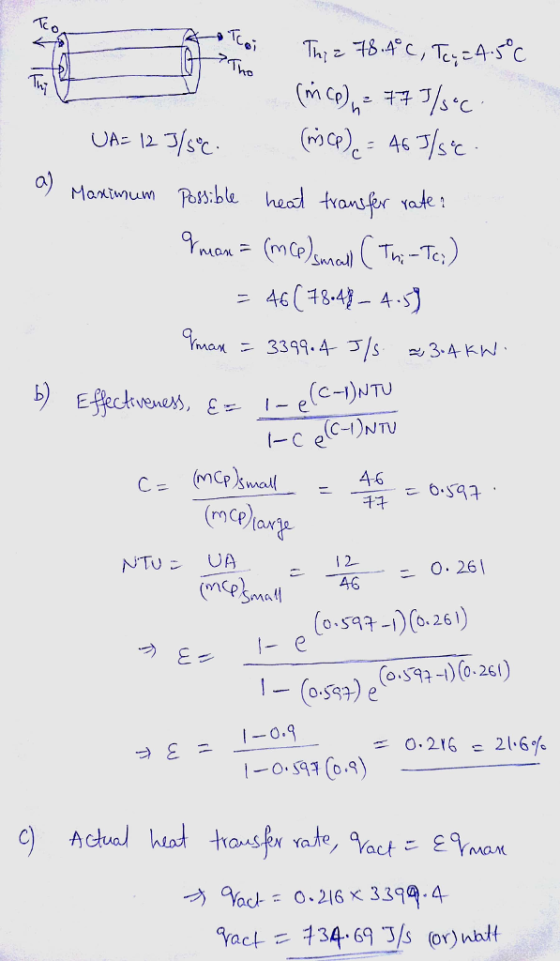
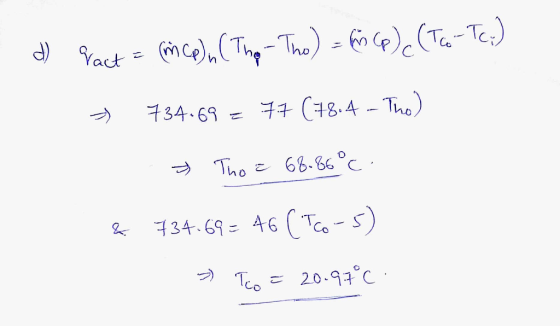
![BY ATTEMPTING THIS ASSESSMENT YOU ARE CONFIRMING THAT YOU ARE FIT TO DO SO Question In a certain double-pipe heat exchanger, the hot and cold fluids (h and c, respectively) flow in the counter flow mode. Given data inc.), = 77J/(s°C). (mCp): 46)/(s°C). UAz 12//(s°C). Tun = 784°C Tem = 4.5 °C. (a) What is the maximum possible heat transfer rate? (b) What is the effectiveness? (c) What is the actual heat transfer rate? (d) Thour and Teout?. [Total 25 marks]](http://img.homeworklib.com/questions/5647cb00-0b8b-11ec-ac83-9b635f8a4b81.png?x-oss-process=image/resize,w_560)
Homework Answers
Add Answer to:
BY ATTEMPTING THIS ASSESSMENT YOU ARE CONFIRMING THAT YOU ARE FIT TO DO SO Question In...
Question 3 A counter flow single pass double pipe heat exchanger is supplied with hot water...
 Question 3 A counter flow single pass double pipe heat exchanger is supplied with hot water at 120°C that is to be cooled by water entering at 20°C. The mass flow rate of the hot stream is 5 kg/s, and that of the cold stream is 6 kg/s. The specific heat capacity of both fluids may be taken as 4180 J/kg.K. The overall U value is 1500W/m2.K, and the surface area for heat transfer is 20 m2 a) Determine the...
e. skisser temperaturpronien u varmt og kaldt vann som en funksjon av rørlengden Engelsk tekst A...
 e. skisser temperaturpronien u varmt og kaldt vann som en funksjon av rørlengden Engelsk tekst A well-insulated double pipe heat exchanger (counter flow arrangement) is used to exchange heat between hot water and cold water. The tube side of the heat exchanger has an internal diameter of 0.05 m and wall thickness of 0.01m. The shell side of the heat exchanger has an internal diameter of 0.1 m. The hot water flows in the tube side with mass flow rates...
Cold water (Cp = 4180 J/kg · °C) leading to a shower enters a thin-walled double-pipe...
Cold water (Cp = 4180 J/kg · °C) leading to a shower enters a thin-walled double-pipe counter-flow heat exchanger at 15°C at a rate of 0.25 kg/s and is heated to 45°C by hot water (Cp = 4190 J/kg · °C) that enters at 100°C at a rate of 3 kg/s. If the overall heat transfer coefficient is 950 W/m2 · °C. determine the rate of heat transfer and the heat transfer surface area of the heat exchanger using the...
Hot and cold water streams exchange heat in a double pipe heat exchanger in counter current...
 Hot and cold water streams exchange heat in a double pipe heat exchanger in counter current flow. The pipes are 3 ft long. The inside pipe is a 5/8 inch BWG 12 copper tube. The outside pipe is a 1 inch Sch 40 steel pipe. The outside pipe is insulated to minimize heat loss to the surroundings. The hot water enters the inside tube at 180F with a flow rate such that Re = 10000 The cold water flows through...
A counter-flow heat exchanger is stated to have an overall heat transfer coefficient of 284 W/m2.K...
 A counter-flow heat exchanger is stated to have an overall heat transfer coefficient of 284 W/m2.K when operating at design and clean conditions. Hot fluid enters the tube side at 101°C and exits at 71°C, while cold fluid enters the shell side at 27°C and exits at 42°C. After a period of use, built-up scale in the heat exchanger gives a fouling factor of 0.0004 m2 K/W. The surface area is 93 m². Assume both hot and cold fluids have...
Part II - Show your work (19 Marks] 16 Cold water (Cp = 4180 J/kg. "C)...
 Part II - Show your work (19 Marks] 16 Cold water (Cp = 4180 J/kg. "C) leading to a shower enters a thin-walled double-pipe counter flow heat exchanger at 15°C at a rate of 0.25 kg/s and is heated to 45°C by hot water (Cp = 4190 J/kg. "C) that enters at 100°C at a rate of 3 kg/s. If the overall heat transfer coefficient is 950 W/m2. C, determine the rate of heat transfer and the heat transfer surface...
Question 5 The following data is given for counter flow in concentric tube heat exchanger, mean...
 Question 5 The following data is given for counter flow in concentric tube heat exchanger, mean heat transfer area = 0.02 m2 Test No Flow rate hot Flow rate Tin hotTout hot|Tin cold Tout cold (L/min) cold (L/min) (THI) (TH2) (TCI) (TC2) 13 1 60 56 30 42 a) Calculate the heat transfer rate in kW. b) The overall heat transfer coefficient U. c) The mean temperature efficiency of the two circuits (ń).
11.20 Heat exchanger of counter flow arrangement with temperatures at inlet of hot and cold fluids...
 11.20 Heat exchanger of counter flow arrangement with temperatures at inlet of hot and cold fluids are (200°C) and (60°C) gave outlet temperature of (110°C) for both sides as the surfaces were clean. After long time of use for same the inlet temperatures and flow rate, the hot fluid outlet was (130°C). Find the change in the overall heat transfer coefficient and the heat transfer values by percentage. Ans.: -37.4%, -22.2% 11.21 A liquid with a specific heat of (3200J/kg....
Please answer clearly and neatly so I can read your work. I will give a good...
 Please answer clearly and neatly so
I can read your work. I will give a good rating! Thank you (:
Consider a concentric tube heat exchanger with hot and cold water inlet temperatures of 202 and 35°C respectively. The flow rates of the hot and cold fluids are 42 and 84 kg/h, respectively. Assume the overall heat transfer coefficient is 178 W/m2k. cc = 4186 J/kgk, ch = 4302 J/kgK What is the maximum heat transfer rate that could be...
Please answer clearly and neatly so
I can read your work. I will give a good rating! Thank you (:
Consider a concentric tube heat exchanger with hot and cold water inlet temperatures of 202 and 35°C respectively. The flow rates of the hot and cold fluids are 42 and 84 kg/h, respectively. Assume the overall heat transfer coefficient is 178 W/m2k. cc = 4186 J/kgk, ch = 4302 J/kgK What is the maximum heat transfer rate that could be...
P11-104. Cold water (Cp = 4180 J/kg-K) leading to a shower enters a thin-walled double-pipe counterflow...
 P11-104. Cold water (Cp = 4180 J/kg-K) leading to a shower enters a thin-walled double-pipe counterflow heat exchanger at 15°C at a rate of 0.25 kg/s and is heated to 45°C by hot water (cp=4190 J/kg K) that enters at 100°C at a rate of 3 kg/s. If the overall heat transfer coefficient is 950 W/m2.K, determine the rate of heat transfer and the heat surface area of the heat exchanger using the effectiveness-NTU method.
 Question 3 A counter flow single pass double pipe heat exchanger is supplied with hot water at 120°C that is to be cooled by water entering at 20°C. The mass flow rate of the hot stream is 5 kg/s, and that of the cold stream is 6 kg/s. The specific heat capacity of both fluids may be taken as 4180 J/kg.K. The overall U value is 1500W/m2.K, and the surface area for heat transfer is 20 m2 a) Determine the...
 e. skisser temperaturpronien u varmt og kaldt vann som en funksjon av rørlengden Engelsk tekst A well-insulated double pipe heat exchanger (counter flow arrangement) is used to exchange heat between hot water and cold water. The tube side of the heat exchanger has an internal diameter of 0.05 m and wall thickness of 0.01m. The shell side of the heat exchanger has an internal diameter of 0.1 m. The hot water flows in the tube side with mass flow rates...
 Hot and cold water streams exchange heat in a double pipe heat exchanger in counter current flow. The pipes are 3 ft long. The inside pipe is a 5/8 inch BWG 12 copper tube. The outside pipe is a 1 inch Sch 40 steel pipe. The outside pipe is insulated to minimize heat loss to the surroundings. The hot water enters the inside tube at 180F with a flow rate such that Re = 10000 The cold water flows through...
 A counter-flow heat exchanger is stated to have an overall heat transfer coefficient of 284 W/m2.K when operating at design and clean conditions. Hot fluid enters the tube side at 101°C and exits at 71°C, while cold fluid enters the shell side at 27°C and exits at 42°C. After a period of use, built-up scale in the heat exchanger gives a fouling factor of 0.0004 m2 K/W. The surface area is 93 m². Assume both hot and cold fluids have...
 Part II - Show your work (19 Marks] 16 Cold water (Cp = 4180 J/kg. "C) leading to a shower enters a thin-walled double-pipe counter flow heat exchanger at 15°C at a rate of 0.25 kg/s and is heated to 45°C by hot water (Cp = 4190 J/kg. "C) that enters at 100°C at a rate of 3 kg/s. If the overall heat transfer coefficient is 950 W/m2. C, determine the rate of heat transfer and the heat transfer surface...
 Question 5 The following data is given for counter flow in concentric tube heat exchanger, mean heat transfer area = 0.02 m2 Test No Flow rate hot Flow rate Tin hotTout hot|Tin cold Tout cold (L/min) cold (L/min) (THI) (TH2) (TCI) (TC2) 13 1 60 56 30 42 a) Calculate the heat transfer rate in kW. b) The overall heat transfer coefficient U. c) The mean temperature efficiency of the two circuits (ń).
 11.20 Heat exchanger of counter flow arrangement with temperatures at inlet of hot and cold fluids are (200°C) and (60°C) gave outlet temperature of (110°C) for both sides as the surfaces were clean. After long time of use for same the inlet temperatures and flow rate, the hot fluid outlet was (130°C). Find the change in the overall heat transfer coefficient and the heat transfer values by percentage. Ans.: -37.4%, -22.2% 11.21 A liquid with a specific heat of (3200J/kg....
 Please answer clearly and neatly so
I can read your work. I will give a good rating! Thank you (:
Consider a concentric tube heat exchanger with hot and cold water inlet temperatures of 202 and 35°C respectively. The flow rates of the hot and cold fluids are 42 and 84 kg/h, respectively. Assume the overall heat transfer coefficient is 178 W/m2k. cc = 4186 J/kgk, ch = 4302 J/kgK What is the maximum heat transfer rate that could be...
Please answer clearly and neatly so
I can read your work. I will give a good rating! Thank you (:
Consider a concentric tube heat exchanger with hot and cold water inlet temperatures of 202 and 35°C respectively. The flow rates of the hot and cold fluids are 42 and 84 kg/h, respectively. Assume the overall heat transfer coefficient is 178 W/m2k. cc = 4186 J/kgk, ch = 4302 J/kgK What is the maximum heat transfer rate that could be...
 P11-104. Cold water (Cp = 4180 J/kg-K) leading to a shower enters a thin-walled double-pipe counterflow heat exchanger at 15°C at a rate of 0.25 kg/s and is heated to 45°C by hot water (cp=4190 J/kg K) that enters at 100°C at a rate of 3 kg/s. If the overall heat transfer coefficient is 950 W/m2.K, determine the rate of heat transfer and the heat surface area of the heat exchanger using the effectiveness-NTU method.
Most questions answered within 3 hours.
-
Where is the error in this code sequence?
String s1 = "Hello";
String s2 = "ello";...
asked 10 months ago -
Financial data for Joel de Paris, Inc., for last year
follow:
Joel de Paris, Inc.
Balance...
asked 10 months ago -
Consider this reaction:
Al2(SO4)3 (aq)+ BaCl3
(aq) Al2Cl6 (aq)- +
3BaSO4(s) . What is the...
asked 10 months ago -
Suppose that Savneet is considering increasing her
recent random sample from 20 car rentals to 40...
asked 10 months ago -
Trucks arrive at an unloading terminal at an average rate of 120
per hour.
Trucks arrive...
asked 10 months ago -
Why are methanol and ethanol completely soluble in water while
octanol is not very little soluble....
asked 10 months ago -
A facilities manager at a university reads in a research report
that the mean amount of...
asked 10 months ago -
When the CuSO4 is rehydrated by adding water to the anhydrous
compound, is this an endothermic...
asked 10 months ago -
A ray of sunlight is passing from diamond into crown glass; the
angle of incidence is...
asked 10 months ago -
A block of mass 0.249 kg is placed on top of a light, vertical
spring of...
asked 10 months ago -
how do the kidneys compensate in the presences of acidosis
a) trigger hyperventilate
b) reserve acid...
asked 10 months ago -
Question 501 pts
The rental rate of capital to the firm increases. Which of the
following...
asked 10 months ago