
Homework Answers
 is the rule
For  we get

For  we get

For  we get

For  we get
 but
but
For  we get

So the given approximation formula is correct for all polynomial
up to degree  but not higher
Hence, the order of the approximation is 

Please do rate this answer positively if you found it helpful. Thanks and have a good day!
Add Answer to:
5. (10 points) What is the order of the following quadrature formula called Neuton's rule given...
What is the order of the quadrature formula corresponding to the approximation .G (6- V6 (6+ V6 Hint: find the coe...
 What is the order of the quadrature formula corresponding to the approximation .G (6- V6 (6+ V6 Hint: find the coefficients (bi, ci)i=1, ,s of this quadrature formula
What is the order of the quadrature formula corresponding to the approximation .G (6- V6 (6+ V6 Hint: find the coefficients (bi, ci)i=1, ,s of this quadrature formula
What is the order of the quadrature formula corresponding to the approximation .G (6- V6 (6+ V6 Hint: find the coefficients (bi, ci)i=1, ,s of this quadrature formula
Question 1 (Quadrature) [50 pts I. Recall the formula for a (composite) trapezoidal rule T, (u) for 1 = u(a)dr whic...
 Question 1 (Quadrature) [50 pts I. Recall the formula for a (composite) trapezoidal rule T, (u) for 1 = u(a)dr which requires n function evaluations at equidistant quadrature points and where the first and the last quadrature points coincide with the integration bounds a and b, respectively. 10pts 2. For a given v(r) with r E [0,1] do a variable transformation g() af + β such that g(-1)-0 and g(1)-1. Use this to transform the integral に1, u(z)dz to an...
Numerical Analysis: a) The basic form of the Gaussian quadrature formula is The integration formula using two points can be made exact when a polynomial of order 3 is integrated. i) Determine the...
 Numerical Analysis:
a) The basic form of the Gaussian quadrature formula is The integration formula using two points can be made exact when a polynomial of order 3 is integrated. i) Determine the weights c, c2 and the points , 2 e-radz.16] (ii) By find using a change of variable use Gaussian Quadrature to 0
a) The basic form of the Gaussian quadrature formula is The integration formula using two points can be made exact when a polynomial of order...
Numerical Analysis:
a) The basic form of the Gaussian quadrature formula is The integration formula using two points can be made exact when a polynomial of order 3 is integrated. i) Determine the weights c, c2 and the points , 2 e-radz.16] (ii) By find using a change of variable use Gaussian Quadrature to 0
a) The basic form of the Gaussian quadrature formula is The integration formula using two points can be made exact when a polynomial of order...
Given the following quadrature formula: (x)dx = c0) + f(a) Find a 4 and 2 so...
 Given the following quadrature formula: (x)dx = c0) + f(a) Find a 4 and 2 so that the quadrature formula has the highest degree of precision. Clearly, state its degree. ſrcade -
3. (15p.) Approximate the following integral using the two-point Gaussian quadrature rule | (2 + a)*e¢8–1)-+de...
 3. (15p.) Approximate the following integral using the two-point Gaussian quadrature rule | (2 + a)*e¢8–1)-+de 2 B=1 ju a=8 0
this is numerical analysis. Please do all the questions 3. (a) Consider the quadrature rule path...
 this is numerical analysis. Please do all the questions
3. (a) Consider the quadrature rule path ( * s(a)dx = Af (a – 1) + Bf(a) + Cf(a+h). Find A, B, C which maximize the degree of precision. Hint: First derive the rule for a = 0 and then use a change of variable. (b) State this degree of precision and verify it is not any higher. (c) Suppase g is a function whose 3rd divided differences are all the...
this is numerical analysis. Please do all the questions
3. (a) Consider the quadrature rule path ( * s(a)dx = Af (a – 1) + Bf(a) + Cf(a+h). Find A, B, C which maximize the degree of precision. Hint: First derive the rule for a = 0 and then use a change of variable. (b) State this degree of precision and verify it is not any higher. (c) Suppase g is a function whose 3rd divided differences are all the...
all one question 3. For the following problems, you will be given either the molecular formula of the compound...
 all
one question
3. For the following problems, you will be given either the molecular formula of the compound or the molecular weight and the necessary spectra to answer the problem. Calculate the formula (if necessary) as well as the degree of unsaturation. Draw a structure of the compound that matches both spectra and assign each of the protons in your structure. (2 or 3 pts each) a) C H100 3, t 2, d 2, d 2.q 1, bs 2...
all
one question
3. For the following problems, you will be given either the molecular formula of the compound or the molecular weight and the necessary spectra to answer the problem. Calculate the formula (if necessary) as well as the degree of unsaturation. Draw a structure of the compound that matches both spectra and assign each of the protons in your structure. (2 or 3 pts each) a) C H100 3, t 2, d 2, d 2.q 1, bs 2...
QUESTION 1 1 points Save Answer 4.5a General multiplication rule 4.5b OPTIONAL Example: general multiplication rule...
 QUESTION 1 1 points Save Answer 4.5a General multiplication rule 4.5b OPTIONAL Example: general multiplication rule P(AnB ALWAYS equals P(A) P(A) P(B) P(B) P(A) P(BIA) QUESTION 2 1 points Save Answer There is no formula for the following intersection: P(AnBn) True False QUESTION 3 1 points Save Answer 4.5c Bayes' Rule Example 4.5d Bayes' Rule Bayes Rule is used when you are given P(AlB) and you want to calculate P(BIA). True False QUESTION 4 1 points Save Answer The only...
Multiple choices Use Gaussian Quadrature to find the value of the integral of: f(x) = 79.13...
 Multiple choices
Use Gaussian Quadrature to find the value of the integral of: f(x) = 79.13 / ( 5.30 + 2.24 * X * X) between X= -0.62 and X= 1.55 Integral using 2 terms Gaussian Quadrature is Integral using 3 terms Gaussian Quadrature is l__ Integral using 4 terms Gaussian Quadrature is Integral using 6 terms Gaussian Quadrature is Use the trapezoidal rule to find the value of the integral of: f(x) = 63.52 / ( 4.07 + 2.23...
Multiple choices
Use Gaussian Quadrature to find the value of the integral of: f(x) = 79.13 / ( 5.30 + 2.24 * X * X) between X= -0.62 and X= 1.55 Integral using 2 terms Gaussian Quadrature is Integral using 3 terms Gaussian Quadrature is l__ Integral using 4 terms Gaussian Quadrature is Integral using 6 terms Gaussian Quadrature is Use the trapezoidal rule to find the value of the integral of: f(x) = 63.52 / ( 4.07 + 2.23...
Part 1: First, let's explore the Simpson's Rule formula itself: This formula has a very distincti...
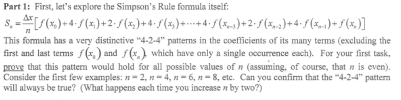 Part 1: First, let's explore the Simpson's Rule formula itself: This formula has a very distinctive "4-2-4" patterns in the coefficients of its many terms (excluding the first and last terms () and ) which have only a single occurence each). For your first task. prove that this pattern would hold for all possible values of n (assuming, of course, that n is even). Consider the first few examples: n = 2, n 4, n = 6, n 8, etc....
 What is the order of the quadrature formula corresponding to the approximation .G (6- V6 (6+ V6 Hint: find the coefficients (bi, ci)i=1, ,s of this quadrature formula
What is the order of the quadrature formula corresponding to the approximation .G (6- V6 (6+ V6 Hint: find the coefficients (bi, ci)i=1, ,s of this quadrature formula
What is the order of the quadrature formula corresponding to the approximation .G (6- V6 (6+ V6 Hint: find the coefficients (bi, ci)i=1, ,s of this quadrature formula
 Question 1 (Quadrature) [50 pts I. Recall the formula for a (composite) trapezoidal rule T, (u) for 1 = u(a)dr which requires n function evaluations at equidistant quadrature points and where the first and the last quadrature points coincide with the integration bounds a and b, respectively. 10pts 2. For a given v(r) with r E [0,1] do a variable transformation g() af + β such that g(-1)-0 and g(1)-1. Use this to transform the integral に1, u(z)dz to an...
 Numerical Analysis:
a) The basic form of the Gaussian quadrature formula is The integration formula using two points can be made exact when a polynomial of order 3 is integrated. i) Determine the weights c, c2 and the points , 2 e-radz.16] (ii) By find using a change of variable use Gaussian Quadrature to 0
a) The basic form of the Gaussian quadrature formula is The integration formula using two points can be made exact when a polynomial of order...
Numerical Analysis:
a) The basic form of the Gaussian quadrature formula is The integration formula using two points can be made exact when a polynomial of order 3 is integrated. i) Determine the weights c, c2 and the points , 2 e-radz.16] (ii) By find using a change of variable use Gaussian Quadrature to 0
a) The basic form of the Gaussian quadrature formula is The integration formula using two points can be made exact when a polynomial of order...
 Given the following quadrature formula: (x)dx = c0) + f(a) Find a 4 and 2 so that the quadrature formula has the highest degree of precision. Clearly, state its degree. ſrcade -
 3. (15p.) Approximate the following integral using the two-point Gaussian quadrature rule | (2 + a)*e¢8–1)-+de 2 B=1 ju a=8 0
 this is numerical analysis. Please do all the questions
3. (a) Consider the quadrature rule path ( * s(a)dx = Af (a – 1) + Bf(a) + Cf(a+h). Find A, B, C which maximize the degree of precision. Hint: First derive the rule for a = 0 and then use a change of variable. (b) State this degree of precision and verify it is not any higher. (c) Suppase g is a function whose 3rd divided differences are all the...
this is numerical analysis. Please do all the questions
3. (a) Consider the quadrature rule path ( * s(a)dx = Af (a – 1) + Bf(a) + Cf(a+h). Find A, B, C which maximize the degree of precision. Hint: First derive the rule for a = 0 and then use a change of variable. (b) State this degree of precision and verify it is not any higher. (c) Suppase g is a function whose 3rd divided differences are all the...
 all
one question
3. For the following problems, you will be given either the molecular formula of the compound or the molecular weight and the necessary spectra to answer the problem. Calculate the formula (if necessary) as well as the degree of unsaturation. Draw a structure of the compound that matches both spectra and assign each of the protons in your structure. (2 or 3 pts each) a) C H100 3, t 2, d 2, d 2.q 1, bs 2...
all
one question
3. For the following problems, you will be given either the molecular formula of the compound or the molecular weight and the necessary spectra to answer the problem. Calculate the formula (if necessary) as well as the degree of unsaturation. Draw a structure of the compound that matches both spectra and assign each of the protons in your structure. (2 or 3 pts each) a) C H100 3, t 2, d 2, d 2.q 1, bs 2...
 QUESTION 1 1 points Save Answer 4.5a General multiplication rule 4.5b OPTIONAL Example: general multiplication rule P(AnB ALWAYS equals P(A) P(A) P(B) P(B) P(A) P(BIA) QUESTION 2 1 points Save Answer There is no formula for the following intersection: P(AnBn) True False QUESTION 3 1 points Save Answer 4.5c Bayes' Rule Example 4.5d Bayes' Rule Bayes Rule is used when you are given P(AlB) and you want to calculate P(BIA). True False QUESTION 4 1 points Save Answer The only...
 Multiple choices
Use Gaussian Quadrature to find the value of the integral of: f(x) = 79.13 / ( 5.30 + 2.24 * X * X) between X= -0.62 and X= 1.55 Integral using 2 terms Gaussian Quadrature is Integral using 3 terms Gaussian Quadrature is l__ Integral using 4 terms Gaussian Quadrature is Integral using 6 terms Gaussian Quadrature is Use the trapezoidal rule to find the value of the integral of: f(x) = 63.52 / ( 4.07 + 2.23...
Multiple choices
Use Gaussian Quadrature to find the value of the integral of: f(x) = 79.13 / ( 5.30 + 2.24 * X * X) between X= -0.62 and X= 1.55 Integral using 2 terms Gaussian Quadrature is Integral using 3 terms Gaussian Quadrature is l__ Integral using 4 terms Gaussian Quadrature is Integral using 6 terms Gaussian Quadrature is Use the trapezoidal rule to find the value of the integral of: f(x) = 63.52 / ( 4.07 + 2.23...
 Part 1: First, let's explore the Simpson's Rule formula itself: This formula has a very distinctive "4-2-4" patterns in the coefficients of its many terms (excluding the first and last terms () and ) which have only a single occurence each). For your first task. prove that this pattern would hold for all possible values of n (assuming, of course, that n is even). Consider the first few examples: n = 2, n 4, n = 6, n 8, etc....
Most questions answered within 3 hours.
-
Where is the error in this code sequence?
String s1 = "Hello";
String s2 = "ello";...
asked 11 months ago -
Financial data for Joel de Paris, Inc., for last year
follow:
Joel de Paris, Inc.
Balance...
asked 11 months ago -
Consider this reaction:
Al2(SO4)3 (aq)+ BaCl3
(aq) Al2Cl6 (aq)- +
3BaSO4(s) . What is the...
asked 11 months ago -
Suppose that Savneet is considering increasing her
recent random sample from 20 car rentals to 40...
asked 11 months ago -
Trucks arrive at an unloading terminal at an average rate of 120
per hour.
Trucks arrive...
asked 11 months ago -
Why are methanol and ethanol completely soluble in water while
octanol is not very little soluble....
asked 11 months ago -
A facilities manager at a university reads in a research report
that the mean amount of...
asked 11 months ago -
When the CuSO4 is rehydrated by adding water to the anhydrous
compound, is this an endothermic...
asked 11 months ago -
A ray of sunlight is passing from diamond into crown glass; the
angle of incidence is...
asked 11 months ago -
A block of mass 0.249 kg is placed on top of a light, vertical
spring of...
asked 11 months ago -
how do the kidneys compensate in the presences of acidosis
a) trigger hyperventilate
b) reserve acid...
asked 11 months ago -
Question 501 pts
The rental rate of capital to the firm increases. Which of the
following...
asked 11 months ago