

Homework Answers

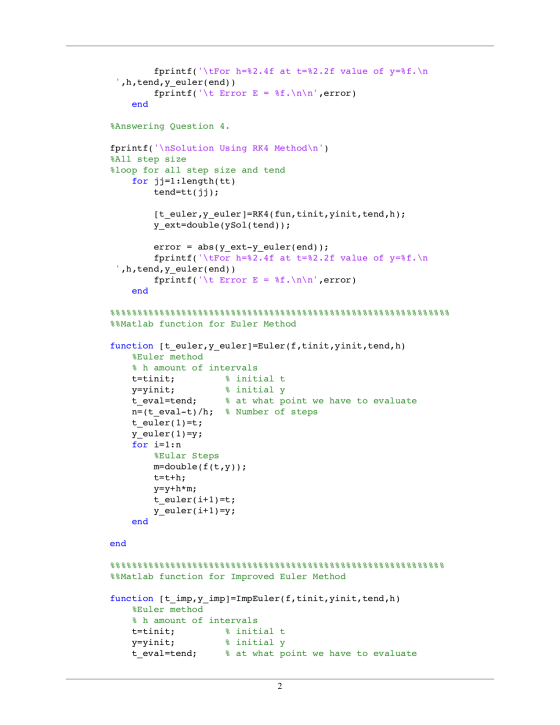

%%Matlab code for solving ode using Euler Improved Euler and
RK4
clear all
close all
%function for which Solution have to do
fun=@(t,y) (2-2.*t.*y)./(t.^2+1);
%initial guess
tinit=0; yinit=1;
%Answering Question 1.
syms y(t)
eqn = diff(y,t) == (2-2.*t.*y)./(t.^2+1);
cond = y(0) == yinit;
ySol(t) = dsolve(eqn,cond);
%displaying result
fprintf('Exact solution phi(t)=')
disp(ySol)
%Answering Question 1.
%all t values
tt=[0.4 1.0];
%All step size
h=0.1;
fprintf('\nSolution Using Euler Method\n')
%loop for all step size and tend
for jj=1:length(tt)
tend=tt(jj);
[t_euler,y_euler]=Euler(fun,tinit,yinit,tend,h);
y_ext=double(ySol(tend));
error =
abs(y_ext-y_euler(end));
fprintf('\tFor h=%2.4f
at t=%2.2f value of y=%f.\n ',h,t_euler(end),y_euler(end))
fprintf('\t Error E =
%f.\n\n',error)
end
%Answering Question 2.
fprintf('\nSolution Using Improved Euler Method\n')
%loop for all step size and tend
for jj=1:length(tt)
tend=tt(jj);
[t_euler,y_euler]=ImpEuler(fun,tinit,yinit,tend,h);
y_ext=double(ySol(tend));
error =
abs(y_ext-y_euler(end));
fprintf('\tFor h=%2.4f
at t=%2.2f value of y=%f.\n ',h,tend,y_euler(end))
fprintf('\t Error E =
%f.\n\n',error)
end
%Answering Question 4.
fprintf('\nSolution Using RK4 Method\n')
%All step size
%loop for all step size and tend
for jj=1:length(tt)
tend=tt(jj);
[t_euler,y_euler]=RK4(fun,tinit,yinit,tend,h);
y_ext=double(ySol(tend));
error =
abs(y_ext-y_euler(end));
fprintf('\tFor h=%2.4f
at t=%2.2f value of y=%f.\n ',h,tend,y_euler(end))
fprintf('\t Error E =
%f.\n\n',error)
end
%%%%%%%%%%%%%%%%%%%%%%%%%%%%%%%%%%%%%%%%%%%%%%%%%%%%%%%%%%%%%%
%%Matlab function for Euler Method
function [t_euler,y_euler]=Euler(f,tinit,yinit,tend,h)
%Euler method
% h amount of intervals
t=tinit; % initial
t
y=yinit; % initial
y
t_eval=tend; % at what
point we have to evaluate
n=(t_eval-t)/h; % Number of steps
t_euler(1)=t;
y_euler(1)=y;
for i=1:n
%Eular Steps
m=double(f(t,y));
t=t+h;
y=y+h*m;
t_euler(i+1)=t;
y_euler(i+1)=y;
end
end
%%%%%%%%%%%%%%%%%%%%%%%%%%%%%%%%%%%%%%%%%%%%%%%%%%%%%%%%%%%%%
%%Matlab function for Improved Euler Method
function [t_imp,y_imp]=ImpEuler(f,tinit,yinit,tend,h)
%Euler method
% h amount of intervals
t=tinit; % initial
t
y=yinit; % initial
y
t_eval=tend; % at what
point we have to evaluate
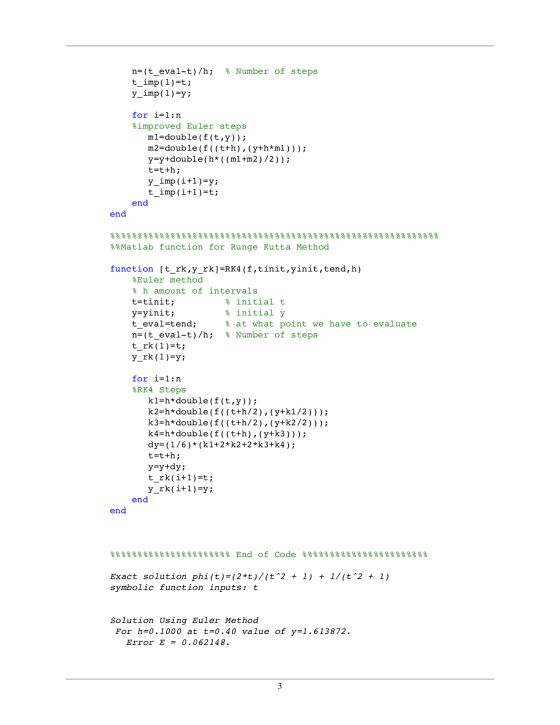
n=(t_eval-t)/h; % Number of steps
t_imp(1)=t;
y_imp(1)=y;
for i=1:n
%improved Euler steps
m1=double(f(t,y));
m2=double(f((t+h),(y+h*m1)));
y=y+double(h*((m1+m2)/2));
t=t+h;
y_imp(i+1)=y;
t_imp(i+1)=t;
end
end
%%%%%%%%%%%%%%%%%%%%%%%%%%%%%%%%%%%%%%%%%%%%%%%%%%%%%%%%%%%%
%%Matlab function for Runge Kutta Method
function [t_rk,y_rk]=RK4(f,tinit,yinit,tend,h)
%Euler method
% h amount of intervals
t=tinit; % initial
t
y=yinit; % initial
y
t_eval=tend; % at what
point we have to evaluate
n=(t_eval-t)/h; % Number of steps
t_rk(1)=t;
y_rk(1)=y;
for i=1:n
%RK4 Steps
k1=h*double(f(t,y));
k2=h*double(f((t+h/2),(y+k1/2)));
k3=h*double(f((t+h/2),(y+k2/2)));
k4=h*double(f((t+h),(y+k3)));
dy=(1/6)*(k1+2*k2+2*k3+k4);
t=t+h;
y=y+dy;
t_rk(i+1)=t;
y_rk(i+1)=y;
end
end
%%%%%%%%%%%%%%%%%%%%%% End of Code %%%%%%%%%%%%%%%%%%%%%%%
Add Answer to:
Question 1: Given the initial-value problem 12-21 0 <1 <1, y(0) = 1, 12+10 with exact...
[7] 1. Consider the initial value problem (IVP) y′(t) = −y(t), y(0) = 1 The solution to this IVP ...
[7] 1. Consider the initial value problem (IVP) y′(t) = −y(t), y(0) = 1 The solution to this IVP is y(t) = e−t [1] i) Implement Euler’s method and generate an approximate solution of this IVP over the interval [0,2], using stepsize h = 0.1. (The Google sheet posted on LEARN is set up to carry out precisely this task.) Report the resulting approximation of the value y(2). [1] ii) Repeat part (ii), but use stepsize h = 0.05. Describe...
1 st s2, y(1)1 The exact solution is given by yo) - = . 1+Int Write a MATLAB code to approximate ...
 1 st s2, y(1)1 The exact solution is given by yo) - = . 1+Int Write a MATLAB code to approximate the solution of the IVP using Midpoint (RK2) and Modified Euler methods when h [0.5 0.1 0.0s 0.01 0.005 0.001]. A) Find the vector w mid and w mod that approximates the solution of the IVP for different values of h. B) Plot the step-size h versus the relative error of both in the same figure using the LOGLOG...
YOUR TEACHER Consider the initial-value problem y = (x + y - 1)?.Y(0) - 2. Use...
 YOUR TEACHER Consider the initial-value problem y = (x + y - 1)?.Y(0) - 2. Use the improved Euler's method with h = 0.1 and h = 0.05 to obtain approximate values of the solution at x = 0.5. At each step compare the approximate value with the actual value of the analytic solution (Round your answers to four decimal places.) h 0.1 Y(0.5) h 0.05 Y(0.5) actual value Y(0.5) = Need Help? Tuto Tutor
YOUR TEACHER Consider the initial-value problem y = (x + y - 1)?.Y(0) - 2. Use...
 YOUR TEACHER Consider the initial-value problem y = (x + y - 1)?.Y(0) - 2. Use the improved Euler's method with h = 0.1 and h = 0.05 to obtain approximate values of the solution at x = 0.5. At each step compare the approximate value with the actual value of the analytic solution. (Round your answers to four decimal places.) 0.1 y(0.5) h 0.05 (0.5) actual value Y(0.5) - Need Help? Tuto Tutor
Given the initial-value problem y'=2-2tyt2+1, 0 ≤t≤1, y0=1 With exact solution yt= 2t+1t2+1 Using MATLAB use...
Given the initial-value problem y'=2-2tyt2+1, 0 ≤t≤1, y0=1 With exact solution yt= 2t+1t2+1 Using MATLAB use Euler’s method with h = 0.1 to approximate the solution of y
- 2y²,y(0) =0. 1+x² 4) Consider the IVP y'= х a) Verify that y= is the...
 - 2y²,y(0) =0. 1+x² 4) Consider the IVP y'= х a) Verify that y= is the solution of this IVP. 1+x? b) Use Euler's method to numerically approximate the solution to this IVP over the interval [0,2] in x. Set the mesh width h=0.1. Calculate the true values of y atthe appropriate values of x as well as the error in your numerical approximation. Report your results in the table given. Report answers to four decimal places. Numerical Actual y...
Use the modified Euler method to find approximate solution of the following initial- value problem y'...
 Use the modified Euler method to find approximate solution of the following initial- value problem y' -Sy + 16t + 2, ost-1, y(0)-2. Write down the scheme and find the approximate values for h 0.2. Don't use the code.
Apply Euler-trapezoidal predictor-corrector method to the IVP in problem 1 to approximate y(2), by choosing two...
 Apply Euler-trapezoidal predictor-corrector method to the IVP in
problem 1 to approximate y(2), by choosing two values of h, for
which the iteration converges. (Don't really need to show work or
do by hand, MATLAB code will work just as well).
1. For the IVP: y' =ty, y(0) = ) 0t 4 Compare the true solution with the approximate solutions from t = 0 to t 4, with the step size h 0.5, obtained by each of the following methods....
Apply Euler-trapezoidal predictor-corrector method to the IVP in
problem 1 to approximate y(2), by choosing two values of h, for
which the iteration converges. (Don't really need to show work or
do by hand, MATLAB code will work just as well).
1. For the IVP: y' =ty, y(0) = ) 0t 4 Compare the true solution with the approximate solutions from t = 0 to t 4, with the step size h 0.5, obtained by each of the following methods....
Solve using Matlab Use the forward Euler method, Vi+,-Vi+(4+1-tinti ,Vi) for i= 0,1,2, , taking yo y(to) to be the initial condition, to approximate the solution at t-2 of the IVP y'=y-t2 + 1, 0-...
 Solve using Matlab
Use the forward Euler method, Vi+,-Vi+(4+1-tinti ,Vi) for i= 0,1,2, , taking yo y(to) to be the initial condition, to approximate the solution at t-2 of the IVP y'=y-t2 + 1, 0-t-2, y(0) = 0.5. Use N = 2k, k = 1, 2, , 20 equispaced time steps (so to = 0 and tN-1 = 2). Make a convergence plot, computing the error by comparing with the exact solution, y: t1)2 -exp(t)/2, and plotting the error as...
Solve using Matlab
Use the forward Euler method, Vi+,-Vi+(4+1-tinti ,Vi) for i= 0,1,2, , taking yo y(to) to be the initial condition, to approximate the solution at t-2 of the IVP y'=y-t2 + 1, 0-t-2, y(0) = 0.5. Use N = 2k, k = 1, 2, , 20 equispaced time steps (so to = 0 and tN-1 = 2). Make a convergence plot, computing the error by comparing with the exact solution, y: t1)2 -exp(t)/2, and plotting the error as...
Use Improved Euler for first question, Runge- Katta for 2nd one. Thank you In each of...
 Use Improved Euler for first question, Runge- Katta for 2nd one.
Thank you
In each of Problems 7 through 12, find approximate values of the solution of the given initial value problem at t-0.5,1.0, 1.5, and 2.0 (a) Use the improved Euler method with h 0.025 (b) Use the improved Euler method with h-0.0125 In each of Problems 7 through 12, find approximate values of the solution of the given initial value problem at0.5,1.0, 1.5, and 2.0. Compare the results...
Use Improved Euler for first question, Runge- Katta for 2nd one.
Thank you
In each of Problems 7 through 12, find approximate values of the solution of the given initial value problem at t-0.5,1.0, 1.5, and 2.0 (a) Use the improved Euler method with h 0.025 (b) Use the improved Euler method with h-0.0125 In each of Problems 7 through 12, find approximate values of the solution of the given initial value problem at0.5,1.0, 1.5, and 2.0. Compare the results...
 1 st s2, y(1)1 The exact solution is given by yo) - = . 1+Int Write a MATLAB code to approximate the solution of the IVP using Midpoint (RK2) and Modified Euler methods when h [0.5 0.1 0.0s 0.01 0.005 0.001]. A) Find the vector w mid and w mod that approximates the solution of the IVP for different values of h. B) Plot the step-size h versus the relative error of both in the same figure using the LOGLOG...
 YOUR TEACHER Consider the initial-value problem y = (x + y - 1)?.Y(0) - 2. Use the improved Euler's method with h = 0.1 and h = 0.05 to obtain approximate values of the solution at x = 0.5. At each step compare the approximate value with the actual value of the analytic solution (Round your answers to four decimal places.) h 0.1 Y(0.5) h 0.05 Y(0.5) actual value Y(0.5) = Need Help? Tuto Tutor
 YOUR TEACHER Consider the initial-value problem y = (x + y - 1)?.Y(0) - 2. Use the improved Euler's method with h = 0.1 and h = 0.05 to obtain approximate values of the solution at x = 0.5. At each step compare the approximate value with the actual value of the analytic solution. (Round your answers to four decimal places.) 0.1 y(0.5) h 0.05 (0.5) actual value Y(0.5) - Need Help? Tuto Tutor
 - 2y²,y(0) =0. 1+x² 4) Consider the IVP y'= х a) Verify that y= is the solution of this IVP. 1+x? b) Use Euler's method to numerically approximate the solution to this IVP over the interval [0,2] in x. Set the mesh width h=0.1. Calculate the true values of y atthe appropriate values of x as well as the error in your numerical approximation. Report your results in the table given. Report answers to four decimal places. Numerical Actual y...
 Use the modified Euler method to find approximate solution of the following initial- value problem y' -Sy + 16t + 2, ost-1, y(0)-2. Write down the scheme and find the approximate values for h 0.2. Don't use the code.
 Apply Euler-trapezoidal predictor-corrector method to the IVP in
problem 1 to approximate y(2), by choosing two values of h, for
which the iteration converges. (Don't really need to show work or
do by hand, MATLAB code will work just as well).
1. For the IVP: y' =ty, y(0) = ) 0t 4 Compare the true solution with the approximate solutions from t = 0 to t 4, with the step size h 0.5, obtained by each of the following methods....
Apply Euler-trapezoidal predictor-corrector method to the IVP in
problem 1 to approximate y(2), by choosing two values of h, for
which the iteration converges. (Don't really need to show work or
do by hand, MATLAB code will work just as well).
1. For the IVP: y' =ty, y(0) = ) 0t 4 Compare the true solution with the approximate solutions from t = 0 to t 4, with the step size h 0.5, obtained by each of the following methods....
 Solve using Matlab
Use the forward Euler method, Vi+,-Vi+(4+1-tinti ,Vi) for i= 0,1,2, , taking yo y(to) to be the initial condition, to approximate the solution at t-2 of the IVP y'=y-t2 + 1, 0-t-2, y(0) = 0.5. Use N = 2k, k = 1, 2, , 20 equispaced time steps (so to = 0 and tN-1 = 2). Make a convergence plot, computing the error by comparing with the exact solution, y: t1)2 -exp(t)/2, and plotting the error as...
Solve using Matlab
Use the forward Euler method, Vi+,-Vi+(4+1-tinti ,Vi) for i= 0,1,2, , taking yo y(to) to be the initial condition, to approximate the solution at t-2 of the IVP y'=y-t2 + 1, 0-t-2, y(0) = 0.5. Use N = 2k, k = 1, 2, , 20 equispaced time steps (so to = 0 and tN-1 = 2). Make a convergence plot, computing the error by comparing with the exact solution, y: t1)2 -exp(t)/2, and plotting the error as...
 Use Improved Euler for first question, Runge- Katta for 2nd one.
Thank you
In each of Problems 7 through 12, find approximate values of the solution of the given initial value problem at t-0.5,1.0, 1.5, and 2.0 (a) Use the improved Euler method with h 0.025 (b) Use the improved Euler method with h-0.0125 In each of Problems 7 through 12, find approximate values of the solution of the given initial value problem at0.5,1.0, 1.5, and 2.0. Compare the results...
Use Improved Euler for first question, Runge- Katta for 2nd one.
Thank you
In each of Problems 7 through 12, find approximate values of the solution of the given initial value problem at t-0.5,1.0, 1.5, and 2.0 (a) Use the improved Euler method with h 0.025 (b) Use the improved Euler method with h-0.0125 In each of Problems 7 through 12, find approximate values of the solution of the given initial value problem at0.5,1.0, 1.5, and 2.0. Compare the results...
Most questions answered within 3 hours.
-
Where is the error in this code sequence?
String s1 = "Hello";
String s2 = "ello";...
asked 11 months ago -
Financial data for Joel de Paris, Inc., for last year
follow:
Joel de Paris, Inc.
Balance...
asked 11 months ago -
Consider this reaction:
Al2(SO4)3 (aq)+ BaCl3
(aq) Al2Cl6 (aq)- +
3BaSO4(s) . What is the...
asked 11 months ago -
Suppose that Savneet is considering increasing her
recent random sample from 20 car rentals to 40...
asked 11 months ago -
Trucks arrive at an unloading terminal at an average rate of 120
per hour.
Trucks arrive...
asked 11 months ago -
Why are methanol and ethanol completely soluble in water while
octanol is not very little soluble....
asked 11 months ago -
A facilities manager at a university reads in a research report
that the mean amount of...
asked 11 months ago -
When the CuSO4 is rehydrated by adding water to the anhydrous
compound, is this an endothermic...
asked 11 months ago -
A ray of sunlight is passing from diamond into crown glass; the
angle of incidence is...
asked 11 months ago -
A block of mass 0.249 kg is placed on top of a light, vertical
spring of...
asked 11 months ago -
how do the kidneys compensate in the presences of acidosis
a) trigger hyperventilate
b) reserve acid...
asked 11 months ago -
Question 501 pts
The rental rate of capital to the firm increases. Which of the
following...
asked 11 months ago